Archive for Uncategorized

The Death of Grant Hart, Five Years Later

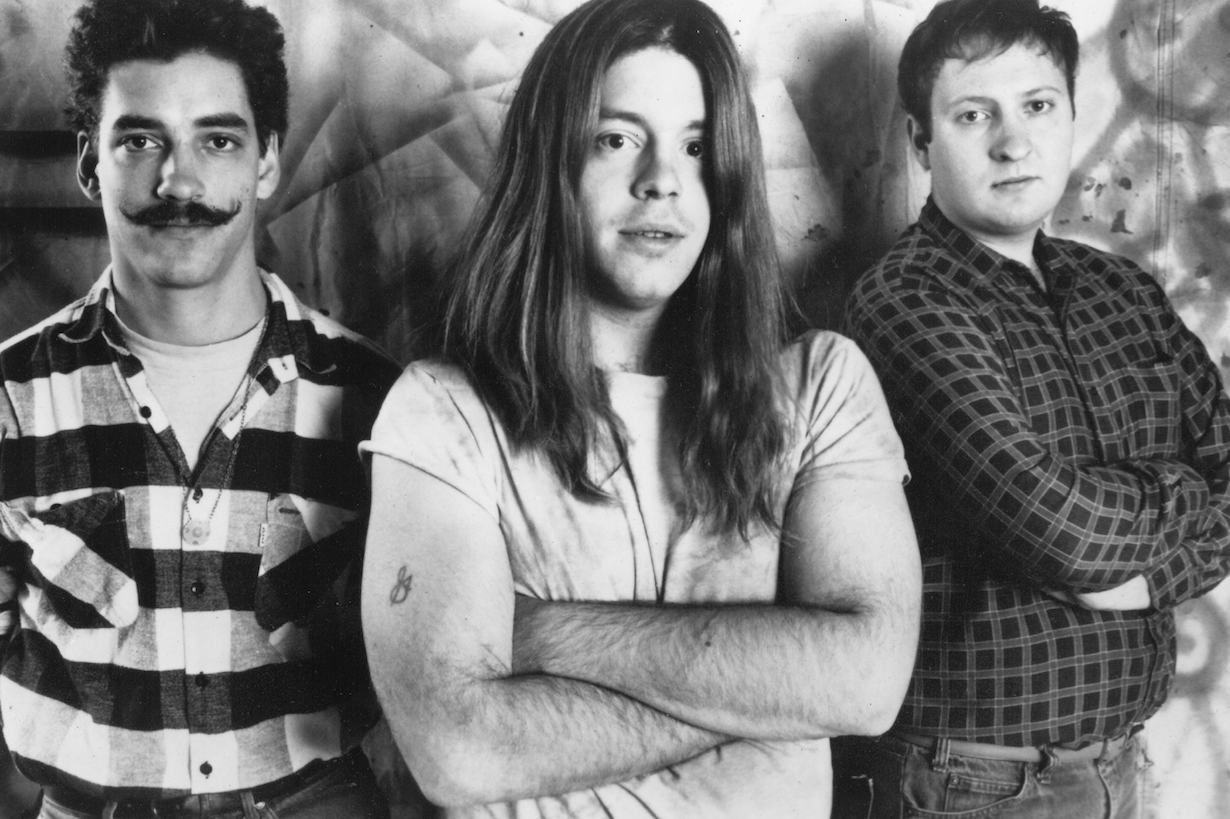
Greg Norton, Grant Hart, and Bob Mould in 1984.

September 14, 2022

TODAY MARKS the fifth anniversary of the death of Grant Hart, drummer and co-vocalist of the Minneapolis trio Hüsker Dü. He passed away on September 14th, 2017, from liver cancer. He was 56.

I’ve been known, in my obsessive, not-at-all objective fan-boy opinion, to describe Grant as the greatest songwriter of the 1980s. While such statements are presumed to contain a measure of hyperbole, how much so is the question. The pantheon of 1980s songwriters is a formidable one. There’s Pat Fish and Billy Bragg. There’s the long-forgotten Roddy Frame. And Strummer and Jones, of course (most of whose brilliance had petered away by 1982 or so). Thinking as unbiasedly as I’m able to, I suppose I’d put Grant in third place, just behind Pat Fish (a.k.a the Jazz Butcher, another of my heroes who died recently) and Bragg.

Grant’s old band-mate, Bob Mould, is somewhere on that list as well. Although Mould ended up more famous, and continues making music to this day, it’s hard to argue that Grant wasn’t the more talented songwriter, if not the more prolific one. Perhaps ironically, among Grant’s finest moments are his backing vocals at the end of one of Mould’s best songs, “Divide and Conquer,” from the Flip Your Wig album in 1985. He almost steals it away.

Grant Hart’s greatest hits…

“Terms of Psychic Warfare”
“Pink Turns to Blue”
“It’s Not Funny Anymore”
“Books About UFOs”
“Keep Hanging On”
“Diane”
“The Girl Who Lives on Heaven Hill”
“Standing by the Sea”
“Turn on the News”
“She’s a Woman (And Now He is a Man)”

Subject to change, depending on my mood. If you’re unfamiliar and curious, you can do the YouTube thing and have a listen.

That final one on the list, I’ve always felt, rests as Grant’s most under-appreciated song. It’s also the last song I ever saw Hüsker Dü perform live, at a club called Toad’s, in New Haven, Connecticut, in 1987. He later sang a delicate acoustic version (a recording of which is one of my most treasured possessions), the last time I saw him play, in Boston around twelve years ago.

I was fortunate to meet Grant on several occasions, the first time in 1983, and I corresponded with him occasionally over the last couple of years of his life. Always gregarious, kind and accommodating, he even lent quotes to a few of my posts. I was a co-executive producer of “Every Everything,” the Gorman Bechard documentary about Grant’s life and work.

I could go on. I’ll finish with a small memory from a night in 1984. I was with some friends at a nightclub called The Living Room, in Providence, Rhode Island, standing in the parking lot just outside. Grant was there, feeding pieces of cheese to a stray dog. He’d hold out the pieces, one by one, raising his arm a little bit each time. And the dog would keep jumping, higher and higher, as everyone watched and laughed.


Related Stories:

THE GREATEST ALBUM OF ALL TIME
THE (SECOND) GREATEST ALBUM OF ALL TIME


Hüsker Dü photo by Daniel Corrigan.
Grant Hart thumbnail photo by Naomi Petersen.

Comments (2)

Ode to the 757

September 13, 2022

WHAT BOEING NEEDS to build isn’t a fancy new long-range widebody. What it needs to build is a replacement for the 757.

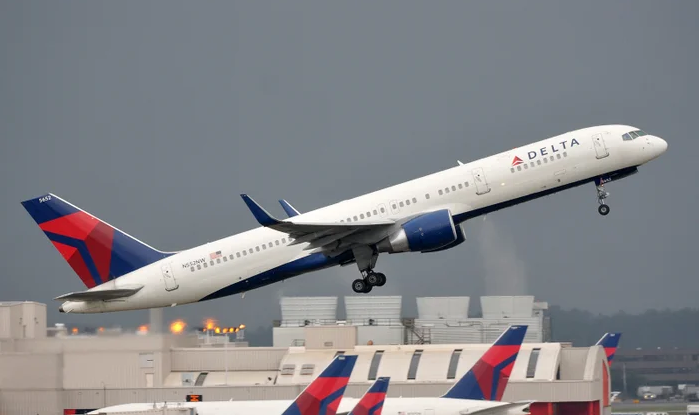
When it debuted in the early 1980s, the twin-engined 757 was ahead of its time, and it went on to sell quite well until the production line closed fifteen years ago. By now the plane is — or should be — obsolete. Indeed it’s rare to spot a 757 outside of the United States. But here at home it remains popular, a mainstay of the fleets at United, Delta, FedEx and UPS, who together operate over two-hundred of them. They’ve kept the plane on their rosters so long for good reason: its capabilities are unmatched, and there’s nothing that can replace it.

The 757 is maybe the most versatile jetliner Boeing has ever built — a medium-capacity, high-performing plane that is able to turn a profit on both short and longer-haul routes — domestic or international; across the Mississippi or across the North Atlantic. The 757 makes money flying between New York and Europe, and also between Atlanta and Jacksonville. United and Delta have flown 757s from their East Coast gateways on eight-hour services to Ireland, Scandinavia, and even Africa. You’ll also see it on 60-minute segments into Kansas City, Cleveland, and Tampa.

Along the way, it meets every operational challenge. Short runway? Stiff headwinds? Full payload? No problem. With 180 passengers, the plane can safely depart from a short runway, climb directly to cruise altitude, and fly clear across the country — or the ocean. Nothing else can do that.

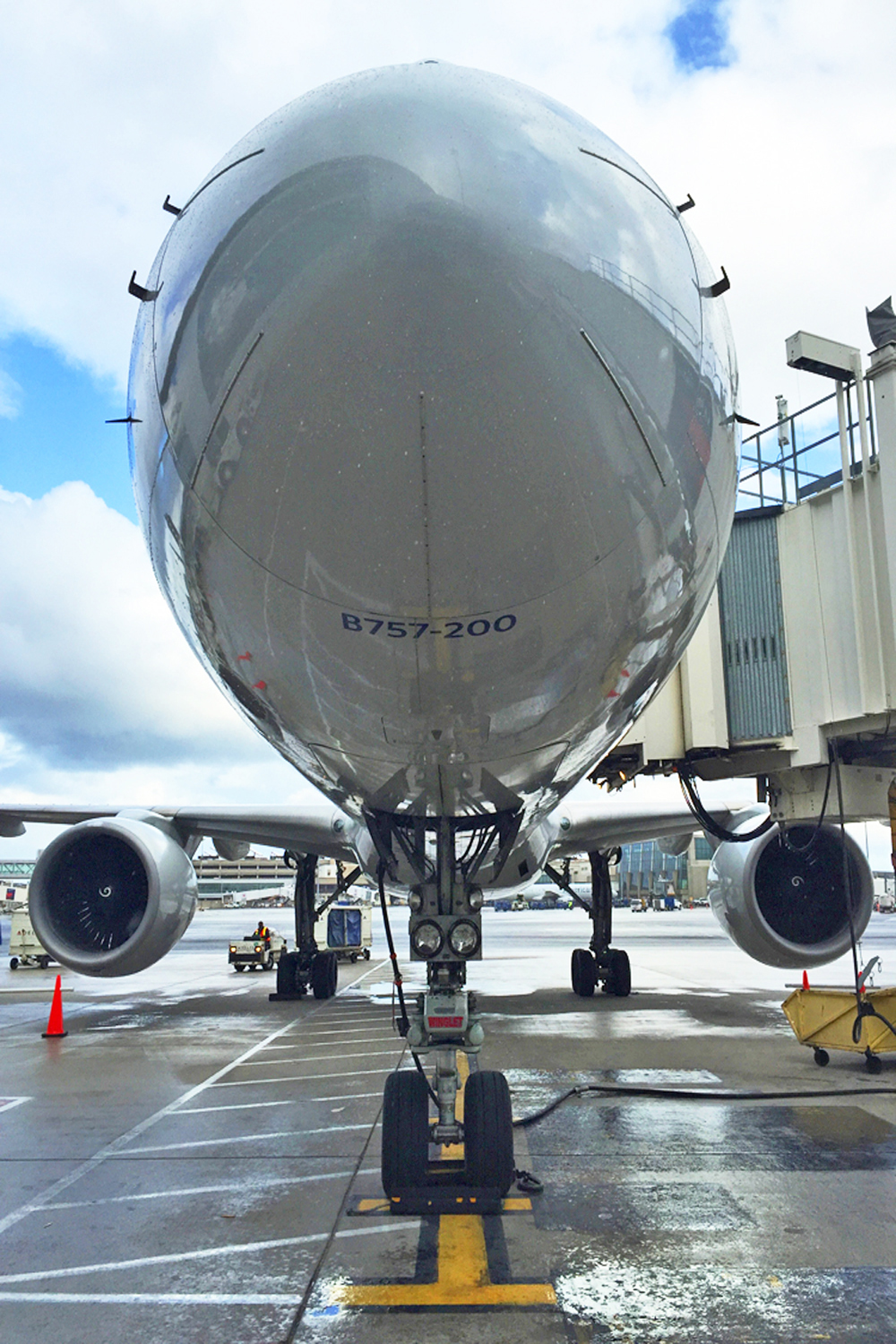
And it’s a great-looking machine to boot, sleek and muscular on its tall, twin-tandem landing gear.

I know this in part because I’ve been piloting the 757 for the past dozen years, along with its somewhat bigger sibling, the 767. The 787 is an excellent replacement for the latter, but what’s going to supersede the 757?

Boeing has been pitching its latest 737 variants as the right plane for the job. Airbus touts the A321. Am I the only one rolling my eyes? Sure these planes are sophisticated and efficient, but neither has the range, power, or capacity to match the 757.

With the 737, Boeing took what essentially was a regional jet — the original 737-100 first flew in 1967, and was intended to carry a hundred or so passengers on flights of around 400 miles — and has pushed, pushed, pushed, pushed, and pushed the thing to the edge of its envelope, over and over, through a long series of derivatives, from the -200 through the -900 and now onward to the 737 MAX. In other words, it has been continuously squeezed into missions it was never really intended for.

The 737’s range allows cross-country pairings, but transoceanic markets are mostly out of the question. It carries fewer passengers and less cargo than a 757, and at heavy weights it is often altitude-restricted. For a jet of its size, it uses huge amounts of runway and has startlingly high takeoff and landing speeds. The cockpit, architecturally unchanged from the 707, is incredibly cramped and noisy. The “Frankenplane,” I call it. I don’t care how many changes and updates the plane has undergone; at heart, it’s still a blasted 737 — a 55 year-old design trying to pass itself off as a modern jetliner.

I was jammed into the cockpit jumpseat — more of a jump-bench, actually — on an American Airlines 737-800 not long ago, flying from Los Angeles to Boston. Man, if we didn’t need every foot of LAX’s runway 25R, at last getting off the ground at a nearly supersonic 165 knots, then slowly step-climbing our way to cruise altitude. What would it have been like in the opposite direction, I wondered — a longer flight, from a shorter runway, in the face of winter headwinds?

By contrast, I recently piloted a 757 on a flight from Boston to San Francisco. At flaps 20, and even with a de-rated thirst setting, we lifted off at a docile 130 knots from Logan’s stubby, 7000-foot runway 9, with nearly half the runway still remaining! With every seat full and seven hours’ worth of fuel, we climbed directly to 36,000 feet and flew all the way to California. That’s performance.

Airbus, for its part, says that its A321, a stretched-out version of the A320, is the more adequate replacement than the 737. Perhaps it is, but this plane, too, fails to match the 757’s range or payload capabilities. The newest variant, the longer-range A321LR might prove more suitable, time will tell. If so, and if Airbus begins to rack up orders, then shame on Boeing.

What Boeing has long needed to do is design us a new airframe — the 797 — that can equal the 757’s remarkable combination of performance and economy. The 797 would be a clean-sheet 190-ish seater with a high-tech wing, fuel-efficient engines and a modernized flight deck. This is well within the technical expertise, if not the imagination, of the world’s largest plane-maker.

You can argue this plane already exists, at least as a template. I’m talking about the 767. Specifically, the older 767-200. The 767-200, which debuted in 1982, was quickly superseded by the larger -300, many of which remain in service. It’s an obsolete model seen today only in a scattering of freighters. But in terms of size, range, and capacity, it’d be just about perfect as a 757 replacement; a mini-widebody with outstanding performance and versatility.

In my opinion, the 797 ought to have been announced the very day the 757 was taken out of production, but for years the company has balked at such an endeavor, insisting that the market for such a plane, estimated at anywhere from 300 to a thousand examples, is too limited. This strikes me as disingenuous; an excuse to flood the market with yet more 737s. And early interest in Airbus’s extended-range A321s bears me out. Indeed, failure to build the 797 has all the makings of another Boeing boondoggle.

We’ll see what happens. For now, the 757 flies on.


Related Stories:

ODE TO THE 767.
FAREWELL DOUGLAS. TWO CLASSIC JETLINERS ARE PUT TO PASTURE.

Delta photo courtesy of Alberto Riva.
Nose-on photo by the author.
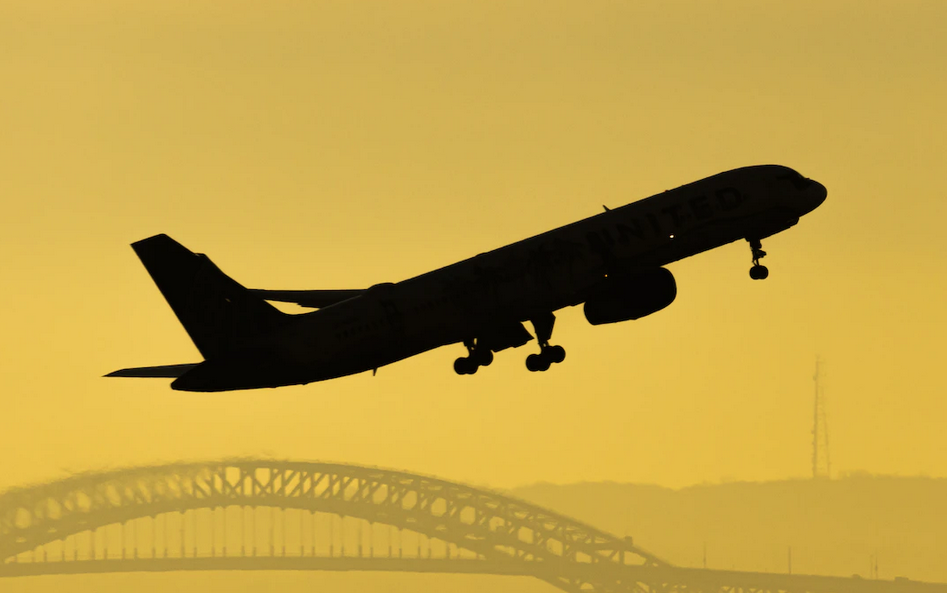
757 silhouette courtesy of Unsplash.

Comments (4)

The New American Airlines Livery

January 6th, 2014

IN MARCH, 2013, American Airlines unveiled its first major identity change in forty-plus years. The news broke as the carrier prepared to emerge from bankruptcy and prepared for its merger with US Airways.

American had bucked more than three decades of design fads. It’s distinctive silver skin, tricolor stripe and gothic “AA” logo dated back to the days of the its 707 “Astrojets.” Heck, my first ever airplane ride, in 1974, was on an American 727 decked out in the very same paintjob that, until last year, was American’s signature.

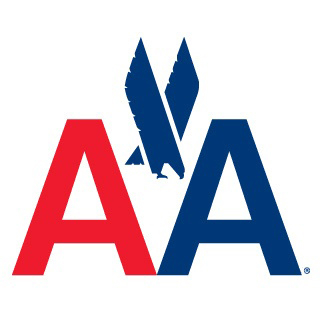
It was never anything beautiful, but what distinguished it was the logo — the famous “AA,” its red and blue letters bisected by the proud, cross-winged eagle. This was one of the last true icons of airline branding left in the world. Created by Massimo Vignelli in 1967, it was everything a logo should be: elegantly simple, dignified, and instantly recognizable.

AA-classic-logo

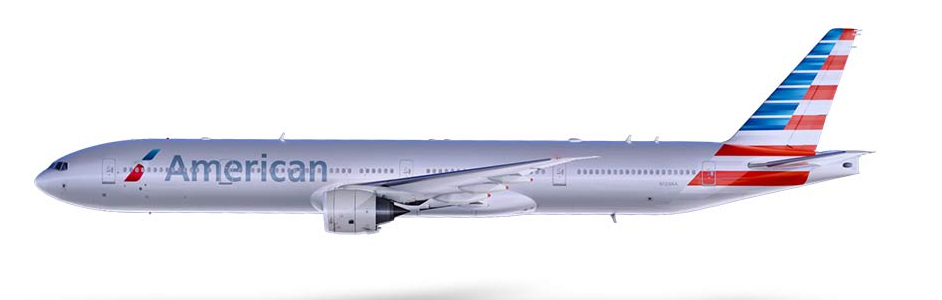
The redesign features a U.S. flag motif tail, a faux-silver fuselage, and an entirely new logo that is so unspeakably ugly that it nearly brings tears to my eyes.

The logo — the trademark, the company emblem, to be reproduced on everything from stationery to boarding passes — is the heart of an airline’s graphic identity, around which everything else revolves. It has been said that the true test of a logo is this: can it be remembered and sketched, freehand and with reasonable accuracy, by a young child? The Pan Am globe, the Lufthansa crane, the Delta tricorn, Air New Zealand’s “Koru” and many others meet this criterion beautifully.

As did the AA emblem. Maybe they need a tweaking or two over time, but the template of such logos — the really good ones — remains essentially timeless. American Airlines had one of the really good ones. And if you’ve got something like that, you dispense with it at your peril.

I was at Kennedy Airport recently and had the opportunity to view several American Airlines jets — some in the old paintjob, others in the new one. I’m sorry, but there was nothing old or anachronistic looking about the AA emblem. It did not need to be “refreshed,” or “modernized,” as some have suggested. Particularly if you’re replacing it with something so utterly vapid.

What exactly is that new, Greyhound Bus-esque logo? It looks like a linoleum knife poking through a shower curtain. If it’s not the worst corporate trademark the airline business has ever seen, I don’t know what is. I can’t imagine a kid with crayons trying to sketch it. Why would anybody want to? It evokes nothing, it says nothing, it means nothing. It gives American Airlines all the look and feel of a bank or a credit card company. I cannot believe how awful a mark this is, and how anybody signed off on it I’ll never understand.

AA New Logo

Its uglier, even, than the hideous Horus head of the new EgyptAir. It’s uglier, even, than the “rising splotch” that Japan Airlines came up with a few years back to replace its beautiful tsurumaru — the circular, red and white crane/Rising Sun it had used since 1960 (and which, by the way, JAL has wisely resurrected).

I’m hardly the only person put off by the new branding. It was controversial from the start, and among those who hated it most were thousands of American’s own employees. Finally, last month, CEO Doug Parker put things to a vote, allowing the carrier’s employees to choose between the new look, or a quasi-retro design that incorporated both the old and new schemes.

AA livery options

By a margin of about 2,000 votes, of some 60,000 cast, workers chose to stay with the new look.

Parker says he is happy about the result. But if he got what he wanted, that’s probably because the vote was effectively rigged. Parker won by making the airplane’s tail the focus of the vote. This misses the point, because like it or hate it, the piano key tail isn’t really the problem. It’s the logo that’s the problem. Neither of the choices dealt with the linoleum knife. In fact, Parker’s retro design would have kept both logos in use — a ridiculous, half-baked appeasement that would have left the plane looking manic and jumbled. A company can’t have two logos.

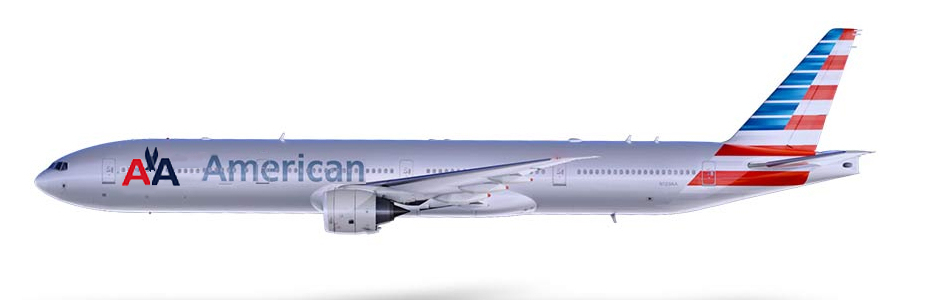
The smarter compromise would have been, and should have been, to keep the new tail, but dispense immediately with the linoleum knife and put the “AA” on the fuselage, as shown below courtesy of yours truly and Photoshop. Had this option been put to a vote, I suspect it would have won by a healthy margin:

AA Livery How It Should Be

To be clear, I’m not arguing that American didn’t need a spruce-up. The striping and typeface were overdue for a revision, and livery changes are all but mandatory, it seems, when airlines exit bankruptcy. But I can live with the tail and with the faux-silver body paint. Doing away with the AA symbol, however, was a tragic and unspeakably bad call.

Each time one of American’s newly painted planes taxis past me, I wince.


RELATED STORIES:

The Yin and Yang of Airline Identity, part 1.
The Yin and Yang of Airline Identity, part 2.


Airplane Shop Banner Ad 1


Comments (3)

Q&A With the Pilot, Volume 5

AN OLD-TIMEY QUESTIONS AND ANSWERS SESSION.

Eons ago, in 2002, a column called Ask the Pilot, hosted by yours truly, started running in the online magazine Salon, in which I fielded reader-submitted questions about air travel. It’s a good idea, I think, to touch back now and then on the format that got this venerable enterprise started. It’s Ask the Pilot classic, if you will.

Q: Flying out of Pittsburgh the other day, about ten minutes after taking off, the pilots deployed the landing gear for about ten seconds, then retracted it again. Nothing was said over the PA. Why would they have done this?

The pilots may have had an indication of hot or overheated brakes. Brakes can heat up during taxi, and stay hot after takeoff. The checklist might call for momentary deployment of the landing gear to help them air-cool. Or, it might have been a landing gear door not in its proper position. Again, the checklist might call for “cycling” of the landing gear.

Neither of these things is especially urgent, which would explain why they waited until 15,000 feet. The first few minutes after takeoff are quite busy.

What’s not explained is why the crew didn’t say anything. I suspect a majority of passengers would realize that dropping and retracting the gear at 15,000 isn’t normal. A quick PA was due.

Q: Prior to landing, the pilots told us they’d be lowering the landing gear much earlier than usual in order to help burn off excess fuel. I had never experienced this before

This happens rarely, but it does happen. It sounds as though your plane may have been above its maximum landing weight for the runway in use. Perhaps the flying time turned out to be significantly shorter than planned. Or, maybe, due to weather or some such, the only available runway was a shorter one than expected. Your weight determines your landing speed, which in turn affects how much distance you need. The increase in drag from dropping the gear early would significantly increase fuel burn. It’s extremely wasteful, but it works.

Larger jets have fuel jettison capabilities, but that’s more for emergency returns, medical or mechanical diverts — that sort of thing. And some planes have exemptions that permit overweight landings up to a certain point, usually requiring a post-flight inspection.

Q: When we landed in Chicago, the pilots told us we were headed into the “penalty box” because there was no available gate. We pulled over, parked, and waited over an hour. What is this penalty box?

That’s just a playful term to describe some spot on the tarmac where, for whatever reason (ATC delay, occupied gate) you’re asked to sit. An airport might have a designated area used for the purpose. Or, more often than not, it’s just an improvised location. The other night at JFK we waited about 45 minutes for a gate to open; the ground controllers sequestered us on a quiet taxiway between two runways.

Q: Okay, we’re sitting in the penalty box and the crew says our gate isn’t available. Yet I clearly see one or more wide-open gates at the terminal. Why can’t we use one?

Yes, I know, this happens all the time. Occasionally you’ll be swapped into one of those open spots, but if not, it’s normally because other inbound flights have dibs on them. Once you start swapping parking spots around at the last minute, you put a lot of different parts in motion (baggage and cargo loading and unloading, and so on), which leads to screw-ups further along. And what time a flight is do out has a lot to do with which gate it needs to use on the way in. It’s a matrix. I’ve had conversations with the apron staff about this, and came away realizing it’s not as simple as it seems.

Keep in mind, too, that the gates you see out the window might belong to another carrier. In the U.S. most gate space is proprietary. American doesn’t use United’s gates, or vice-versa. Their facilities, and the personnel that run those facilities, are separate — unlike in other parts of the world, where gates and concourses often are shared.

Q: I was watching the ramp crew give hand signals to the pilots as a jet was pulling in to the gate. Some of the gestures were obvious, like the guy at the nose moving his batons closer together until they crossed, telling the plane to stop. But why did the same guy raise his arms and flash four finger, two or three times in rapid succession? What did that mean?

He was telling the pilots that the plane’s landing or taxi light was still on, and was perhaps shining in his face. The taxi lights are usually located on the nose gear strut, and we switch them off once we turn into the parking bay to avoid blinding the marshaler. Occasionally if there’s a lot activity or we’re busy looking outside, we forget.

EMAIL YOUR QUESTIONS TO patricksmith@askthepilot.com

Related Stories:

Q&A WITH THE PILOT, Volume 1
Q&A WITH THE PILOT, Volume 2
Q&A WITH THE PILOT, Volume 3
Q&A WITH THE PILOT, Volume 4
Q&A WITH THE PILOT, Volume 5
Q&A WITH THE PILOT, Volume 6
Q&A WITH THE PILOT, COVID EDITION

Portions of this post appeared previously in the magazine Salon.

Comments (3)

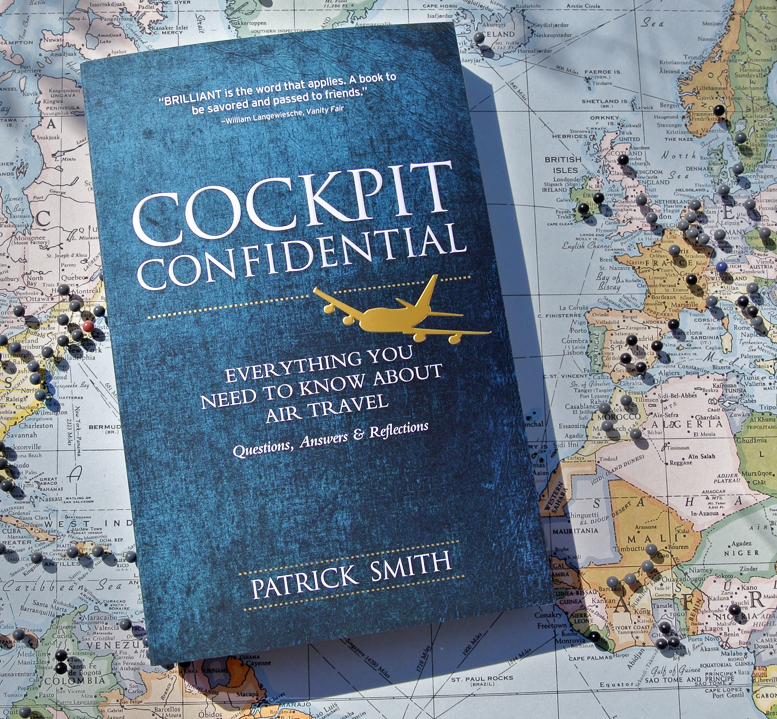
Cockpit Confidential


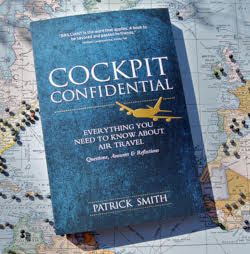
Patrick Smith and Sourcebooks are proud to announce publication of the second edition of

Cockpit Confidential:
Everything You Need to Know About Air Travel.
Questions, Answers & Reflections

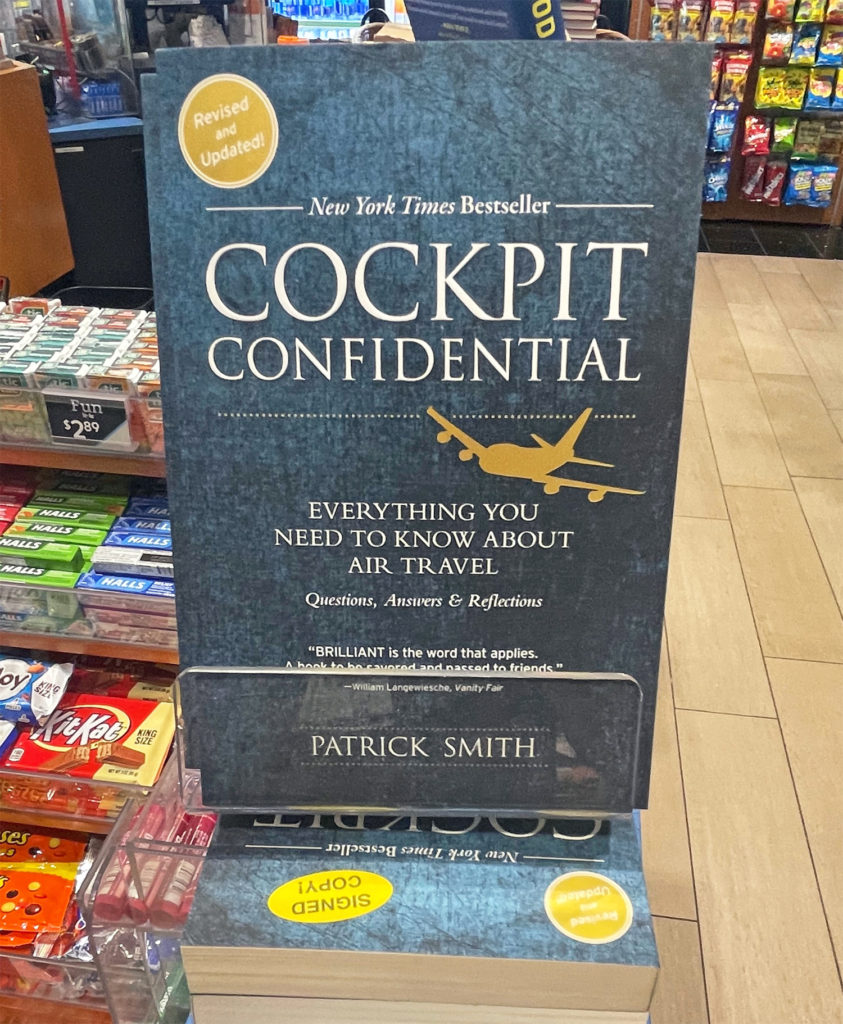
NOW A NEW YORK TIMES BESTSELLER

The original version of Cockpit Confidential was published in 2013. Suffice it to say the world of air travel has seen major changes since then. All seven chapters have been updated, revised, and in some cases totally rewritten. Approximately 20 percent of the text is all-new.

“Brilliant is the word that applies. A book to be savored and passed to friends.”
— William Langeweische, Vanity Fair

A wry, thoughtful, and at times provocative look into the confounding world of commercial air travel, this is the ideal take-along for frequent flyers, nervous passengers, world travelers, and anybody yearning for an enlightened, behind-the-scenes look at the strange and misunderstood business of commercial aviation. More than just a book about flying, its subject is everything and everything about the grand theater of air travel, from airport architecture to terrorism to the colors and cultures of the world’s airlines.

Patrick Smith has been called the thinking man’s pilot. For the better part of a decade, his Ask the Pilot column at Salon.com was a singular and remarkable sensation: an aviation column, for heaven’s sake, that could offer up trenchant analysis of an air disaster one day, then the next day stride fearlessly into politics, culture, or even rock music, and somehow tie it all together. Cockpit Confidential features the best of that material, refreshed and adapted into a seven-chapter volume of FAQs, essays and personal memoir. Whether it’s the nuts and bolts of cockpit operation or a hilarious critique of airline logos and color schemes, Cockpit Confidential is smart, funny, and brimming with useful information.

“Nobody covers the airline experience like Patrick Smith. And, he’’s a damned good writer.”
— Clive Irving, Condé Nast Traveler

• How planes fly, and a revealing look at the men and women who fly them
• Straight talk on turbulence, pilot training, and safety
• The real story on congestion, delays, and the dysfunction of the modern airport
• The myths and misconceptions of cabin air and cockpit automation
• Terrorism in perspective and a candid look at security
• Airfares, seating woes, and the pitfalls of airline customer service
• The colors and cultures of the airlines we love to hate
• The yin and yang of global travel
• Gratuitous references to 80s-era indie rock bands

“Cockpit Confidential is the document that belongs in the seat pocket in front of you.”
— David Pogue

Look for the “Revised & Updated” seal in the upper left corner.

AVAILABLE IN PRINT, AUDIO, AND EBOOK FORMATS…

IN THE U.S.

ORDER HERE FROM AMAZON

IN CANADA

ORDER HERE FROM AMAZON CANADA

IN THE U.K. AND IRELAND

ORDER HERE FROM AMAZON.UK

IN AUSTRALIA

ORDER HERE FROM BOOKTOPIA

IN INDIA

ORDER HERE FROM FLIPKART

Comments (1)

The Mad, Mad Summer of 2022

June 27, 2022

IF YOU’VE been to the airport lately, you’ve experienced the mayhem. Terminals are swamped, planes are overbooked, cancellations are rampant, delays are out of control.

I’ve been working quite a bit over the last few months, so I’ve been in the thick of it. “Travel is back,” I wrote in a post back in May. “I wasn’t sure we’d get here, so count me among those who are happy to see a little chaos again at the airport.” I meant what I said, but things have rapidly reached a breaking point. How bad is it, exactly? It’s tough to quantify in terms of statistics, but suffice it to say that in 30 years of commercial flying, I’ve never seen anything like this.

The gist of the problem is staffing. The media keeps talking about a pilot shortage, and certainly that’s a factor, but the crisis extends across the entire industry: at the airlines and their various contractors, at air traffic control, security, airport retail, and so on.

Yes, it mostly goes back to how things were handled at the height of the COVID-19 pandemic, when thousands of employees were shed, and a failure to adequately re-staff as things swung back to normal. On the surface, the airlines and their partners look pretty stupid, but perhaps it’s not that simple. Remember the environment at the height of COVOD-19 downturn. The industry had never faced anything like it, and was desperate to stay alive. There was no way of predicting when, or to what extent, flyers would return. Travel restrictions and border closings changed week to week, and absolutely nothing was certain. Almost nobody predicted a return to 2019 numbers so soon. The expectation, so much as there was one, was of a gradual, incremental return over a period of years.

Air travel logistics are challenging enough in normal times, never mind when the entire world has flipped upside-down. When it came to aligning their fleets and staffing, they did what they calculated was the smartest thing to do. Some guessed better than others. And that’s what it was to a big degree: guesswork.

And so here we are. And it’s not just the United States. Security and check-in lines at some European airports are three or more hours long. I was flying out of Dublin the other day, and the lines for U.S. immigration preclearance snaked all the way to the second floor. Amsterdam-Schiphol has enacted flight restrictions, and a luggage system meltdown at London-Heathrow left passengers without their bags for several days.

As to that pilot shortage we keep hearing about, there are, in fact, two shortages, the effects of which are overlapping. One is short-term and pandemic-related, per above. The second is more systemic and longer term.

Carriers are now taking on hundreds of new-hire pilots every month. This, combined with the lingering effects of the pandemic reshuffling, finds training departments overwhelmed, with long backlogs for classroom time, simulator slots, line certification flights, etc. Pilot training is modular, and it does not happen quickly. New-hire training can take several weeks, as can moving from one aircraft type to another, or upgrading from first officer to captain. Many pilots are sitting at home, waiting their turn. Thus, it’s less a dearth of pilots than a training system overload.

Then we have the other, more systemic shortage. As I talked about in this older article, this is a significantly bigger problem at the regional carrier level than at the majors. All of the legacy airlines are currently hiring, and although they’re having no trouble filling their slots, those pilots have to come from somewhere. This is causing a ripple effect downward through the industry. The regional sector has all but reinvented itself in a plea for new-hires, offering salary and benefits packages heretofore unheard of for entry-level airline pilots.

For decades, the salaries and working conditions at regional carriers were laughably substandard. In many cases pilots were asked to foot their own training costs, only to earn poverty level wages in return. And as the regional sector expanded, taking over more and more mainline flying, a job at a regional often meant an entire career at a regional. This led to fewer and fewer pilots getting into the business, helping create the shortage we have today. These companies now have little choice but to significantly improve pay scales and benefits, both to entice new-hire pilots and to retain the ones they already have. You could say they had it coming; there never needed to be a shortage in the first place.


Overall passenger numbers are still off about 15 percent from 2019. The problem is, the 85 percent who are back are being crammed into an infrastructure that can’t handle them.

What nobody is talking about, meanwhile, is the issue of airspace and runway saturation. It was bad enough pre-pandemic. Now, several upstart carriers are pumping even more airplanes into a system at or beyond maximum capacity. It’s especially bad in the eastern half of the U.S. Things run fairly smoothly when the weather is good, but the minute a storm develops, blocking off air routes, the delays and cancellations start to cascade.

Even on clear-weather days, the taxiway queues at airports like Newark or La Guardia can be hours long. Airlines need to better rationalize their schedules and, in many markets, consolidate departures to help reduce congestion. To this end, the short-haul widebody jet is a concept whose time has maybe returned.

When will the madness end? Will it end? I keep my fingers crossed that we’re not being set up for a sort of new normal in which chaos is taken for granted. I worry, because as we’ve seen with airport security over the past two decades, the traveling public has a remarkable and discouraging ability to adapt to almost anything, no matter how absurd or inconvenient.

Let’s hope, instead, the crisis is temporary. I suspect things will improve as demand dies down after Labor Day. In the meantime, if you bring one thing to the airport this summer, have it be this: patience.


Related Stories:

THE MELANCHOLY OF AN EMPTY AIRPORT
BIG PLANES, SHORT ROUTES. WHAT A CONCEPT.
FACT AND FALLACY OF THE PILOT SHORTAGE

Comments (20)

Who’s More Experienced, the Copilot or the Captain?

June 1, 2022

YESTERDAY was my birthday. I’m old. And I can’t believe the “Ask the Pilot” franchise has been running now for twenty years.

My first job as an airline pilot was in 1990. My first plane was an antique 15-seater with no pressurization or autopilot. I’d just turned twenty-four, and was one of the youngest pilots at the company. I made a thousand bucks a month, flying four days a week, in and out of the awful New England weather.

Suffice it to say my salary has improved. Nowadays I earn more on the average flight, wheels up to wheels down, than I made in an entire month flying those Beech 99s. I don’t mean that as a brag. It’s not that I’m overpaid today so much as I was ridiculously underpaid in those days.

On the downside, I’m no longer, by any stretch, one of the youngest pilots at my airline. This is depressing for the reasons you’d expect, but also has its advantages. I’m now one of the most senior pilots in my category, and can more or less pick and choose my trips, my time off, and so forth. I fly where and when I want to, as much or as little as I like. My salary has never been better, and neither has my quality of life — or “QOL” as pilots call it. The price I pay is being an old bastard with most of his life behind him.

Everything at an airline comes down to seniority. The moment a pilot is hired, he or she is the most junior pilot in the company, and from there begins the long climb upward. How quickly you ascend depends on different things: the health of the industry, the growth (or contraction) of your airline, and so on. As older pilots retire and new ones are taken on, up the list you go.

And because each airline has its own seniority list, your number is of value only within that company. When a pilot is out of work, for whatever reason, he or she cannot slide over to another airline and pick up where they left off. There is no sideways transfer of benefits or salary, ever. If you move to a different company, you begin again at the bottom, at probationary pay and benefits, regardless of experience.

For this reason — at least at the major carrier level, and once you’ve accrued a reasonable amount of seniority — it’s almost unheard of for a pilot to move from one airline to another. It’s also why any sort of industry upheavals (COVID, wars, recessions) make pilots very nervous. If your company goes bust, you lose everything.


My airline has roughly 13,000 pilots and I sit somewhere in the 4,000s. But it’s not that simple: there are lists within that list, broken down by base city, aircraft assignment, and seat (captain or copilot). Some bases are, on the whole, more senior than others, depending where pilots prefer to live or commute to. The same goes for aircraft type. Being senior in one base, or in one plane, doesn’t mean being senior in another base, or in another plane.

In my base city (New York), in my aircraft type (767), and in my seat (copilot), I’m in the top ten percent of seniority. A desirable place to be. However, if I were to change to a different base, or bid to captain, or bid to first officer on a higher paying plane, my ranking could drop considerably. I might earn more money, but my QOL wouldn’t be as cushy. My schedule, my commute, the trips I fly — everything would be more difficult. It’s a tradeoff. For the time being, I’ll take the QOL.

The potential training commitment is another reason I’ve been hesitant. The last thing I feel like doing right now is sitting through a month of training to learn an entirely new plane. I enjoy the 767, including its mix of domestic and international flying. Europe, Africa, domestic coast-to-coast… it’s an enjoyable mix.

And this results in situations like the one I found myself in the other day, when I was working a flight to Mexico City. The captain was a decade younger than me, and far more junior overall. I’d been hired in 2001; he’d been hired in 2015. I was older, more senior, and considerably more experienced than he was.

A week later I was working a flight to Europe. Long-haul flights carry augmented crews, and this time there were three of us: the captain and two copilots, one of whom was me. The captain was by far the most junior of our trio, a good 3,000 seniority numbers below me.

For different reasons, many pilots prefer life as a junior captain rather than as a senior copilot. Maybe it’s the money. Or maybe it’s ego, or a sense of fulfillment that comes with being called “captain.” I didn’t ask.

Bear in mind that I’m talking mostly about the United States. In other parts of the world, the seniority system isn’t as rigid. Copilots are often hired with very low experience levels, and upgrades to captain aren’t always based on tenure.

But here at home, a copilot becomes a captain not merely by virtue of skill, but when his or her seniority standing allows it. And not every copilot wants to become a captain right away.

Beyond the salary and responsibility aspects, the two positions aren’t a whole lot different from each other. “Copilot” is a colloquial term for first officer, and contrary to what a lot of people think, a first officer is not an apprentice. He or she shares on-the-job duties more or less equally with the captain. The captain is in charge, and earns a larger paycheck, but both individuals fly the plane. Copilots perform just as many takeoffs and landings as captains do, in pretty much all weather conditions, and both are part of the decision-making process.

That’s good enough for me. We’ll see how things look in another year. For now, I’m happy and staying put.


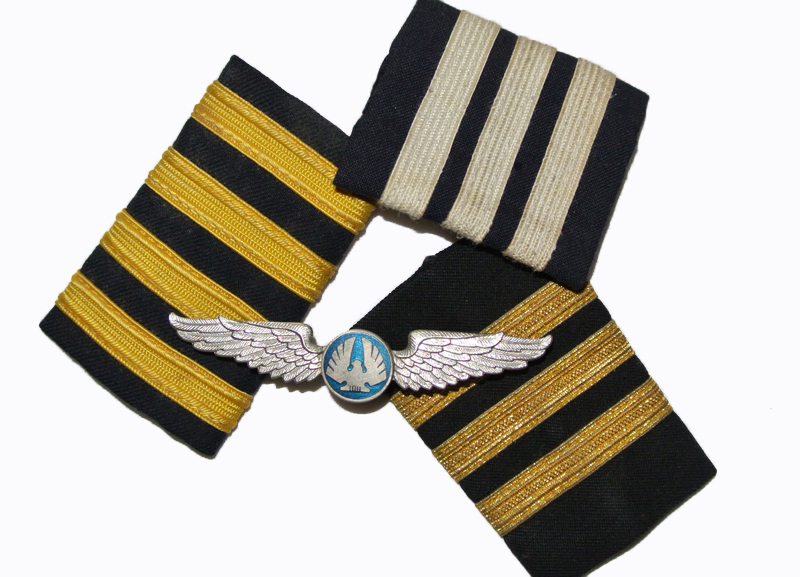
Epaulets photo by the author.

Related Story:

THIRTY YEARS ON
LIFE DURING COVID

Comments (19)

Here Comes the Summer

May 15, 2022

AIRLINES are understaffed, employees are overworked, passenger volumes are back to pre-pandemic levels, masks are off. And here come the three busiest travel months of the year. We’re already at the ragged edge of the envelope; just wait until those midsummer thunderstorms start barreling in. It’s going to be messy. If you bring one thing to the airport this summer, have it be this: patience.

I’m not the only one sounding the alarm. The major media, along with all the travel blogs, have been putting out their warnings as well. I like to believe that precisely because there’s so much hype, chances are things won’t turn out as bad as everyone says. So think of this post as a kind of reverse jinx. I’ll be traveling a lot in the next few months, and would prefer to keep my frazzle levels low.

Part of the mess is due to an ongoing pilot shortage, as I’m sure you’ve heard. In fact there are two pilot shortages, the effects of which are overlapping. One is short-term and mostly the result of poor planning. The second is more systemic and longer term.


When I say “poor planning,” I’m talking about the industry’s failure to adequately re-staff as things swung back to normal. However, while on the surface the airlines look pretty stupid, it’s not that simple: Consider the environment at the height of COVOD-19 downturn. The industry had never faced anything like this, and was desperate to stay alive. There was no way of predicting when, or to what extent, flyers would return. As the virus ebbed and surged, travel restrictions and border closings changed week to week; absolutely nothing was certain, and almost nobody predicted a return to 2019 numbers so soon. The expectation, so much as there was one, was of a gradual, incremental return.

Air travel logistics are challenging enough in normal times, never mind when the entire world has flipped upside-down. When it came to aligning their fleets and staffing, they did what they calculated was the smartest thing to do. Some guessed better than others — and that’s what it was to a big degree: guesswork.

Airlines are now taking on hundreds of new-hire pilots every month. This, combined with the lingering effects of the pandemic reshuffling, finds training departments overwhelmed, with long backlogs for classroom time, simulator slots, line certification flights, and so on. Many pilots are sitting at home, waiting their turn. Thus, it’s less a dearth of pilots than a training system overload.

Then we have the other, more systemic shortage. As I talked about in this older article, this is a significantly bigger problem at the regional carrier level than at the majors. All of the biggest airlines are currently hiring, and although they’re having no trouble filling their openings, those pilots have to come from somewhere, with high requisite levels of skill and experience. This is causing a ripple effect downward through the industry. The regional sector has all but reinvented itself in a plea for pilots, offering salary and benefits packages heretofore unheard of for entry-level airline pilots.

What nobody is talking about, meanwhile, is the issue of airspace and runway saturation. This is an even bigger factor than anything related to labor. Airlines continue adding planes into a system already at maximum capacity, especially in the eastern half of the U.S. It was bad enough pre-pandemic. Now, several upstart carriers are pumping even more airplanes into the sky.

Things run fairly smoothly when the weather is good, but the minute a storm develops, blocking off air routes, the delays and cancellations start to cascade. There’s no slack, no logistical breathing room. Even on clear-weather days, the taxiway queues at airports like Newark or La Guardia can be hours long.

It’s hard to say to what impact all of this will have on the summer of 2022. Pilots are just one of the moving parts.

Things might get messy, no doubt. But try to look at the bright side: People are out and about. Borders and attractions are (mostly) open. Travel is back. I wasn’t sure we’d get here, so count me among those who are happy to see a little chaos again at the airport.


“Here Comes the Summer” is a horrible song by the Undertones. Here’s a better one.

Related Stories:

THE MELANCHOLY OF AN EMPTY AIRPORT
BIG PLANES, SHORT ROUTES. WHAT A CONCEPT.
FACT AND FALLACY OF THE PILOT SHORTAGE

Comments (8)

Rarefied Air

April 21, 2022

FLY ENOUGH, and every so often you’ll encounter this or that famous — or infamous — person.

Maybe it’s a pop star. Maybe a film star. Maybe a newscaster, an athlete, or a washed-up comedian nobody remembers (see below). Maybe it’s 1981 and you’re a ninth-grader, standing in baggage claim at the Los Angeles airport, and the actor known as “Mr. T” walks past you with his entourage.

As a pilot, I have the added thrill of not just seeing or perhaps sharing a row of seats with whomever it is, but being somewhat indispensable to whatever journey he or she is embarking on — be it a flight home from an awards show or a trip to rehab. They’re counting on me.

Or so it’s fun to think…


The thing about Mr. T is that he was short. Or shorter than he should have been, as I understood it. There’s always something about a celebrity that catches you off guard.

Spike Lee was on board once. This was a shuttle flight from Boston to La Guardia. Lee also is on the shorter side, but I knew that ahead of time.

Kevin McHale, the Hall of Fame basketball star from the Boston Celtics, is not short. One afternoon I was working a flight from Atlanta to San Francisco, and Kevin was sitting in first class. “You and me go way back,” I said to him. This was a reference to the days in the early 1980s when I followed every Celtics game, and McHale was the power forward of the team’s “big three” attack, along with Larry Bird and Robert Parish.

(As it happens, some years ago I was waiting to appear on a local television show, and I shared the green room with none other than Robert Parish. It was just the two of us, and we chatted for a few minutes. That was cool.)

About two months after the flight to San Francisco, I was standing at the gate in Boston waiting to board a plane to JFK, when I looked over and there, again, was Kevin McHale. “Hey!” I said. “I flew you out to San Francisco a couple of months ago!”

Kevin McHale didn’t seem impressed. I guess I don’t blame him.

Another time it was Dan Rather. “What’s the frequency, Kenneth?” I said to the captain. He didn’t get the joke. You probably don’t, either. It’s an old reference.

Dan Rather is old. I’m old. Everyone is old.

Kirk Douglas was certainly old. He lived to be 103. And although I never met or flew Kirk Douglas, I did carry his famous son, the actor Michael, on a run from JFK to LAX. I learned later that Michael had been en route to his father’s centennial birthday celebration.

I knew who Michael Douglas was right away, but in general my celebrity recognition skills are poor.

Kanye West was on my plane coming back from Zurich. I remember he walked aboard carrying a glass of cognac that he’d taken from the lounge. I was standing near the doorway, and as he passed I made some goofy remark about people bringing drinks onto planes. A flight attendant took me aside and told me the guy was Kanye West. I had only the vaguest idea who Kanye West was, and until that moment couldn’t have told you what he looked like.

Another night, there was a buzz among the cabin crew because “one of the Kardashians” was sitting in row two. I seemed to be the only person on the plane who didn’t know what a Kardashian was. I’d heard the name enough times, sure, but it didn’t mean much to me. I knew they were a celebrity family for some bizarre reason — though, to me, the name has always makes me think of an arms dealer or a Wall Street villain. When I looked over at row two, I saw a pleasantly dressed woman reading a magazine. This was a Kardashian?

Which one was it? I don’t remember.

At the gate in Los Angeles one morning, a couple come aboard and take their place in business class. They have a kid with them, a toddler. They’re conspicuous for a few different reasons. For one, their clothes and haircuts are — I don’t know how to describe it, exactly. Flamboyant, I guess is the word. The woman has plumes of hair going in all directions, like Sideshow Bob. The kid, who is maybe three, has a miniature version of the same hair, but in a more vertical, mohawk style. He’s wearing a brightly striped onesie outfit that appears to be made of silk. He’s kicking and fussing and screaming. Later I’m told that that the woman is the singer Alicia Keys, and the little troublemaker is her son.

Would you recognize the former news anchor Katie Couric? I didn’t, but she was on my plane a few years ago, and, long story short, ended up borrowing my iPhone charger. I gave Ms. Couric my card and told her to let me know if ever she needed help with a story about airplanes or airlines. One morning, not long afterwards, she called me at home, with questions about something that had been in the news. I forget what the topic was, and nothing ever came of it.

I flew the actor F. Murray Abraham out of Bucharest, Romania. This was a big one for me, because Abraham has the starring role in what, to me, is the funniest scene ever filmed for television. I’m talking about the Russian Tea Room scene with Louis C.K. during season three of the show “Louie.” You can view it here. The genius of this scene can’t be overstated. I wanted to tell the actor that, but I kept my mouth shut.

I did not keep my mouth shut the afternoon I flew Anthony Bourdain from Ireland to the U.S. This was in 2012, shortly before my book was published. The title of my book is, of course, a derivative ripoff of Bourdain’s famous book, “Kitchen Confidential.” I’d always felt uneasy about this, and here was my chance to let Mr. Bourdain know. “The publisher forced it on me,” I said to him, lying through my teeth.

He laughed.

And we haven’t even gotten to presidents…

I’ve met three presidents. None of them American presidents, but presidents nevertheless. The first of them was John Atta Mills, the semi-beloved leader of Ghana. Mills died in 2012, but during his tenure he rode aboard my airplane at least twice.

I also had the honor of meeting and flying the President of Guyana, Bharat Jagdeo. (Contrary to what my father and others seem to think, Ghana and Guyana are in fact different countries, on different continents, with different presidents to boot.)

Third on the list is Ellen Johnson Sirlief, Nobel Peace Prize laureate and former President of Liberia. I met her four times, including once at a reception at Roberts Field. On one of those occasions, I asked if she’d be kind enough to sign a copy of our flight plan. She obliged, writing her name in green ink at the bottom of the dot-matrix printout.

Things have worked out well for me, I think. Years ago, when I was puttering around over Plum Island, sweating to death in some noisy old Cessna, the idea that one day I’d be be carrying presidents in the back of my plane would have struck me as ludicrous.

Next we have the would-be presidents…

Doing this chronologically, we have to go all the way back a weekend afternoon in 1980. I’m at Boston’s Logan Airport, planespotting with a pair of my junior high pals, when who disembarks from a TWA jet only a few feet in front of us but Jerry Brown, then-governor (and, later, governor again!) of California. Brown was running for President that year along with Jimmy Carter, John Anderson and Ronald Reagan.

In addition to his political aspirations, Governor Brown, a.k.a. “Governor Moonbeam,” is known for his dabbling in Buddhism, his long liaison with Linda Ronstadt, and his appearance in one of the most famous punk rock songs — the Dead Kennedys’ “California Über Alles.”

Six years after that, on a Sunday morning in 1990, I’m standing at Teterboro Airport, a busy general aviation field in New Jersey, close to New York City. A private jet pulls up. The stairs come down, and out steps Jesse Jackson and several burly bodyguards. Jackson walks into the terminal, passing me by inches.

The following summer I’m back at Logan, using a payphone in Terminal E. Suddenly Ted Kennedy is standing at the phone next to me, placing a call. (Quaint, I know, in this age of wireless, but there’s the famous Senator, the brother of JFK, slipping dimes into the slot.) I’m talking to a friend, and I surreptitiously hold up the receiver. “Listen,” I say, “whose voice is this?”

“Sounds like Ted Kennedy,” she reckons. And it is.
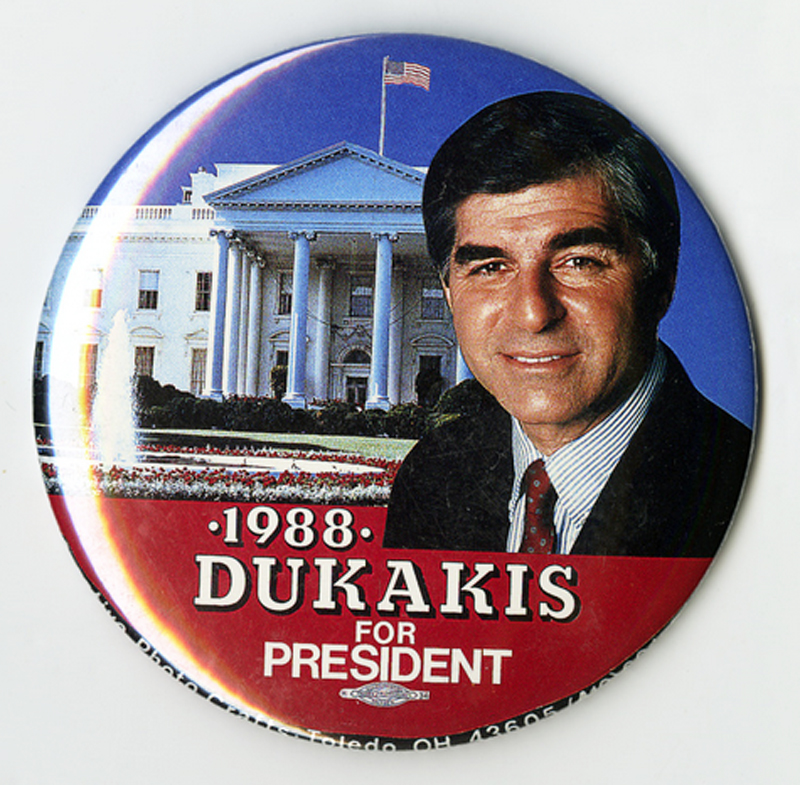
Next it’s 1994. Logan again, and I’m in the captain’s seat of a Northwest Airlink 19-seater, preparing for departure to Baltimore. Up the front stairs comes Michael Dukakis, who in 1988 had lost the election in a landslide to George Bush the Elder. He stops briefly behind the cockpit and says hello.

After we land in Baltimore, Dukakis thanks us for the ride and remarks, “Not a lot of room in here.” Even at 5’8″ he’s right about that. The Metroliner’s skinny, tubular fuselage earned it the nickname “lawn dart.”

“Yeah,” I answer, “It’s not exactly Air Force One.”

Meanwhile, intentionally or otherwise, the Duke has left a sheaf of important-looking papers in his seat pocket — probably because he’s run to a phone to cuss out his secretary for booking him on that stupid little plane with the annoying pilot. I carry the papers inside to the counter. “Here,” I say to the agent. “These belong to Mike Dukakis.” She looks at me like I’m crazy.

In 2012 I shared a shuttle flight from New York to Boston with Chelsea Clinton. She and her husband were sitting just a few rows ahead of me. At one point I was taking something down from the overhead locker when she passed me in the aisle. I was in her way and had to move aside. “Sorry,” I said. “Excuse me.”

“Thanks,” said Chelsea Clinton.

All of those people were Democrats. Rounding things off ideologically, I once had the controversial Supreme Court nominee Robert Bork on my plane. That was in the summer of 1991. Bork was riding in my rattletrap 15-seater from Boston to Nantucket.

That same summer, again to Nantucket in the same shitty plane, I flew David Atkins, better known to the world as “Sinbad,” the thankfully-forgotten actor and comedian who once had his own talk show and HBO comedy special. He sat in the back row of the Beech-99, surrounded by an entourage of beautiful women.

Okay, “thankfully-forgotten” is a cruel thing to say, even if he did wind up emceeing the Miss Universe pageant. Sinbad couldn’t have been friendlier, and in the Compass Rose restaurant at the Nantucket airport he bought me and my copilot chicken sandwiches, asking us for advice on what kind of airplane he should buy. We told him to invest in a Cessna Citation — a twin-engine executive jet — though I can’t remember why. I was making about thirteen grand a year at the time, and would have said anything for a chicken sandwich.

The great New York Yankees catcher Thurman Munson was killed at the controls of a Cessna Citation in 1979, but I don’t think we mentioned this to Sinbad.


Related Stories:

POLITICS, PLANES, AND PILOT BLACK MAGIC

Comments (35)

Unmasked

April 19, 2022

IF YOU’RE headed to the airport today, you can leave your face covering at home.

Yesterday, a Federal judge struck down the Biden Administration’s extension of the TSA-enforced mask mandate for airports, airplanes, and public transit. By late afternoon, the White House basically threw in the towel, announcing that TSA would no longer enforce the rule. Already extended on two prior occasions, the mandate was set to expire in under three weeks. Apparently this wasn’t a fight worth taking on.

Within hours, the country’s airlines began informing passengers and employees that, effective immediately, masks are now optional.

The new policy will affect U.S. domestic flights and airports. Protocols on international flights will vary with the destination country.

Here’s hoping the pre-departure testing requirement for passengers returning to the United States is next to be eliminated.

Regardless of where I fall on the matter, what I fear is that the to-mask-or-not-to-mask question becomes a kind of binary political litmus: if you’re politically on the left, you’ll continue wearing a mask. If you’re a Trumper or politically to the right, you won’t. Ideological affiliations will thus be judged instantly, based on appearance.

This kind of non-thinking is bothersome and very unfair, but this is the nation we’re living in these days — and another of the reasons I’ve come to feel so politically homeless of late.

And that’s about all I wish to say. If readers feel like arguing the good and bad, have at it in the comments section.

It’ll be interesting to see this how this plays out. I imagine the percentage of people sticking with masks will, at first, remain quite high. I was at the Dublin airport a couple of weeks ago, where the policy has been optional for a while, and it was about 50/50. Will you wear a mask still? Why or why not? And talk us through the different scenarios. What if, for example, you prefer to be masked but find yourself seated in a row of unmasked flyers. Etc.

One thing that hopefully goes away forever are the mask selfies on Instagram posted by pilots and flight attendants. If, like me, you’re a fan of the various commercial aviation photostreams, you’ve seen them: picture after picture of airline workers cheerfully mugging in face masks. This seems wrong to me, and often smells sanctimonious.

And why do I get the feeling that most of these photos would never exist in the first place if not for the masks? Somehow the mask seems to be the entire point, which makes it all the more frustrating.

Yes, until now, everyone who flew needed to put a mask on. This was understood and accepted, as was any airline’s attempt to make the policy clear through advertising, promotional materials, on-board safety videos, and so forth. What’s driven me crazy, however, have been the constant attempts to cute-ify the wearing of masks. Because, in fact, there’s nothing cute about them. Masks are physical symptom of a society in pretty serious distress. This isn’t something to giggle at, normalize, or make light of.


Related Stories:

A PILOT’S LIFE UNDER COVID
CORONAVIRUS CASUALTIES
HOTEL ROOM MADNESS
DEPARTURE TESTING MADE EASY

Comments (43)