Author Archive

Dignified and Old

July 26, 2023

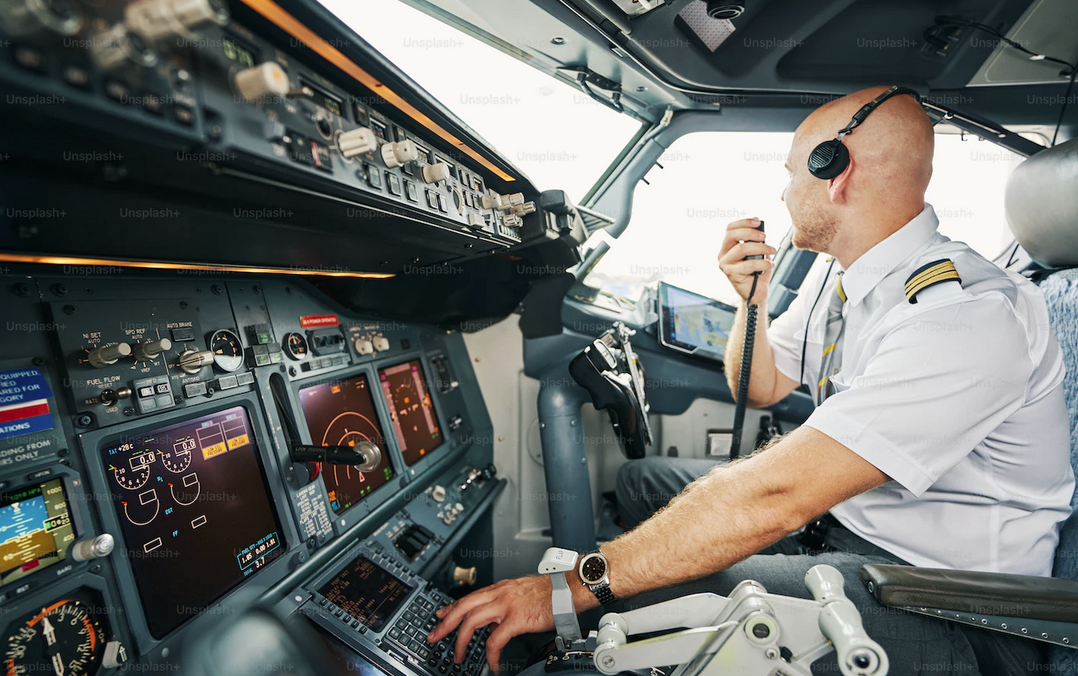
A PROPOSAL is moving through the U.S. Congress right now that would increase the mandatory retirement age for pilots from 65 to 67. The proposal has momentum and bipartisan support, and many expect it to become law.

Count me among those hoping this happens.

Those pushing for the change cite the ongoing pilot shortage as one of the reasons. Fair enough, though for me it’s more personal. For one, I really enjoy my job. As things currently stand I have eight years left, and I’d love to stay at it for a couple more (assuming all the radiation exposure doesn’t kill me first). But perhaps more importantly, I have a substantial amount of lost income to make up for, having been laid off for half a decade in my mid-thirties — prime earning years.

Not everyone is on board, including Transportation Secretary Pete Buttigieg. Also among the opposers is the Air Line Pilots Association (ALPA), the world’s largest pilot union. This might seem a bit of a head-scratcher, and I suspect their resistance is owed to demographics: pilot rosters are skewing younger and younger these days, and many of the newest pilots see age 67 as a threat to their career progression. Older pilots like me will stay on the property slightly longer, the thinking goes, impeding their seniority advantages (aircraft bidding, seat bidding, and so forth).

Forgive me if I’m less than sympathetic.

In 2001, after slogging it out at the regionals and a cargo carrier for nine years, I was hired by a major carrier at age 35. Starting annual pay at the time was around $30,000, and I was promptly furloughed in the wake of the September 11th attacks. (My ensuing gig as an online columnist and author was fun, but by no means lucrative.)

While I was out of work, my airline, along with several others, declared bankruptcy. Industry-wide, wages were cut some 40 percent and retirement plans eliminated.

Then, in 2007, shortly after being recalled, the retirement age was extended not merely two years, but five, from age 60 to age 65. Not only did I miss out on several years of major airline salary, but the minute I got back, seniority movement slowed to a crawl.

You wanna whine about threats to your career progression? Try five years of furlough, a bankruptcy, and a massive seniority slowdown first.

If this sounds like a sob story, it’s not just mine. Thousands of other airline pilots went through all of the same things — or worse.

The industry has since changed dramatically, and pilots entering the ranks today have never had it better. It’s common now for the legacy carriers to bring on pilots in their mid-twenties, and under the latest contracts, new-hires are earning in their first one or two years what it used to take a decade or more to make. When I returned from furlough, my sixth-year first officer hourly rate was $65 per flight hour. Pilots are now making $100 or more per hour on day one.

These same pilots are upgrading to captain in record time (at some airlines, new-hires are getting widebody captain slots), and otherwise racing up the seniority lists. Projected over a thirty or forty-year career, the earning potential for a pilot hired today is absurd. Adjust for inflation all you want; the differential over any length of time is huge.

I should mention also that salaries at the regional carriers have vastly improved. Most airline pilots begin their careers at the regional level, and here too they are cashing in. In my day, starting pay at the regionals was under $20,000 a year, working conditions were abysmal, and in some cases you had to pay for your own training. Today an RJ pilot can easily bring in six figures. You can make a good living even before scoring that dream job with a major.

To say nothing of the fact that junior pilots skated through the COVID-19 fiasco without so much as a hiccup. Thanks to the taxpayer bailouts, they avoided furloughs and in some cases were paid nearly a full salary to simply stay at home for a year. Many of them took on second jobs and collected two salaries.

For those of us of baby-boomer and Generation X vintage, such fortune is difficult to fathom. Hence, when I hear some twentysomething hotshot whining about the “damage” the age 67 change might wreak, my reaction is a combination of exasperation and bemusement. You’ve got to be kidding.

Wars, recessions, and any of a dozen other calamities could set the industry reeling yet again, it’s true. But that doesn’t offset the tremendously good fortune the newest pilots are currently basking in. I, along with thousands of my peers, faced those same risks, but without the front-end benefits of today’s generation. Things might go sour at some point, but if nothing else they’re making fantastic money in the meantime. For us that wasn’t the case.

All told, it has never been a better time to be a pilot.

If you’re worried about competency, training cycles and medical certification standards are there to ensure older pilots are up to the task. And, I should add, nobody is going to force you to work until 67. You’re free to retire at 65, or any other age at which you feel comfortable. And the extra two years aren’t just for the older workers; they’re for the new-hires as well, eventually.

The idea isn’t without its complications. Most foreign authorities remain committed to the age 65 limit, effectively blocking any U.S. airline pilot over that age from flying beyond American borders. Unless that changes, pilots between 65 and 67 would be restricted to domestic-only routes. This will cause some training headaches and require some finessing of airline seniority lists, but it’s certainly doable.

You’ll maybe detect a tone of resentment in this piece. That’s not quite how I mean it. Much as I might be jealous, I cannot begrudge anyone the advantages of youth and fortuitous timing. Good for them. Just please don’t take it for granted. They need to understand how lucky they are, and how different things used to be. While most new pilots realize this, there are those who don’t, and who seem to think they’re entitled to a hassle-free career and a bursting bank account before they’ve hit 30. If you’re in that camp, try to understand why and how, to some of your older coworkers, griping over a two-year age extension sounds greedy and petty.


Related Story:
THE REGIONAL RECKONING.

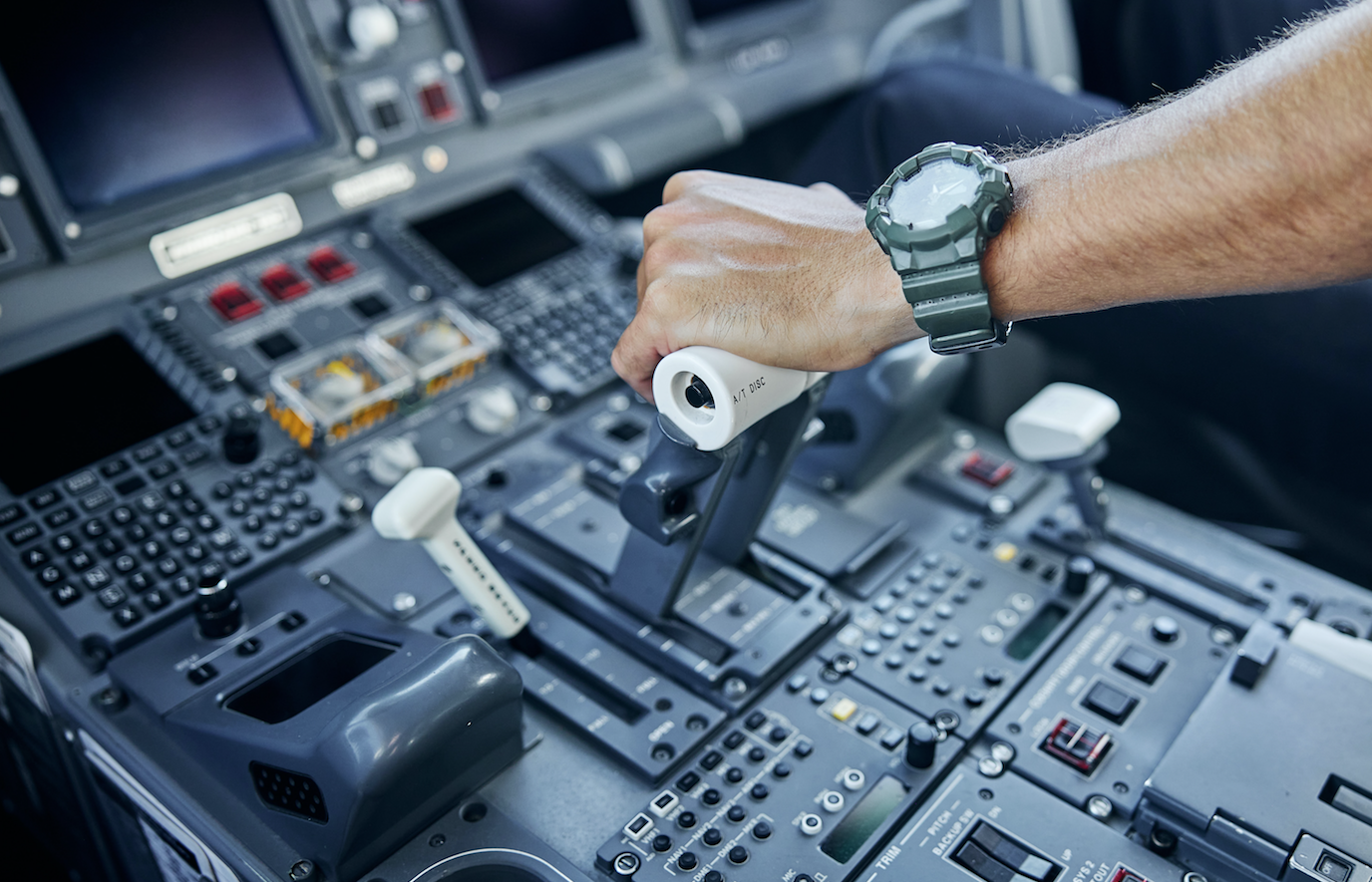
Photo courtesy of Unsplash.
Numbers graphic by the author.

Comments (36)

Open Door Policy

May 31, 2023

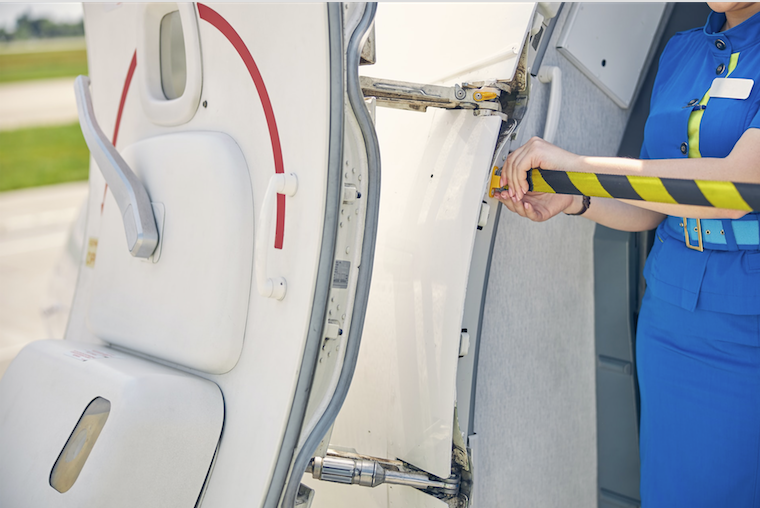
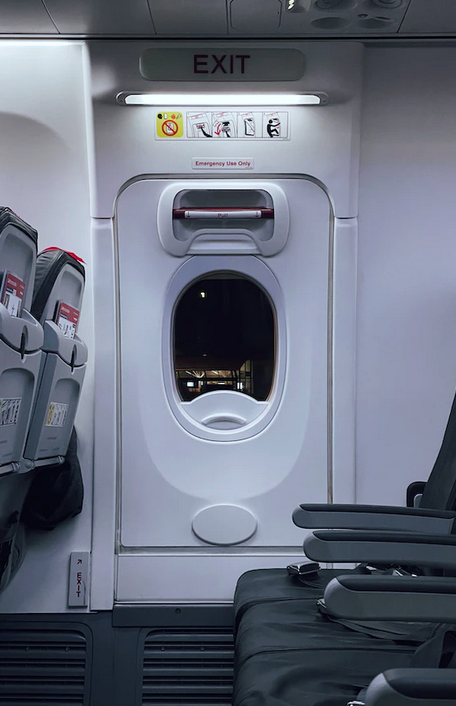
LAST WEEK, a distraught passenger opened an emergency door aboard an Asian Airlines flight as it prepared to land on the Korean holiday island of Jeju. A dozen people were injured in the ensuing melee.

Numerous readers have sent unfriendly emails taking me to task for statements I’ve made in the past about the ability to open a door in flight. Specifically, we turn to chapter five in my book, where one beholds the following:

You cannot — I repeat, cannot — open the doors or emergency hatches of an airplane in flight. You can’t open them for the simple reason that cabin pressure won’t allow it. Think of an aircraft door as a drain plug, fixed in place by the interior pressure. Almost all aircraft exits open inward. Some retract upward into the ceiling; others swing outward; but they open inward first, and not even the most musclebound human will overcome the force holding them shut. At a typical cruising altitude, up to eight pounds of pressure are pushing against every square inch of interior fuselage. That’s over 1,100 pounds against each square foot of door.

Well, yes and no, the over-confidence of that first sentence being the main offense. What I describe is basically correct, but as a plane descends, the pressure differential lessens, eventually dropping to zero at the point of touchdown. When very close to the ground, the “weight” holding the doors shut may in fact be negligible enough to permit a door to open. In the case of Asiana, the Airbus A321 was at only 700 feet; just a minute or so from the runway.

The book further states…

Even at low altitudes, where cabin pressure levels are much less, a meager 2 p.s.i. differential is still more than anyone can displace — even after six cups of coffee and the aggravation that comes with sitting behind a shrieking baby. On the ground, the situation changes—as one would hope, with the possibility of an evacuation . During taxi, you will get the door to open. You will also activate the door’s emergency escape slide.

While the part about being on the ground is true, there’s a difference between low altitudes and very low altitudes. I should’ve made this clear. If my publisher is kind enough to move forward with a third edition, I’ll revise this entire Q&A.

What I was trying to do, a bit too eagerly, is dispel the idea of opening a door during cruise, creating the sort of disaster movie situation that people envision when this topic arises: the one of complete chaos, with people getting sucked through the hole. That can’t happen. What can happen, though, is what happened aboard Asiana.

Fortunately, the very ability to get the door open also means that nothing catastrophic will occur. It’ll be noisy and scary, and unsecured objects could get whipped around; but without any serious pressure differential, nobody’s getting sucked out.


Photos courtesy of Unsplash.

Comments (23)

Flying With Air Baltic

May 23, 2023

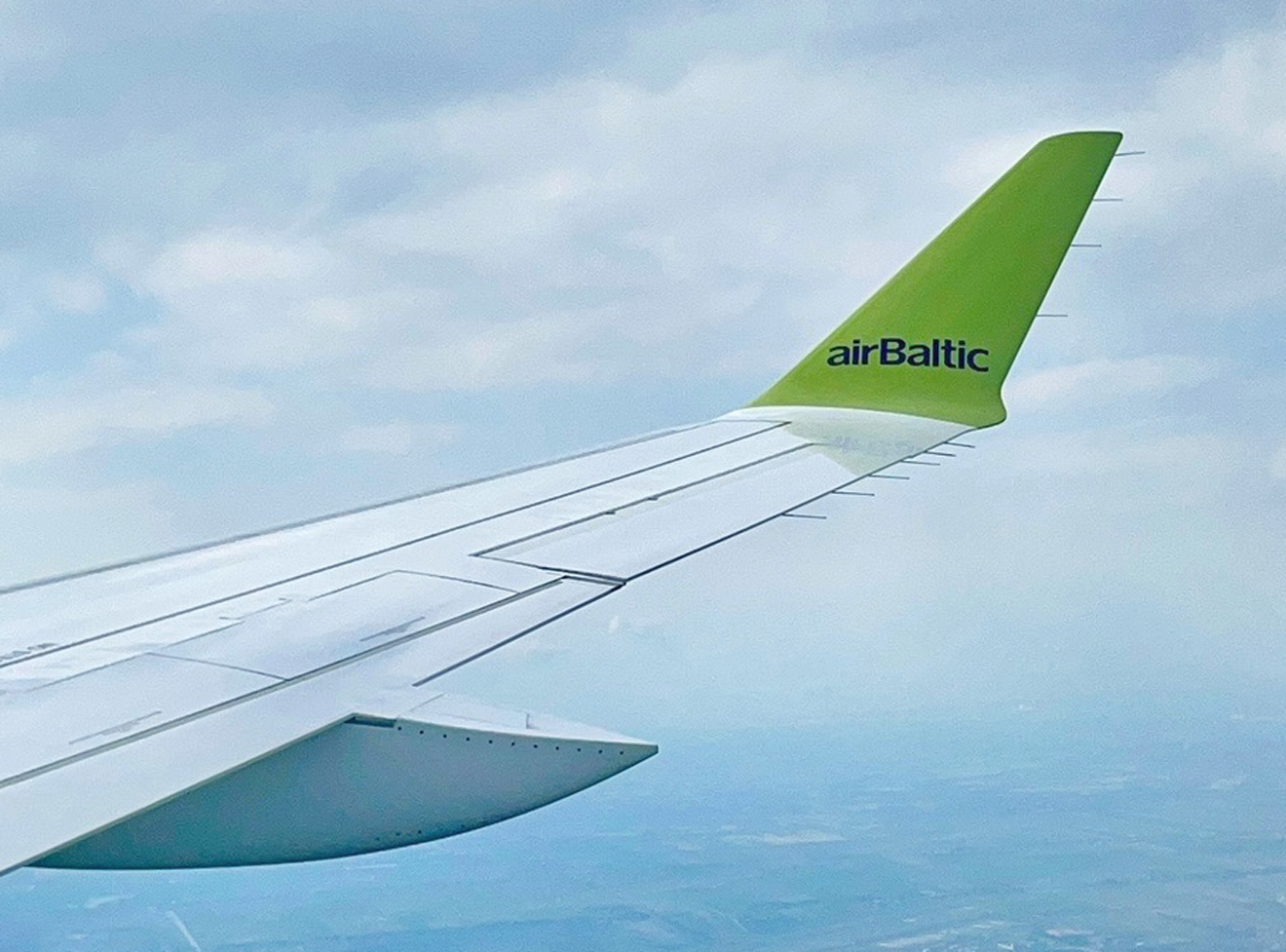
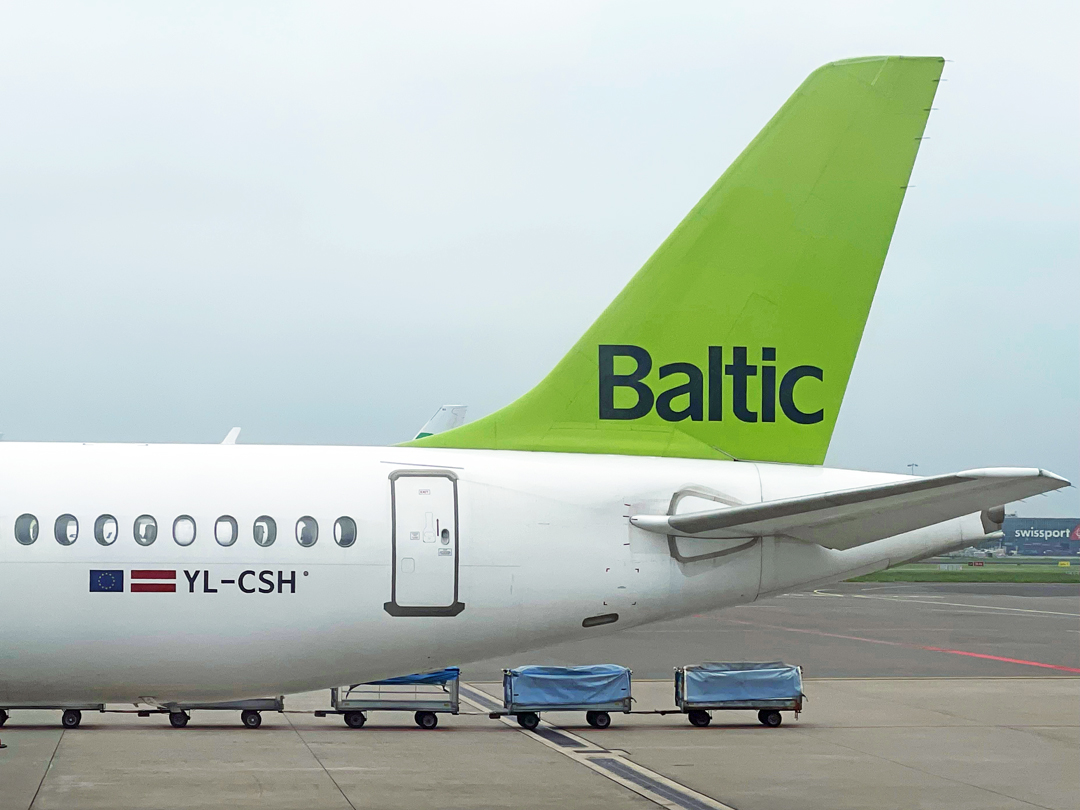
NOT MUCH GOING ON, so I’ll bore with you some details about my vacation flights with airBaltic.

A young company that got its start 1995, Air Baltic lacks the recognition factor of the mainstay European airlines. But it’s maybe a bigger company than you’d expect, with a 40-strong fleet of Airbus A220s and a network touching every major city in Europe. New routes extend all the way to Dubai and Armenia. Its main hub is in Riga, Latvia, with smaller hubs out of Tampere, Finland, and the Estonian capital of Tallinn. We flew up to Tallinn, then down to Riga a few days later.

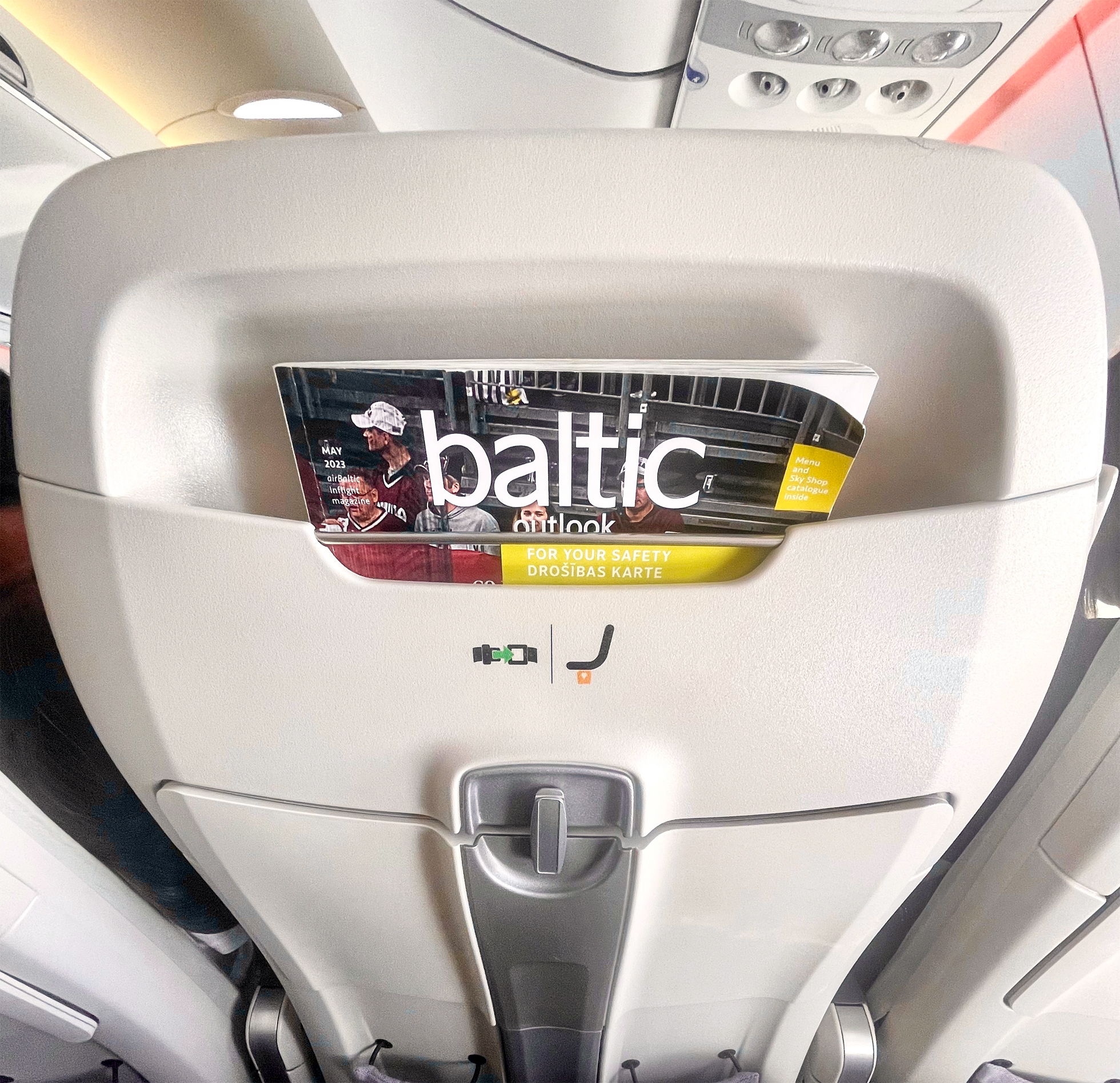
airBaltic follows a quasi low-cost carrier (LCC) model, with a la carte pricing and a streamlined onboard product. There’s a small, unfussy business class up front with complimentary hot meals. Economy class is no-frills, but with ample legroom and a reasonable selection of buy-on-board food and drink. Similar to jetBlue in the United States, airBaltic is more of a hybrid than a true LCC. Service-wise they’re leagues ahead of European budget giants Ryanair and easyJet. (They also borrow jetBlue’s and easyJet’s unusual branding affectation, using a lowercase “a” and the camel-cap “B.”)

I wasn’t hungry, so I can’t vouch for the quality of that buy-on-board food, but the guy next to me ordered a tasty looking wrap. He also got annoyingly chatty after two very large cans of Latvian beer.

The seats in airBaltic’s A220s feature an unusual design in which the tray table pivots from the bottom of the seat structure. If you’ve got food or a laptop on your tray, this avoids any pinching or crushing when the person in front of you reclines.

There’s no entertainment system or seat-back screens, but most of airBaltic’s flights are under three hours long.

The airline’s website is straightforward and user-friendly.

The airports in Riga and Tallinn are quiet and compact. Both have Priority Pass lounges that, surprise of surprises, were pleasantly uncrowded. My only gripe was the third-degree experience at the security checkpoints. The lines were short, yet it still took half an hour to get through because the guards pored through our bags, scrutinizing every last container of liquid, no matter how small.

Overall grade: B

Most people couldn’t care less which airline they fly with. Many can’t remember which carrier took them to their last vacation. I guess it’s different for airline geeks, with our weird notions of posterity. It always excites me flying on an airline for the first time, and this was no exception. A new one for my list.


PHOTOS BY THE AUTHOR

For pictures from Estonia and Latvia, visit the author’s Instagram feed.

Comments (9)

Jet Bridge Blues

May 15, 2023

PHOTOS BY THE AUTHOR.

THE JET BRIDGE, that strange, too-often troublesome umbilicus connecting terminal to fuselage.

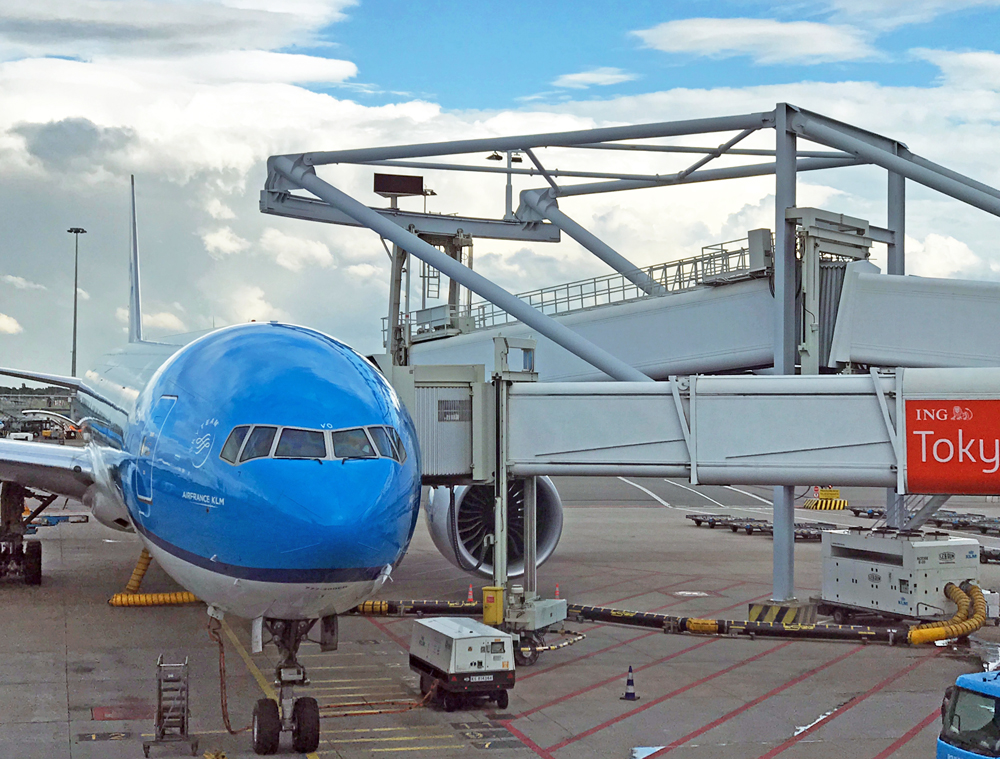
The other day I was stuck on a regional jet for twenty minutes because the gate agent couldn’t get the damn thing into the right position. If only I had a dollar for every time this has happened. And much of the problem, I think, is that these devices are so monstrously over-engineered. Take a look at the typical jet bridge. The things are enormous. They must weigh hundreds of thousands of pounds and cost millions of dollars.

(Note: I’ll be using the generic term rather than “Jetway,” which is a brand.)

That wayward bridge at JFK was twice the size of the plane. As the agent fumbled with the thing, it looked like she was trying to steer a battleship. Hydraulic arms flexed and groaned, machinery wailed, lights flashed and bells rang. Finally the tires began to turn — like the wheels of those huge mobile barges that NASA used to position the Saturn rockets. All of this so that fifty people could walk the negligible distance from the aircraft to the terminal.

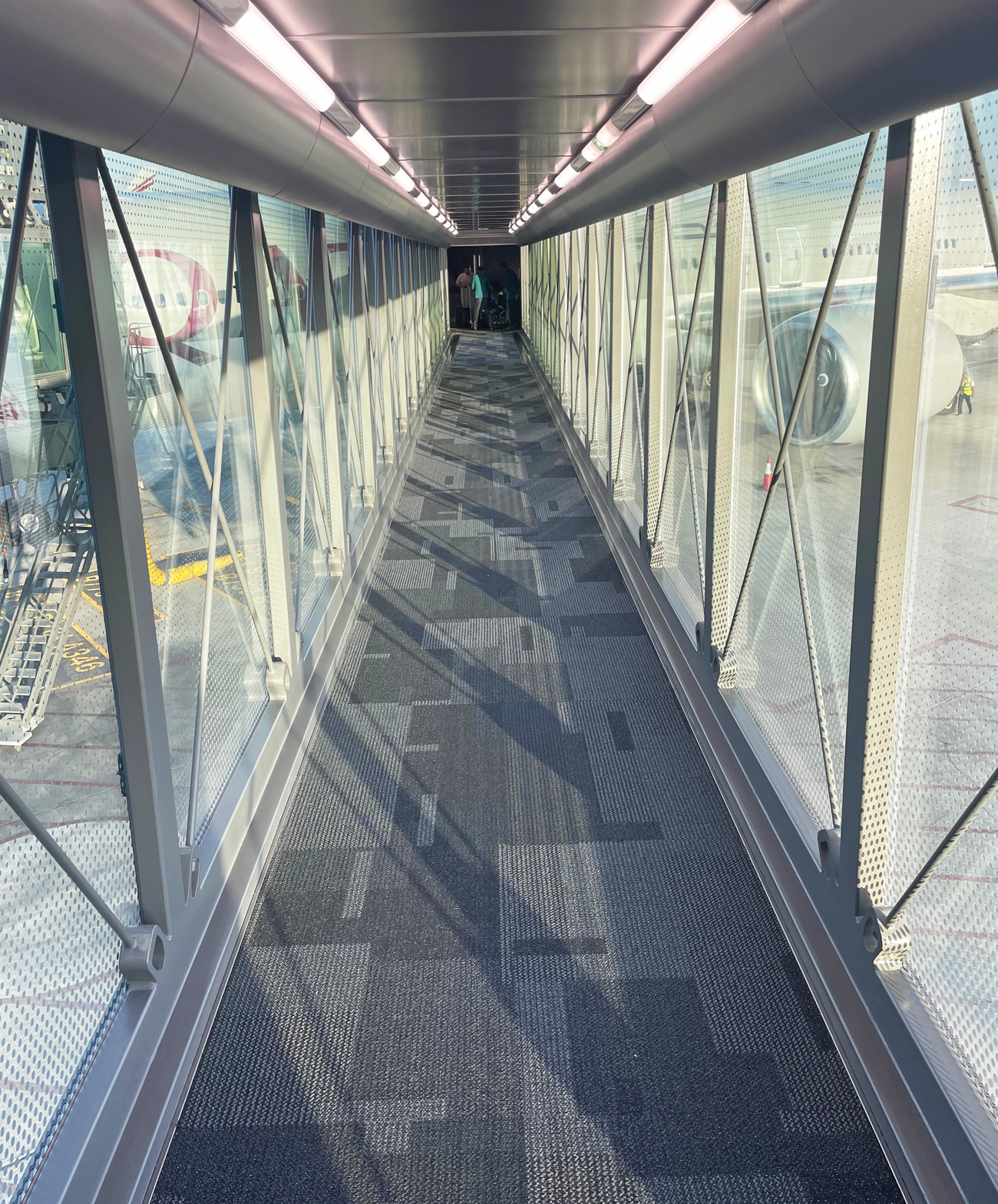
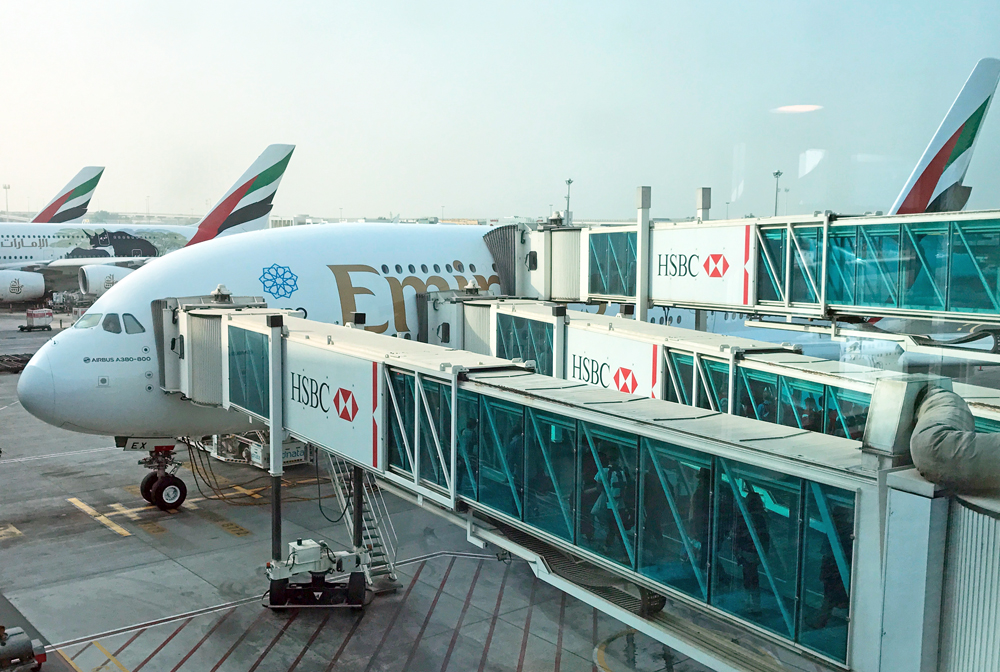
I realize the bridges are multifunction. The air conditioning and power connections used by the plane during its downtime are part of the assembly. But do they need to be so big and heavy, with all of this Rube Goldberg machinery? It’s just a gangway for crying out loud. You see simpler, lightweight, often glass-sided jet bridges in Europe and elsewhere around the world (see the following photo), but here in the U.S. we rely on these ponderous, lumbering contraptions.

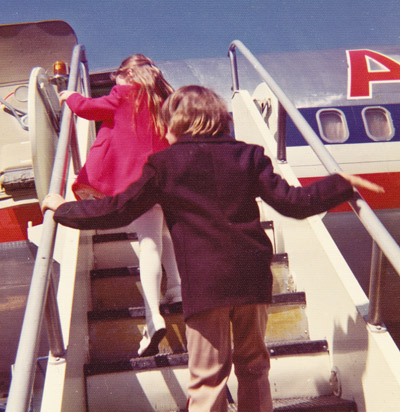
Of course, I’m opposed to jet bridges on principle. I prefer the classic, drive-up airstairs. Some of the international stations I fly to still employ those old-timey stairs, and I always get a thrill from them. There’s something dramatic about stepping onto a plane that way: the ground-level approach along the tarmac followed by the slow ascent. The effect is like the opening credits of a film — a brief, formal introduction to the journey. The jet bridge makes the airplane almost irrelevant; you’re merely in transit from one annoying interior space (terminal) to another (cabin).

Plus, it takes me back to my first-ever ride on an airplane. It was 1974 and I was eight years-old, and I vividly remember walking up the stairs to that American Airlines 727. A photo snapped by my mother immortalizes the moment…

I know, the bridges are important for passengers with limited mobility or who rely on wheelchairs, and for avoiding inclement weather. But the old-style stairs worked well for decades, and I see no reason they couldn’t still. Hydraulic lifts could be used for wheelchairs while the rest of us climb the stairs. I’m convinced this would be a faster and more efficient method. Ryanair is one carrier that agrees with me. The European budget giant relies on stairs, not bridges, at most of its stations.

But if we’re going to rely on jet bridges, we ought to have not only simpler ones, but more of them. Airports outside the U.S. routinely board and deplane a widebody jet through multiple doors using multiple bridges — at least two, and sometimes even three. This makes a massive difference in how long it takes to move hundreds of people, and their hundreds of carry-ons, between the terminal and the cabin. Here at home it takes 45 minutes to get a few dozen people onto a regional jet, and it’s chaos the entire time, while in Asia I’ve seen 500 passengers board an A380 in under thirty minutes. Dual-bridge boarding does exist in the United States, but it’s uncommon.

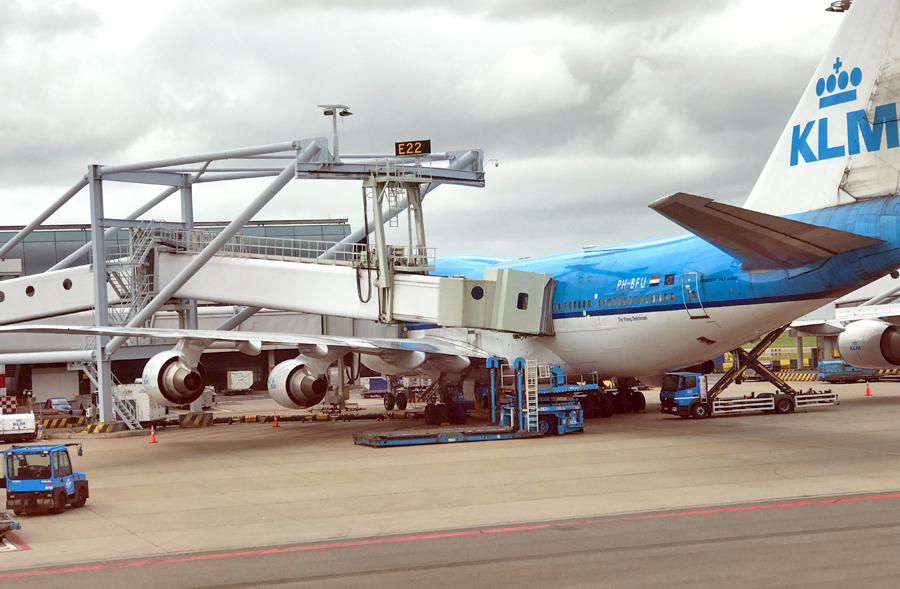
In Amsterdam, KLM boards some of its flights using forward bridges, plus a unique, over-the-wing bridge that connects to the rear fuselage. These overwing bridges are by no means lightweight, slung from a superstructure that looks like something you’d see in a shipyard where they build aircraft carriers, but they do make getting on and off the jet quicker and more pleasant.

Another reason that boarding is more efficient in other countries, Asia especially, is that carriers there tend to use bigger planes. In Asia, even a 45-minute hop is often aboard a 777 or A330. Widebody planes, with dual aisles and all-around greater spaciousness, are by their nature easier to get on and off. In the U.S., aircraft size has been steadily shrinking over the past three decades. More people are flying than ever before, it’s true, but we’re doing it on smaller planes: regional jets, A319s, 737s and the like. The reasons for this are a subject for another time, but the narrow aisles and limited bin space mean longer boarding and deplaning times.

A few years back, my friend Harriet Baskas penned this interesting story for USA Today on the history of the jet bridge.

In closing, just an observation…

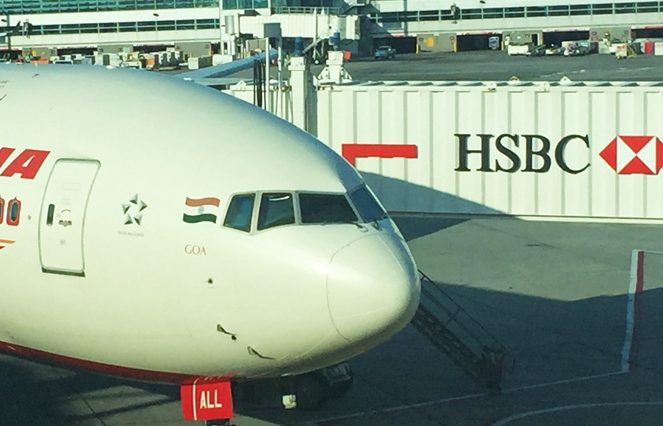
Look around, and it seems that 90 percent of the world’s jet bridges are emblazoned with logo of HSBC.

I’m not sure this advertising strategy has been all that effective, however, because although millions of people see these four letters every day, relatively few of them know what they’re looking at. I did a little impromptu research, asking several colleagues if they knew what HSBC was. Not one of them could tell me.

HSBC is a British bank, originally founded in Shanghai and Hong Kong. The letters stand for “Hong Kong and Shanghai Banking Corporation.” It’s one of the ten biggest banks measured by assets. The company pays tens of millions of dollars every years to airport authorities the world over — mostly at major international hubs — for the rights to put its name on boarding bridges.

In 2012, HSBC was hit with a $1.9 billion fine for laundering money on behalf of drug cartels and terrorist groups — carrying on a tradition of questionable practices that goes back generations, apparently, to the days of the opium trade.


Comments (34)

Full Circle


April 18, 2023

PHOTOS BY THE AUTHOR

SO MUCH OF a piloting career is leaving things behind. Change is a constant — new airlines, new planes, new routes — and you’re always saying goodbye. Goodbye to companies, goodbye to colleagues, goodbye to places you loved (or hated) to fly.

And goodbye to airplanes. Seems we’re always jumping from one model to another. Maybe your company finally retired those aging 757s. Maybe you upgraded to captain on a different type, or switched to something bigger and better.

And those airplane farewells aren’t always fond. So it was in 1992 when I completed my final flight in the Beech 99, a twin-engined fifteen-seater from the 60s that was my first assignment as an airline pilot. When I stepped off the stairs of that sad contraption for the last time, I couldn’t run away fast enough. To borrow from an earlier story…

Unpressurized and slow, the Beech 99 was a ridiculous anachronism kept in service by a bottom-feeder airline and its tightfisted owner. The rectangular cabin windows gave it a vintage look, like the windows in a 19th-Century railroad car.

Passengers at Logan would show up planeside in a red bus about twice the size of the plane. Expecting a modern Boeing or Airbus, they were dumped at the foot of a fifteen-passenger wagon built during the Age of Aquarius. I’d be stuffing paper towels into the cockpit window frames to keep out the rainwater while businessmen came up the stairs cursing their travel agents.

A Northeast Express Beech 99, circa 1992.

The noise, the cramped cockpit, the shame. Good riddance. My logbook lists my valedictory flight as a run from Augusta, Maine, to Boston, on August 13th, 1992. I don’t remember it, specifically, but my sentiments at the time remain indelible: I never wanted to set foot in a Beech 99 again. And because the plane was an obsolete antique that no respectable airline would operate, never in my dreams did I expect to.

Fast forward to 2023, and I’m sitting with my girlfriend at the airport in Nassau, Bahamas, about to catch a flight to the tiny island of Staniel Cay. We’re booked with something called Flamingo Air, which until three days ago I’d never heard of. Sitting in the departure lounge, I’m idly wondering what kind of plane will be making the half-hour hop to Staniel. A Twin Otter? A Caravan? A Cessna 402?

And then I see it. Or I hear it, actually — that vaguely familiar buzz-rumble of PT-6 engines. I turn and there it is, taxiing towards the building. The awkward, tail-low silhouette and the square windows. The long tapered nose. You can’t be serious. Well fuck me if it isn’t a Beech 99.

“You can’t be serious.”

“What?” says Liz.

“That’s our plane.”

“It’s so cute!”

Nostalgia, you’re thinking, would be the way to approach this. But the only sensation I can muster up is wary combination of disappointment and fear. The Beech 99 was already a tottering piece of junk 32 years ago. To discover one still airworthy is equally hilarious and startling.

And now I have to get in the thing. Being a superstitious sort who can’t help seeking out those nooks of fate where irony and tragedy intersect, I’m convinced I’m going to die.

An agent walks us across the apron towards the plane, which is mostly tombstone-colored. Coming around the wing, I notice the red tail-stand. The 99 is aft-heavy, and boarding has to be staggered to keep it from plopping onto its tail. At Northeast we’d hold the thing up with our shoulders until the forward rows were full. Then after landing we’d run back and do it again.

Going up stairs I catch a view of the tail, decked out in a colorful design of the famous swimming pigs of Big Major Cay. The charm of the image is a little hard to savor because the decal is webbed and cracked and peeling, giving the fin the look of a shattered window.

“All the way forward,” the agent tells me. I climb inside and go to the first row, just behind the pilots. I have to turn sideways because there isn’t enough legroom between my seat and the copilot’s. There’s no cockpit door, of course. At Northeast Express, some of our 99s had curtains. Not this one. The copilot’s shoulder is inches from my face.

It all comes back to me, the details suddenly familiar, even after three decades. The comically small seats and the dearth of headroom, the wing spar cutting across the middle of the cabin floor. The grime and the chipped paint and broken-off moulding. The sun-baked upholstery and the scratched-up plastic windows. The shambles of it all.

Elizabeth eyes me cheerfully, asks me to take her picture. To her this is all great fun. She has no idea of this rattletrap’s significance in my life, or the fact that I’m terrified of it.

I look at the instrument panel. More memories, none of them especially welcome. The toy-sized artificial horizon, the torque gauges, the radio panel straight from a 1970s Piper Cherokee. Theres a primitive GPS, at least, which is something we didn’t have in the early 90s. Several of the annunciatior panel lenses are cracked or missing. The whole thing has the look and feel of a military surplus plane reassembled in someone’s garage.

I recall my first-ever time at the controls of this thing. “It seems like yesterday,” I might say. But it doesn’t. It seems like when it was: October of 1990. On the glamorous route between Manchester, New Hampshire, and Boston — a flight even shorter than this one. I remember cutting my knuckles on the cabin door latch the first time I closed it, flying with bloody fingers.

Off we go. The copilot’s sun visor is broken in six places. It’s turned to the side, and as we accelerate for takeoff it slips from its mount and lands in my lap. I place it on the floor.

The plane is louder than I remembered, and with every seat taken our takeoff roll seems to go on forever. Once airborne, it shimmies and wobbles as it climbs, as if aggravated by its own lack of strength.

At last we reach 5,500 feet and the pilots level off. Takeoff is the most inherently dangerous part of any flight, and I feel better now with the ground a mile below. I relax a little — at least until I glance at the engine gauges and notice the RPM indicator for the left engine sitting at zero. The propeller is still happily turning, thank goodness, so clearly the instrument is kaput. I don’t think that would’ve been “deferrable,” as we put it, back at Northeast Express. Not a big deal, but the little things are adding up.

Elizabeth is looking out the window. The scenery as we near the Exumas chain is unworldly, a psychedelic swirl of blue and cream, sandbar and sea. At least someone is enjoying it.

I already know that I’m going to write about this. Assuming I survive, of course. The question is how. What will the angle be? Should I interview the pilots? The captain is an older guy who looks like a lifer, not some kid building experience with his eyes on a better job elsewhere. He’s not saying goodbye. He must have some stories, flying around the Bahamas all these years, dodging storms, landing on tiny runways. This is the kind of flying highly dependent on seat-of-the-pants skills and local knowledge.

Maybe that should be my article. I jot a few things in my notebook, my handwriting vibrating in time with the engines. But ultimately I decide that I don’t care. I don’t care about the nuances of flying in the Bahamas. I don’t care about local knowledge or the captain’s derring-do. I just want off this thing before the coast guard is fishing my half-eaten body out of some barracuda-infested reef.

And that — this — is my article.

There’s a warbling as we start down, the propellers out of synch as the power comes back. I see an island in the distance, a candy-bar landing airstrip at the center of it. A few minutes later the gear drops. If either pilot says so much as a word over the radio, I don’t notice it.

We whistle over the rocky edge of Staniel and settle onto the pavement. The touchdown is feather-smooth, but when the props go into reverse, it sounds like a table saw chewing through plywood.

The runway is three-thousand feet, the captain tells me after shutting down the engines. We chat for a couple of minutes. “I have eleven hundred hours in one of these,” I tell him. I do some quick and depressing math in my head, calculating how many days of my life that works out to.

He seems impressed, or something. And maybe he’s annoyed. There I was in the first row, watching so intently. Back-seat flying, as it were.

“What’s up with that RPM gauge?”

And though we’re safe and sound, for now, I can’t really savor the moment, because the scarier part is yet to come. Landing on a 3,000 foot runway is one thing, taking off is another. Something to worry about for the next five days.

None of this, if you can’t tell, is especially rational. It’s all me. Was that airplane actually unsafe? It was old and cosmetically beat-up, sure, but aside from a malfunctioning non-critical instrument, everything seemed normal. The ones I flew thirty years ago were no different. The pilots are experienced and know what they were doing. Is it safe to fly this airline to Staniel Cay? No doubt.

The danger exists entirely in my head. It’s not about the airplane; it’s about my past. I’ve been taken hostage, it feels, by the neurotic and the annoying games I play with memories and fate, self-conspiring to wreck my vacation. I can’t help myself.

At the airport we rent a golf cart. That’s how you get around on Staniel, switching from one silly mode of transportation to another. Liz steers us towards the villa while I ruminate. Is there a ferry back to Nassau, I wonder? A fishing boat? Anything but a Beech 99?


Related Story:

THE RIGHT SEAT. PROPELLERS, POLYESTER, AND OTHER MEMORIES.

For more pictures from Staniel Cay, see the author’s Instagram sets.

Comments (48)

Lucky and Good

March 20, 2023

A FLURRY of recent close calls finds us nervous. There were near misses on runways in New York, Boston, and Austin. A United Airlines jet plunged to within 800 feet of the ocean after takeoff from Maui. And so on.

The billion-dollar question is, are these incidents symptoms of something gone rotten, or a spate of bad luck? Are they harbingers of disaster, or outliers?

Much discussed are staffing woes both at the airlines and air traffic control. The post-pandemic aviation world is operating at maximum capacity, but with lesser levels of experience and expertise. The job losses during COVID aren’t just measured in raw numbers; there was a brain-drain as well, as many senior employees took early-retirement packages. Now, thousands of new-hire employees are being taken on: pilots, cabin crew, controllers, dispatchers, schedulers, mechanics. They find themselves in a high-stress environment where learning curves are steep and mistakes can be unforgiving or worse.

Whatever the root causes, it’s been alarming enough to gather the FAA and airline officials in an aviation safety summit taking place this week in Washington.

And that’s a good thing. Surely it’s better to be digging into things now, rather than after there’s a catastrophe that kills 250 people. It’s all about being proactive; identifying weaknesses in the safety chain, and fixing them.

Our vantage point is a remarkable one. Twenty-one years have passed since the last major crash involving a legacy U.S. airline. That’s by far the longest such streak in commercial aviation history. Whether you look at it nationally or globally, never has commercial flying been as safe as it’s been over the last two decades.

For a sense of how true this is, all one needs to do is flip through the accident annals of the 1960s through the 1990s, when multiple deadly crashes were the norm year after year after year, killing 200, 300, even 500 people at a time. In some years we’d rack up ten or more mishaps worldwide. In 1985, perhaps the deadliest year on record, we saw a major crash on average of once every two weeks! Even with vastly more planes in the sky, accident rates are a small fraction of what they were.

It’s not easy, I know, for the average person to keep this in perspective. The media certainly doesn’t help. Precisely because there aren’t as many serious crashes to steal the headlines, there’s a tendency to hyper-focus on even the most insignificant events, inflating and sensationalizing them. This creates an atmosphere in which it can feel like flying is becoming riskier, when really the opposite is true.

Over at that safety summit, the focus is on preventing runway collisions. At least three of the most recent incidents involved so-called “incursions,” where planes were on active runways when they shouldn’t have been. Scary, sure, but when you look at the FAA data, the number of incursions so far in 2022 and 2023 match those from 2018 and 2019 almost exactly. The numbers aren’t going up, but the attention they receive is.

It’s a double-edged sword, to a degree. The safer we are, the more obligated we are to keep it that way. Near-misses like the ones we’ve seen draw so much talk both because and in spite of how reliable flying has become. And while it’s easy to see them as warning signs, they end up making us safer in the long run.

Sure, we’ve been lucky. There’s no denying we’re overdue, and accidents, including really bad ones, will continue to occur from time to time. But also we’ve been pretty damn good, having engineered away what used to be the most common causes of crashes. Better training, better technology, and better oversight have brought us to where we are.

And so, while maybe it sounds bizarre, or disingenuous, the way I see it, for the FAA to be holding an emergency summit underscores not how overdue we might be for a crash, but rather how safe it is to fly. We’re living in an age when major disasters, once commonplace, are virtually unheard of. What they’re trying to do is keep it that way.


Related Story:
The Silent Anniversary

Comments (33)

Short Haul Surprise

On the apron at Lusaka, Zambia.

December 4, 2019

All photos by the author

WHEN IS economy class better than business class? Never, basically. The distinctions, though, can sometimes be blurry, particularly on shorter flights. Which brings us to a pair of intra-Africa hops I took recently with South African Airways.

Logistically the flights were similar. Both were international but brief sectors, at about 90 minutes each. The first was aboard a widebody Airbus A330; the second on a much smaller, single-aisle A319. Now, any flight review comes with a critical disclaimer: experiences can very tremendously from one flight to the next. A terrible flight on Tuesday could be a wonderful flight on Wednesday, depending on everything from who’s sitting beside you to the temperament of your particular crew. Duly noted, but would you believe that coach on an A319 could be a better experience, and certainly a better value, than business on an A330?

Indeed it could, and here’s how:

Business class, Johannesburg (JNB) to Victoria falls, Zimbabwe (VFA). Airbus A330-300.

Like any premium class experience, this one started in the lounge. South African has two lounges in the international wing at JoBurg’s O.R. Tambo International Airport, named “Platinum” and “Premium.” The former is reserved for high-level frequent flyers, so for us it was the latter. Walking past the smoked-glass entry to the Platinum room, not to mention the luxe facade of the Emirates lounge just down the hall, it was easy to feel envious. But the Premium lounge was a more than comfy respite after the hectic immigration and security lines. It’s a bright, amply appointed space with plenty of seats and a sweeping view of the apron. This was a morning departure, and the buffet had all the breakfast fare you’d expect, both hot and cold. And maybe the best surprise of all, there were no shrieking kids or other obnoxious patrons.

Boarding, on the other hand, was noisy and chaotic, as it always is, with people ignoring the zone calls and crowding around the doorway and podium. (Something desperately needs to be done, industry-wide, about the boarding crush.) A placard indicated a priority lane for business class, but getting there meant pushing our way through a scrum of heedless passengers. When we finally stepped into the plane, the sudden peace and quiet was palpable.

The business cabin had 46 sleeper pods in a 1-2-1 configuration. This is South African’s top-of-the-line product. Not even its A340s, used on its longest intercontinental routes, have these seats, using a much tighter six-abreast layout instead. I was struck by the colors: sandy tones accented with red and silver. It was one of the more attractive cabins I’ve seen in some time, and the feel was warm and inviting. A shoulder panel featured all the usual mod cons: AC and USB ports, a reading lamp, seat controls, and a storage nook.

There was no amenities kit of any kind, though, and the headset compartment was empty. And the lack of a headset rendered my 15-inch video screen all but useless. Granted, this was a long-haul aircraft filling the gap on a quick morning turn between runs to Accra, Lagos or wherever, and we weren’t gonna get all the frills. That’s to be expected, and a missing amenities bag and headset aren’t much of a penalty on a flight so short. Nonetheless, it seemed a little… skimpy. I settled in, looking forward, at least, to a glass of champagne.

Seat 5A on the A330.

Except, there wasn’t any. Indeed, this goes down as the first time I’ve ever sat in business class and was not offered any type of pre-departure beverage. No champagne, no juice, nothing. Quite peculiar.

After takeoff I switched on my screen. The remote control device was cumbersome to manipulate, but after a few minutes of fumbling I managed to pull up the moving map display, tracking our progress as we crossed from South Africa into Botswana, taking in a sunny view of the Limpopo River and Botswana’s Makgadikgadi salt pan, where I visited some years ago.

A short while later a breakfast was served. Or snack, maybe, is the appropriate word. There was no printed menu, so I’m unsure what the airline called this particular entree, but imagine a cold, saucer-sized plate of sliced tomato, pepper, mushroom and cheese. It sounds better than it was. Julia had gone for the vegetarian option, which was far worse. In fact, it may have been the worst meal I’ve ever seen served on a plane: a plastic box of cast-off fruits and veggies featuring a deflated tomato, carrot shavings, a dehydrated pickle and lemon slices.

And the strangeness of the lack of a pre-departure drink was outdone only by a lack of wine once aloft. Drink options were restricted to coffee, juice, and soda. Again, very unusual. There was no hot towel service, either.

By the time we touched down at Vic Falls, I was bored and eager to disembark. This is not my usual feeling when traveling in premium class. If an airline is doing it right, you don’t want to get off. With a flying time of an hour-and-a-half, I didn’t expect the same service I’d get on a transoceanic flight. Still, this was a widebody plane on an international sector, however short, and the global standard — at least on legacy carriers outside the United States — is a higher one. It was a perfectly relaxing flight, but underwhelming just the same, especially at a price that was double the economy fare.

You call this business class?

Economy class, Lusaka, Zambia (LUN) to Johannesburg (JNB). Airbus A319.

Imagine my surprise, then, when the second leg, from the Zambian capital of Lusaka back to JoBurg, turned out to be more enjoyable. In economy class, no less, on a much smaller plane. Had the seat next to me not been empty, or had the flight been longer, the take-away might not be as positive. But the seat was empty, and it was a short flight — a surprisingly pleasant one that managed to throw the shortcomings of the first one into starker relief.

There were no jet bridges at LUN, and the aircraft was parked a good distance from the gate. While it might seem a silly thing, I appreciated the chance to walk to the jet, by way of a marked pathway that ran along the inside of the apron, rather than be forced into a jam-packed bus, which is usually how it works with remote parking. And I always thrill at the chance to board via old-timey air-stairs rather than through a window-less tube. I fully understand the negatives of stairs, but here’s something dramatic about stepping onto a plane that way: the ground-level approach along the tarmac followed by the slow ascent. The effect is like the opening credits of a film.

My big gripe was the hideously long check-in queue and disorganized boarding lounge, which probably had more to do with poor design than any failure on SAA’s part (a new, Chinese-built terminal is opening at LUN soon). I’ll also dock some points for the absence of any seat-back video on the A319. On the plus side, however, the 32-inch pitch felt unusually generous, cabin staff were extra-friendly, and the meal — a hot chicken and pasta dish — was five times better than the weird little pile of tomatoes and peppers I’d picked at on the way to Vic Falls.

And what’s this, complimentary wine! That Victoria Falls is predominately a leisure market might explain some of what happened on the A330, but let me get this straight: we were served complimentary wine in economy class, yet not in business, on what were otherwise identical routes? Talk about a head-scratcher.

For the price ($180), I got what I paid for and a little bit more. And isn’t that what it’s all about: expectation? This cannot be said for the first leg. Pretty much everything was better on the economy class ride, save for the seat itself. The business class pod was stylish and comfortable, but impossible to properly savor on a flight so brief. For twice the fare, it simply wasn’t worth it.

Economy meal, LUN to JNB.

Maybe SAA’s financial troubles have something to do with this? The carrier has been in distress for some time, under pressure from the Gulf carriers and fast-growing African juggernauts like Ethiopian Airlines and Kenya Airways. In December the carrier was placed under the provisions of “business rescue” — the South African equivalent of bankruptcy protection.

For now, SAA holds membership in what I call the Six Continent Club. That is, it’s among only a handful of airlines to serve at least one city on each of the major continents. (For SAA that means New York and Washington in North America, Hong Kong in Asia, Sao Paulo in South America and Perth in Australia.) Nevertheless, I was startled when I flipped open the inflight magazine and had a look at the destinations map. What used to be a respectable global network has been whittled away. The airline currently serves only three cities in Europe, and a high percentage of its flying — even across much of Africa — is handled by partner carriers.

South African Airways is one of the world’s “classic” legacy carriers. In the 1970s and 1980s, its 747s and 747SPs helped pioneer ultra long-haul flying. South Africa itself has a rich aviation history, and has trained thousands of pilots whom, faced with a dearth of jobs at home, have gone on to work for airlines elsewhere around the world. Surely the country deserves an airline to call its own.

South African’s radio call sign is “Springbok” — one of the coolest and most evocative call-signs out there. For that reason alone I hope they make it.


This article appeared originally on The Points Guy website and is being used with permission.


For photos from Zambia, visit the author’s Instagram stream.

Related Story:
LONG LIVE AIR MALTA

Comments (1)

Bush Boutique

Hippos and Haute Cuisine in a Zambian Safari Lodge.

March 15, 2023

IT WAS FOUR in the morning. The footsteps outside were wet and concussive, one after the other, like a sort of hydraulic pile-driver. They came closer, drifted away, then came closer again. I tugged the sheets up and slowed my breathing, convinced that if I made so much as a sound, he or she would come crashing through the canvas wall of our chalet and devour me.

The culprit was a hippopotamus, a nightly visitor to the grassy patches only a few feet from our beds, contentedly munching in the moonlight. Supposedly there was nothing to worry about. We’d been assured that a hippo would never pose a threat, so long as we stayed inside. But that didn’t make it less scary. This was an animal the size of minivan, with teeth that could puncture aluminum. Each night I’d lay awake in the predawn hours, waiting for the hippo to rumble in from the river, equal parts thrilled and terrified.

That river would be the Kafue, in west-central Zambia. A tributary of the more famous Zambezi River, the Kafue meanders for almost a thousand miles. Midway along, it intersects the enormous Kafue National Park, tracing the park’s eastern boundaries. The second-largest park in Africa, and one of the largest protected areas in the world, Kafue is home to elephant, lion, zebra, antelope, hundreds of bird species, and plenty of hungry, hungry hippos to mess with your sleep cycle.

Think “safari” and Zambia isn’t among the places that normally pop to mind. Kenya, Tanzania, and Botswana get most of the attention. They also get the crowds. Many African parks have come to feel more and more like zoos, replete with screaming kids and conga lines of minivans encircling some bewildered cheetah. It was the promise of a quieter and more secluded experience that drew me to Zambia, and to Kafue in particular.

Here you’ll find 8,600 square miles of unspoiled wilderness. Lush swaths of greenery skirt the riverbanks, then give way to endless expanses of the semi-deciduous woods known locally as “miambo.” Sun-baked plains of scrub and thorn are studded by century-old termite mounds; Baobab and fig trees soar in prehistoric-looking clusters. It’s as beautiful as it is hostile, but either way offering some of the most spectacular vistas you’ll ever see. Tourists are here, but not many. On a game drive you’re more likely to encounter an elephant than a Land Rover.

Of course, as much I appreciate remoteness and solitude, I’m also a sucker for creature comforts and letting someone else arrange the logistics of what to see, when to see it and how. That’s where the Kaingu Safari Lodge comes in. Five hours by road from the Zambian capital of Lusaka, or six from the southern frontier town of Livingstone, Kaingu is the most idyllically set of the Kafue game lodges. It’s right on the river, with six tented chalets, a “family” chalet with space for eight guests, and three campsites.

Kaingu was established in 2005 by Rick and Lynda Schultz, a pair of globe-trotting Australians from Melbourne. They were joined six years ago by Gil and Julia Dixon, by way of Scotland and Germany respectively. The two couples oversee a staff of up to 22 employees, including two chefs and a team of guides.

Kaingu deftly navigates the sometimes uneasy line between luxury and adventure. There’s that phrase, “white tablecloth safari,” with its colonialist overtones and 19th-century style affectations. That’s not Kaingu. Instead, you get just the right blend of rustic and indulgent. It’s not inexpensive, but neither is it extravagant or pretentious. “Bush boutique,” is how Julia Dixon describes it. The tented chalets, with thatched roofs and walled-in outdoor showers, are stylish but unfussy. Each overlooks the river, with a porch and chairs for that golden hour gin and tonic. Just remember to latch the screen door any time you step away. The resident vervet monkeys are as dastardly as they are amusing, and are liable to run off with your passport or binoculars.

Kaingu’s outstanding pair of chefs, Wina and Elizabeth, prepare thrice-daily meals as good or better than anywhere in the country. I’m the ultimate non-foodie, yet there I was jumping with anticipation at the sound of the dinner bell (there is, literally, a bell). Every appetizer and entree, without exception, left me in a state of blissful satisfaction. One night it was the Kafue River crayfish with smoked tomato risotto and snow peas. The next it was lamb chops with ginger and almond sauce. Fish curry with cucumber lime salad? Seared breast of duck with glazed sweet potatoes? Hundreds of miles from the nearest big city, and I’ve never eaten so good. The ingredients are grown at the lodge or otherwise locally sourced, and everything — even the bread — is cooked on site.

Guests are assigned a guide, in whose company you can enjoy any of several partial or full-day activities, from game drives and treks to excursions along the river. The lodge has three aluminum outboards, each with seats for six. Overnight stays are available on nearby islands.

Our guide was the curiously named John Deere. We took this to be a humorous coincidence until John explained that Zambian children are often named in honor of material objects of meaning to their families. In this case, yes, a venerable tractor that had been a fixture on the family farm. John Deere turned out to be the most startlingly knowledgable nature guide I’ve met in over thirty years of travel. In an instant he could identify and describe virtually any of the park’s flora or fauna, be it a tree, a bird or a mammal. Some of these were the sort of marquee stars that needed no introduction (elephant, zebra, warthog, hippo), but without John, we wouldn’t have known a bushbuck from a waterbuck from a reedbuck; a grysbok from a hartebeest from a kudu.

He was particularly helpful when it came to birds. After a pair of full-day game drives I had logged close to 90 species, including several I’d never seen before, like the schalow’s turaco and the red chested cuckoo. The majority of these, if not for John’s keen eye and expertise, would have gone onto my life list accompanied by question marks or asterisks.

In the dry season, water levels in the Kafue drop substantially, revealing strings of almost comically picturesque islets. Soft sandy beaches are backdropped by stacks of enormous boulders buffed smooth and white after millennia of erosion. Beneath the boulders grow lawns of brilliantly green grass, strangely manicured to a perfect 3/4 inch, as if by machine. Thus each islet looks uncannily like a primordial miniature golf course, complete with rock sculptures and putting greens.

I was standing in the center of one of these putting greens when, to my consternation, John Deere matter of factly explained that the “machine” responsible for keeping the grass so neatly trimmed is, of course, the hippopotamus. I’d been dealing with enough hippo-related anxiety as it was, and didn’t need to hear this. We’d seen several hippo pods during the boat ride over, and I knew they were lurking nearby.

That anxiety would reach a crescendo 24 hours later:

It was our final afternoon, and the plan was to take a trip down the Kafue in inflatable kayaks. Whose idea this was I can’t remember, but I spent the morning dreading it, wracked by premonitions of being impaled on a hippo tusk and dragged to my demise. John Deere and Gil Dixon did their best to assuage my worries, employing such non-encouragements as, “It’s not likely to be dangerous.”

“But a hippo can chomp through metal,” I protested. “A golden retriever can sink an inflatable kayak.”

“You’ll be fine,” promised John. “If we do see a hippo anywhere close, just turn 90 degrees and paddle to the bank.”

We weren’t five minutes into the river when exactly that scenario happened. We’d entered a small channel alongside one of those cartoon islets when, right there, not thirty feet in front of me, I saw the hippopotamus, its ears wriggling adorably in that way you see in nature documentaries. It turned directly towards us, then ducked under.

“Hippo!” I yelled, digging in my paddle with an energy I’m scarcely capable of, yawing us hard toward the shore.

A few minutes later we were standing in the mud, waiting for a rescue boat. I refused to go any further.

That evening, on the veranda overlooking the river, Gil handed me a cocktail. “You know,” he said. “That hippo, it was just minding its business. I doubt it posed a threat.” He sighed. “But I guess I can’t blame you.” He then went on to entertain me — which is to say embarrass me — with tales of other guests whose bravado and derring-do made me feel like the biggest coward in Africa. Like the swaggering foursome of Aussies who took to the river in inner tubes, armed with only a pocket knife and a broomstick. They survived, and I would have too.

But heck, it wouldn’t have been a safari without a dose or two of fright. Even if most of it was self-induced.

ALL PHOTOS BY THE AUTHOR

This story was originally published in 2020 in the Boston Globe.

Comments (10)

The Weirdness of the Post-Pandemic Hotel Room

March 7, 2023

IS IT JUST ME, or is post-pandemic America a wobbly one? Superficially things appear normal, but every so often you find yourself tripping on something that isn’t quite right. Customer service levels, certainly, have slipped across the board. And though it’s easy to blame staffing shortages, you can’t deny that the world we’ve reassembled feels a little, well, lazier than the old one.

For those of us who travel a lot, these weak spots can be stubbornly annoying. I call these my Post-Pandemic Pet Peeves (PPPP, or P4s, for short). I’ve got quite a list, as goes my whiny nature, but today let’s focus on just two of them, both of which you’ll find in hotel rooms:

First is the disappearance of drinking glasses. For reasons that were never fully explained, cups and glasses were removed from most hotel rooms during COVID. Just as strangely, they were never put back.

In the old days, every hotel room on earth, from a suite at the Four Seasons to a $39 room at Motel 6, had a couple of cups or glasses on the bathroom vanity. Maybe they were crystal, maybe they were throw-aways wrapped in cellophane. No more. In the post-COVID world, guests who would dare brush their teeth are expected to stick their mouths under the faucet, or to slurp from cupped hands like savages.

If you’re lucky, you can scrounge a paper cup from the coffee maker, but even that’s no guarantee. And this has become normal not only in budget properties, but in five-star places as well. I was in a Hyatt recently. No glasses, anywhere. So I call the front desk, and the guy says, “Would you like us to bring you some?” Hell, why not skip the pillows and sheets as well? If guests want them, they can always call.

Is this one of those “supply chain issues” we keep hearing about, or something else? Of all the things.

No less infuriating, meanwhile, has become the preponderance of QR codes in place of paper menus.

I wanted room service in a hotel in Florida recently. When I couldn’t find a menu, I phoned reception and was told a QR code was available through the TV, on the guest services channel. After fumbling with the non-responsive television for several minutes, I found the code, which in turn told me I needed to download the hotel’s entire guest services app. After doing that, I needed to dig through page after page of different hotel locations until finding the one I was in, and then hunt down the restaurant menu. Hit the wrong arrow and whole application would bounce to the beginning.

Or, I could’ve picked up a paper menu from the desk and instantly had what I needed.

At a hotel in Spain, a QR code for room service instead kept directing me to a company in Malta that repaired boats. When I called downstairs, they sent someone up to slip a menu under the door. Maybe just have one in the room to start with?

QR mania is hardly particular to hotels, of course. Many dine-in restaurants have forsaken tradition and force their guests to participate in this barbaric task.

We don’t read menus anymore. We “navigate” them. “Where are the entrees?…. Wait, where did the starters go?… Was that an appetizer?… Is there a wine list in here?… Oh shit… No, go back to that first page… Those are the desserts… Did that come with anything?… Was that the one with calamari?… Hang on, I can’t find that veggie burger… What was that called?… Wait… ”

On an airplane, fine. At a take-out joint, sure. But for a serious dining establishment to ask its patrons to peck around on their phones is nothing if not rude.

I understand that menu items change and there are costs involved with re-printing, and so on. And I’m all for saving trees and reducing waste. But there are those situations, and this is one of them, where old-fashioned paper is the friendlier, more civilized, all-around better solution.

As maybe you already know, many restaurants have a secret inventory of paper menus for those irritating customers who insist. I am one of those customers. I was at a Thai place in Long Beach the other day, and asked for a “normal menu.” I use this phrasing intentionally. To say “paper” implies lesser or obsolete. “Normal” implies better. Which it is.

The look on the waiter’s face is one I won’t forget, but 90 seconds later, there it was: leather-bound, elegant and simple. Everyone at the table put their phones down, and we ordered the normal way.


Related Story:
THE STATE OF FLYING IN 2022

Hotel room photo by the author.

Comments (33)

Decline and Fall of the U.S. Airport

Our airports are terrible, and our airlines are finding it harder to compete. We’ve done it to ourselves through flyer-unfriendly policies.

January 24, 2018

FORGIVE ME for repeating myself. In earlier posts, as well as in my book, I’ve emphasized the myriad ways in which U.S. airports pale in comparison to those overseas. I hate driving a topic into the ground, but my experiences over the past few days force me to revisit this:

The other day, traveling on vacation, I flew from Singapore to Amsterdam, with a connection in Hong Kong. The connection process in HKG went like this: I stepped off the first plane into a quiet, spacious, immaculately clean concourse. After a quick and polite security screening that took all of sixty seconds, I proceeded to my departure gate a few minutes away.

That’s it.

Compare this, if you dare, to the process of making an international connection in the United States of America. Imagine you’re a foreign traveler arriving in the U.S. from Europe or Asia, with an onward connection either domestically or to a third country:

You step off the plane and make your way to the immigration hall, which as always is packed to capacity. After standing in line for upwards of an hour, you’re photographed and fingerprinted before finally being released into baggage claim and the customs hall. Or maybe it takes even longer: after docking at the gate, airline station personnel inform you that due to extremely long lines at immigration, all passengers are asked to remain aboard for the time being.

Not to mention, if you’re coming from a country that’s not on the U.S. visa waiver list, you’ll need to have obtained a visa in advance just to begin this process, even you’re only passing through.

Your next task is to stand at the baggage carousel for twenty minutes and wait for your suitcase. American airports do not recognize the “in transit” concept, meaning that all passengers arriving from overseas, even those in-transit to a third country, are forced to claim and re-check their luggage. Once you’ve got your bag, another line awaits at the customs checkpoint, followed by yet another line at the luggage re-check counter.

Finally you’re released into the terminal. Of course, this building is used for “international arrivals only” — another of those peculiarly American airport concepts — and your connecting flight is leaving from a totally different terminal on the other side of the airport. To get there, you walk outside and spend fifteen minutes in the rain waiting for a bus.

And we haven’t gotten to the worst part yet: once you’ve reached the correct terminal, it’s time for security screening. The line at TSA is a good forty minutes long, the guards barking at people amidst the clatter of bins and luggage.

At long last you’re in the departure concourse, which is undersized, overcrowded, and, in the distinct fashion of too many American airports, louder than a football stadium. Babies are crying, CNN news monitors are blaring, and waves of public address announcements — most of them pointless and half of them unintelligible — wash over one another.

How long did all of that take? A solid two hours on some days. Welcome to the American airport.

Even if you’re not making a connection, the arrival process alone often takes over an hour. Back at Hong Kong, a passenger can be off the plane, through immigration and onto the train to Kowloon in fifteen minutes. I remember my last trip to Bangkok, and how I, an arriving foreigner, made it from the airplane to the taxi stand in less than ten minutes. BKK is one of the biggest and busiest international airports in the world, yet the waiting times at immigration can often be measured in seconds, never mind minutes.

Incheon (Seoul) Airport, Korea.  Photo by author.

Incheon Airport, Korea.   Photo by the author.

Two years ago in a CNN poll of 1,200 overseas business travelers who’ve visited the United States, twenty percent said they would not visit the country again due to onerous entry procedures at airports, including long processing lines. Forty-three percent said they would discourage others from visiting. Separately, in a copy of Air Line Pilot magazine, U.S. Chamber of Commerce counsel Carol Hallett stated that “the United States risks falling behind Asia, the Middle East, and Europe as the global aviation leader.”

I’d say that battle was lost a long time ago.

To be fair, the scenario above is a worst-case to best-case comparison. Most overseas airports require a secondary security check for third-country connections, and there can be a secondary immigration checkpoint as well. Terminal transfers aren’t unheard of, and even some European airports go out of their way to make the travel experience tedious and confusing (CDG we’re talking to you). However, if we’re going to compare the typical connection experience in the U.S. versus the typical connection experience in Europe or Asia, the latter wins almost every time.

The crossroads of global air commerce today are places like Dubai, Istanbul, Seoul and Singapore. These are the places — not New York or Chicago or Los Angeles — that are setting the standards. They’ve got the best airports, the fastest-growing airlines, and the most convenience for travelers.

Some of their success is owed to simple geography. Dubai, for instance, is perfectly placed between the planet’s biggest population centers. It’s the ideal transfer hub for the millions of people moving between Asia and Europe; Asia and Africa; North America and the Near East.  The government of the U.A.E. saw this opportunity years ago, and began to invest accordingly. Today, Dubai airport is one of the busiest, and its airline, Emirates, is now the largest in the world if you exclude the U.S. domestic market.

Not far from Dubai, Istanbul’s new airport is poised to become a similar mega-hub. Its hometown carrier, Turkish Airlines, flies to more countries than any other airline.

There’s not much we can do about geography. At the same time, there’s no excuse for the American aviation sector to have fallen so far. We’ve done it to ourselves, of course, through shortsightedness, underfunding, and flyer-unfriendly policies. The Federal government seems to treat air travel as a nuisance, something to be dissuaded, rather than a vital contributor of tens of billions of dollars to the annual economy. As a result our airports are substandard across a number of fronts, both procedurally and infrastructurally; our terminals are dirty and overcrowded; our air traffic control system is underfunded; Customs and Border Protection facilities are understaffed; passengers are groped and hassled to the point where, if that CNN poll is to be believed, millions of them will refuse to visit the country.

Suvarnabhumi Airport, Bangkok.   Photo by the author.

And although our physical location may not be ideal as a transfer point, there are still plenty of travelers moving between continents who can and should be connecting at U.S. airports aboard U.S. carriers — if only we weren’t driving them away.

Traveling between Australia and Europe, for example, or between Asia and South America, the U.S. makes — or should make — a logical transfer point. Hell, we don’t even try, beginning with the fact that our airports don’t allow for transit passengers.

Flying from Australia to Europe, to pick another example, a traveler has two options. He or she can fly westbound, via Asia (through Singapore, Bangkok, Kuala Lumpur or Hong Kong) or the Middle East (Dubai, Qatar, Abu Dhabi, etc.), or eastbound via the U.S. West Coast (Los Angeles or San Francisco). Even though the flying times are about the same, almost everybody will opt for the westbound option. Changing planes at LAX on the other hand, passengers have to stand in at least three different lines, be photographed and fingerprinted, collect and re-check their bags, and endure the full TSA rigmarole before slogging through a noisy terminal to the departure gate.

It’s a similar story traveling between Asia and South America. Europe to Latin America, ditto. Few passengers on these routes will choose to connect in the United States because we’ve made it so damn inconvenient. We can only guess at how many millions of passengers our carriers lose out on each year.

Insult to injury, airline tickets in America are taxed to the hilt. Overall, flying is a lot more affordable than it has been in decades past, but if it feels expensive, one of the reasons is the multitude of government-imposed taxes and fees. There’s an excise tax, the 9/11 Security Fee, the Federal Segment Fee, the Passenger Facility Charges, International Arrival and Departure Taxes, Immigration and Customs user fees, an Animal and Plant Health Inspection Service charge, and so on — a whopping 17 total fees! Airline tickets are taxed at a higher federal rate than alcohol and tobacco.

Finally, you should know that the government-run Export-Import (Ex-Im) Bank of the United States provides billions of dollars in below-market financing each year to carriers overseas, helping deliver hundreds of American-built aircraft at rates not available to our own airlines. This is one of the reasons Persian Gulf carriers such as Emirates and Qatar Airways have been able to expand so rapidly. U.S. taxpayers are in fact subsidizing the growth of carriers that compete directly with our own. Ex-Im’s assistance is helpful to Boeing, but it gives foreign carriers a competitive advantage.


Related story: WHAT’S THE MATTER WITH AIRPORTS?

Comments (4)