Hotel Room Madness

May 4, 2021
HOUSEKEEPING: Good evening.
PATRICK SMITH: Hola. Can you help me? The door to my mini-fridge is locked.
HOUSEKEEPING: Yes, sir.
PATRICK SMITH: I need somewhere to store my leftovers. The fridge is locked.
HOUSEKEEPING: Yes, it is locked. For COVID-19.
PATRICK SMITH: What?
HOUSEKEEPING: The fridge is locked. Because of COVID.
PATRICK SMITH: I don’t understand. What does COVID have to do with my mini-fridge?
HOUSEKEEPING: I am sorry sir.
PATRICK SMITH: But… what about my sandwich?
HOUSEKEEPING: The fridge must be locked. Because of the sanitary condition.
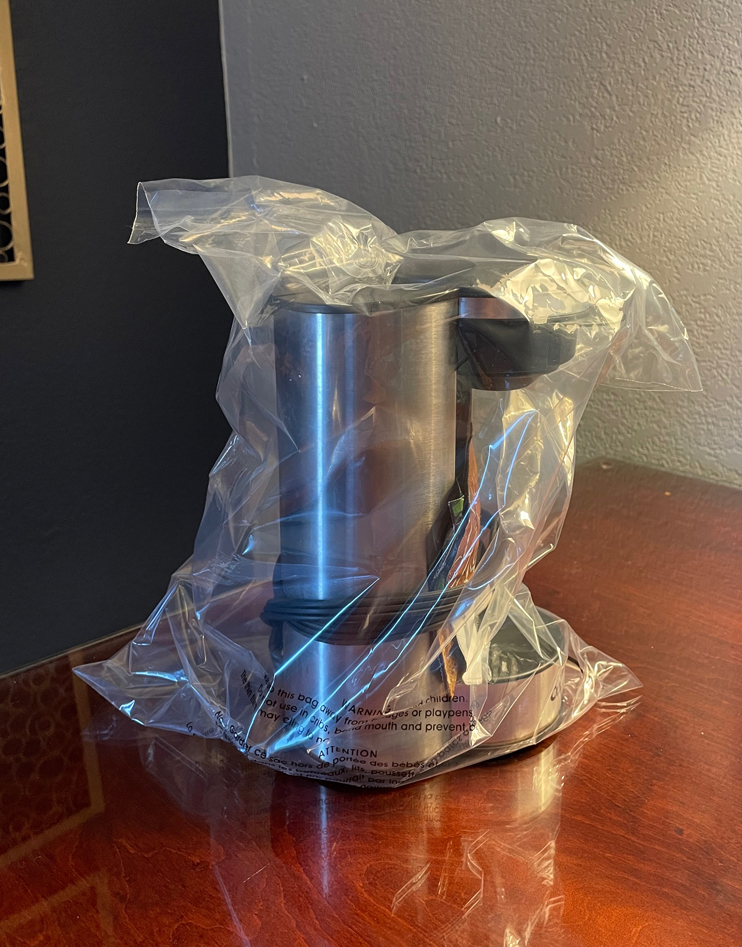
I spend a lot of time in hotels. Witnessing the various ways they’ve responded to the ongoing pandemic has been equally amusing and frustrating. The focus on cleanliness has been relentless, spawning an arms race of extreme and often bizarre measures. Although different chains have come up with different gestures, there are certain constants: the remote-control handset encased in plastic, for example, and the ubiquitous QR placard in place of a room service menu. The Gideon’s have been scooped from the drawers; pens and notepads have disappeared.
How effective these measures might be isn’t my expertise, but suffice it to say I’m skeptical. The idea, so far as I can tell, is to reduce the number of so-called “touchpoint.” In a hotel room, of all places, this feels a bit absurd. Not to mention, health organizations say that the chances of COVID spreading via surfaces are tiny.

Usually the effect is merely comical, but occasionally it’s maddening. One night in Los Angeles I was forced to drink tap water out of my hand because the room had been stripped of cups and glasses. “Yes, we’ve removed all beverage-related items,” was the response to my complaint. There’s still a bed, and a shower, and toilet for that matter. But nothing to rinse with after brushing your teeth.
In a hotel near Kennedy Airport, “per order of the governor,” according to the sign, the 24-hour continental snack buffet — a small cabinet of pastries and fruit — is now available only from 5 a.m. until 10 a.m. Did I miss something about people contracting coronavirus through donuts? If so, from this point on you can only catch it in the morning.
Cynics will wonder how much of this, misguided as it might be, is truly in the interest of safety rather than opportunistic cost-cutting. We’ll see what returns and what doesn’t. When companies start throwing around words like “streamlining” to describe their customer experience strategies, that’s a euphemism for scaling back.

Meanwhile, I’m convinced that one of the byproducts of the pandemic has been a tenfold increase in the manufacture — and subsequent discarding — of single-use plastics. Everything now is wrapped in plastic, from hotel silverware to the food on airplanes.
Have you flown in first or business class lately? On many airlines, each course of the meal service — salad, entree, dessert — comes plated in its own little polystyrene house. Indeed, each individual roll or bread slice is wrapped in cellophane. Mind you this wrapping is done by hand, which would seem to undermine the whole endeavor, but in a world drifting ever deeper into dystopian madness, never let reason stand in the way of pointlessness and waste.
The morning after that mini-fridge episode, I was passing through the crew security checkpoint at the Mexico City airport. I was subjected to repeated pat-downs and was asked to proceed twice through the body scanner. The culprit was — wait for it now — a slip of paper in my shirt pocket. A man ordered me to stand before him with my arms outstretched. He slipped on a pair of sanitary gloves, touched me lightly on the breast pocket, then took off the gloves and threw them away. Off to the side, at the x-ray belt, my colleague was having his suitcase eviscerated by two guards who’d spotted a tiny corkscrew inside — the kind that attaches to a keychain.
Am I the only one who sees the parallels here? Am I the only one getting nervous? We are all familiar with the phrase “security theater.” Will “virus theater” be next?
Twenty years after the attacks of 9/11 and we’re still confiscating pointy objects from pilots, wasting billions of dollars and immeasurable amounts of time on security protocols that nobody can justify or explain. And it’s doubtful they will ever go away. Once such things become policy, with entire bureaucracies constructed to support them, they are often impossible to march back. The traveling public simply gets used to them.
Although the COVID crisis will not last forever, don’t be surprised if aspects of it — even, or especially, the silliest and most illogical ones — are still with us for years to come.

PHOTOS BY THE AUTHOR.
A Night at the TWA Hotel
January 24, 2021
THANKS TO SOME terrific rates offered to airline workers in these times of low occupancy, I’ve been staying regularly at the TWA Hotel at New York’s Kennedy Airport. It’s become my go-to layover when I’ve got an early-morning sign-in or a night to kill between trips.
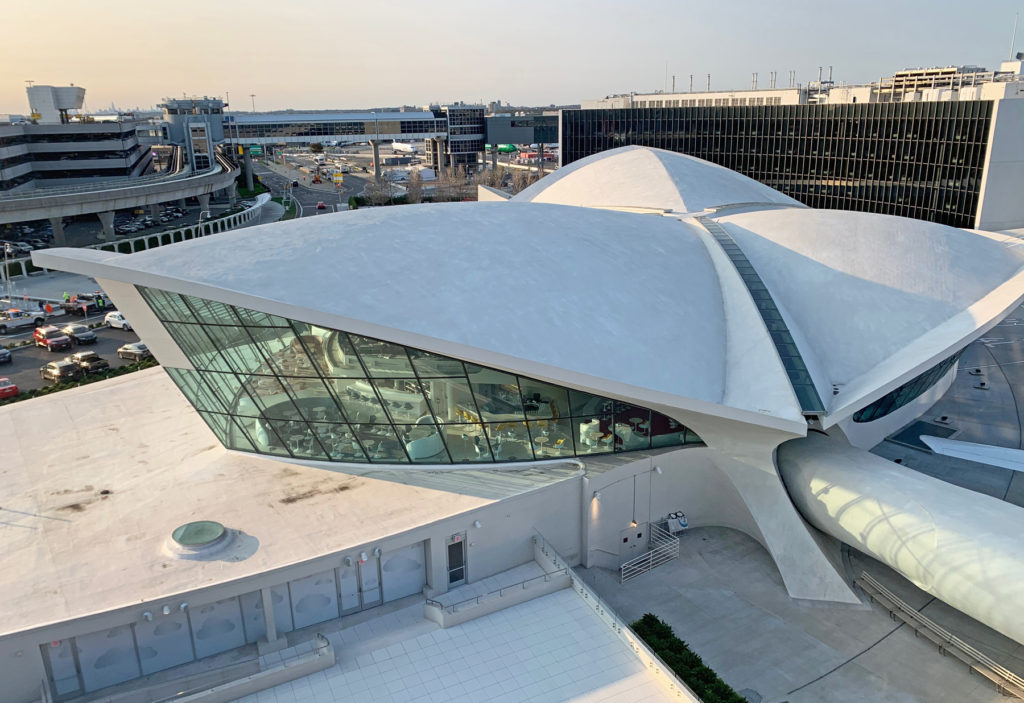
The 512-room property, set between terminals 4 and 5, incorporates the famous “Flight Center” — Eero Saarinen’s swooping, soaring, masterpiece TWA terminal completed in 1962. The most architecturally significant airport terminal ever built, the Flight Center was also the first one designed expressly for jet airliners. After the takeover of TWA by American Airlines in 2001, its fate was bounced around between preservationists and Port Authority bureaucrats, its survival in doubt until it was saved from the wrecking ball thanks mainly to the efforts of New York City’s Municipal Arts Society. The initial plan was for the terminal to serve as a lobby and ticketing plaza for JetBlue, whose Terminal 5 sits directly behind it. This fell through, however, and the terminal sat in a state of semi-dereliction until the hotel plan came together.
When it opened in 2017, the travel blogs went giddy, binging on terms like “retro,” and “throwback,” with the obligatory references to “Mad Men” and so forth. This made me nervous. Aware that such endeavors have a tendency to go aesthetically awry, I was worried the renovators had spoiled the place.
I’m happy to report this is not the case. They understood what made the terminal special, and have kept it that way. The building’s beauty rests in its continuity. “All one thing,” is how Saarinen, a Finn whose other projects included the Gateway Arch in St. Louis and the terminal at Washington-Dulles, once said of it. It’s a fluid, unified sculpture of a space, at once futuristic and organic; a carved-out atrium reminiscent of the caves of Turkish Cappadocia, overhung by three cantilevered ceilings that rise from a central spine like huge wings. And, bless their hearts, they’ve left it alone. It speaks for itself, free of any architectural gimmickry.
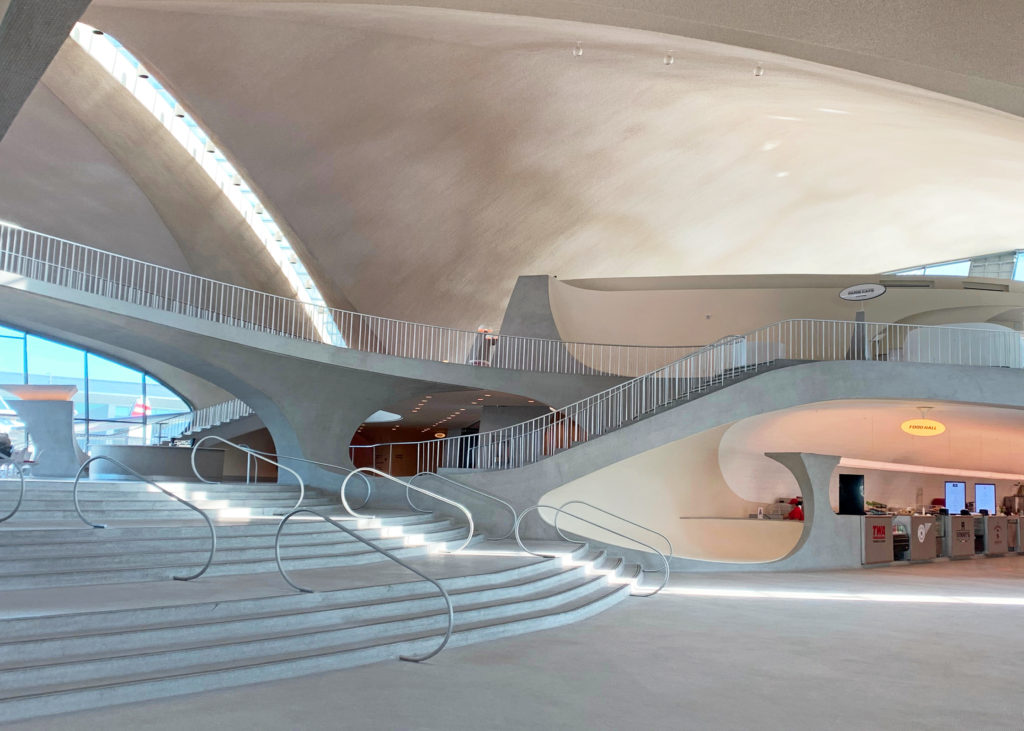
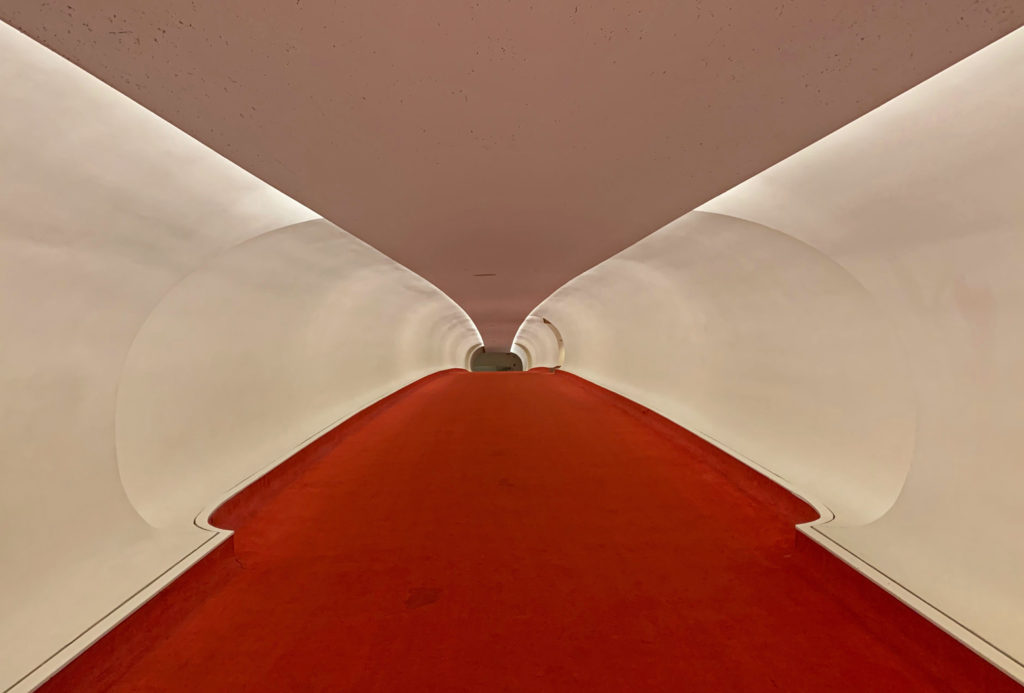
The hotel is not exactly “inside” the terminal, as some have stated. The Flight Center is too small a structure for that. It’s merely the check-in lobby and central atrium. Which, essentially, is what it’s always been. Now, however, the two long pedestrian tunnels, through which passengers once walked to the boarding gates, connect instead to a pair of multi-story hotel blocks. Along the lobby’s left side, at the long counter where in 1962 you would have received your boarding pass for Rome or Paris or Athens, guests pick up their keys and head to rooms in either the “Saarinen” or “Hughes” wing — the latter in honor of Howard Hughes, who controlled TWA from 1939 until the 1960s. Along the right side is a 24-hour bistro for pizza and panini, and, on the floor above, a very expensive sit-down place called the Paris Cafe. On the rooftop level of the Hughes wing is an all-season infinity pool overlooking the runways — it’s small, but the view makes up for it. In the warmer months, a bar with open-air tables serves drinks and sandwiches.
Out back, photographed and Instagrammed no fewer than eighty billion times, is a brilliantly restored Lockheed Constellation, wings and all, with an onboard cocktail bar. Few people would notice or care, but in fact this is a touch anachronistic: the Connie was a propeller-driven plane and mostly obsolete by the early 60s. A 707 would have been better. But we shouldn’t quibble. It’s a beautiful installation and it does the job it’s supposed to, taking us back to another age and time — even if not quite the correct one.
Mixed in with all of this are several displays featuring 60s-era ephemera, period photographs, vintage TWA uniforms and so forth. Indeed the entire place has the feel of a museum, which I suppose it is.
On the negative side, the front desk is understaffed, with check-in times often hitting twenty minutes or more. The tilework is grubby and could use a power wash, and, for some confounding reason there’s no luggage ramp between the upper and lower levels of the lobby. The levels are staggered only slightly, but guests have no choice but to carry their bags up and down the stairs.
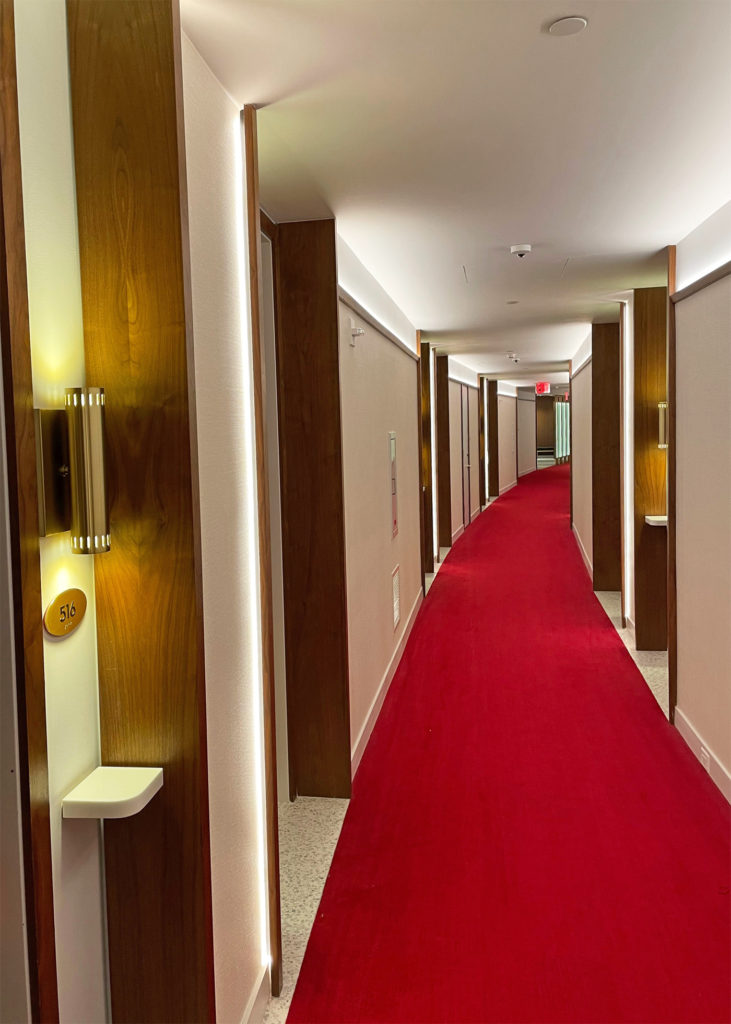
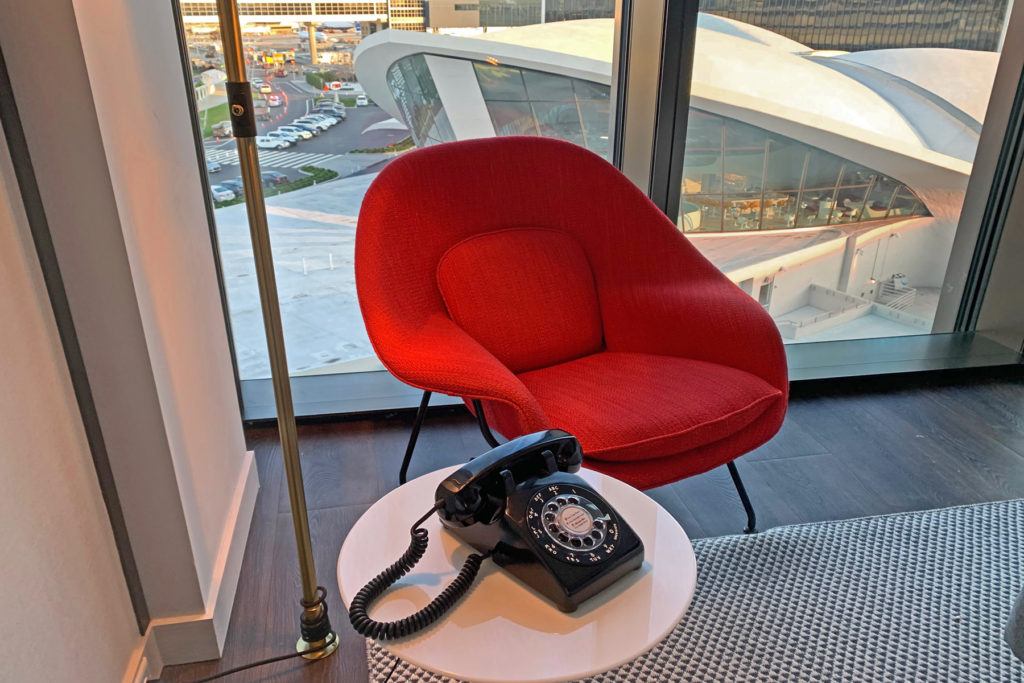
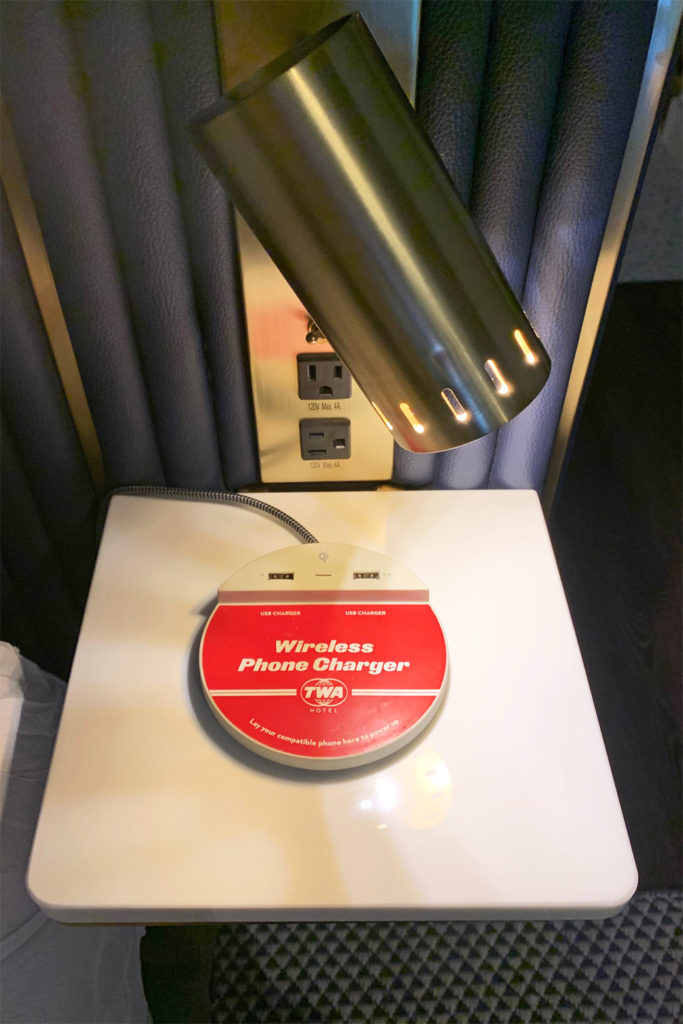
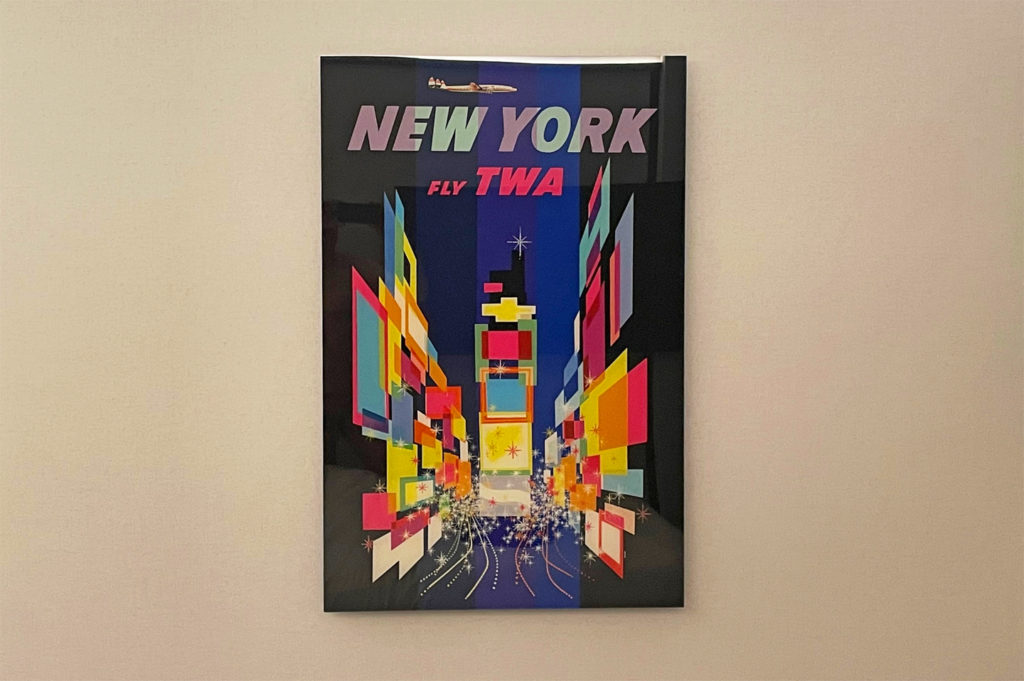
The rooms themselves have the same time capsule vibe, outfitted with Saarinen-designed furniture and other period touches. Things wobble just a bit along the fine line between nostalgia and kitsch — the martini glasses and the Western Electric rotary phones — but the feel overall is elegant and smart. The travel posters are wonderful, and I love the cordless phone chargers (every hotel needs these).
What’s sorely lacking, however, is some counter and closet space. The standard rooms have barely enough space for a roll-aboard bag, and no closet whatsoever. The four-point peg-and-hanger contraption in the alcove is useless; I was forced to hang my coat and shirt over the floor lamp. There’s plenty of open wall that could be outfitted with additional hangers or storage nooks, making the lack of them all the more frustrating.
The bathrooms, on the other hand, are oddly enormous, with wide vanities and walk-in showers that could fit an entire 747 crew. Why they opted for oversized bathrooms while skimping on the rest I’ll never understand. Above the mini-fridge is an equally wasteful serving ensemble with two each of martini and champagne glasses, the point of which, other than to use up precious square footage, escapes me. Here, the hotel becomes a little too full of itself, sacrificing practicality in order to make some pretentious aesthetic statement.
There’s also a peculiar “no wake-up calls” policy. People have flights to catch, do they not? And if you’re like me, a backup to your mobile phone alarm is important.
All criticism aside, there’s that phrase: I love what they’ve done with the place.
In 1996, Saarinen’s building was still a functioning airline terminal. As a young pilot for TWA Express, I was one of the employees who worked there. Into its fourth decade and home to a financially struggling carrier, it was neglected and forlorn. I remember sitting in the space now occupied by the Paris Cafe, eating shitty cafeteria food while clutches of sparrows swooped from the yellowed overhangs to snatch up crumbs. The red-carpeted tunnel that now leads to the Hughes wing once took me to the TWA Express operations room, where five-gallon buckets were spaced along the floor to collect rainwater that dripped from holes in the ceiling.
To see it today is heartening. It almost feels miraculous. Watching people mill around the lobby — businesspeople, a family of four, a Singapore Airlines crew taking selfies — I wonder how many of them have an idea what this place even is, or was. I imagine to most folks, not being airport buffs or historians, it’s just a cool hotel with a funky old lobby.
For it have become a trendy hotel — rather than a museum, or even a working terminal again — is maybe not the ideal outcome, but it’s a welcome alternative to demolition — as befell two other iconic JFK structures: I.M. Pei’s National Airlines “Sundrome,” which was cleared away so that jetBlue could expand its hideous Terminal 5, and the former Pan Am “Worldport,” a.k.a Terminal 3, torn down in 2013. The Flight Center narrowly escaped a similar fate. Fortunately it lives on, a place both old and new, restored with commitment and care.
Not every iconic airport building deserves to stay standing forever — Terminal 3 for example, was beyond rehabilitation and overdue for the wrecking ball. What I wish, though, if we’re not preserving these structures, is that we put a little more imagination and vision into the ones that take their place.
In this regard, JFK sets a best and worst example. It kept Saarninen standing, but has otherwise has lost most of its character through a long series of tear-downs and replacements. Worst of the new terminals is without a doubt JetBlue’s aforementioned, wildly overrated Terminal 5. Let’s dip into my book for a description …
“‘T5’ as the carrier likes to call it — is a $743 million, 72-acre structure that opened in 2008 to considerable promotion and fanfare. Inside, the fast-food outlets and shops conspire to make yet another airport look and feel like yet another mall. But it’s T5’s exterior that’s the real tragedy. Although the street-side facade is at worst cheerless, the tarmac-side is truly abominable — a wide, low-slung, industrial-brutalist expanse of concrete. Once again it looks like a shopping mall. To be more specific, it looks like the back of a shopping mall. All that’s missing are some pallets and dumpsters. The facility’s only visual statement is one of not caring, a presentation of architectural nothingness, absolutely empty of inspiration — precisely what an airport terminal should not be. Is this the best we can do?”
T5 sits directly between Saarinen and the spot where Pei’s Sundrome stood. There’s something troublingly ironic about that.
Related Stories:
Long Live the Airport Marquee
Harkening to an earlier age.
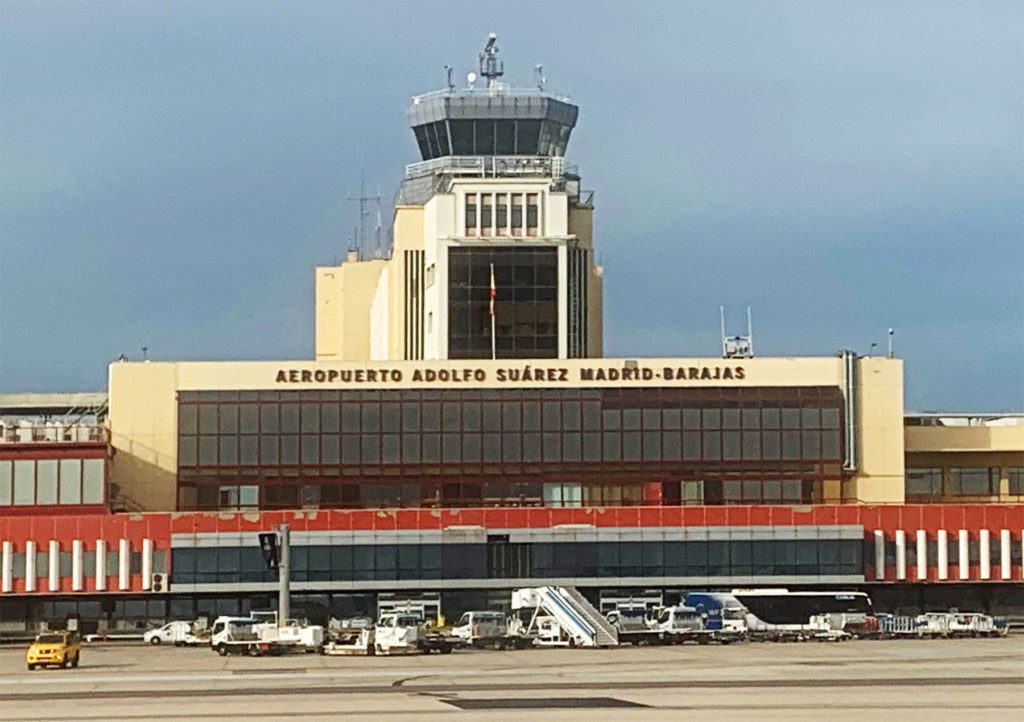
I WAS IN Madrid the other day and was able to snap the photograph above. This is the old Terminal 2, built in 1954, when the field was known as Barajas Airport. Like many old airport buildings, it instantly evokes another time, another era. I can easily picture an Iberia DC-8, or maybe a Caravelle, parked below the control tower, passengers in hats and suits climbing a set of drive-up stairs.
What I love best, though, is the airport name up on the facade. This was a common flourish in decades past, a nod to the platform signs often seen at railroad stations. The purpose, in this case, isn’t for orientation; obviously the airline passenger knows what city he or she has arrived in. That’s not the point. Rather, it’s a matter of greeting. The thrill of air travel isn’t so much the journey as it is the destination, and like the title frame in the opening credits of a film, this is a way of welcoming the visitor with a bit of drama and flair.
And I’m happy to report that location signs still exist, even at some of the newest and most modern terminals. You’ll find them on the apron side, facing the runways, or on the roadway side where passengers enter and exit the terminal. The latter are perhaps more common — the enormous lettering atop the departure hall at Bangkok’s Suvarnabhumi Airport being the most dramatic example. But it’s the apron-side marquees that I like the best, the ones glimpsed from the airplane window, adding a touch of excitement as you prepare to disembark.
I always get a picture when I can. Most of my collection is posted below. Reader submissions are welcome, and I’ll add the best of them to the page.
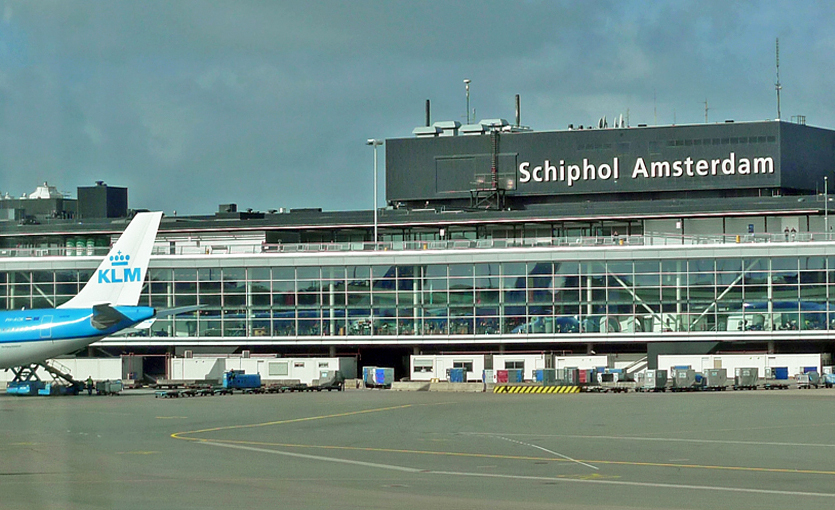
Welcome to Amsterdam.
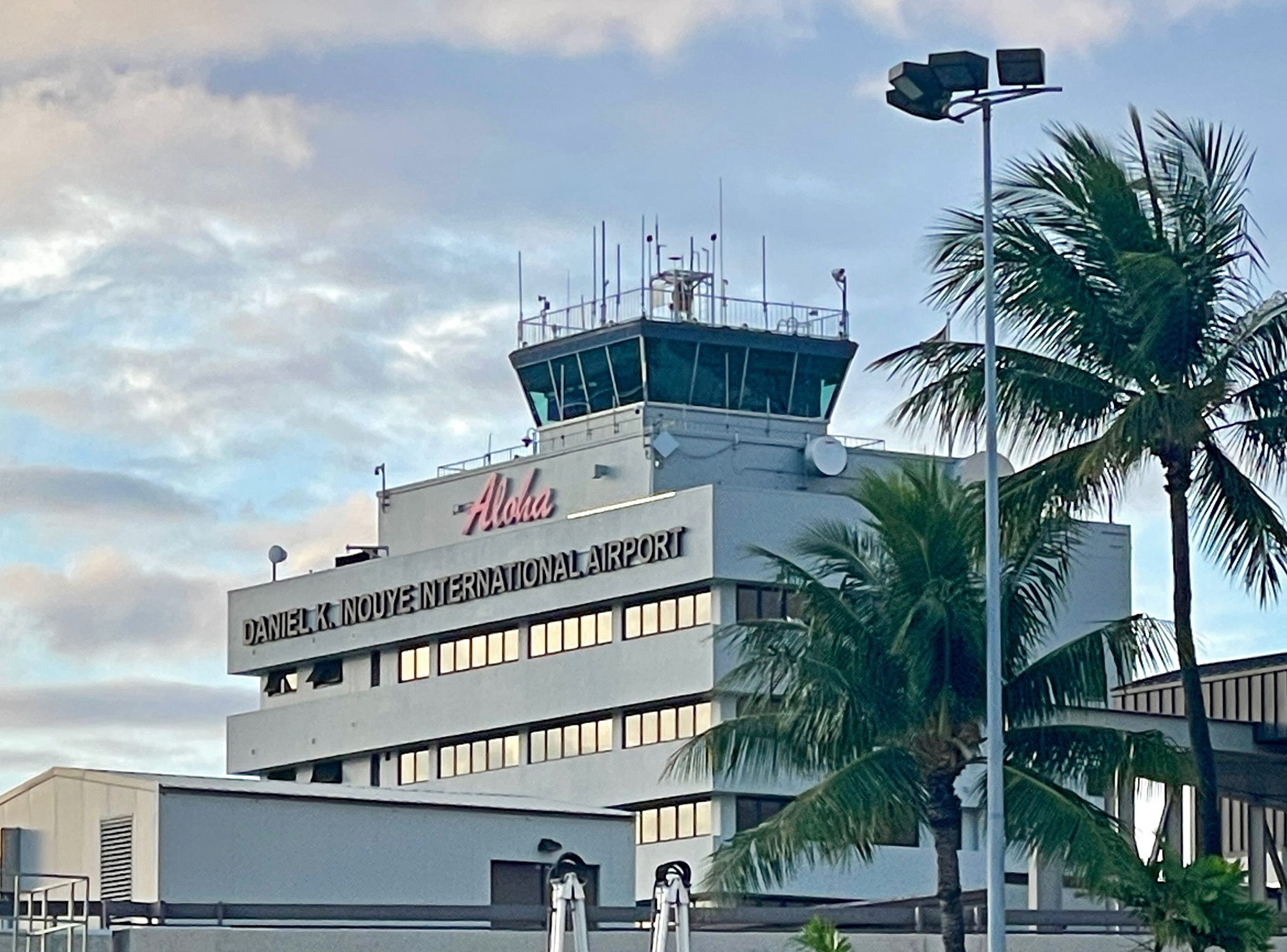
Aloha, Honolulu
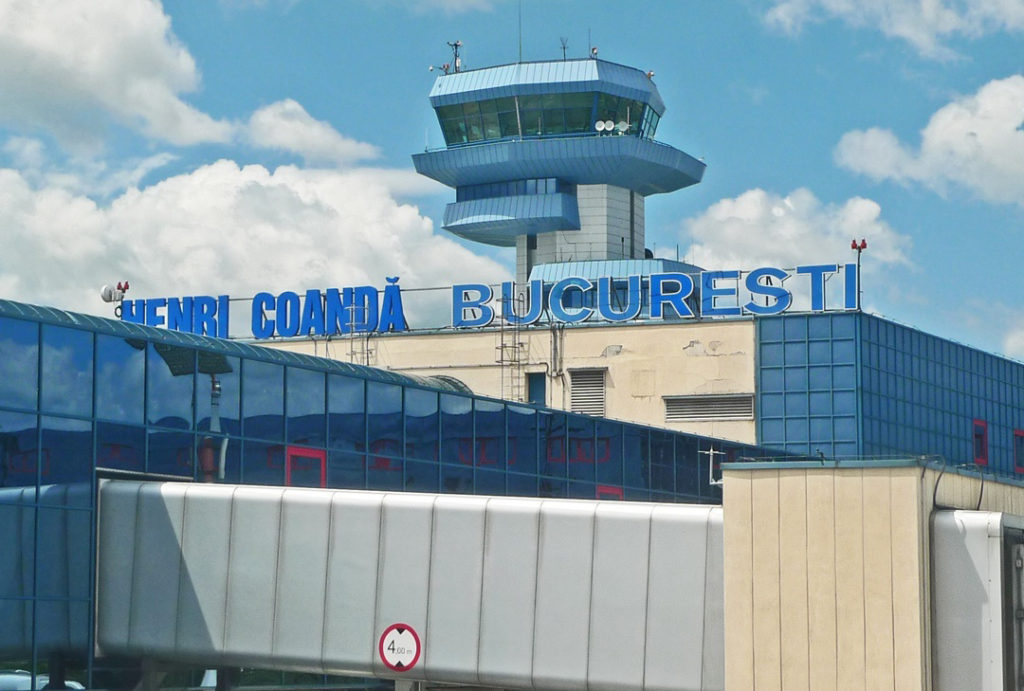
Bucharest’s Henri Coanda – Otopeni Airport.
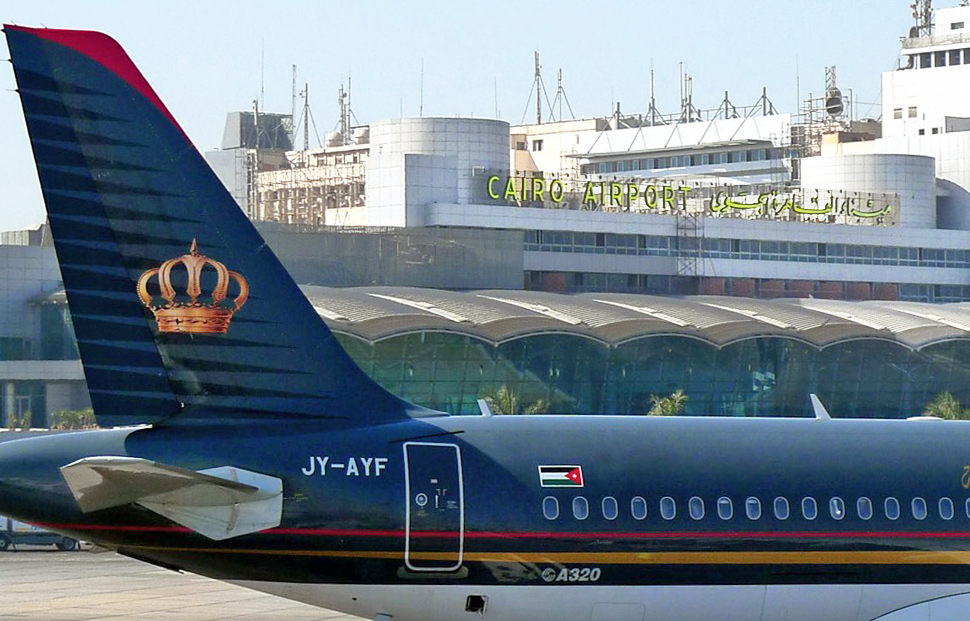
A Royal Jordanian A320 at Cairo International.
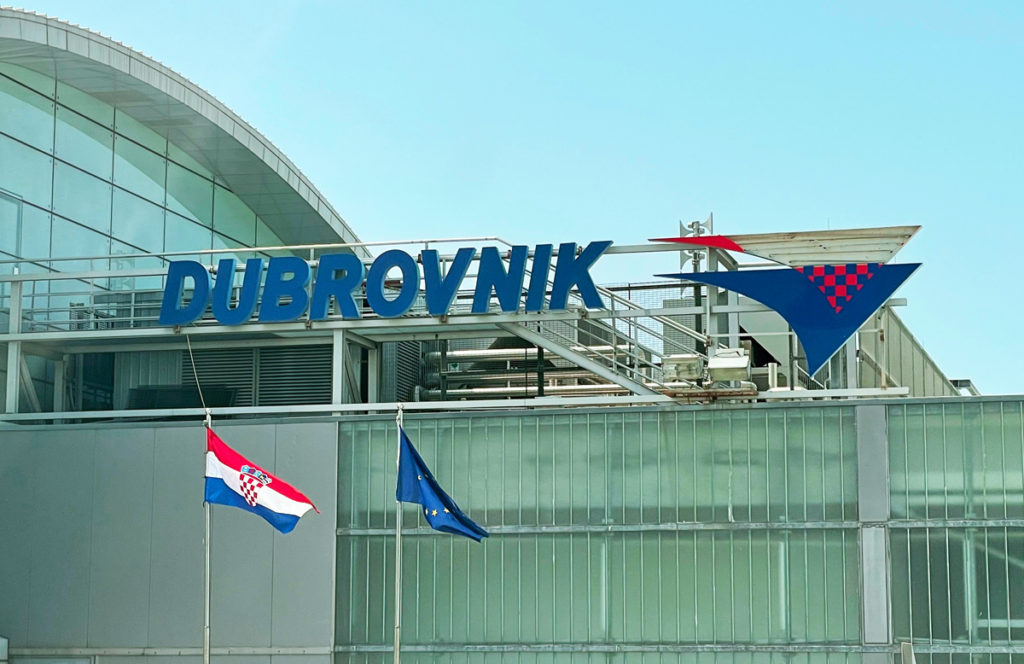
Dubrovnik, Croatia.
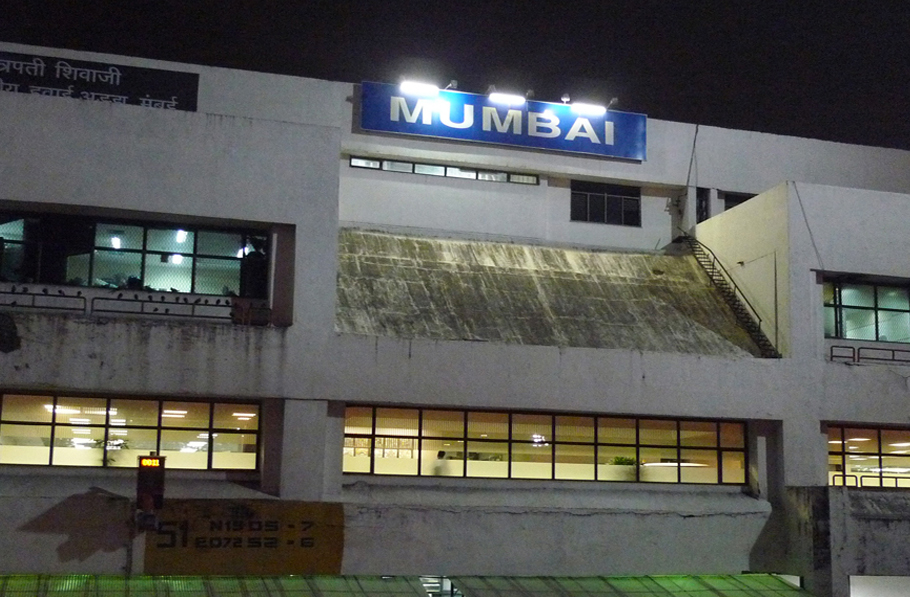
The old terminal at BOM was replaced in 2014.
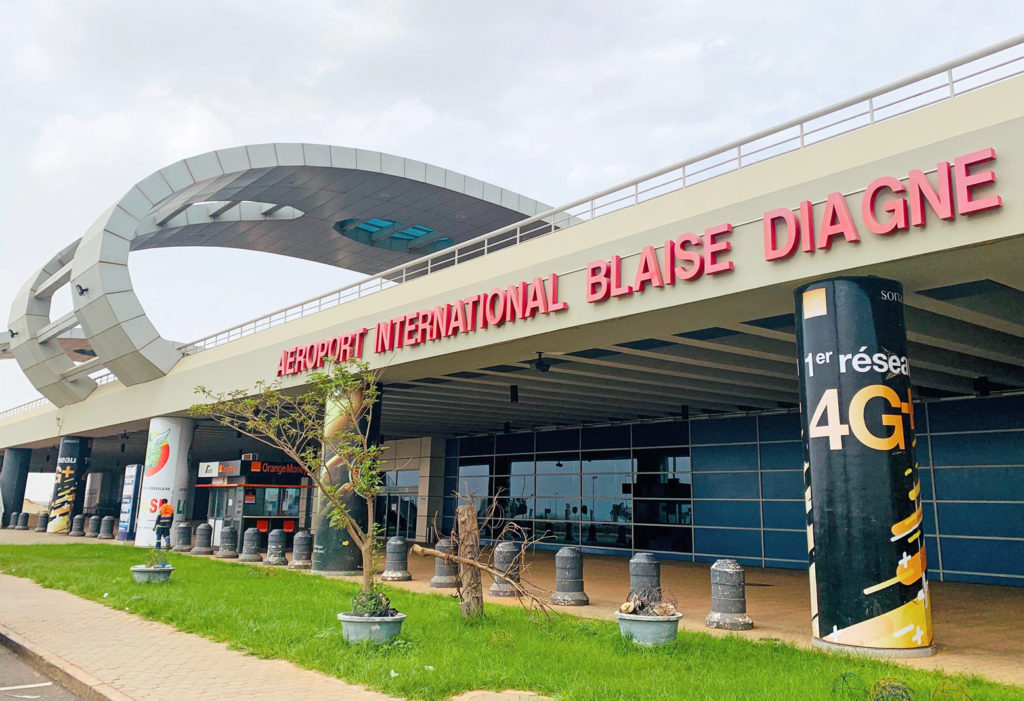
Dakar’s newly opened Blaise Diagne International.
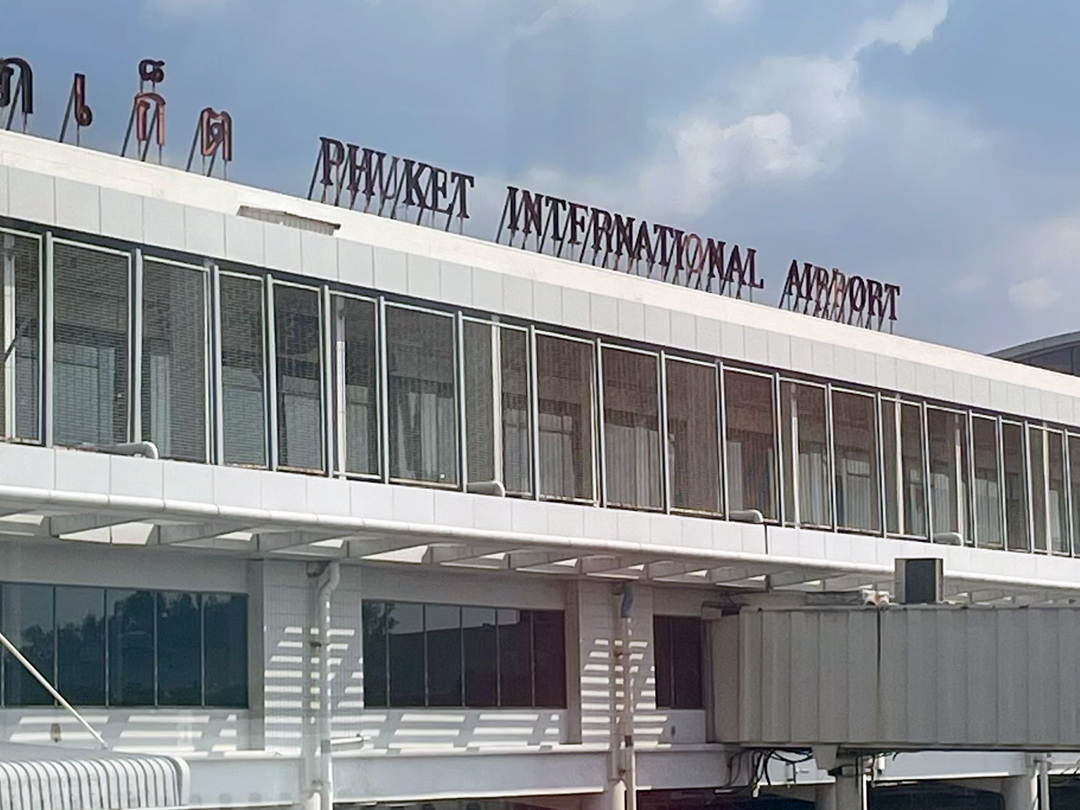
Phuket, Thailand.
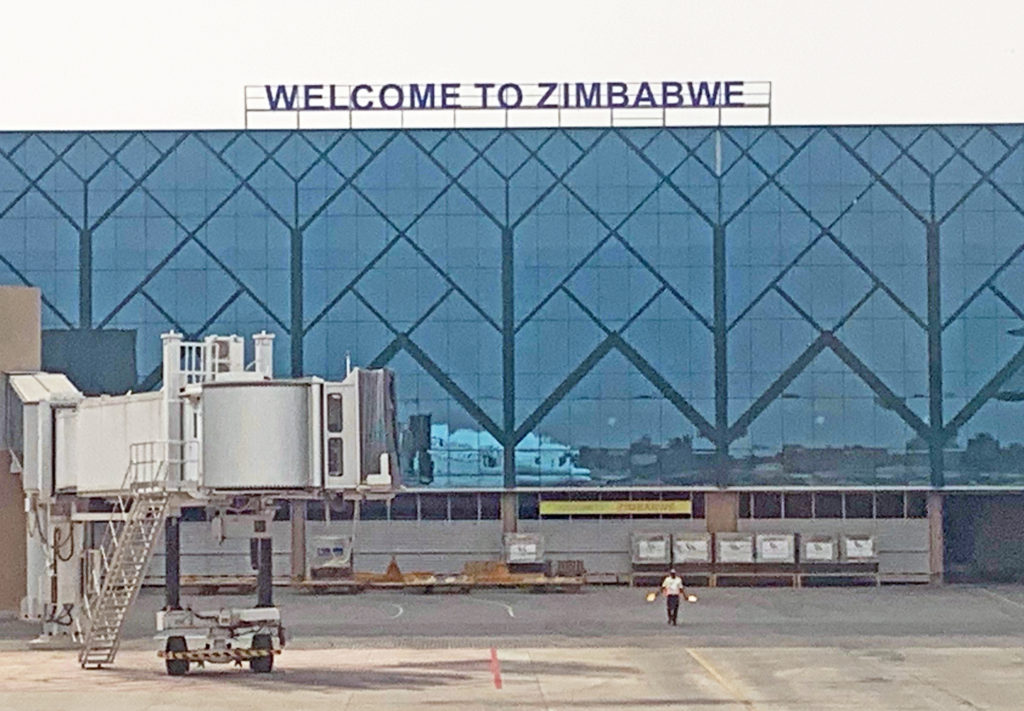
Victoria Falls, Zimbabwe.
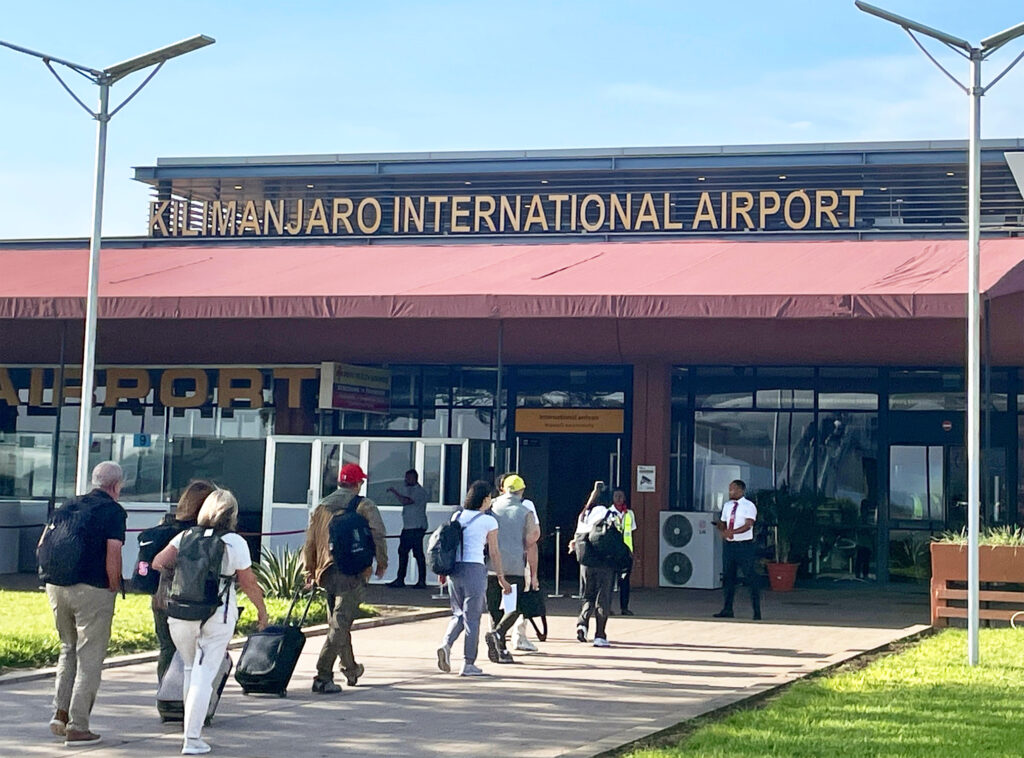
JRO airport, Tanzania.

“Town of the hurdled ford.”
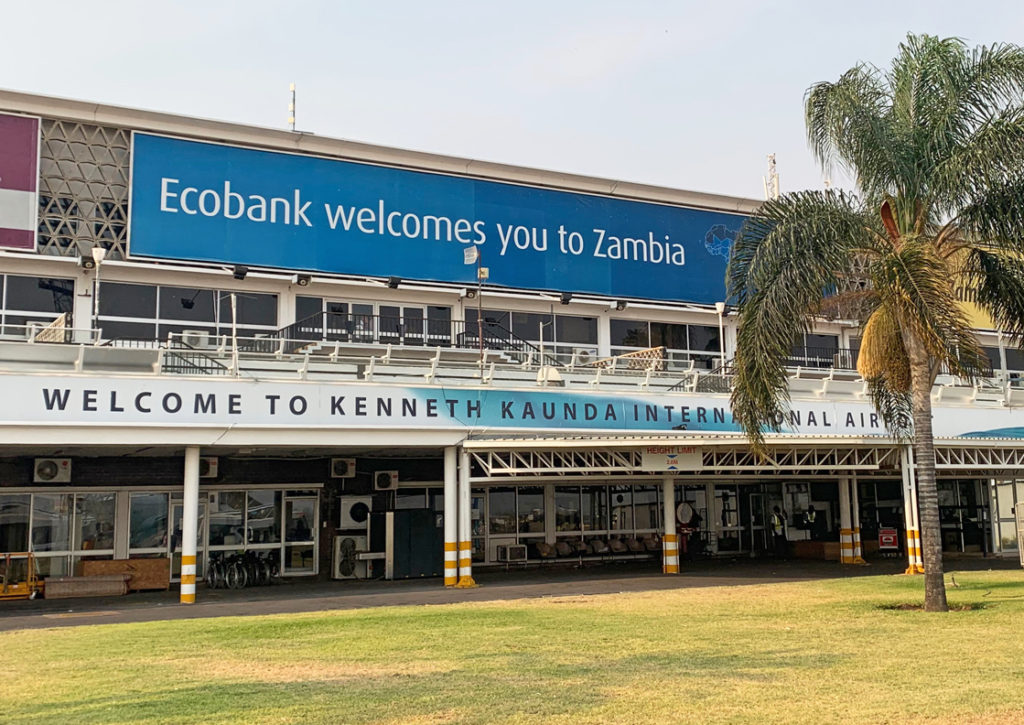
Kenneth Kaunda International, in Lusaka, Zambia.
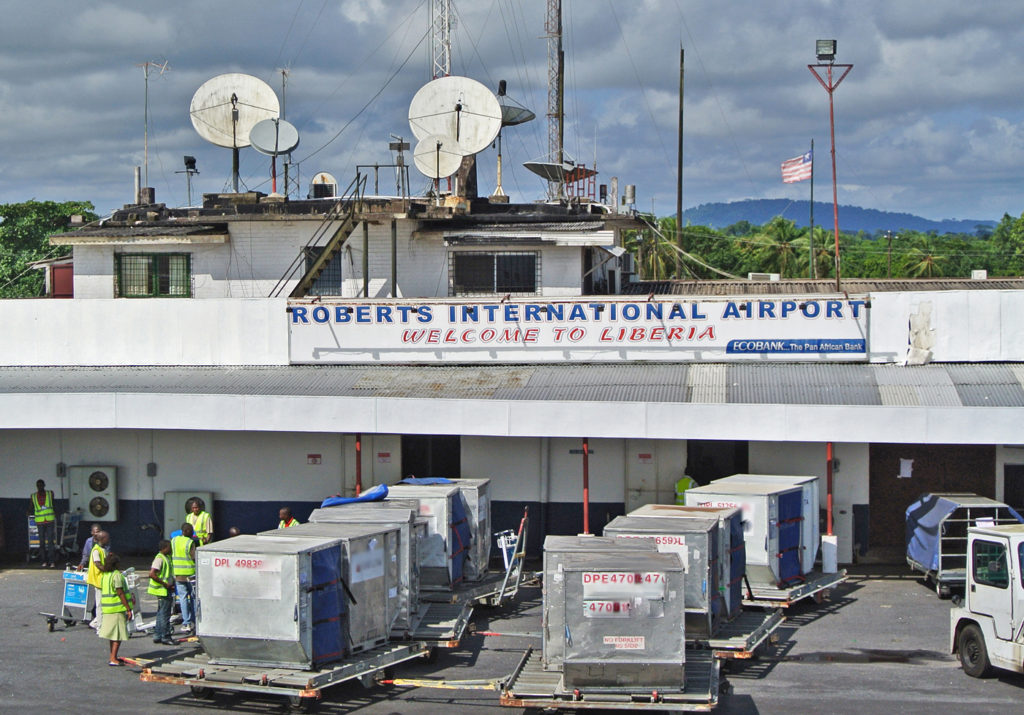
A down-home effort at Roberts Field, Liberia.
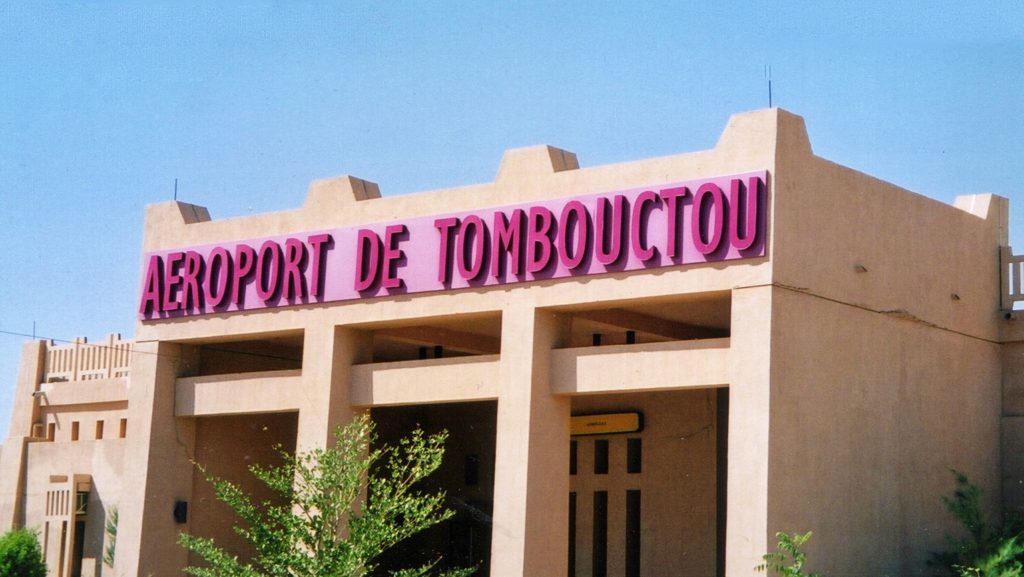
The Sudanese-style main building at Timbuktu, Mali.
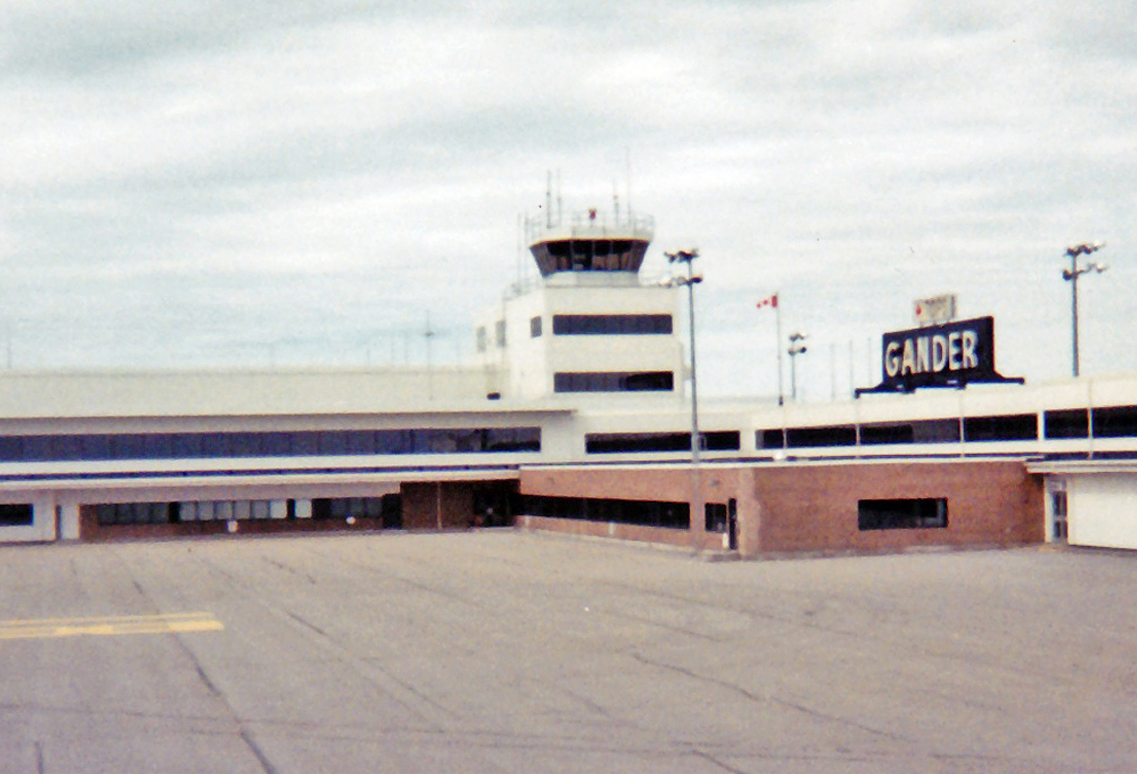
Once a bustling stopover point, Gander sits empty.
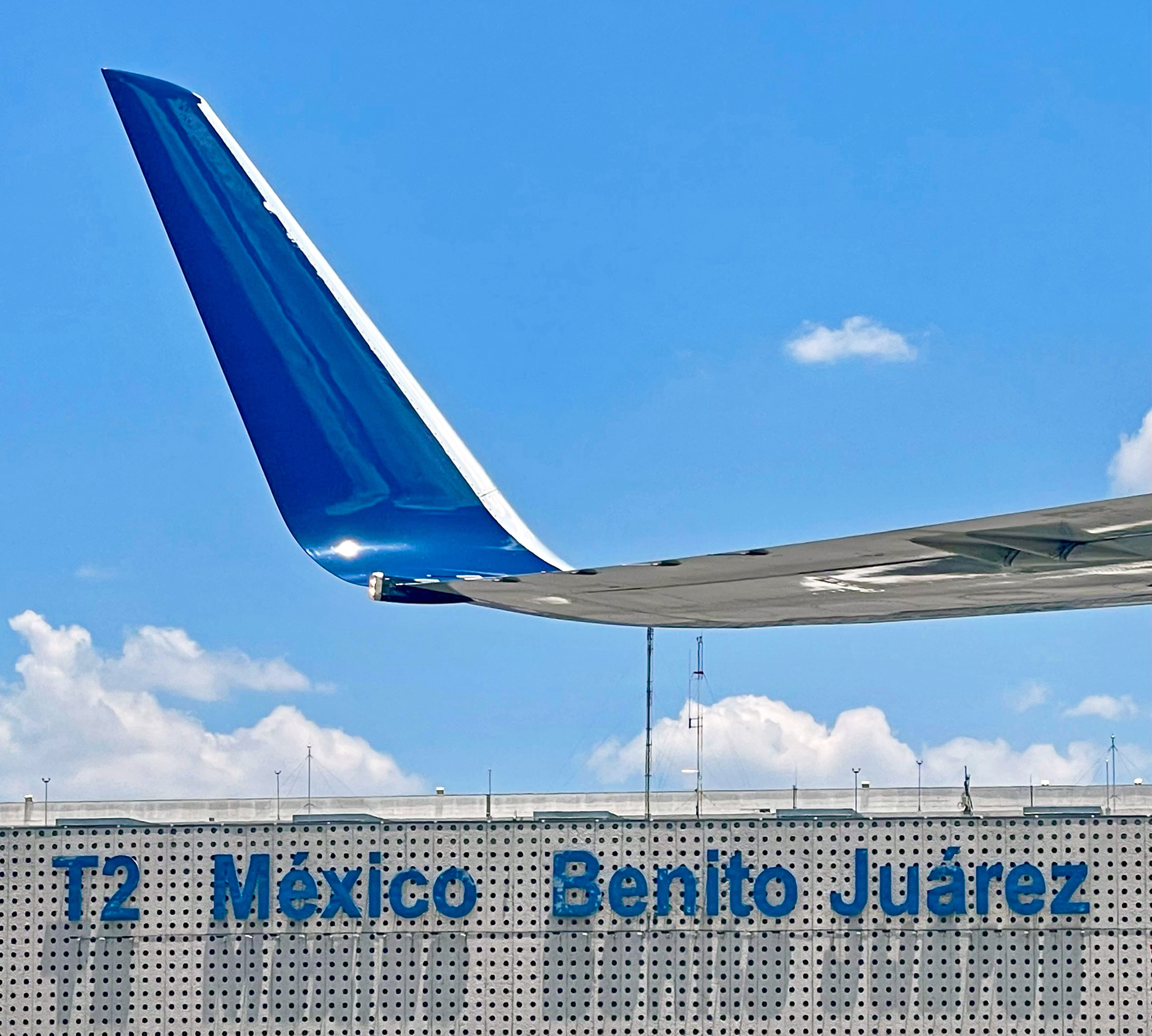
Mexico City’s terminal 2.
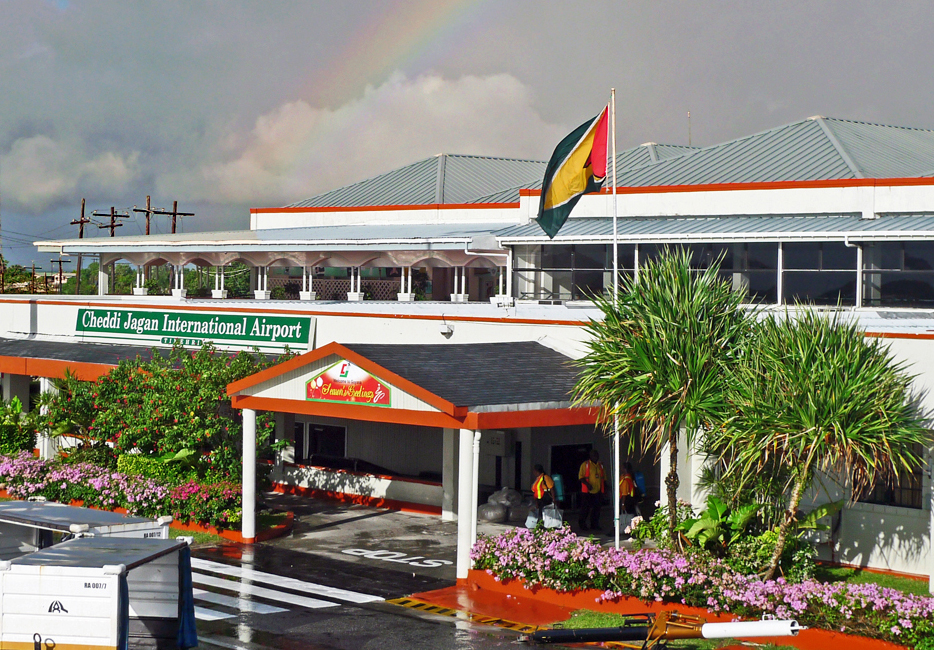
The colorful Cheddi Jagan airport in Guyana.
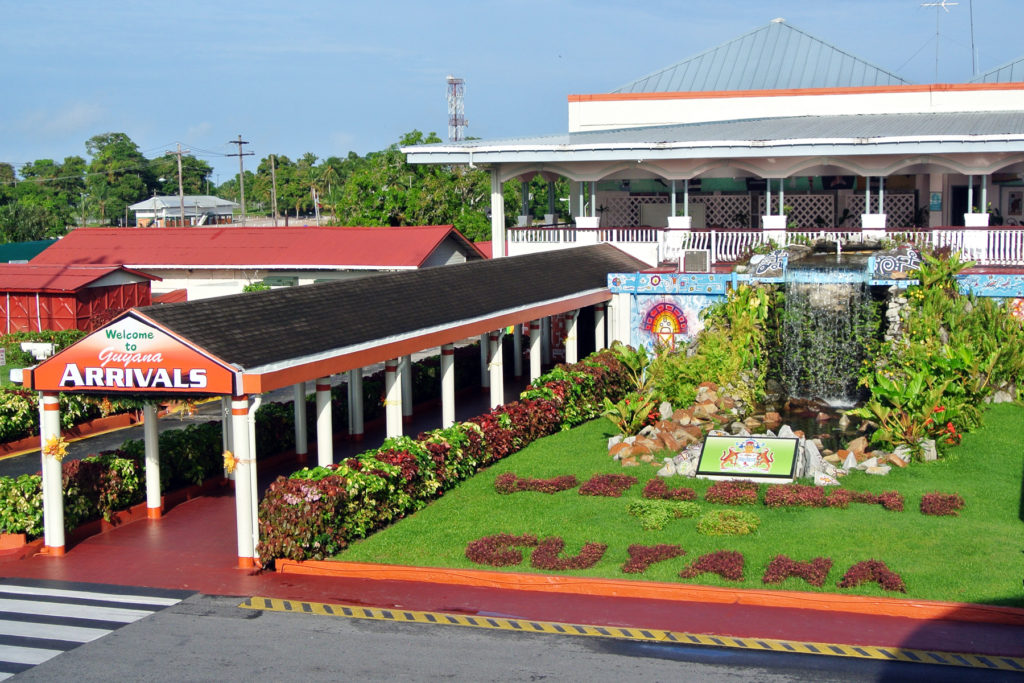
Another shot from Cheddi Jagan. Notice the topiary.
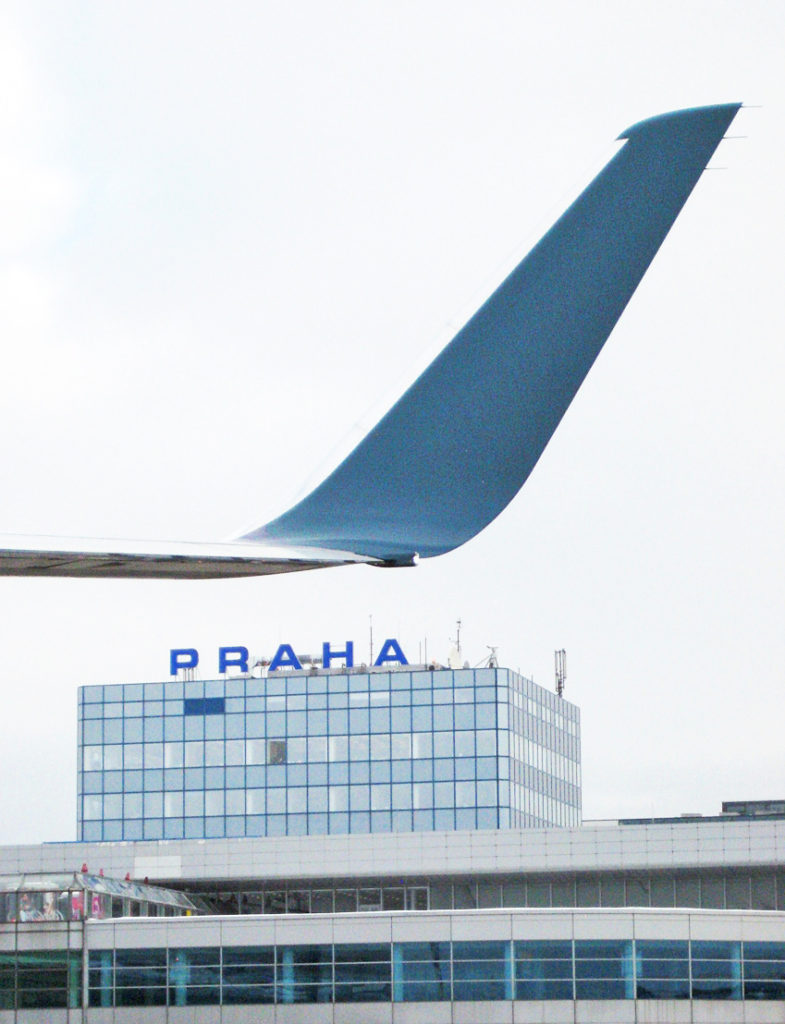
Under the wing at Prague’s Vaclav Havel International.
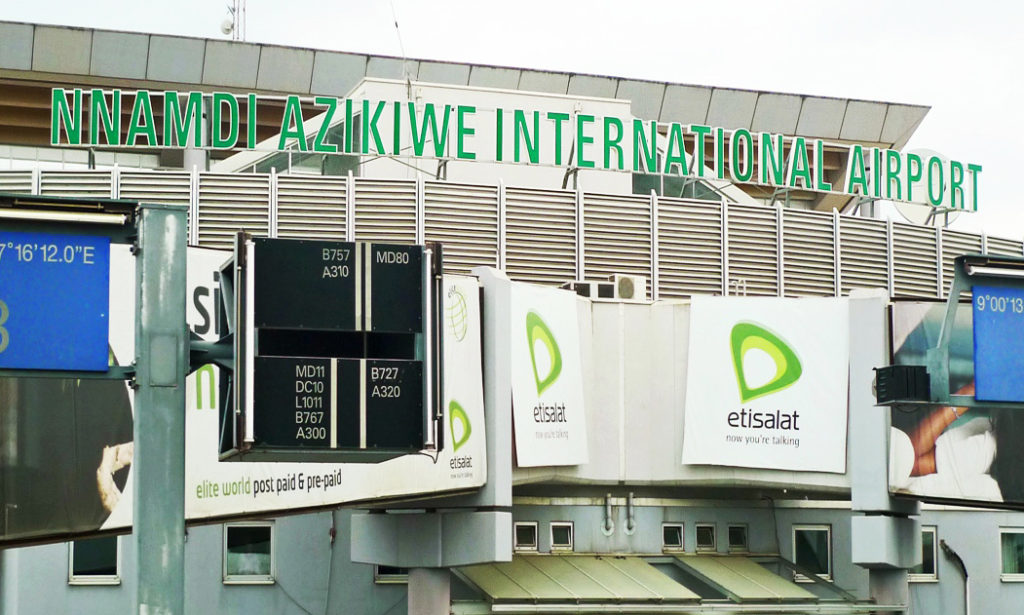
Nnamdi Azikiwe is the airport serving Abuja, Nigeria.
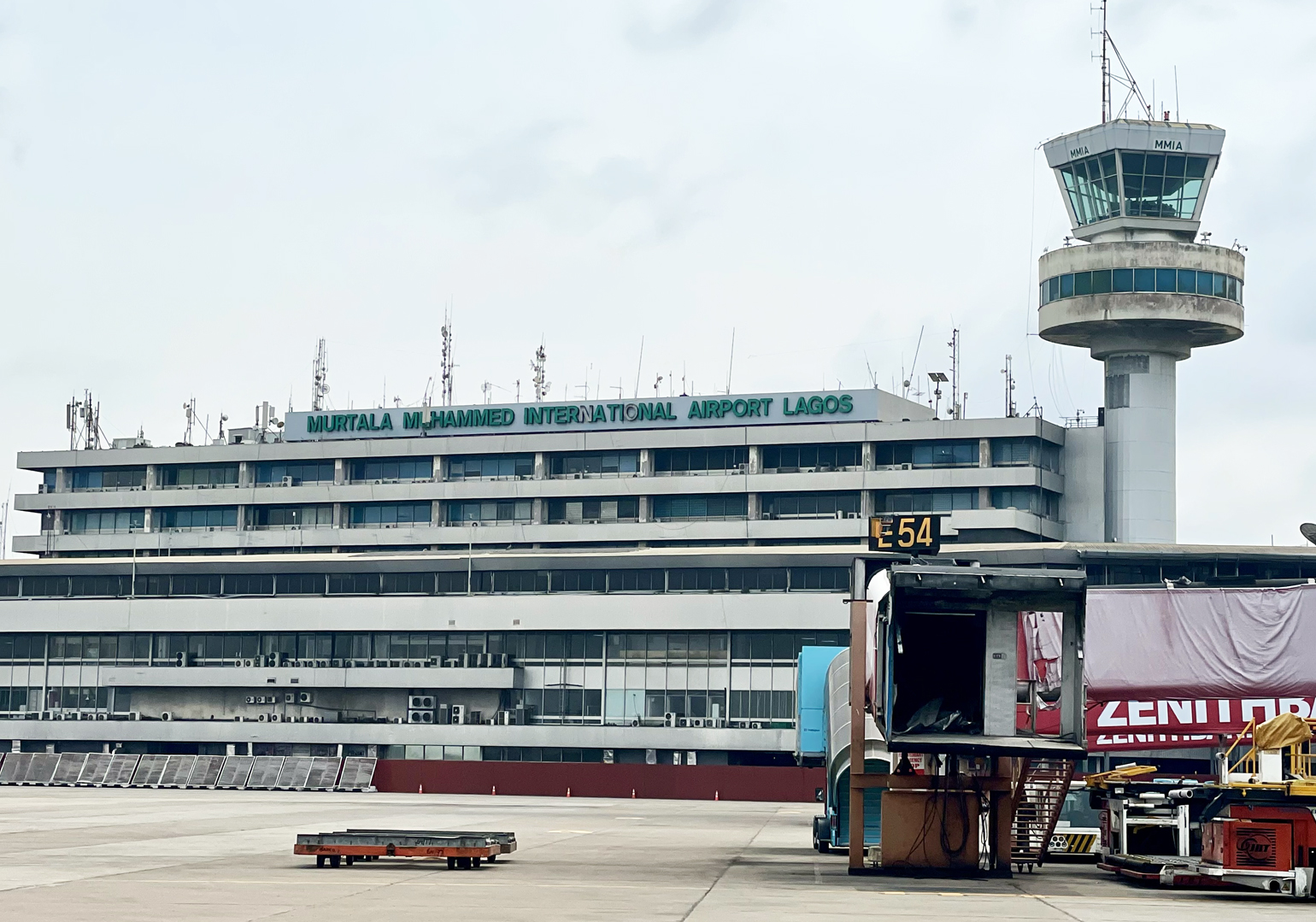
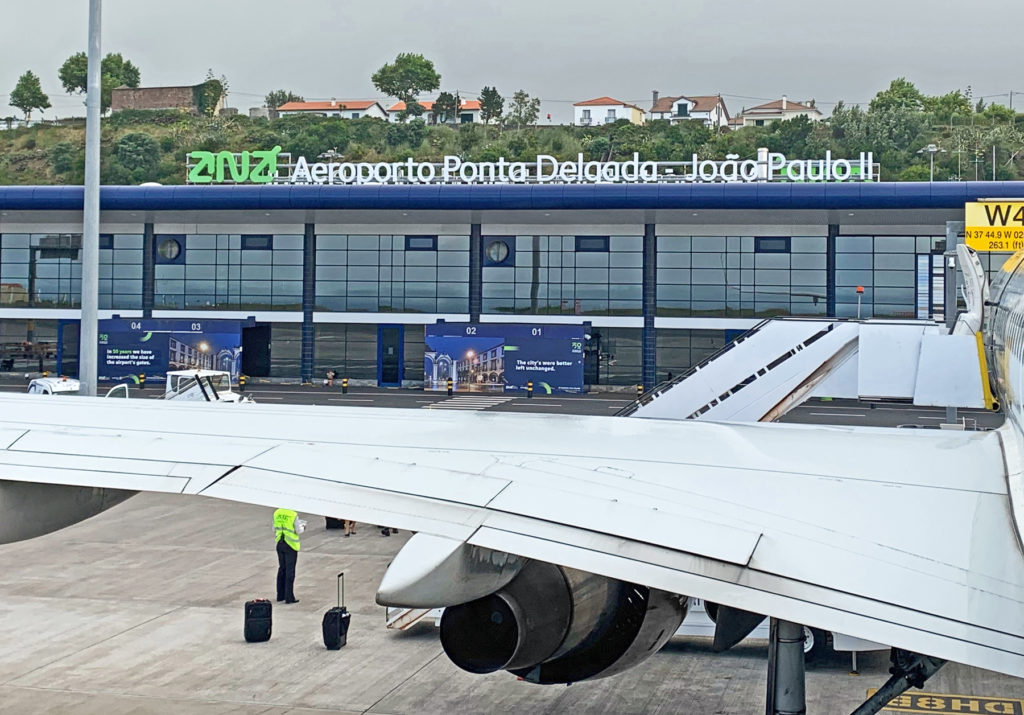
John Paul II Airport in Ponta Delgada, Azores.
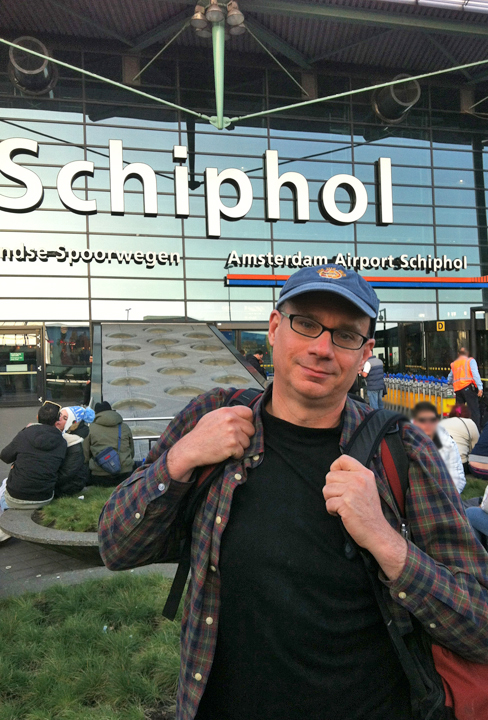
Your favorite pilot at Amsterdam-Schiphol.
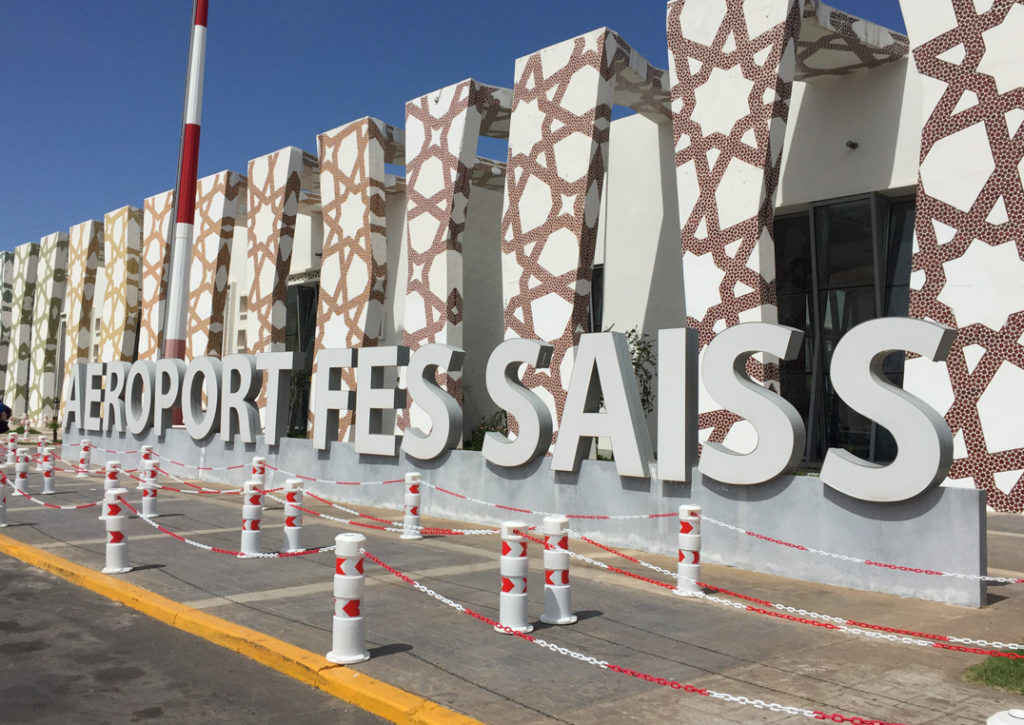
Fes (Fez), Morocco. From Daniel Foster.
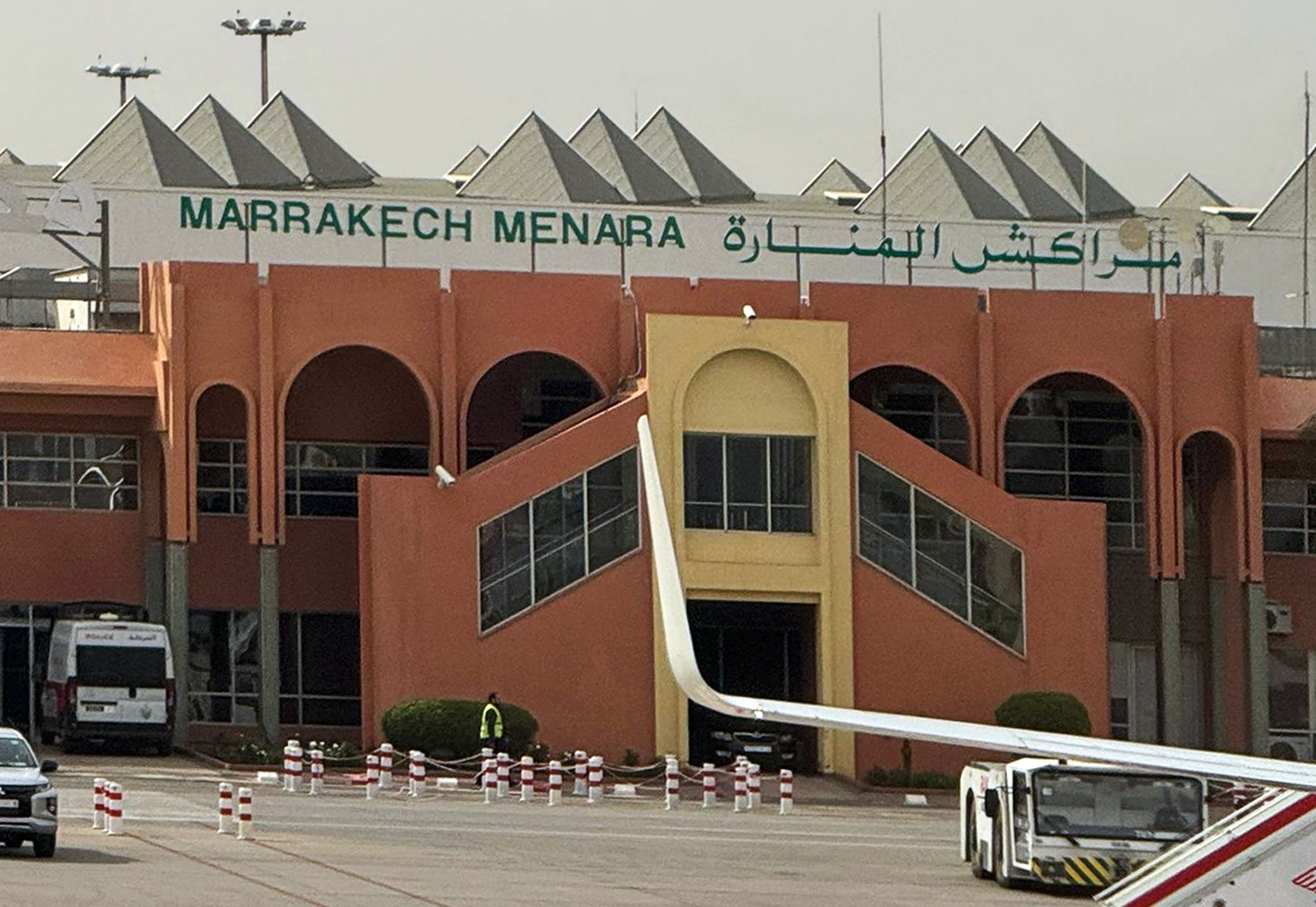
Marrakech, Morocco. From Itamar Reuven.
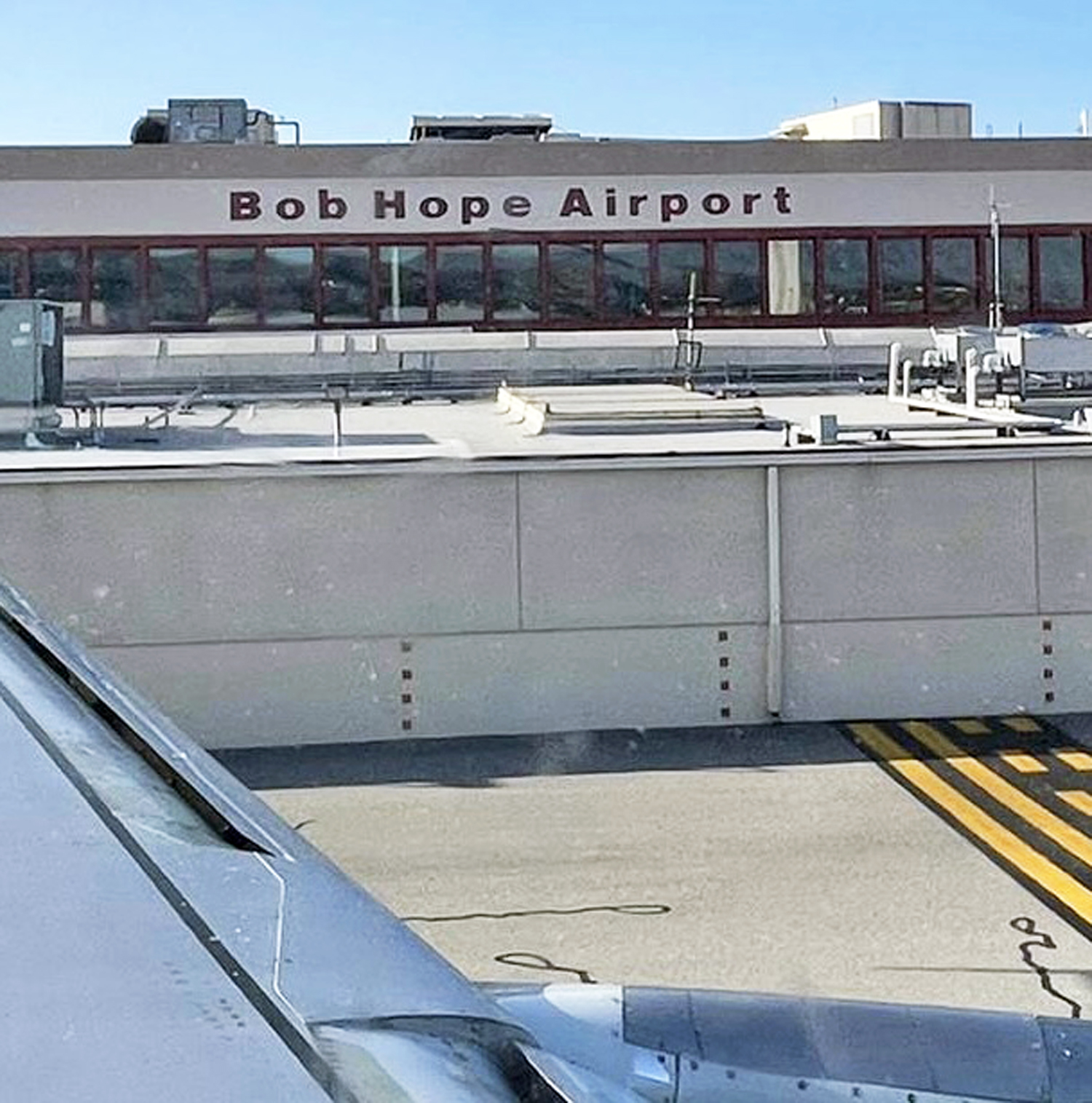
Burbank, California. From Itamar Reuven.
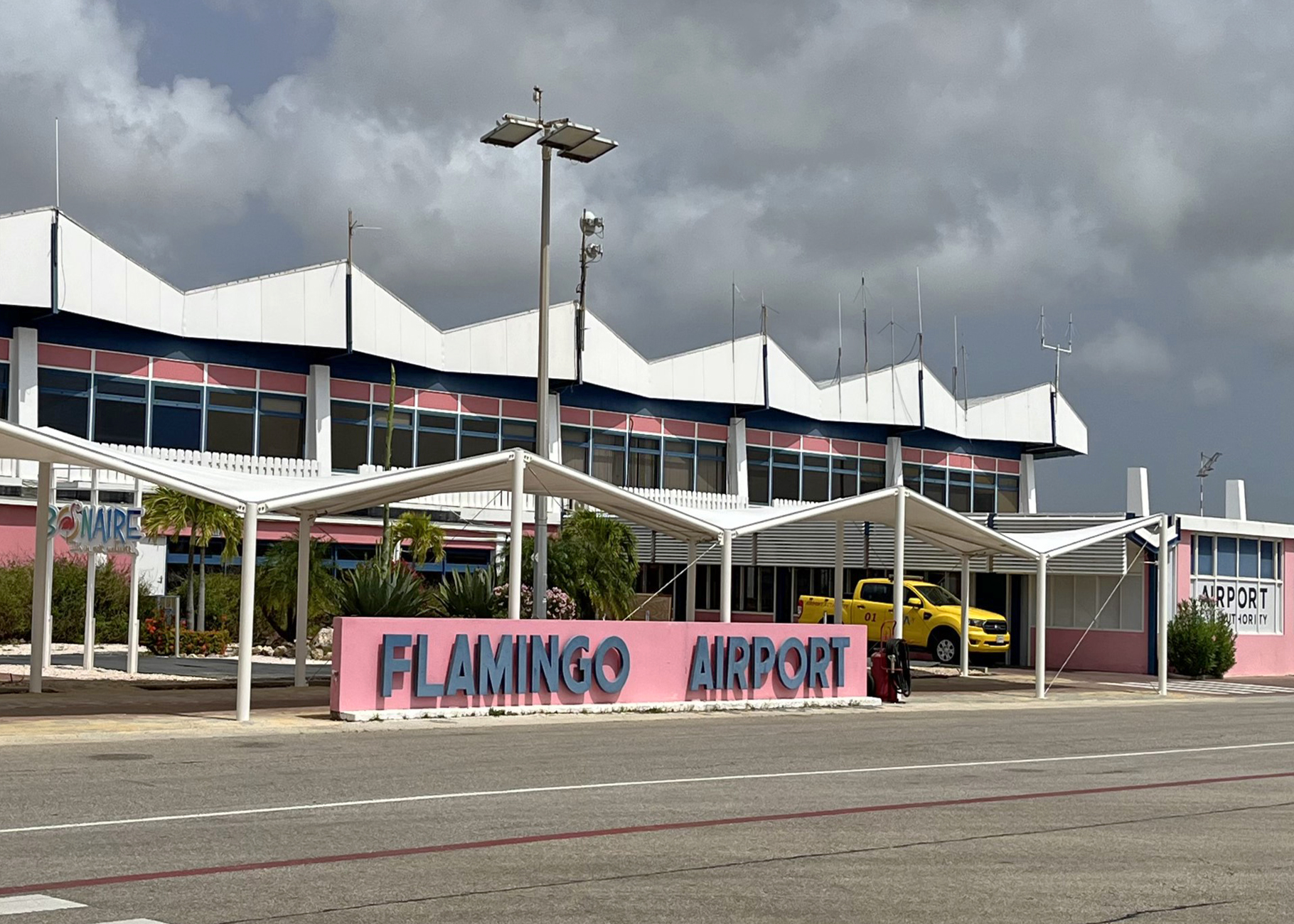
Flamingo Airport, Bonaire. From Bruce Myrick.
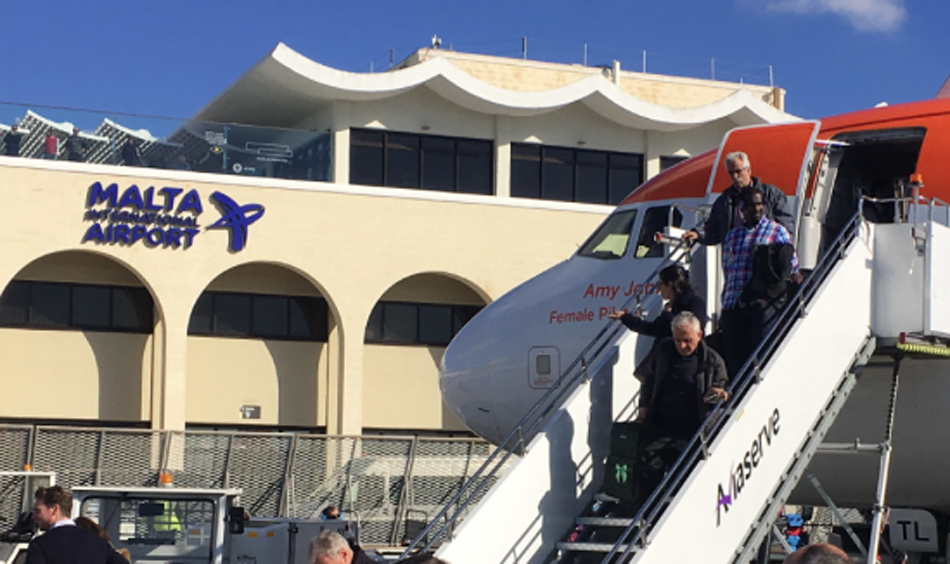
Valetta, Malta. From Rick Wilson.
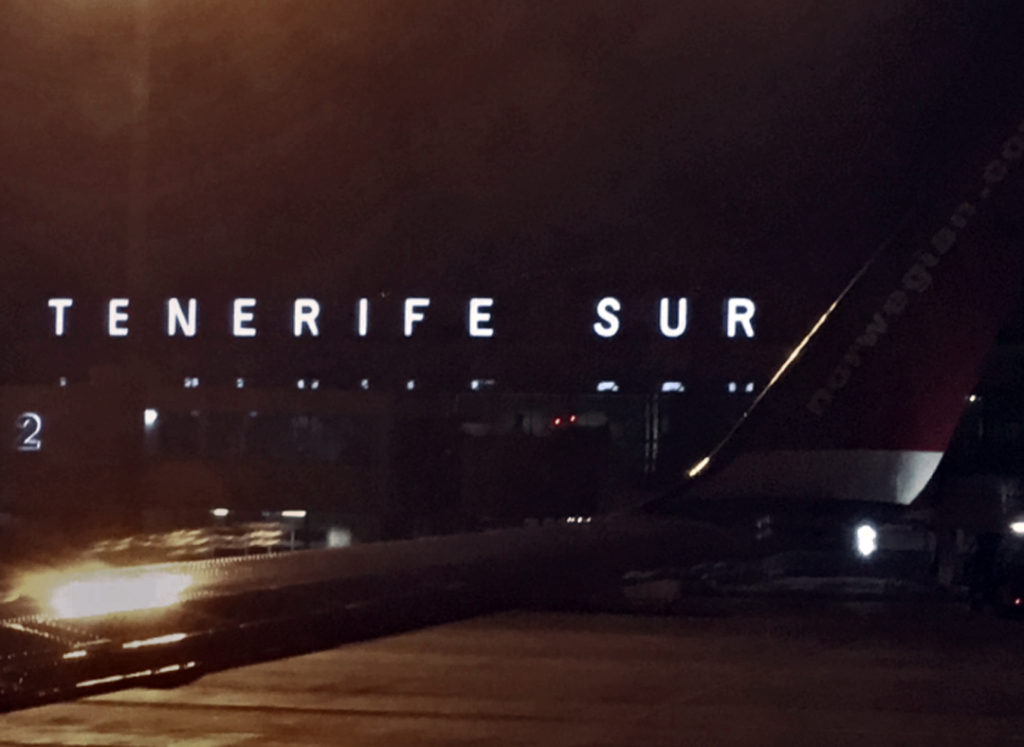
Tenerife South (TFS). From Rick Wilson.
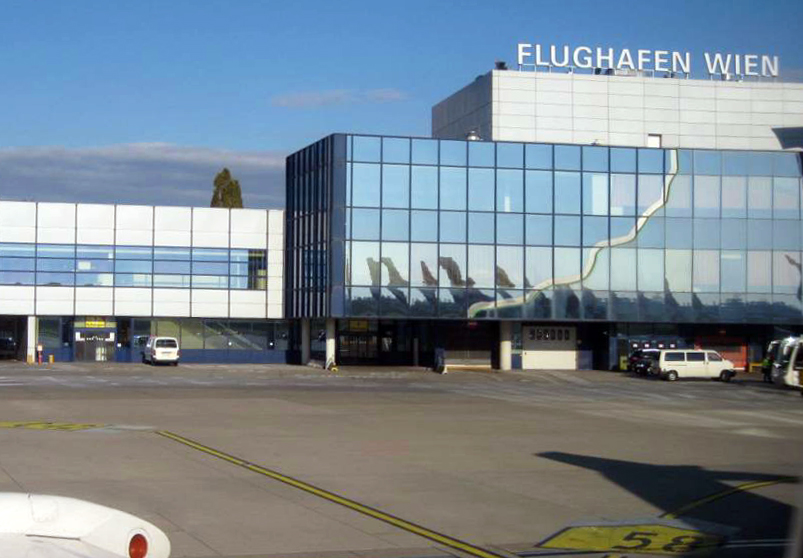
Vienna, Austria. From Andrew Nash.
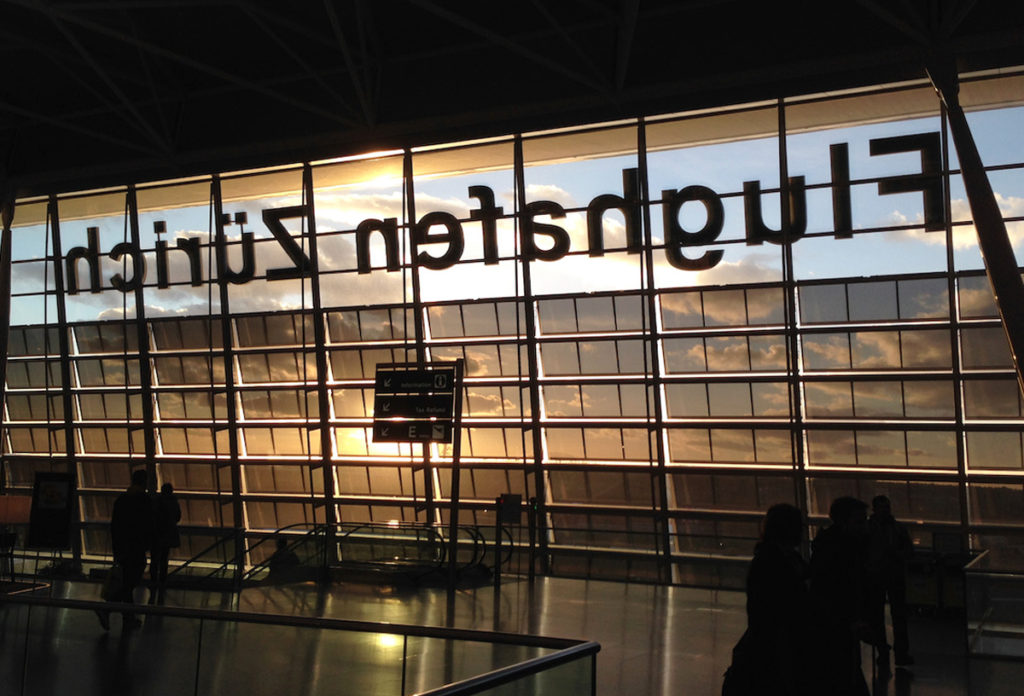
Zurich. From Andrew Nash.
Flying in the Age of Coronavirus
MOSTLY, this has been an exercise in stress. I suppose that’s an ambiguous term, so constituently we’re talking about fear, dread, and uncertainty. Not a fear of the virus. Coming down with COVID-19 isn’t what scares me. What scares me is what the airline business might look like by the time things settle out — whenever that might be.
Particularly astonishing was the speed at which things went to hell. In February, three friends and I were relaxing around a swimming pool in the Philippines talking about the size of our profit sharing checks and contemplating which aircraft we might bid in the months ahead. Within days — days! — the entire industry would be avalanched by panic and brought to a virtual halt.
The first three months were the worst. March, April, and May. Scant few flights were operating, and nobody had the slightest idea what lay ahead. These were some of the most stressful days of my life. Since then, things have settled into a certain routine. It’s not a happy routine by any stretch, and little about it feels normal. It’s just a routine.
If nothing else, I’ve kept busy. You might be surprised to hear that I’ve been spending more time aloft than ever. I’ve flown more in the past four months than in any four-month period of my entire career. Since June I’ve been to Europe twice, Africa five times, and back and forth across the country more times than I can count.
Normally I’m not the most ambitious pilot. The ancillary hassles of the job — the delays, the hellishness of airports, and the stress of commuting between the city I fly from (New York) and the city where I live (Boston) — encourage me to keep my schedule light and my blood pressure low. I might be on the road for twelve days in a month, logging around 70 pay hours. The average pilot aims closer to 80 and is gone for two weeks. But these aren’t normal times. Suddenly airports are quiet, delays are nonexistent, commuting is a breeze. It’d be perverse to say that flying is “better” than ever, but certainly it’s easier. Easier for all the wrong reasons, but it’s a way to keep my head up and maintain a sense of normalcy. So I’ve been doing it as much as I can.
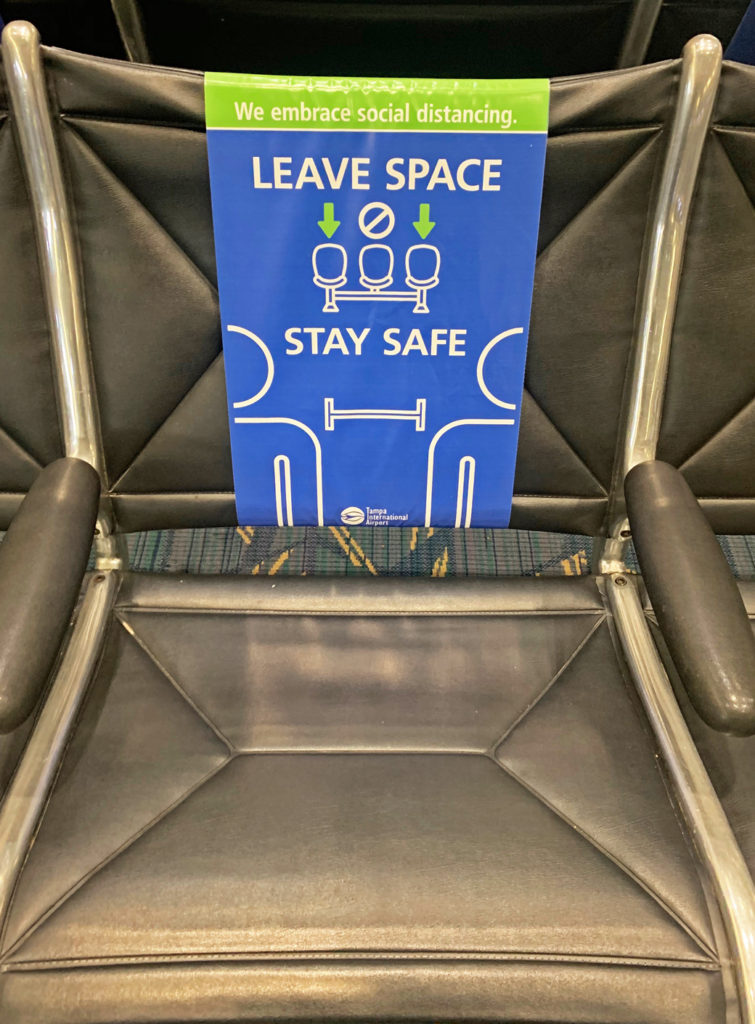
Besides, there’s little else to do. What is life now but a sad morass of masks and placards and agitated people. So much of life has come undone that I dread the most innocuous of tasks and errands, like a trip to Trader Joe’s or a walk to the Post Office. And the extent to which the American public seems to have acquiesced to all of this leaves me fearful of the future. I’m not talking about wearing masks or following restrictions; I’m talking about accepting as normal a world that is anything but. More than once I have heard people shyly admit they are enjoying this. Hence, I’m happier on the job, where I feel engaged and useful, than I am at home, where I’m apt to stew and wallow.
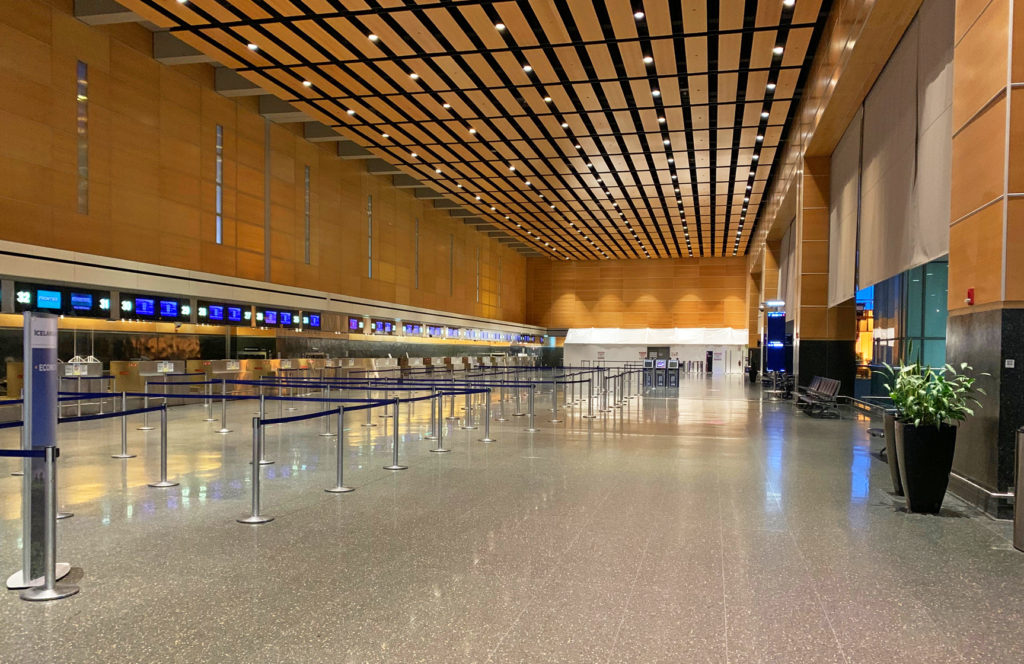
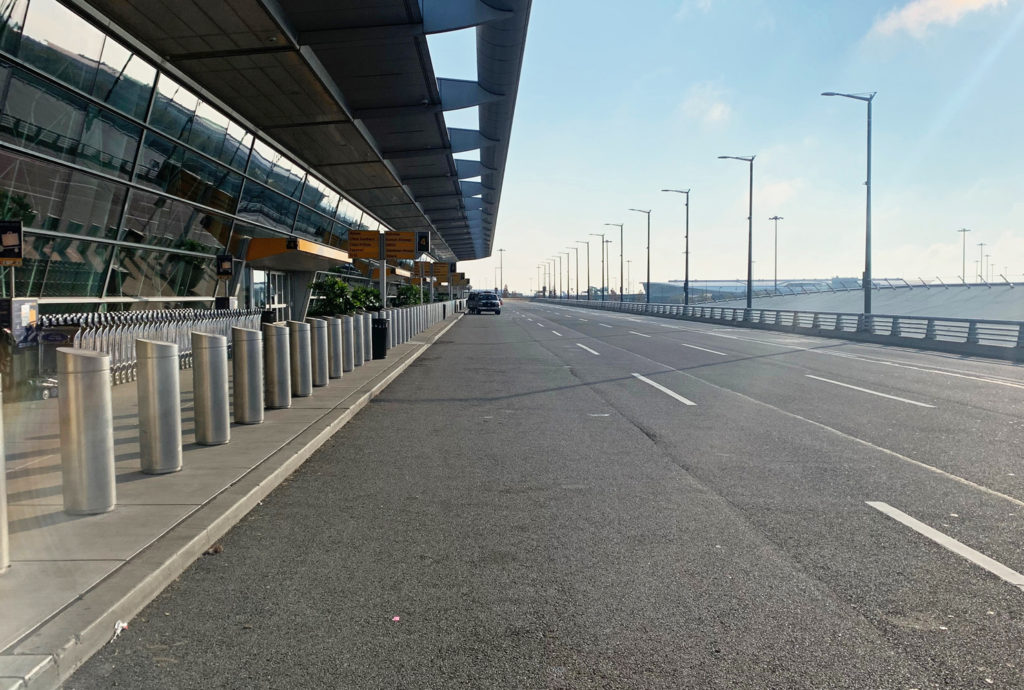
Though here too, the damage is visible at every turn: the empty planes, the desolate concourses and shuttered shops. A stroll through an airport in the COVID era is, on the one hand, a relaxing one, free of the usual ruckuses and long lines. On the other hand it’s a way of beholding just how massively this crisis has impacted aviation. There’s a fine line between peaceful and haunting. It’s nice to be free of the noise and crowds, but for an airline employee it’s also a little terrifying.
Then we have the small things, the obstacle course of petty annoyances that now litter the travel experience. Like the endless stream of COVID-related public address announcements. Or the fact that every hotel room amenity now comes wrapped in plastic (because this somehow “saves lives,” and because if the world needs one thing it’s more plastic waste). Or needing to strategize over how to score food during layovers in locked-down cities.
There’s little to feel optimistic about, though at least I’m busy.
Not all pilots have this opportunity. Huge swaths of the pilot ranks have been sitting idle. Seniority is everything at an airline, and I’m high enough on the roster to avoid this fate, but many of my colleagues haven’t set foot in a cockpit in weeks or even months. Airlines are utilizing different fleets at different rates; at a given carrier, 767 crews might be busier than A320 crews, for example, or vice-versa. Some airlines have been operating long-haul cargo charters, which is keeping their biggest planes — and their pilots — surprisingly busy. Other fleets, meanwhile, have been shut down almost entirely, meaning those pilots are doing nothing.

The job itself is little different, but now has the added challenge of keeping focused in a time of angst and worry. Before every takeoff is a crew briefing, where we talk through any threats or difficulties that might lie ahead. Most of these spiels now include a line or two about concentration. “We’re all a little distracted, so let’s remember to follow procedures and stay disciplined…”
In the rows behind us, the customers savor those empty adjacent seats they always dreamed about. People are afraid, we’re told, and you read about the guy or woman who causes a commotion over masks and gets hauled off by the airport cops. But I’m not seeing this. On the contrary, passengers seem blithely content. There’s room to spread out, the flights are on time, and it’s a cinch through TSA. If you’re concerned about getting sick, a Department of Defense study released in October says the risk of catching COVID-19 on an airplane, as long as everyone is masked, is just about nonexistent. The air on planes has always been cleaner than people think, and it’s even cleaner now. In addition, cabins are being deep-cleaned after every flight, including a wipe-down of all trays, arm-rests, lavatories and so on. Those fancy business class menus have been curtailed — or “modified” as many airlines describe it — but otherwise there’s little not to like. Flying hasn’t been this comfortable in decades.
There’s a facetiousness in my voice when I say that, of course. For the workers, it’s hard to enjoy the ride when your company is losing twenty million dollars a day.
My take on this whole mess is no doubt tempered by earlier career hardships. I’ve been through two airline bankruptcies, one of which resulted in the company liquidating, and in the wake of the terror attacks of 2001 I spent five years on furlough. That’s airline talk for being laid off. I was in my mid-thirties at the time, in the middle of what customarily would be a pilot’s “prime-earning years.” Instead of saving money and making a good living, I scraped by as a freelance writer. This was, in a sense, an adventurous and successful half-decade; had I not lost my flying job, it’s unlikely the “Ask the Pilot” enterprise, or my book along with it, would ever have come to be. But despite the accolades, the book tour to Rome, the TV crews that often came to visit and the satisfaction of having used my improvisational talents to spin a little gold from a rotten situation, this was a long and financially bleak hiatus.
And when a pilot is out of work, for whatever reason, he or she cannot simply slide over to another airline and pick up where they left off. The way airline seniority systems work, there is no sideways transfer of benefits or salary. If you move to a different company, you begin again at the bottom, at probationary pay and benefits, regardless of how much experience you have. You lose everything. So any threats to our jobs or companies make us very nervous.
Five years on the street left me in a career no-man’s land, and upended my whole sense of self as a professional. Was I even a pilot any more? When I finally was called back, early in 2007, all I knew for sure is that I never wanted to live through that again.
And I didn’t expect to. Oh, sure, for any airline worker who endures a crisis — a furlough, a merger, a bankruptcy — nothing is ever again certain or taken for granted. No matter how rosy things are the moment, there’s always a hum of dread, a shoe waiting to drop, in the back of your mind. But this? This? Nobody foresaw a cataclysm of such speed or magnitude.
I have my ways of dealing with it. Others have theirs. On and on it goes.
PHOTOS BY THE AUTHOR.
Related Stories:
COVID CASUALTIES: OBSERVATIONS AND FAREWELLS
Q&A WITH THE PILOT, CORONAVIRUS EDITION.
30 YEARS ON: THE AUTHOR’S FIRST AIRLINE JOB.

A Gourmet Diversion. Savory Snapshots From 30,000 Feet.
March 20, 2025
HERE ARE some pictures of airline food. Pardon such a vapid diversion, but most aviation news these days is depressing. Plus, I’m hungry.
Before the coronavirus madness began, we’d reached a point where the food in international premium class could rival that of a fancy restaurant. Carriers took pride in their onboard product: the food itself, the presentation, choreography — the whole indulgent kabuki of premium class, from the menus to each carrier’s signature cutlery. It could be pretentious, but always fun. The pandemic wiped that out, but things have since bounced back. An airplane ride no longer feels like a medical evacuation and flight attendants have stopped dressing like the firemen at Chernobyl.
Here, in no special order, are some examples. New and old, fancy and not so fancy.
These weren’t employee freebies. I’ve spent a lot of money on these seats. Maybe let me flex a little…
ALL PHOTOS BY THE AUTHOR
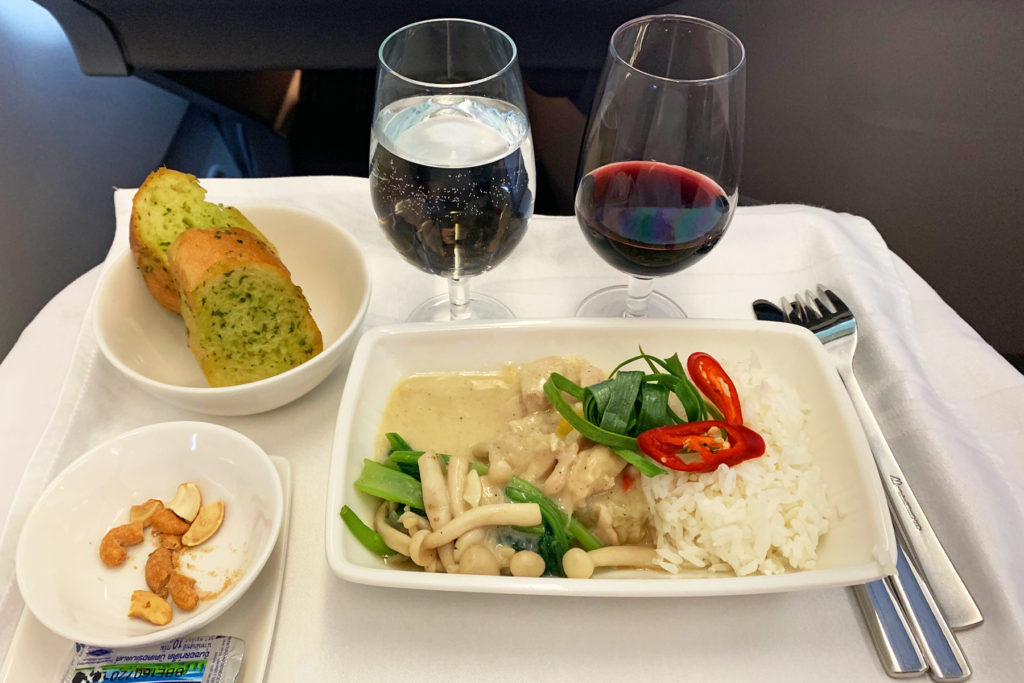
Philippine Airlines
A business class meal aboard a Philippine Airlines A330, Singapore to Manila. Adequate if underwhelming. This was a three-hour, intra-Asia service; presumably the airline’s long-haul routes have a more lavish spread. Not visible are my second and third helpings of garlic bread.
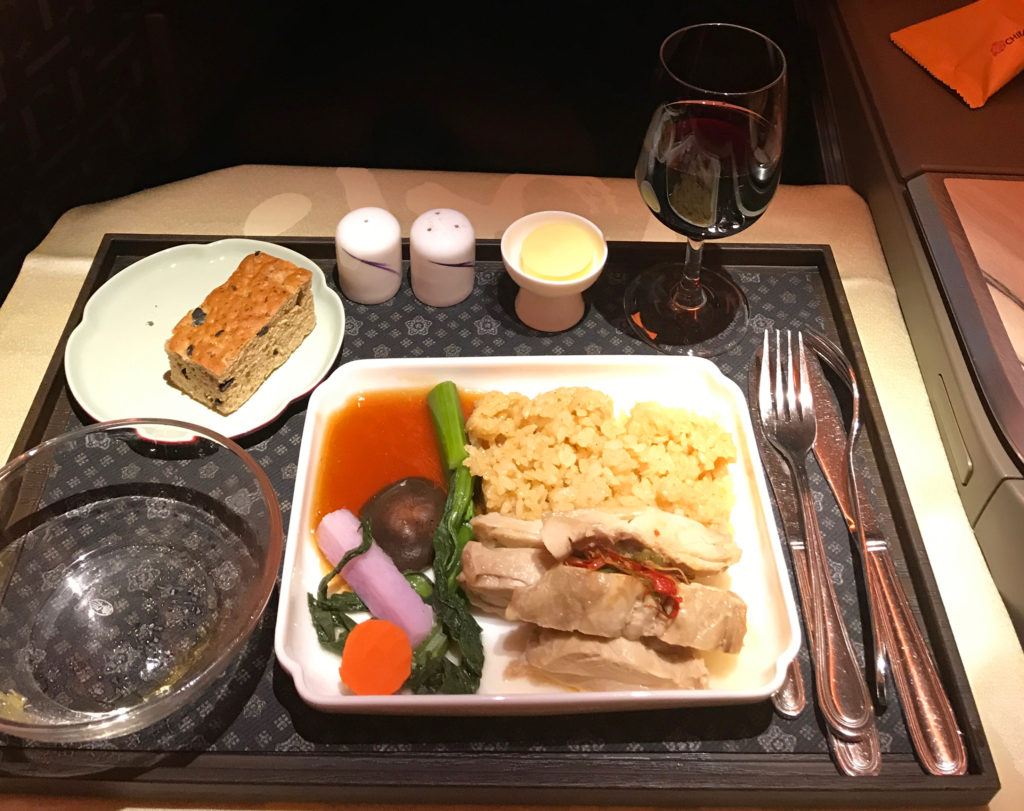
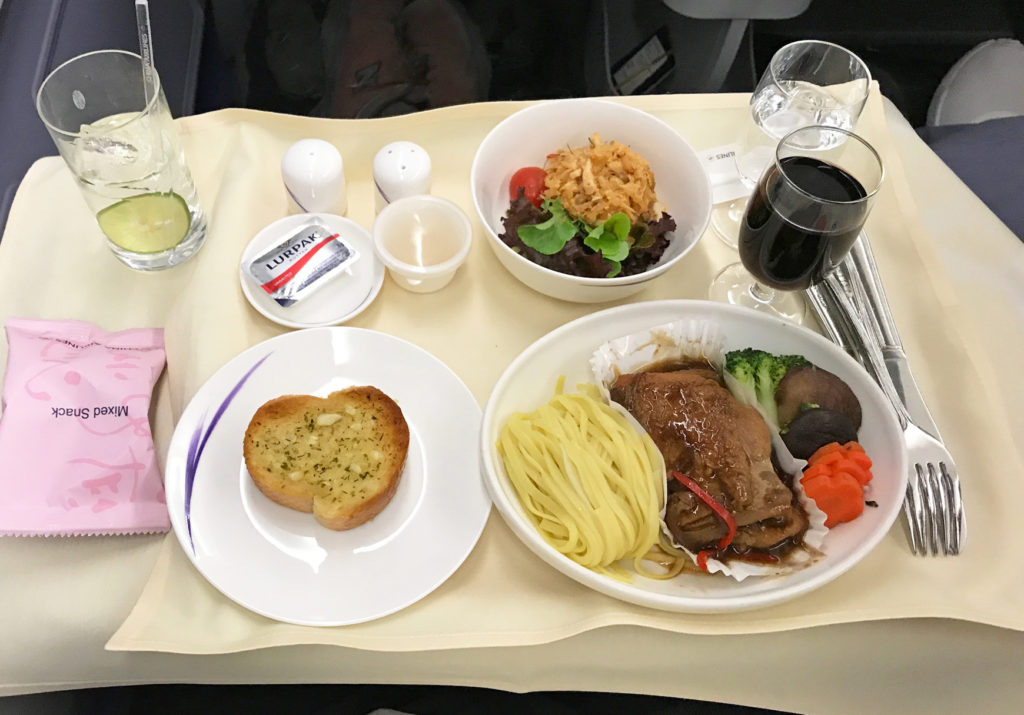
China Airlines
The upper photo shows a business class dinner en route from Taipei to Amsterdam. The cabin decor on this Airbus A350 was strikingly handsome, gold highlights and elegant wood tones. The food was less impressive, and they were super stingy with the wine. The lower pic showcase the carrier’s shorter-haul service on the A330.
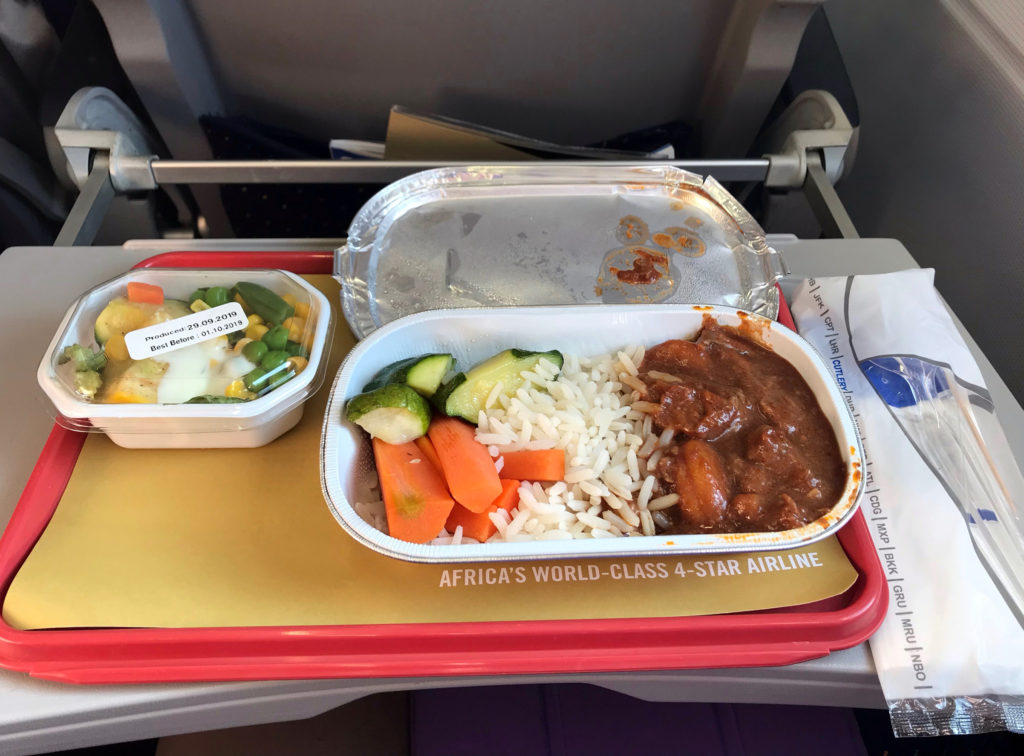
South African Airways
Economy class dinner on the quick jump from Lusaka, Zambia, to Johannesburg. The second pic beholds one of the sadder things I’ve seen on a plane. Believe it or not, this was the business class vegetarian entree, served on the Johannesburg-Victoria Falls route. Click here for a detailed review of this flight.
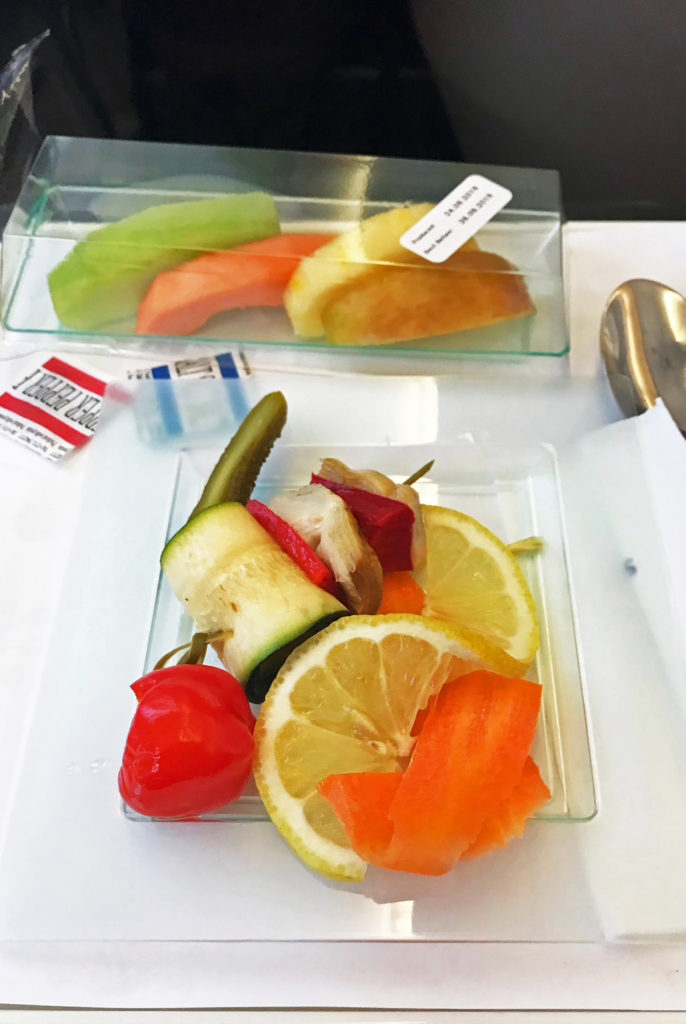
Qatar Airways
Qatar’s business class food is arguably the best in the world. It’s served on-demand, meaning you order whatever you want, whenever you want it. There’s no scripted service, per se, with trays or carts coming down the aisle.
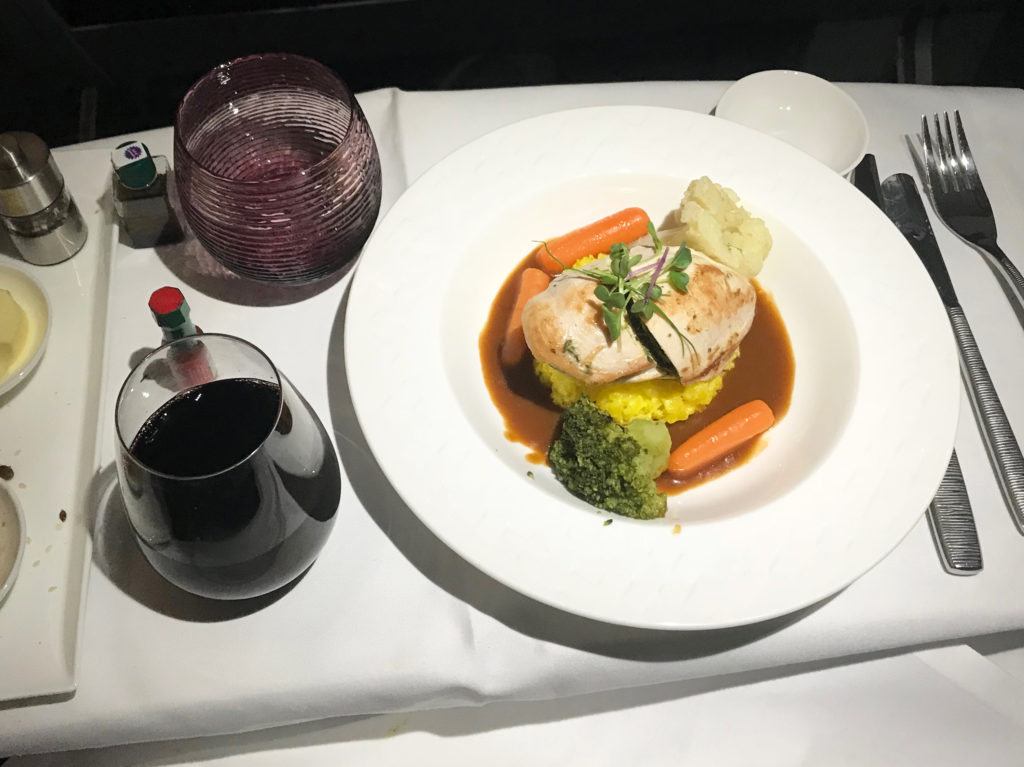
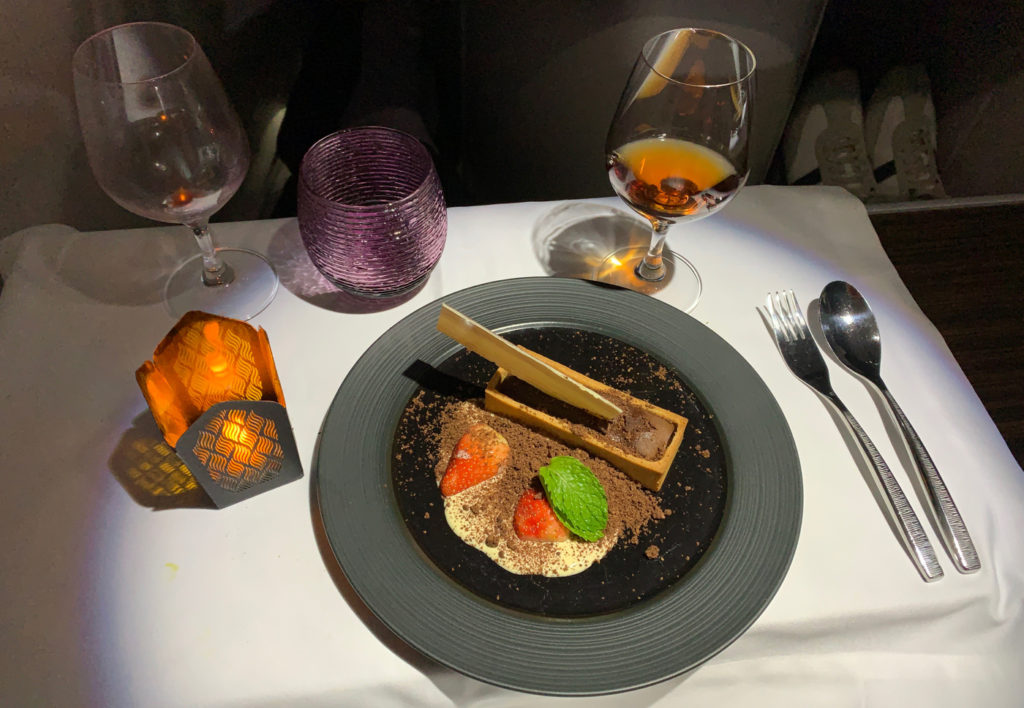
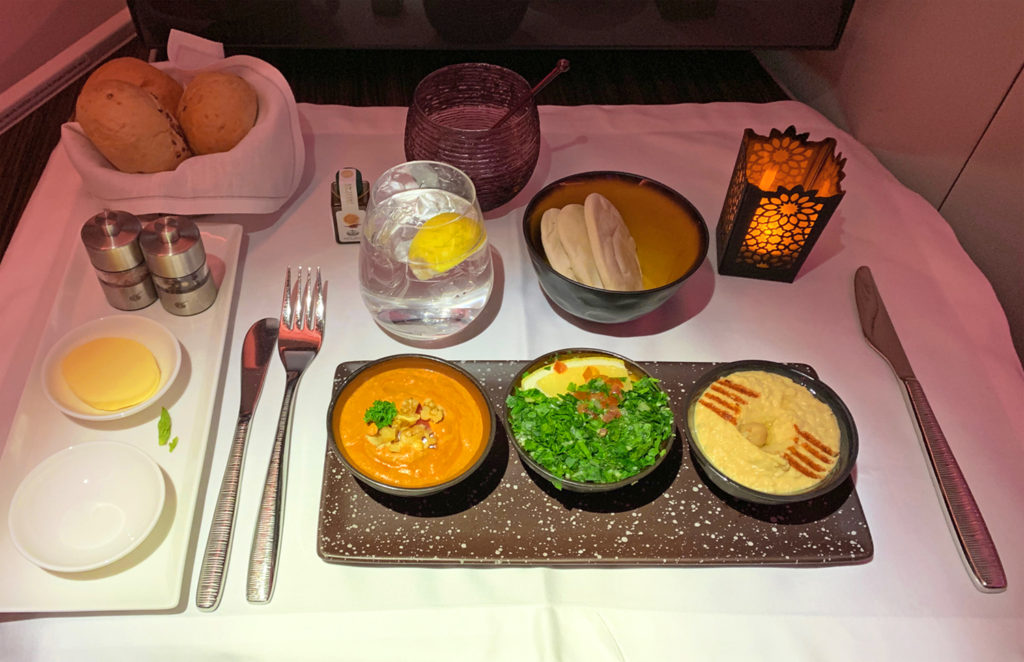
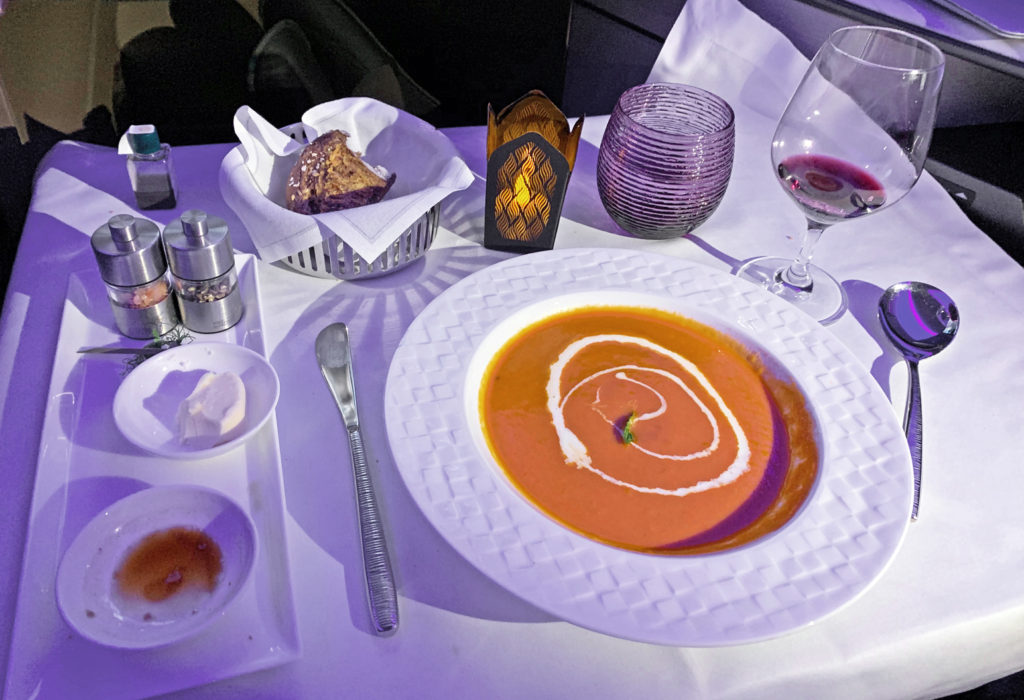
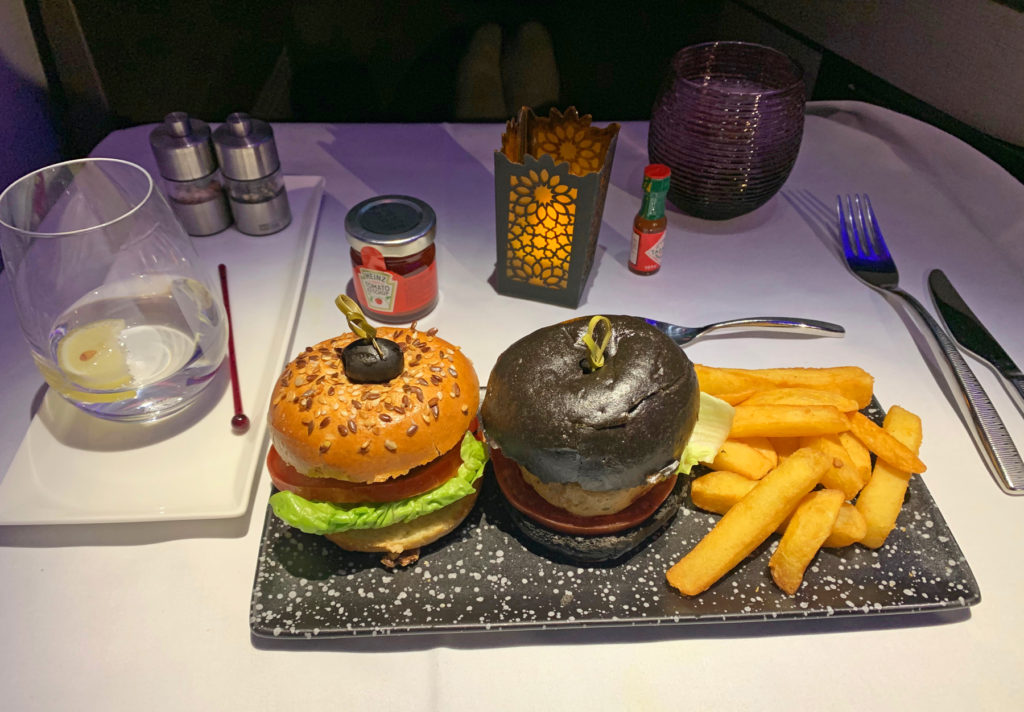
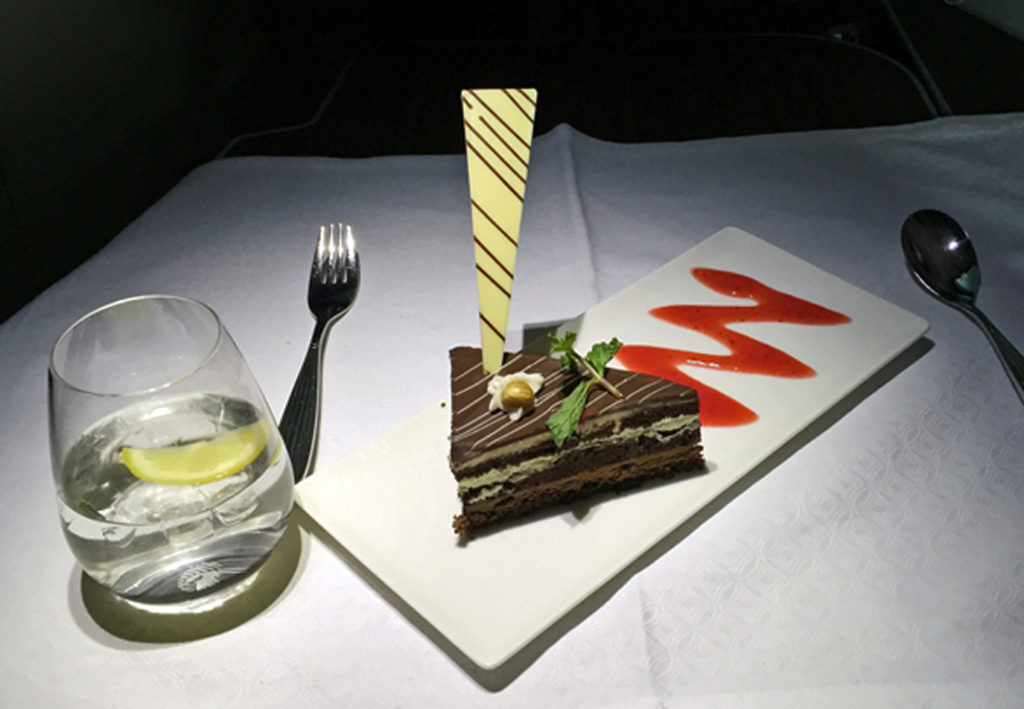
Air Asia
At the other end of the spectrum, here’s what low-cost carrier Air Asia has for you on the 60-minute run between Bangkok and Phuket. This was a buy-on-board option that cost about ten dollars.
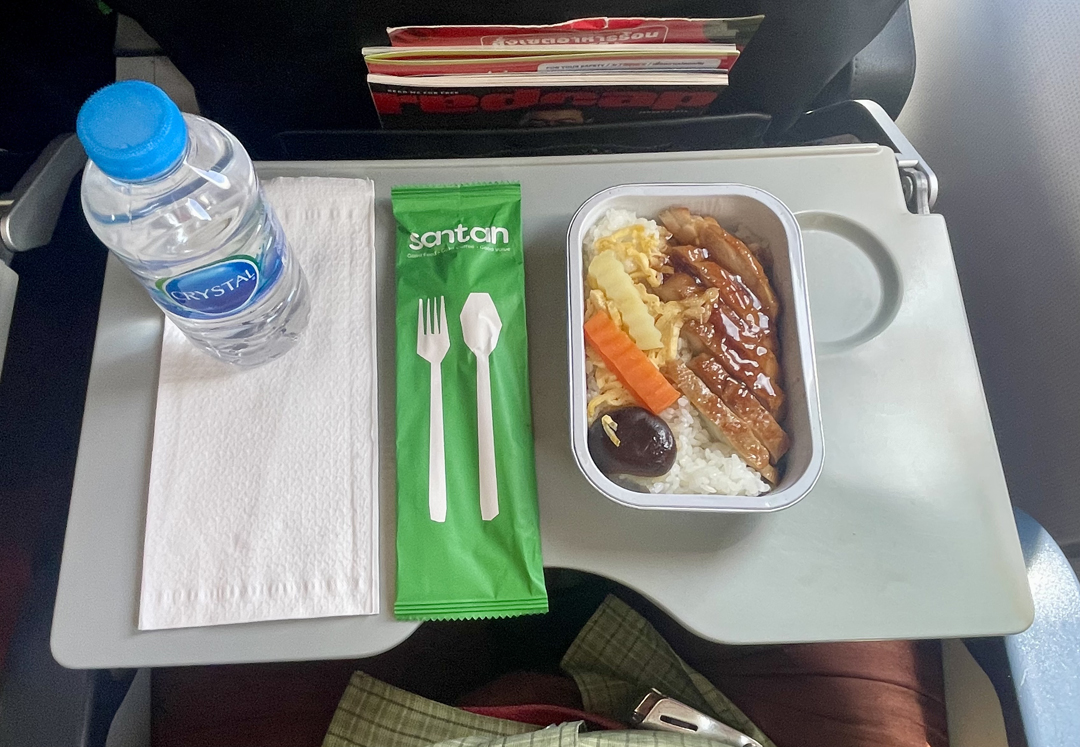
Sky Airline
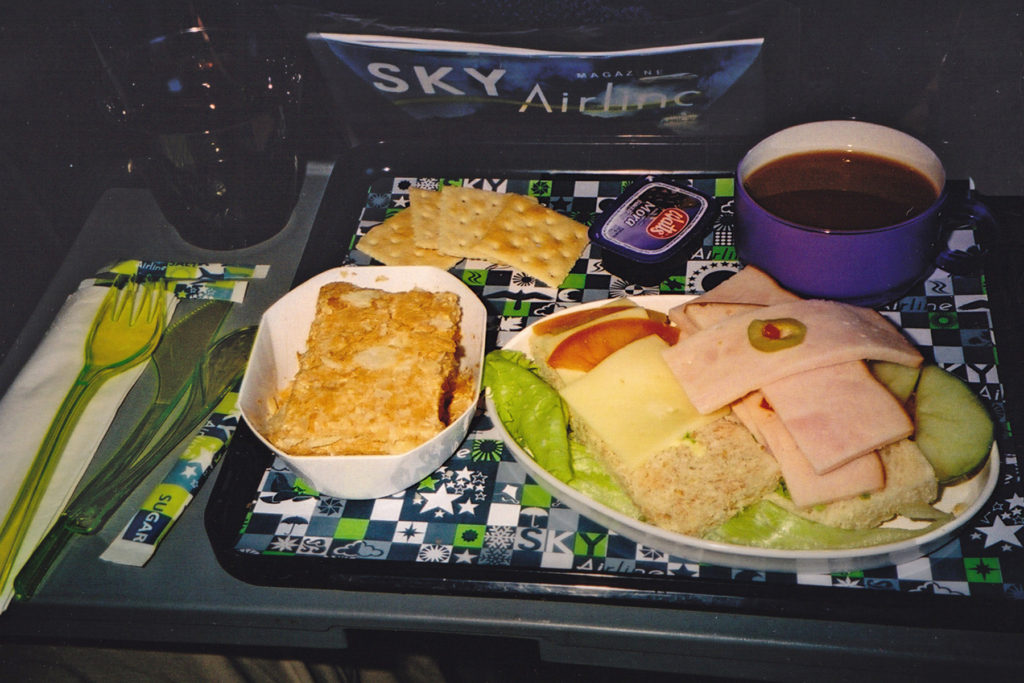
Sky Airline (there is no “s”) is a Chilean carrier, and this was the economy meal on a 737 between Santiago and Punta Arenas. Let’s just say that I loved the paper tray liner, and leave it there. The green plastic silverware was a curious, some would say unappetizing touch.
Sri Lankan Airlines
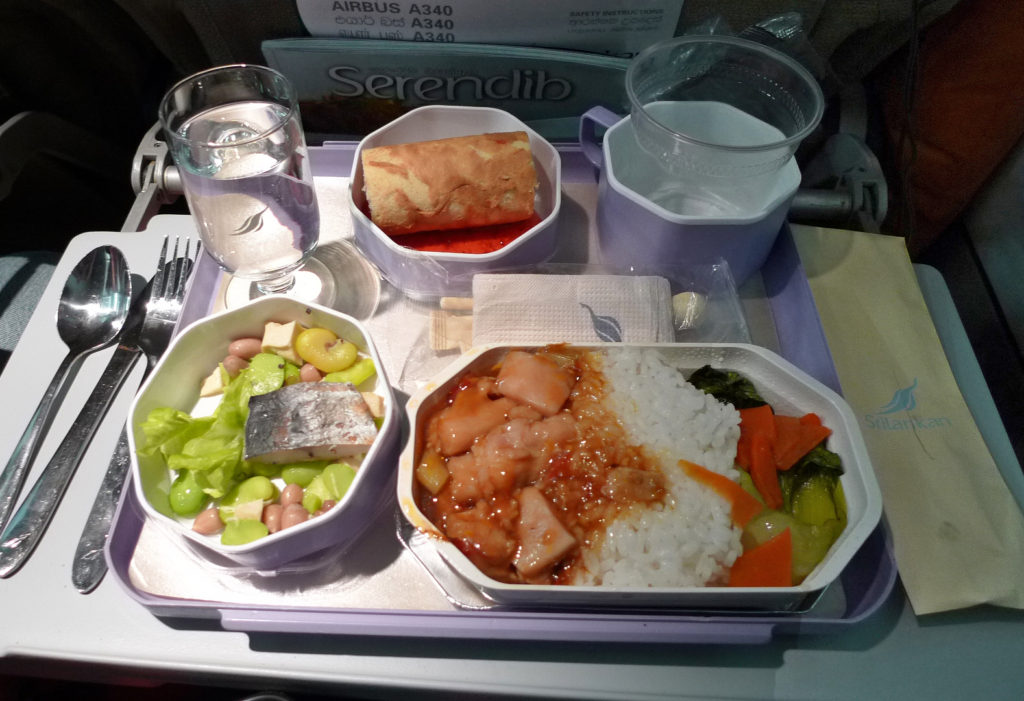
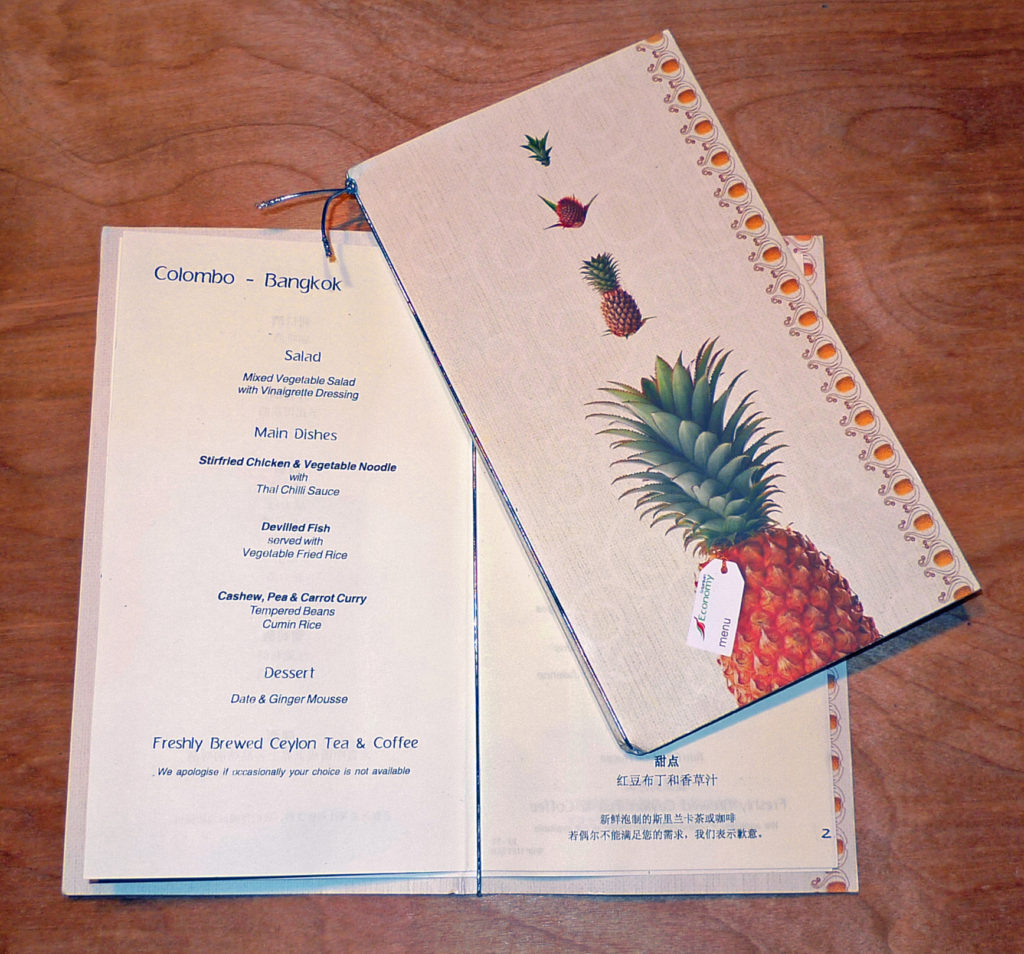
A beautiful little menu to whet your appetite on the way from Bangkok to Colombo. The meal itself was standard economy fare. Maybe the best thing you can say about economy class food is to call it “uneventful,” and this was no exception. The seat-pocket magazine is called Seredib — a sanskrit term from which the word “seredepity” comes from.
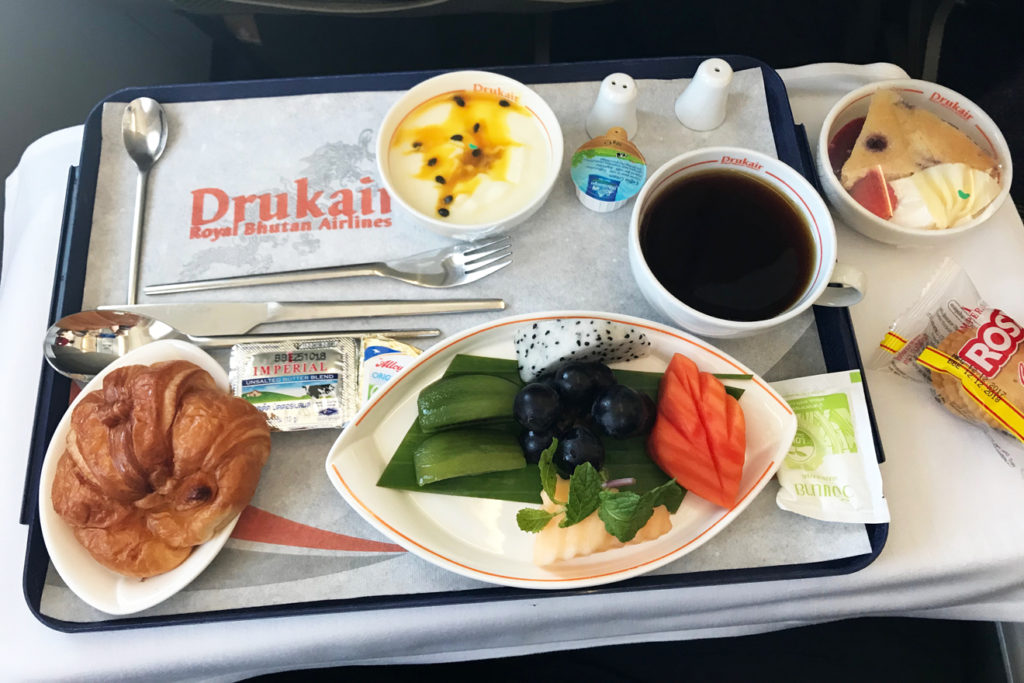
Drukair
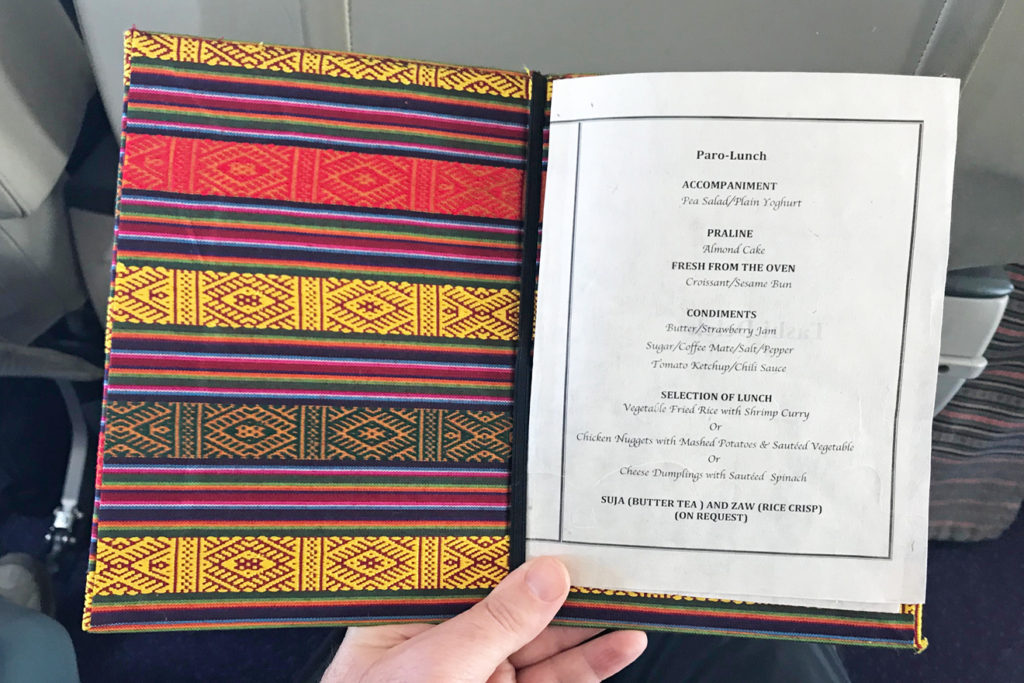
One of Bhutan’s two airlines, Drukair flies smaller planes and offers a limited, if tasty business class menu. Here you see the lunch options on the daily run from Paro to Bangkok. This flight is further reviewed here.
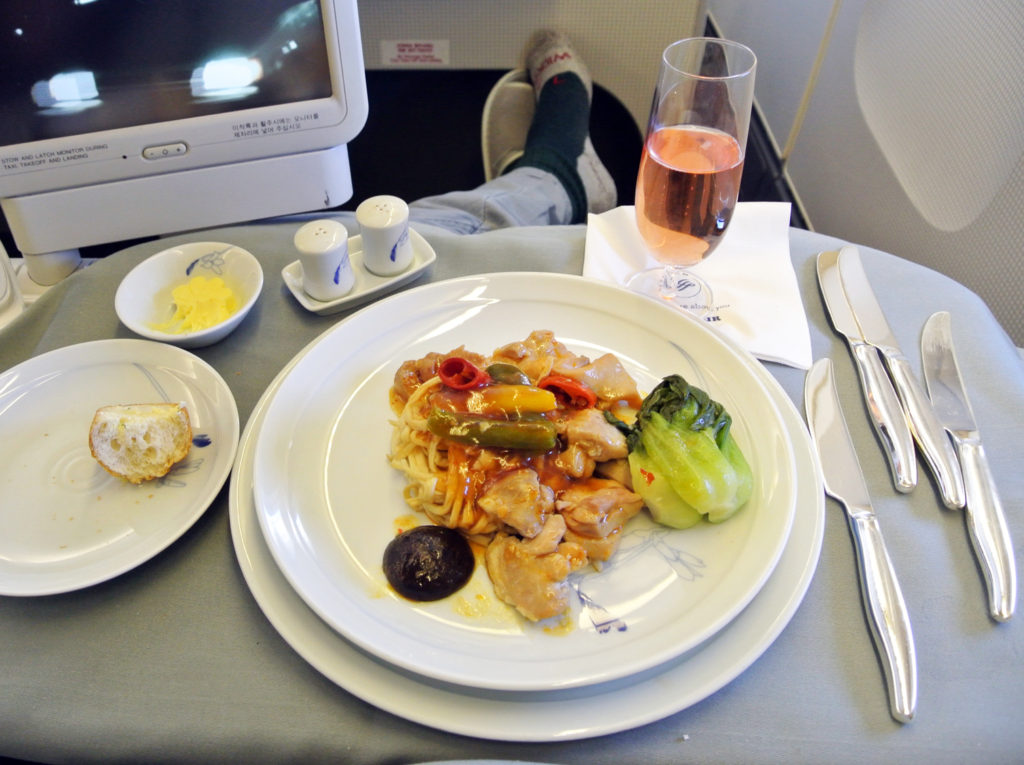
Korean Air
This was first class from Incheon to Bangkok in one of Korean’s inter-Asia 747s with an older configuration that is no longer used. Notice the pull-out style entertainment screen and non-sleeper seat. Talk about slumming it! And if that noodle concoction looks a little too sloppy and greasy, it was.
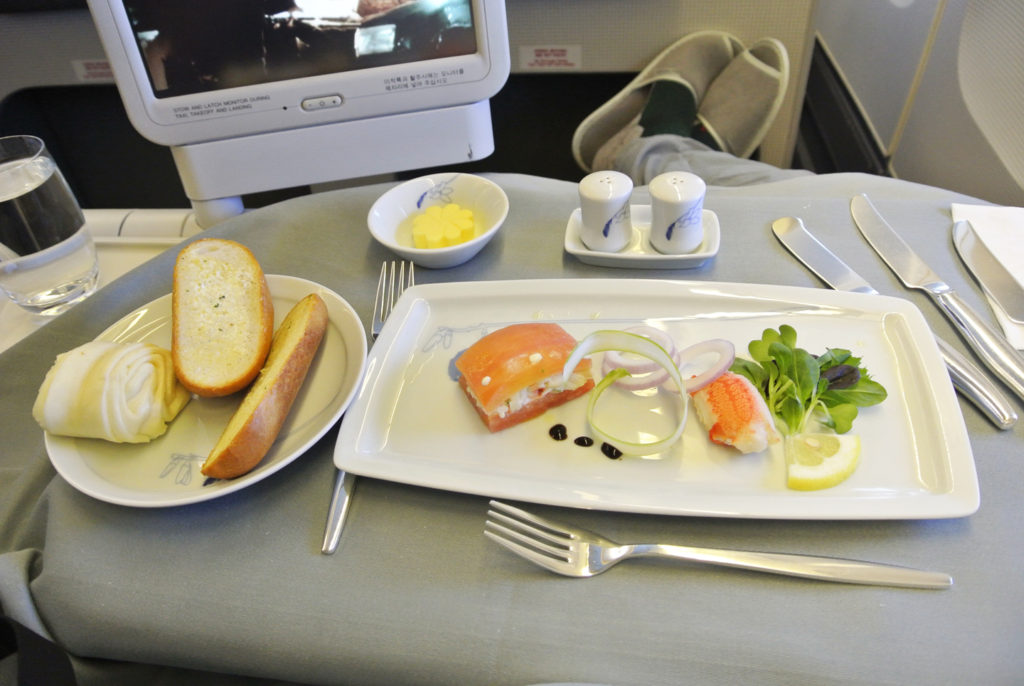
Singapore Airlines
For whatever reason, I failed to keep any photos of the business class delectables I enjoyed one night on the long ride from Singapore to Amsterdam. Instead I have this less interesting picture from a shorter flight. This is what you get on an A330 between Singapore and Japan.
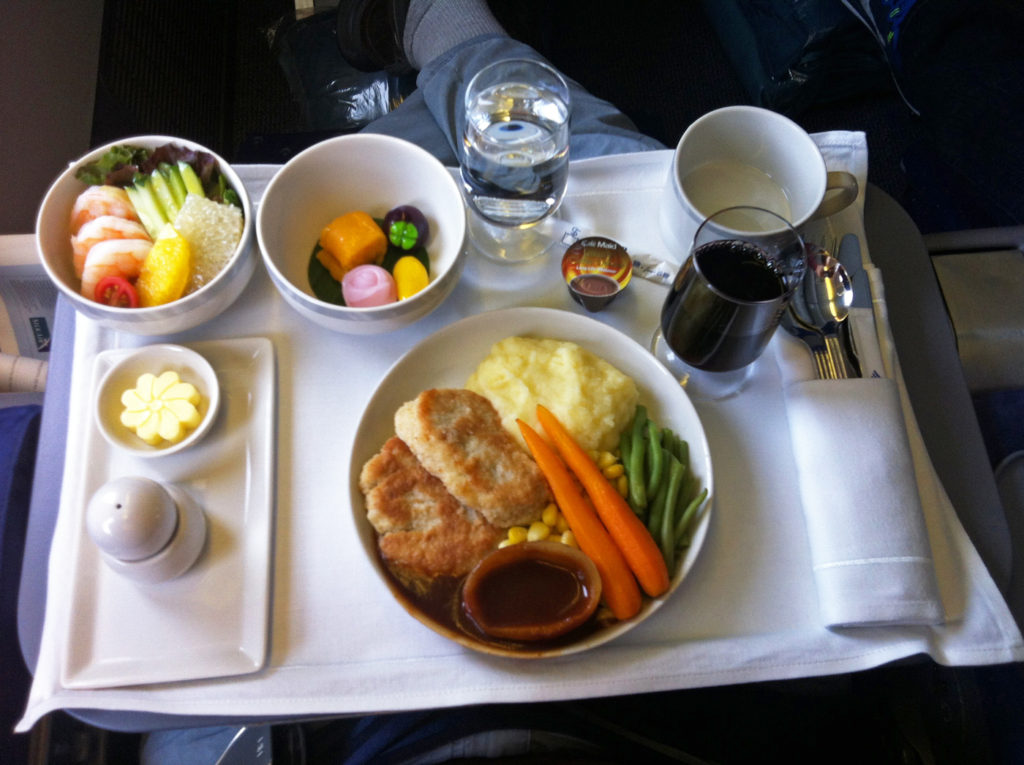
Kenya Airways
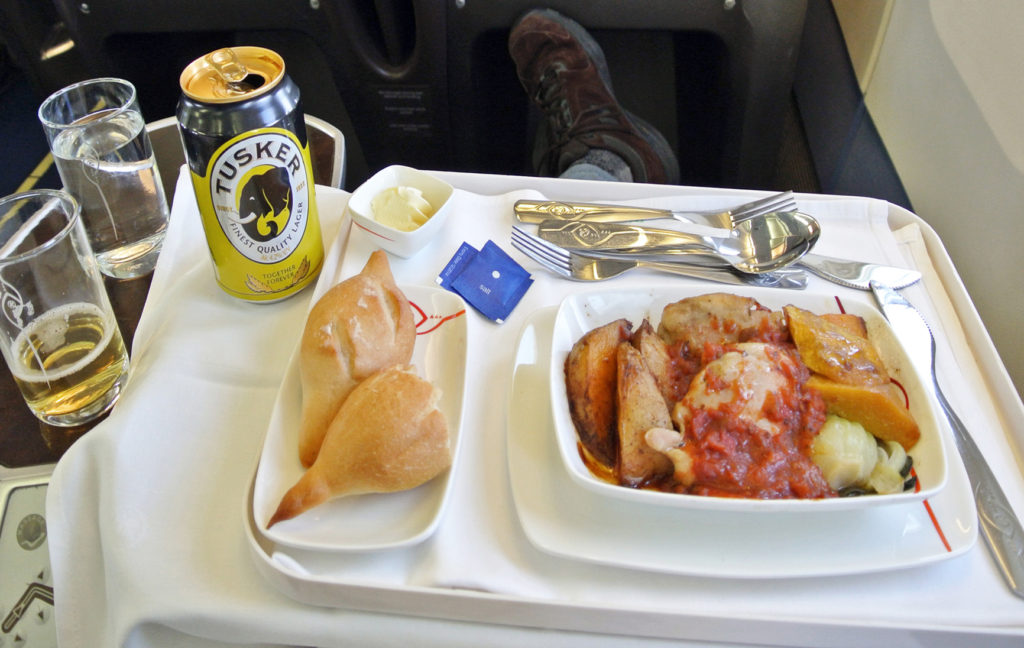
Bangkok to Hong Kong with Kenya Airways. A decent lunch and a can of Tusker. What’s not to like? And although you can’t see it here, this airline provides the world’s most luxurious fleece blankets. The crew even let me abscond with one, and today it resides on my couch. What they didn’t have, at least on this vintage 767 (since retired), is an entertainment system. I spent several perplexed minutes trying to locate my screen before realizing there wasn’t one.
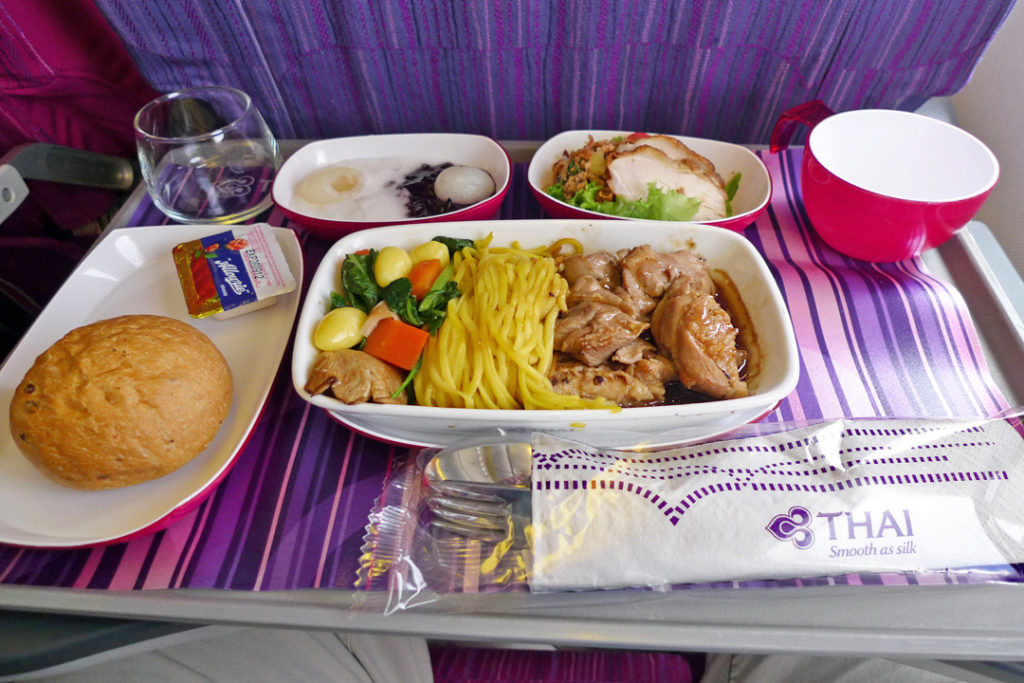
Thai Airways
On the red-eye from Bangkok to Incheon. Another satisfying, if unspectacular, economy dinner.
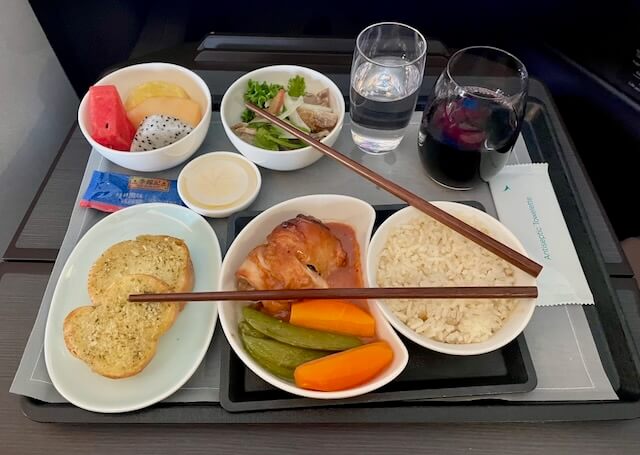
Cathay Pacific
As good as it gets on a two-hour hop. Business class from Bangkok to Hong Kong. Find me a U.S. carrier that would offer something like this on such a short ride.
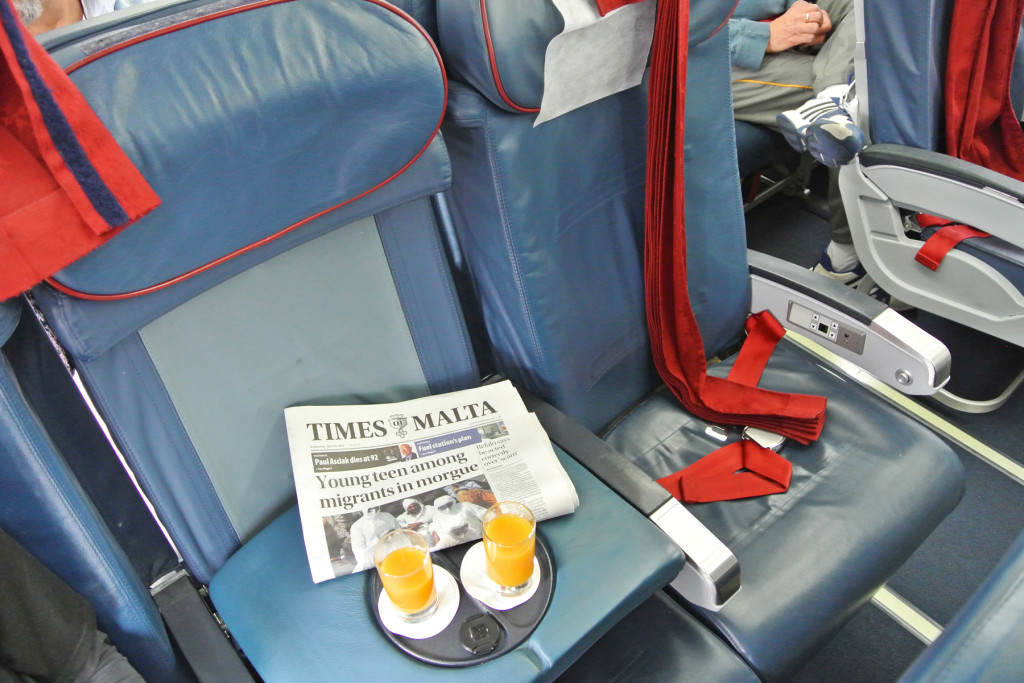
Air Malta
Air Malta is not longer in business, but like the aforementioned Drukair, they operated only shorter routes using narrow-body planes (pictured is Heathrow to Valetta), doing what they could with limited time and space. This involved some improvising, such as folding down the center seat to create a kind of instant business class. The result, all things considered, was surprisingly pleasant.
Emirates
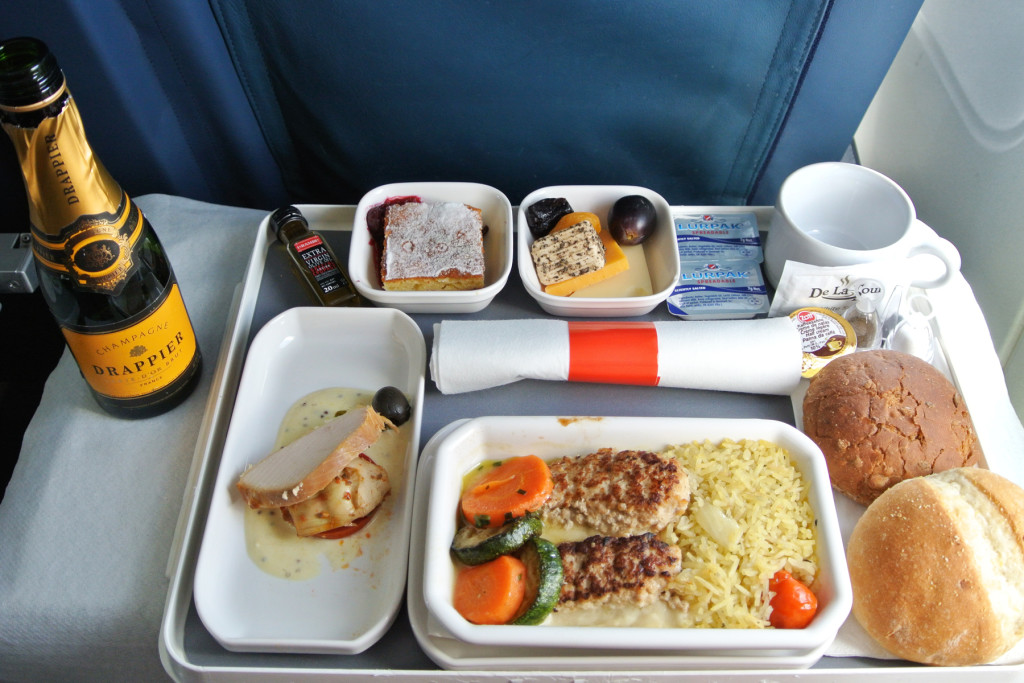
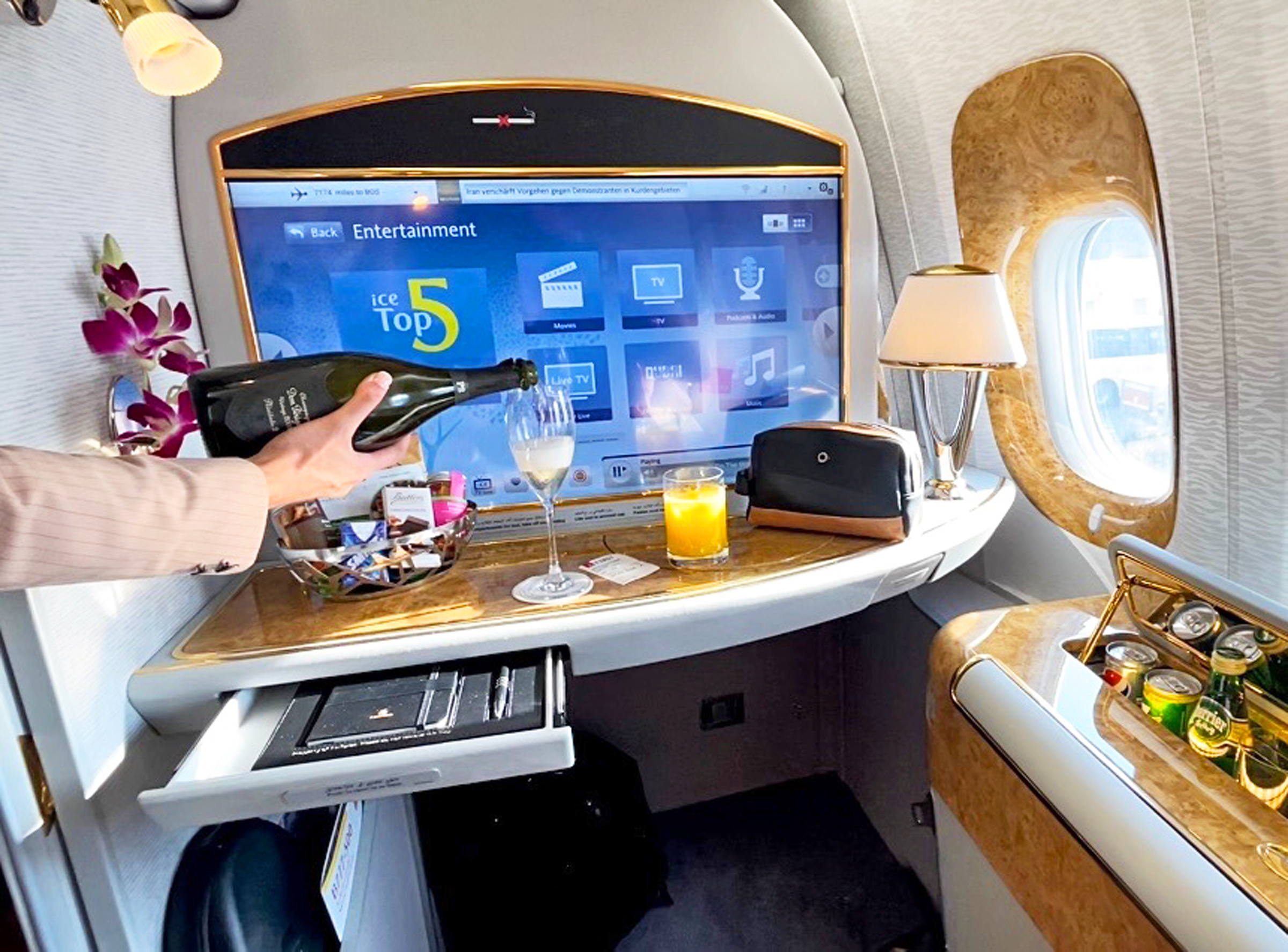
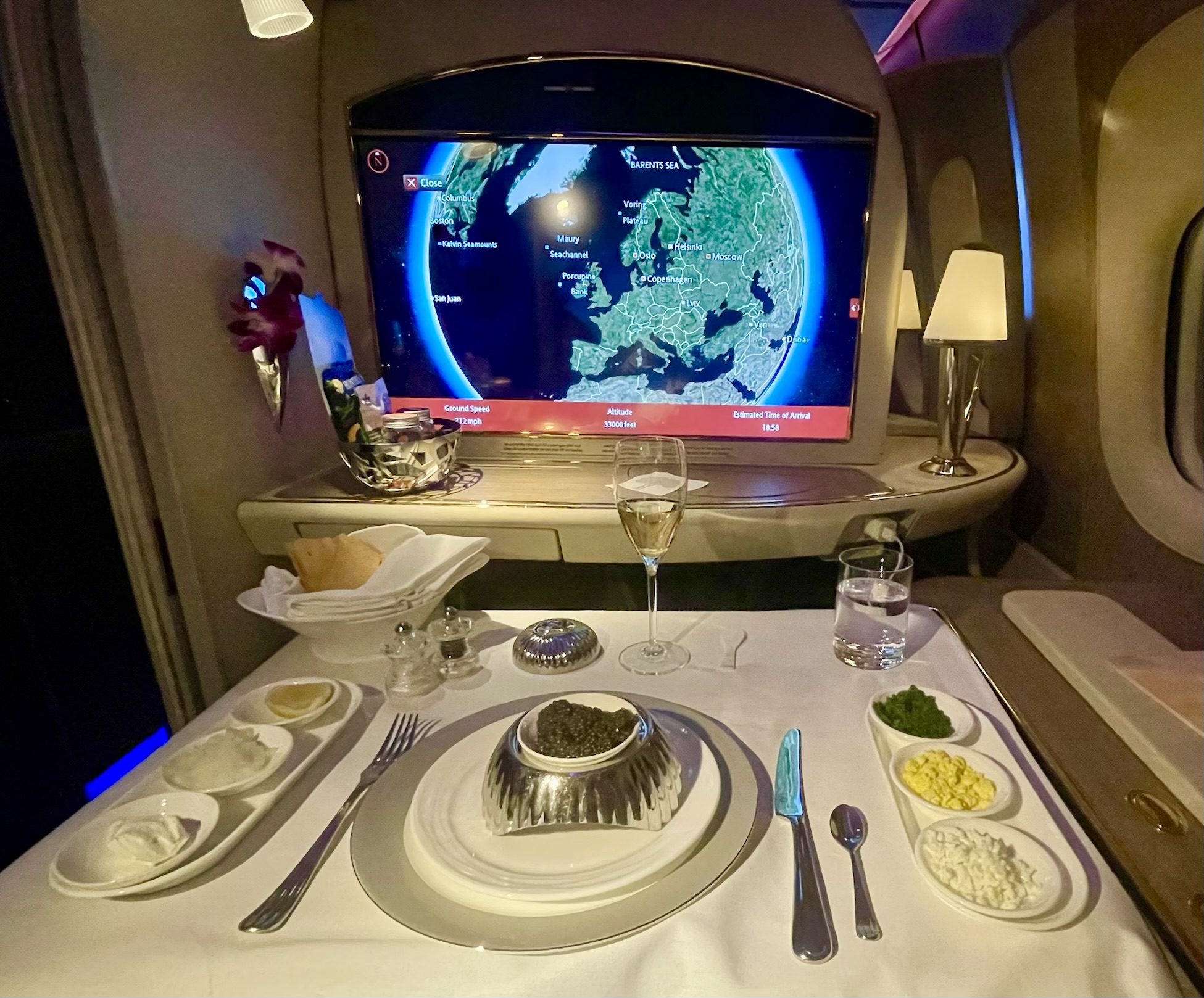
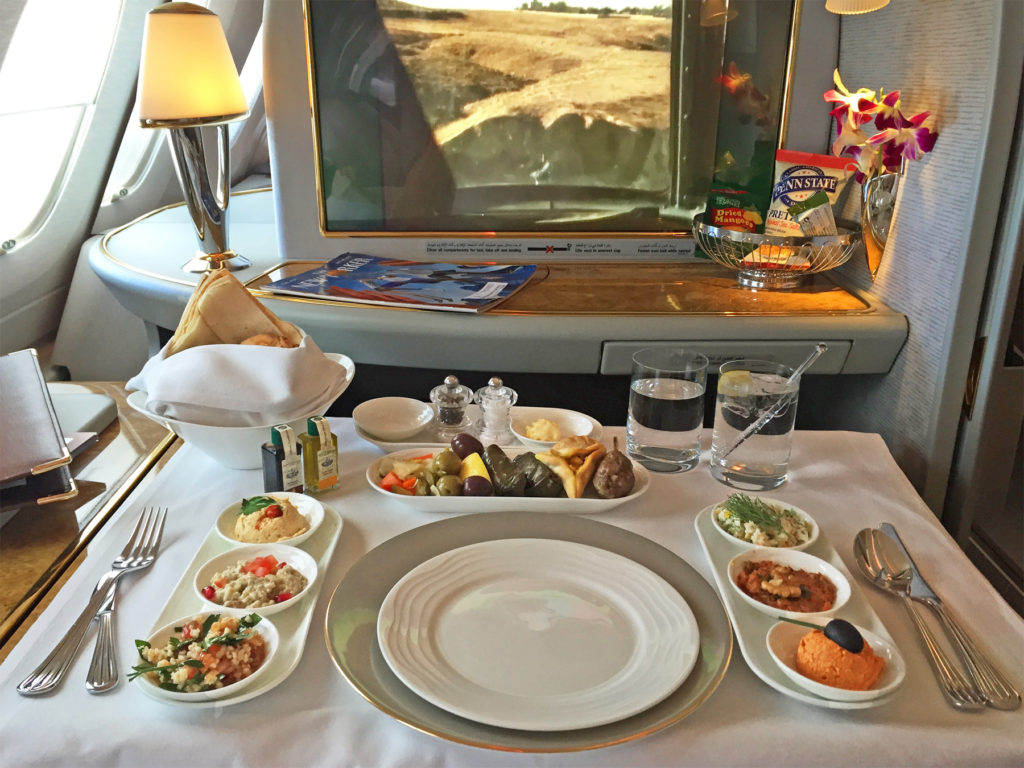
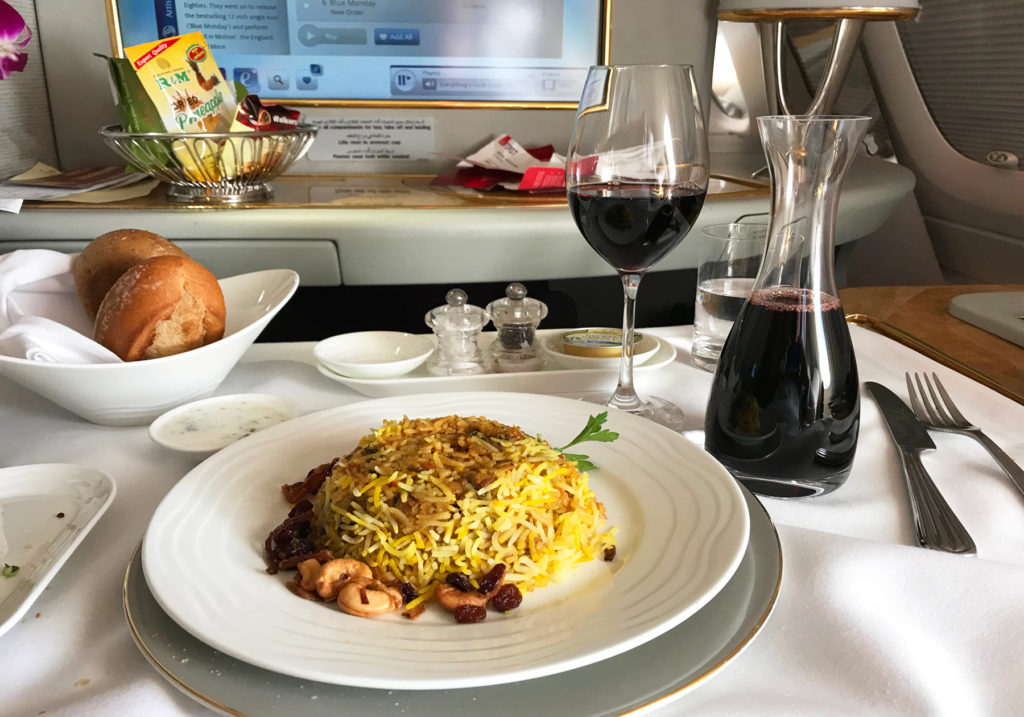
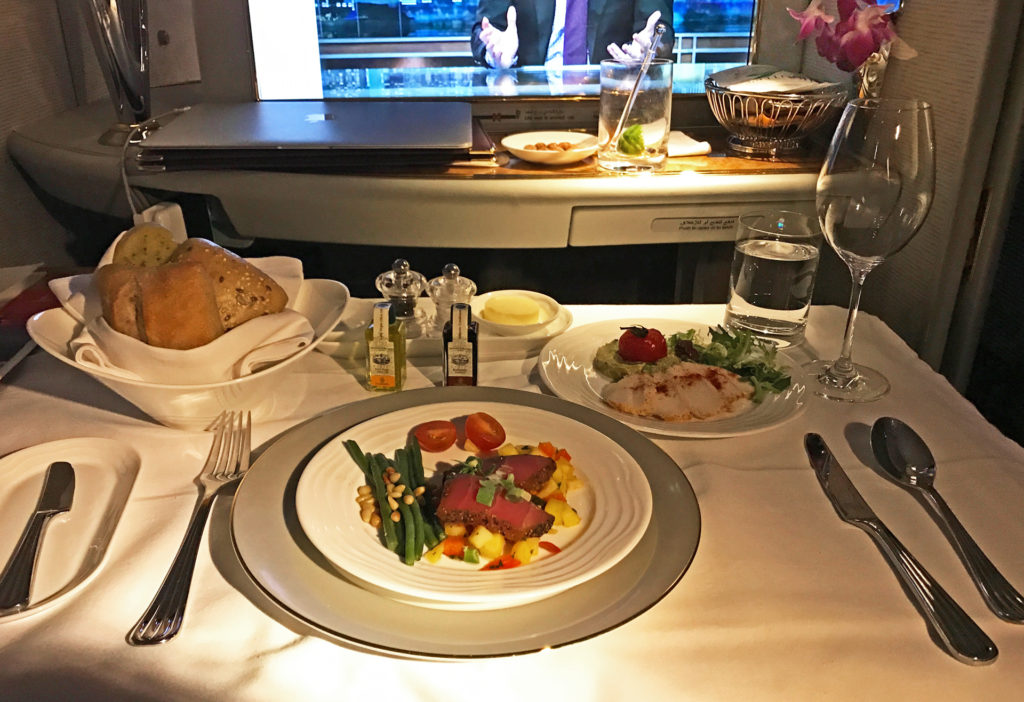
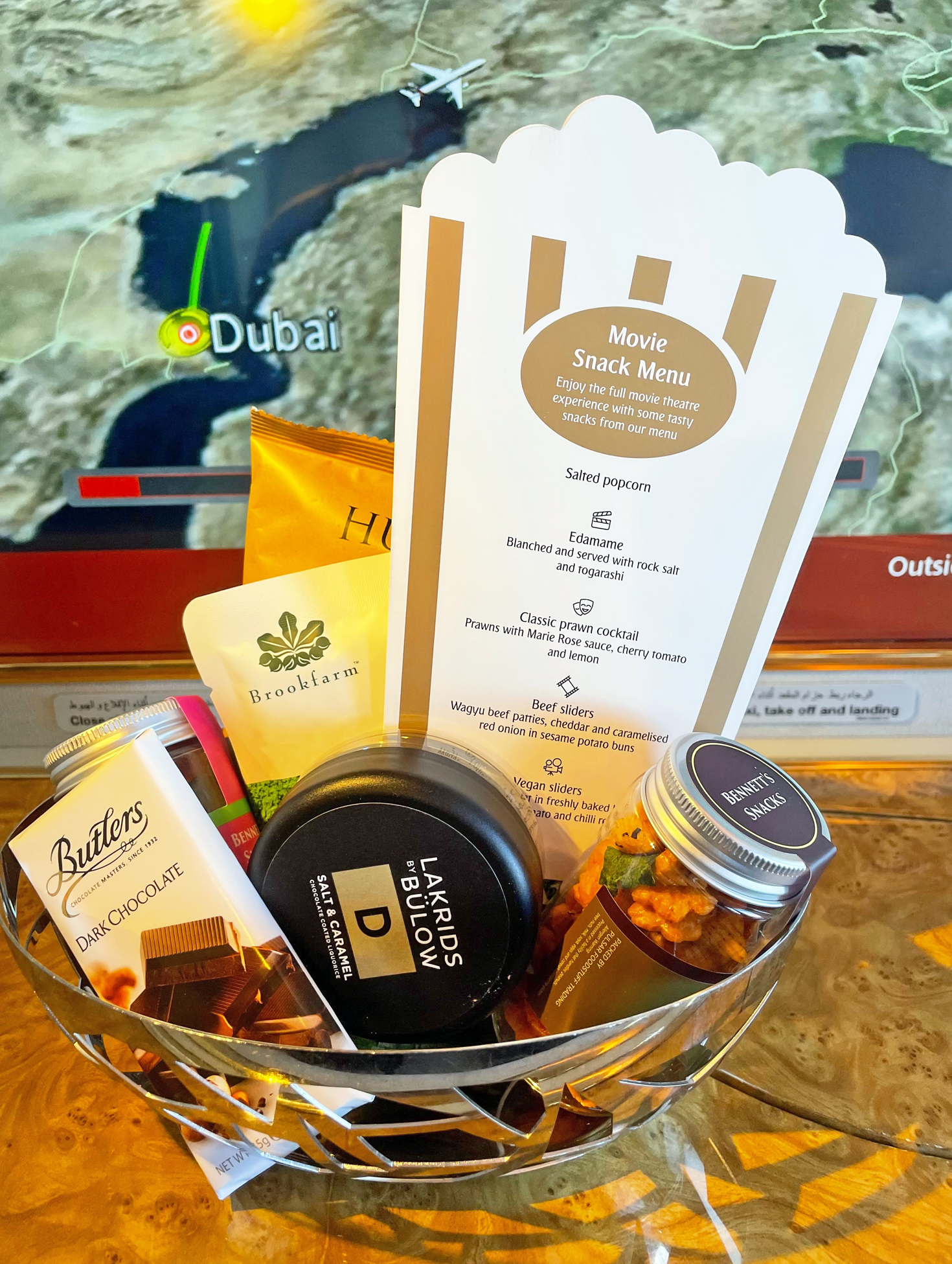
Emirates first class is… well. You’re looking at flights to Mauritius, Johannesburg, and Bangkok. Similar to Qatar Airways, this is dine-on-demand, and you’re free to mix and match entrees, appetizers, and desserts to your heart’s content. We start with a welcome-aboard glass of Dom Perignon followed by the airline’s signature caviar; then we see a mezze appetizer spread (yes that’s an appetizer), a shockingly delicious chicken biryani, and a tuna dish. Mind you this is first class; Emirates business is less lavish.
KLM
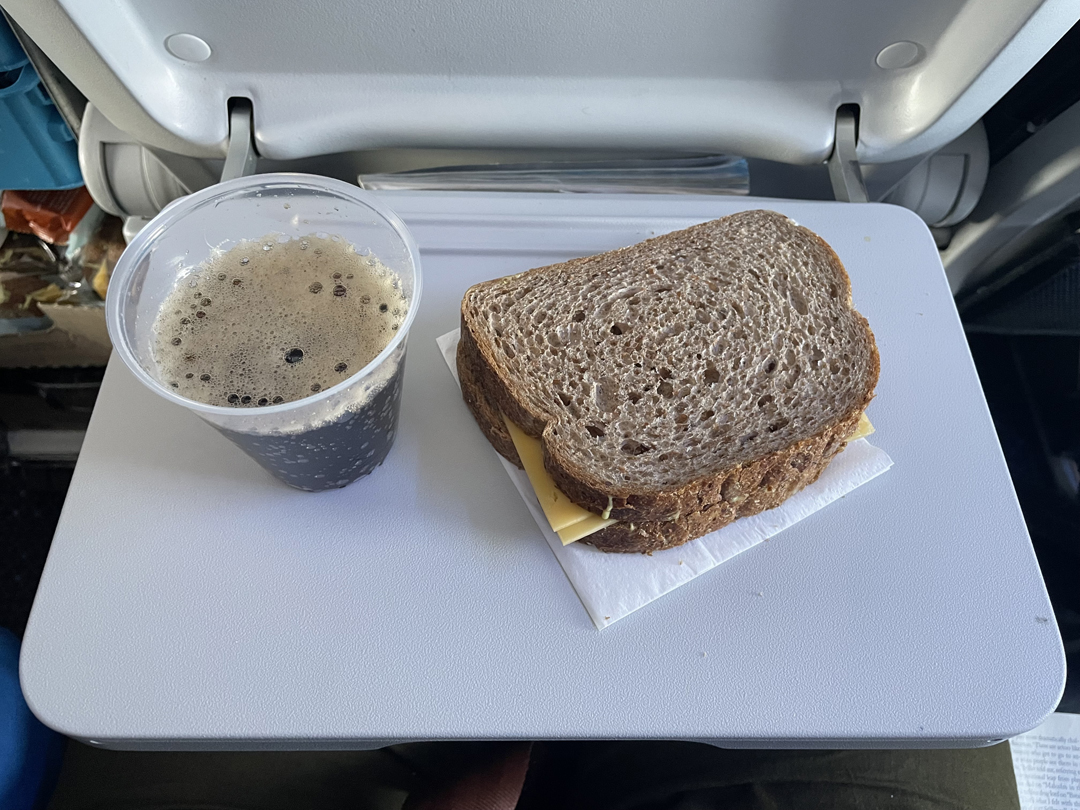
Or, you can fly KLM economy class from Dubrovnik to Schiphol and savor this.
Battle of the Bars
The Airbus A380s at Emirates and Qatar both have onboard lounges. Qatar’s is situated in the center of the upper-deck. The Emirates version is also upstairs, but in the back, behind business class. Emirates also has an exclusive upper-deck bar only for first class customers, located at the forward bulkhead between the shower spas. The lounge is staffed by a bartender, while the forward bar is serve-yourself.
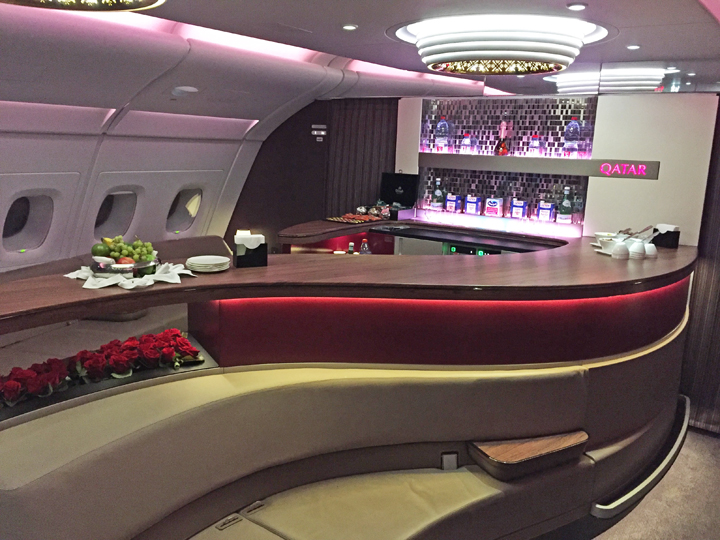
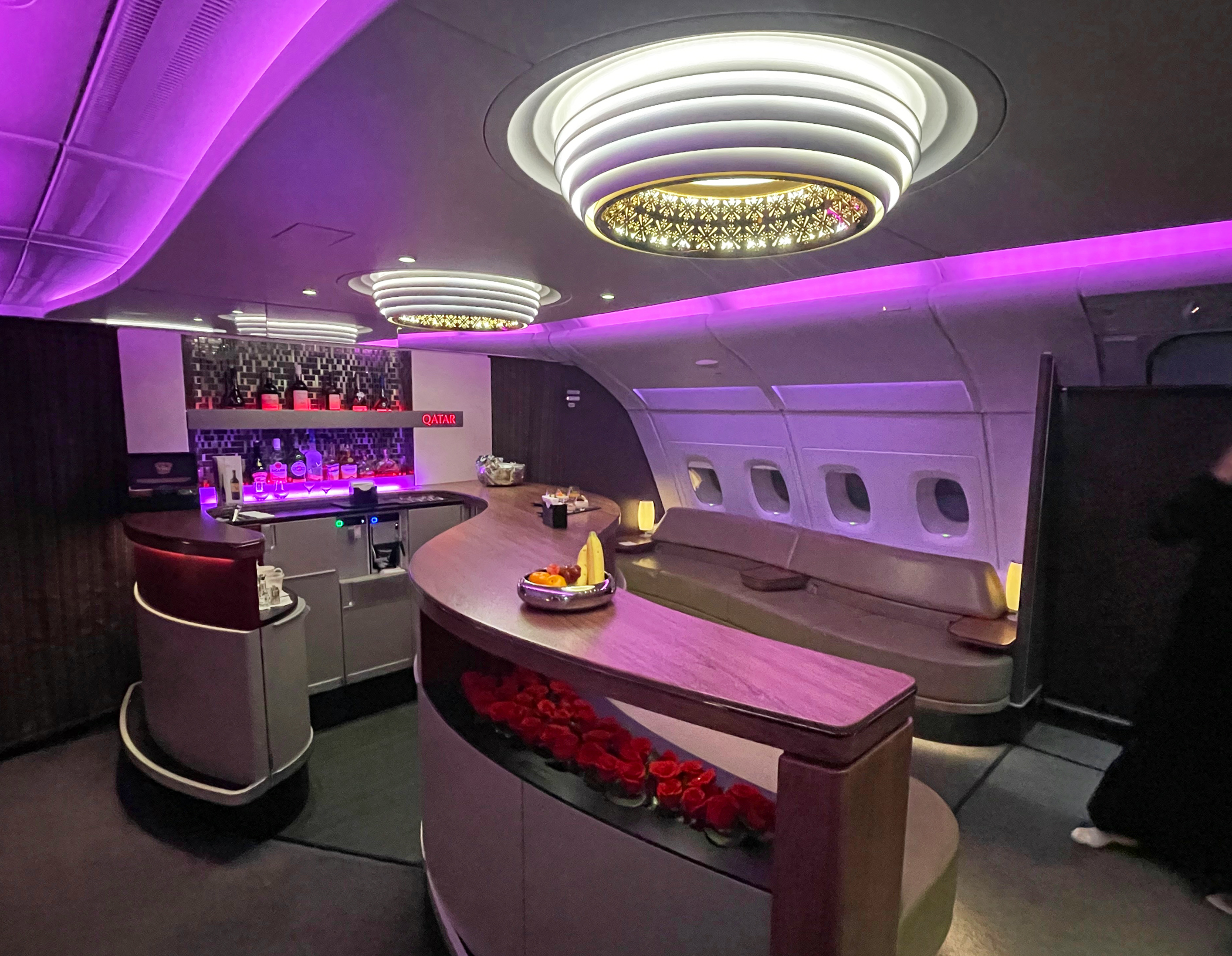
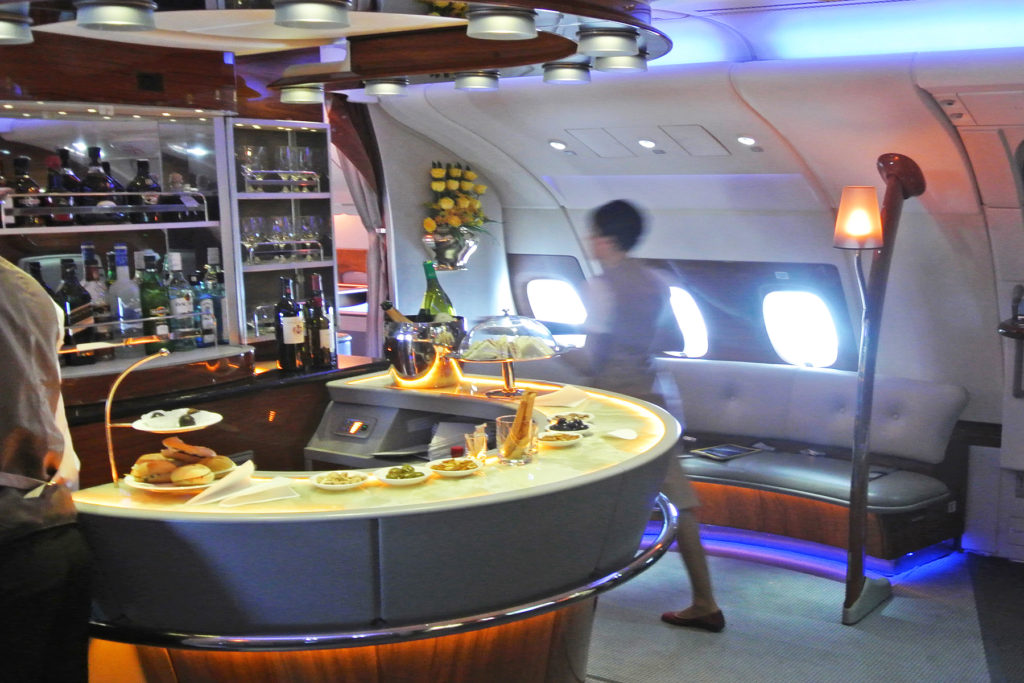
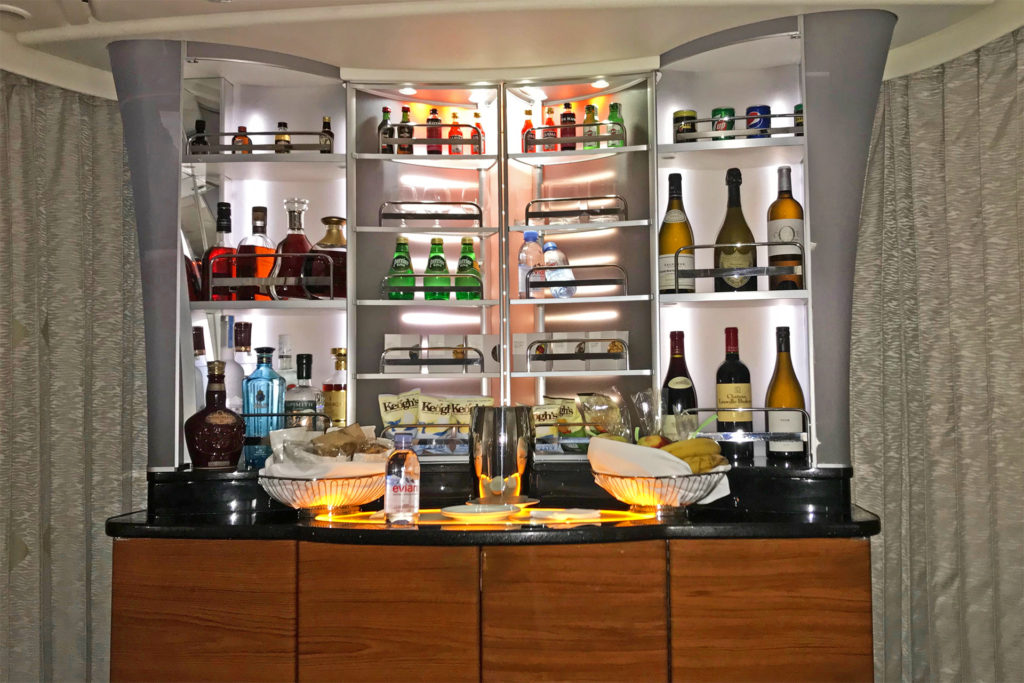
Tea Time
At the top, tea service on Qatar. On Emirates, the forward bar is taken down prior to arrival and a tea station is arranged in its place, backdropped by ornamental stones and waterfall. I mean, it’s hardly an airplane without rocks and a waterfall.



The Quiet Americans
Looking at those photos from the Gulf carriers, it’s easy to see that none of this is fair. Competing with heavily subsidized, government-owned airlines is pretty much impossible for American, European, and even most Asian carriers. Which isn’t to say their onboard products aren’t good. None of the U.S. carriers have returned quite to where they were pre-pandemic, but they’ve come a long way since the early 2000s, when broken seats, lousy food and terrible service were the standard.
Thirty Years On
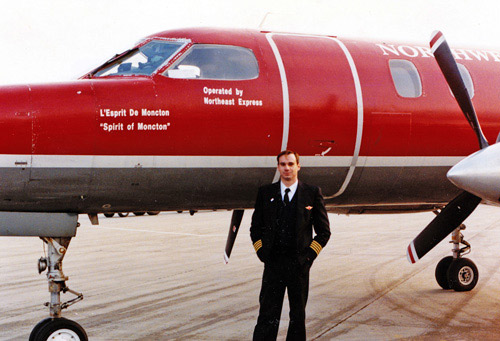
The author and the “Spirit of Moncton,” in 1994.
August 28, 2020
HOW LONG have you been a pilot?
I’m never sure how to answer that question. I had my private pilot’s license at nineteen, but is that the proper benchmark? For a number of years after that, building time as an instructor, I flew nothing bigger than a single-engine four-seater. Define “pilot,” I guess.
What most people are getting at, I think, is how long I’ve been an airline pilot. And the answer to that one is easy: thirty years. Thirty years to the day, in fact. There couldn’t be a worse time for the marking of such a milestone, what with the entire industry bleeding at the jugular. But that’s aviation for you. In this weird business, the forces that shape your career are usually those beyond your control.
And here we are.
I vividly remember “the call.” Nowadays it’s more likely to be a letter, or an email, but in those days it was always a call. It was the summer of 1990, and I remember the phone ringing. I remember standing in the kitchen of the house I grew up in, where I still lived at the time, and picking up the receiver, hoping it was the airline at the other end. And I can recall, pretty much verbatim, the entire conversation between me and a secretary named Vanessa Higgins, as she told me I’d been selected for class. I should report for training on Monday, August 28th, Vanessa explained. The adrenaline rush almost knocked me to the floor.
I date my 30th anniversary not to the moment of that phone call, or to the day, a few months later, when I lifted off the runway with passengers for the first time. To me, it’s the day that I showed up for classroom training, in a rented schoolroom in downtown Bangor, Maine. That was the day I became an employee. Our instructor was a young pilot named Ubi Garcez, who today is a captain for Delta Air Lines. He welcomed us, allowed us to dispense with our neckties, and issued our ID badges, which in those days were little more than pieces of laminated cardboard on which Vanessa had hand-typed our names. My employee number was 421. And typed across the bottom was my date of hire: August 28, 1990 — probably the most significant day of my life, save for my birthday.
The company was an upstart outfit called Northeast Express Regional Airlines. We were one of the feeder affiliates for Northwest. Our planes, painted in red, said “Northwest Airlink” on the side. The company had been started in Maine, and kept its offices there, but its hub was in Boston, where our small turboprops would bring passengers in from outlying cities and connect them to Northwest’s Boeings and Douglases headed around the country and overseas.
This was the shittiest of shitty airlines. The planes were old and working conditions dismal. My starting salary was $850 per month, gross, and my first aircraft, the Beech-99, was a relic from the 1960s. It had no pressurization or autopilot, and most of its instruments and radios were the same ones I’d seen in the cockpits of the Pipers and Cessnas I’d flown as a novice. But none of that mattered. Salary, working conditions — those things meant nothing to me. All that mattered was to be sitting in that room, with that stupid-looking ID clipped to my pocket.
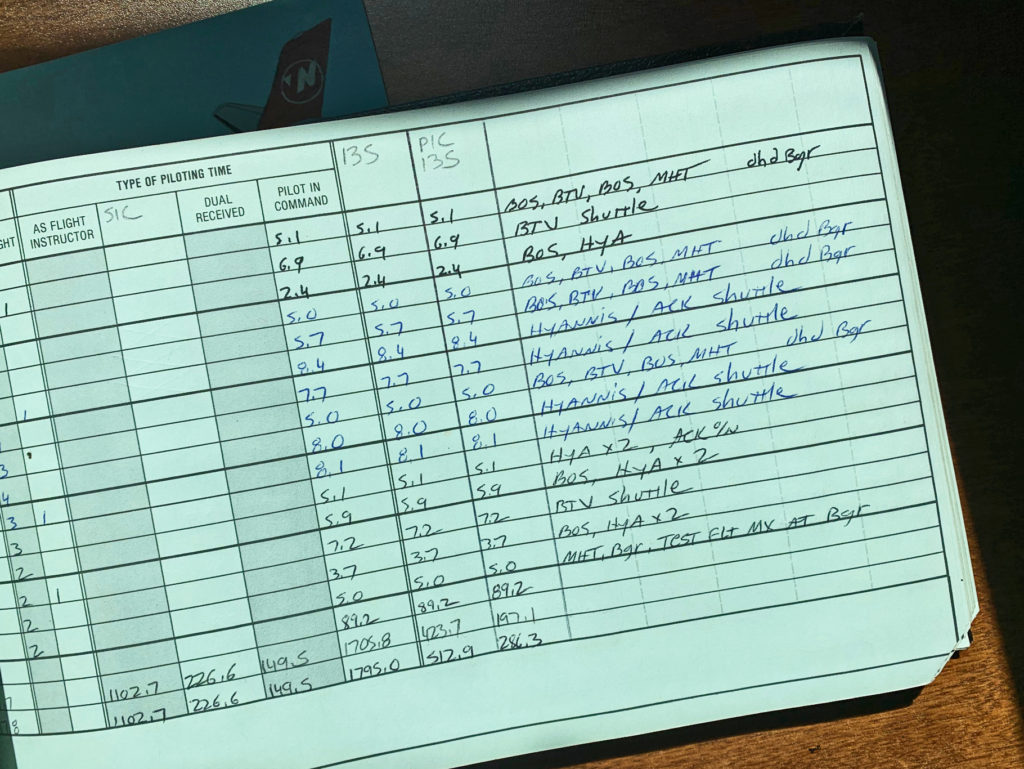
Page from the author’s logbook, 1991.
Pilot jobs in those days were exceptionally competitive. At twenty-four I was the third-youngest in our class of about a dozen. And with 1,600 or so flight hours I was one of the least experienced. I was fortunate to be there at all. I would study the others, wondering where and how I fit in. To this day I remember most of their names and can still hear their accents. One guy had flown business jets, another had flown 727s at Eastern. No, this wasn’t the major leagues. To make a baseball analogy, it was like getting to play for a last-place team at Triple-A in front of about 35 fans. But it was pro ball, so to speak. I’d made it. I was an airline pilot now.
My first “revenue flight,” to use a common if charmless aviation term, didn’t come for another three months. It would take place on October 21, 1990, a date promptly immortalized in yellow highlighter in my logbook. This cherished day involved, among other misfortunes, a drive to Sears at 9:30 in the morning, an hour before my sign-in time, because I’d already lost my tie. (And then the clerk’s face when I told him, “plain black” and “polyester, not silk.”). Then the big moment, in a thickening overcast just before noon, when I would depart on the prestigious Manchester, New Hampshire, to Boston route — a fifteen-minute run frequented, as you’d expect, by Hollywood stars, sheikhs, and dignitaries.
The plane was too tiny for a flight attendant, and I had to close the cabin door myself. Performing this maneuver on my inaugural morning, I turned the handle to secure the latches as trained, deftly and quickly in one smooth motion. What I didn’t see was the popped screw beneath the fitting, across which I would drag all five of my knuckles, cutting myself badly. The door was in the very back, and so I came hobbling up the aisle, stooping to avoid the low ceiling, with my hand wrapped in a bloody napkin.
It was oddly and improbably apropos that my inaugural flight would touch down at Logan International. Airline pilots, especially those new at the game, tend to be migrants, moving from city to city as the tectonics of a seniority list dictate. It’s a rare thing to find yourself operating your very first flight into the airport you grew up with. And I mean that — “grew up with” — in a way that only an airplane nut will understand. As I maneuvered past the Tobin Bridge and along the approach to runway 15R, I squinted toward the parking lot rooftops and the observation deck from which, as a kid, I’d spent so many hours with binoculars. Looking down, I was watching me watch myself, in a sense, celebrating this weird, deeply emotional culmination of nostalgia and accomplishment. If only my hand wasn’t bleeding so much.
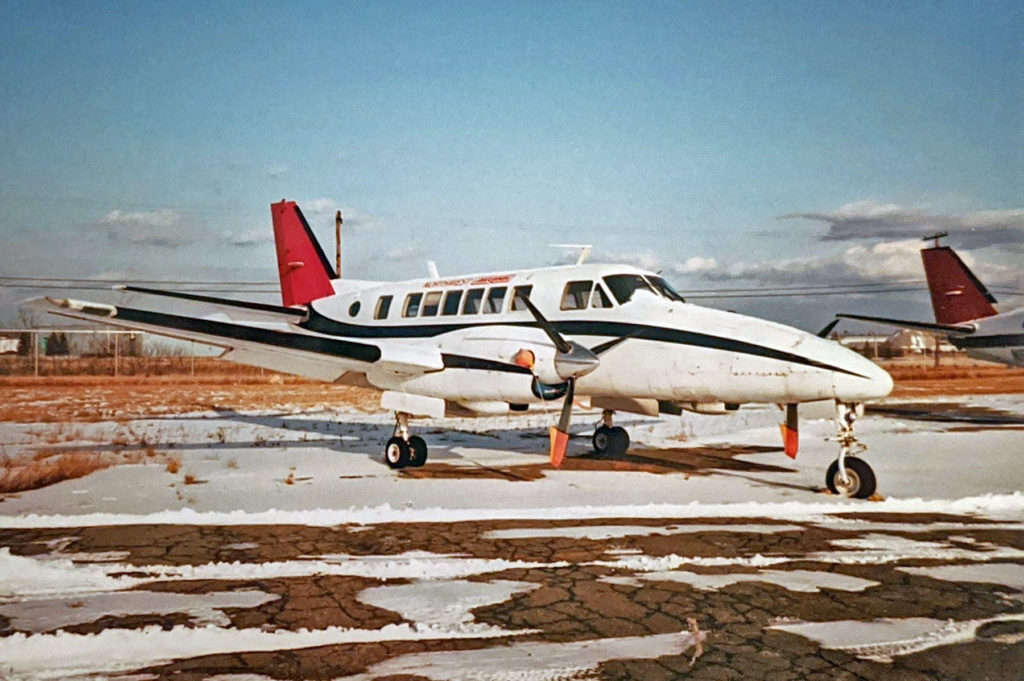
A Beech 99 of Northeast Express.
Noisy and slow, the Beech-99 was a ridiculous anachronism kept in service by a bottom-feeder airline and its tightfisted owner. It had rectangular cabin windows that gave it a vintage, almost antique look, like the windows in a 19th-Century railroad car. Passengers at Logan would show up planeside in a red bus about twice the size of the plane. Expecting a 757, they were dumped at the foot of a fifteen-passenger wagon built during the Age of Aquarius. I’d be stuffing paper towels into the cockpit window frames to keep out the rainwater while businessmen came up the stairs cursing their travel agents. They’d sit, seething, refusing to fasten their seat belts and hollering up to cockpit.
“Let’s go! What are you guys doing?”
“I’m preparing the weight and balance manifest, sir.”
“We’re only going to goddamn Newark! What the hell do you need a manifest for?”
And so on. But this was my dream job, so I could only be so embarrassed. Besides, the twelve grand a year was more than I’d been making as a flight instructor.
In addition to just enough money for groceries and car insurance, my job provided the vicarious thrill of our nominal affiliation with Northwest. Our twenty-five or so little planes, like Northwest’s 747s and DC-10s, were done up handsomely in gray and red. Alas, the association ran no deeper — important later, when the paychecks started bouncing — but for now I would code-share my way to glory. When girls asked which airline I flew for, I would answer “Northwest,” with a borderline degree of honesty.
Our uniforms were surplus from the old Bar Harbor Airlines. The owner, Mr. Caruso, had also been the owner at Bar Harbor, and I suspect he had a garage full of remainders. Bar Harbor had been something of a legendary commuter airline in a parochial, New England sort of way, before finally it was eaten by Lorenzo’s Continental. As a kid in the late ’70s I would sit in the backyard and watch those Bar Harbor turboprops going by, one after another, whirring up over the hills of Eastie and Revere. A dozen years later I was handed a vintage Bar Harbor suit, threadbare at the knees and elbows. The lining of my jacket was safety-pinned in place and looked as if a squirrel had chewed the lapels. Some poor Bar Harbor copilot had worn the thing to shreds, tearing the pockets and getting the shoulders soaked with oil and jet fuel. I’m fairly sure it had never been laundered. Standing with my fellow new-hires in our new (old) outfits for a group picture, we looked like crewmembers you might see stepping from a Bulgarian cargo plane on the apron at Entebbe.
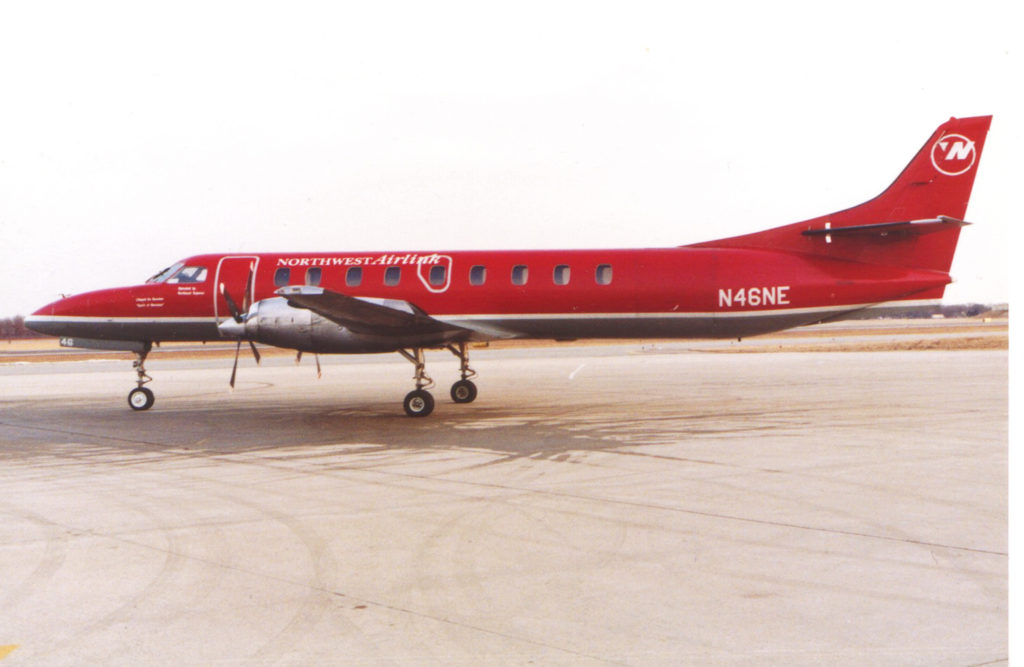
A Metroliner of Northeast Express, 1994.
My second plane was the Fairchild Metroliner, a faster and somewhat more sophisticated machine. It was a long, skinny turboprop that resembled a dragonfly, known for its tight quarters and annoying idiosyncrasies. At the Fairchild factory down in San Antonio, the guys with the pocket protectors had faced a challenge: how to take nineteen passengers and make them as uncomfortable as possible. Answer: stuff them side by side into a 6-foot-diameter tube. Attach a pair of the loudest turbine engines ever made, the Garrett TPE-331, and go easy on the soundproofing. All of this for a mere $2.5 million a copy. As captain of this beastly machine, it was my duty not only to safely deliver passengers to their destinations, but also to hide in shame from those chortling and spewing insults: “Does this thing really fly?” and “Man, who did you piss off?”
The answer to that first question was sort of. The Metroliner was equipped with a pair of minimally functioning ailerons and a control wheel in need of a placard marking it “for decorative purposes only.” It was sluggish and unresponsive, is what I’m saying. Somewhere out there is a retired Fairchild engineer feeling very insulted. He deserves it.
Like the 99, the Metro was too small for a cockpit door, allowing for nineteen backseat drivers whose gazes spent more time glued to the instruments than ours did. One particular pilot, whose identity I’ll leave you to guess, had doctored up one of his chart binders with these prying eyes in mind. On the front cover, in oversized stick-on letters, he’d put the words HOW TO FLY, and would stow the book on the floor in full view of the first few rows. During flight he’d pick it up and flip through the pages, eliciting some hearty laughs — or shrieks.
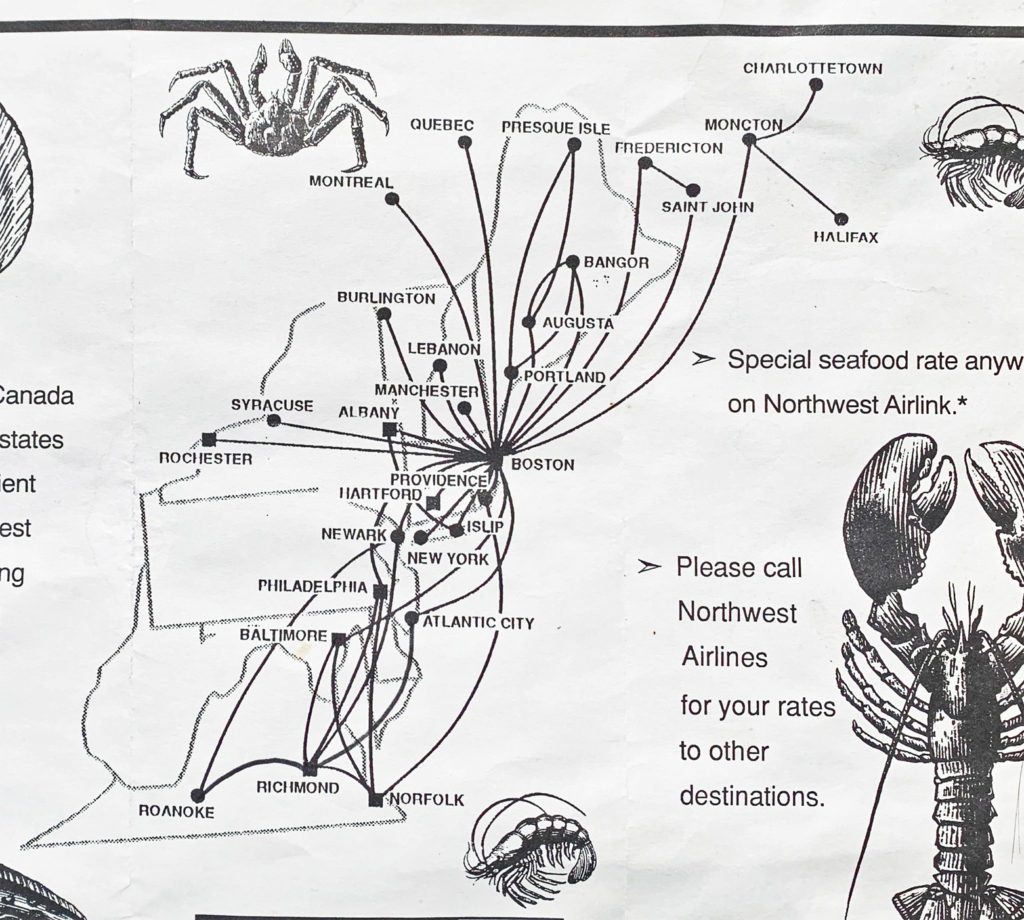
Northeast Express route map, 1994.
In the spring of 1993 I graduated from the Metro to the De Havilland Dash-8. The Dash was a boxy, thirty-seven-passenger turboprop and the biggest thing I’d ever laid my hands on. A new one cost $20 million, and it even had a flight attendant. Only thirteen pilots in the entire company were senior enough to hold a captain’s slot. I was number thirteen. I went for my checkride on July 7th, shortly after my twenty-sixth birthday. For the rest of the summer, I would call the schedulers every morning, begging for overtime. Getting to fly the Dash was a watershed. This was the real thing, an “airliner” in the way the Metro or the 99 could never be, and of all the planes I’ve flown, large or small, it remains my sentimental favorite.
I flew the Dash only briefly, and Northeast Express would be around only for another year. Things began to sour in the spring of ’94. Northwest, unhappy with our reliability, would not renew our contract. We were in bankruptcy by May, and a month later the airline collapsed outright.
The end came on a Monday. I remember that day as vividly as I remember my bloody-knuckle inaugural in New Hampshire four years earlier. No, this wasn’t the collapse of Eastern or Braniff or Pan Am, and I was only twenty-seven, with a whole career ahead of me; still it was heartbreaking — the sight of police cruisers circling our planes, flight attendants crying, and apron workers flinging suitcases into heaps on the tarmac. Thus the bookends of my first airline job were, each in their own way, emotional and unforgettable. That second one, though, I could have done without.
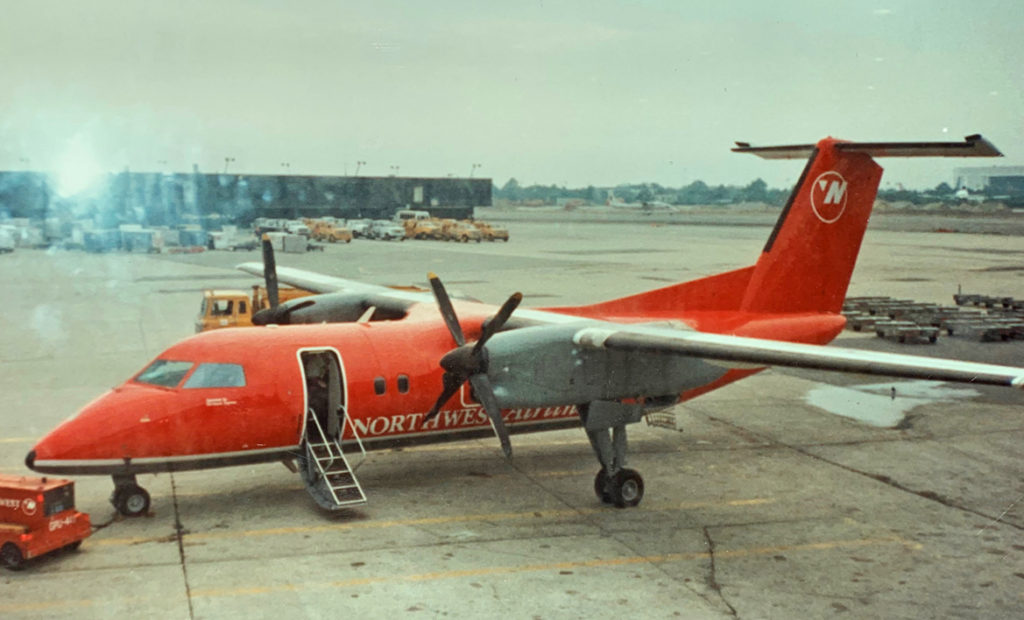
Dash-8 at Kennedy Airport, 1993.
I have only a few mementos from that job. A few scraps of paper, a set of wings, a coffee mug, and a tiny number of poor-quality photos, not one of which, for better or worse, shows the Beech-99.
From that final day at Northeast Express through today, it’s been both an uphill and downhill journey. Many years and five airlines later, I finally made it to the major leagues — to the New York Yankees, as it were, to revisit my baseball analogy. Along the way I’ve endured bankruptcies, multi-year furloughs, and now the COVID-19 debacle that, for all I know at this point, could end the game completely. Highlights, lowlights, life-defining thrills and crushing disappointments, it’s all packed in there.
And it continues. I judge my career as a successful one — I made it further than most pilots do — and it remains a work in progress. However and whenever it reaches its conclusion, at the beginning of it all — and really at the heart of it all — is that first day of class in 1990. Thirty years ago today.
Q&A With the Pilot, Coronavirus Edition

July 22, 2020
Q: How about a general comment or recommendation on the safety of flying during COVID-19. Should passengers be afraid?
The risks of contracting COVID-19 might be slightly higher on a plane than in certain other settings, but with everyone masked, middle seats empty, etc., they are still very low overall. The air on planes has always been cleaner than people think, and is even cleaner now. In addition, cabins are being disinfected and deep-cleaned after every flight, including a wipe-down of all trays, arm-rests, lavatory surfaces and so on.
At my airline, pilots, believe it or not, have been contracting COVID at a higher rate than flight attendants (though neither rate has been “high”), despite being isolated in the cockpit. That should underscore just how unlikely transmission is between passengers.
I’ve been flying a lot of late, both within the U.S. and a little bit overseas. In the past couple of months I’ve been to New York, Los Angeles, Orlando and San Francisco, among other places, plus two trips to Africa and one to Holland. COVID-19 itself is among the lesser of my worries. What frightens me is the destruction to society caused by our responses to it, necessary or otherwise.
Q: Planes are mostly empty right now. How does that affect the way a jet handles?
First, although fewer planes are operating, not all of them are lightly loaded. Flights have been consolidated and many are full — or as close to full as you’ll get in this environment, with many carriers having blocked off middle seats.
Second, passengers and their luggage comprise only a portion of a plane’s total weight — and that portion can be surprisingly small, especially on larger jets that carry a lot of fuel. For instance, the maximum takeoff weight of a Boeing 747 is about 850,000 pounds. The weight of 400 passengers (basically a full cabin) and their carry-ons is around 72,000 pounds. That’s under ten percent of the total.
It becomes more of a factor on smaller planes, but it’s still not as significant as you might think. The maximum weight for a 150-seat Boeing 737 or Airbus A320 is around 150,000 pounds. A full complement of passengers is roughly 27,000 pounds, or 18 percent of the total.
When I’m flying a 767 back from Europe, our fuel load alone might be 80,000 pounds. With every seat taken (those were the days), the combined weight of the plane’s occupants and carry-ons is under half that.
But now imagine a short, mostly empty flight. Here you have a low passenger load, a small amount of fuel, and perhaps no cargo. In this case the aircraft is substantially lighter than what the crew is used to, and it will handle differently.
The most noticeable change will be slower takeoff and landing speeds. Depending on the runway and configuration settings (flaps, slats, thrust), your liftoff speed (Vr) could be 20 or more knots below normal. This is a good thing in pretty much every respect. You’re using less runway and you’ve got better engine-out performance, all at more docile speeds.
Also you’ll have a more robust rate of climb, at a steeper “deck angle,” as pilots call it — maybe upwards of 20 degrees. I was riding on a mostly empty regional jet out of JFK the other day, and we took off like a rocket. It felt like we hit 5,000 feet within about sixty seconds.
On landing, unusually slow touchdown speeds can throw off a pilot’s perspective. The dynamics of how, exactly, will vary plane to plane and situation to situation. I recently flew an empty Boeing 757 from San Francisco to Los Angeles. Our Vref speed over the numbers was a ridiculous 108 knots, versus the 130 or so that is customary. The sense of “hovering” messed with my flare and the touchdown was, um, lumpier than I’d have preferred. (Strong headwinds can have this same effect: although your airspeed is normal, velocity relative to the ground can be 20 knots or more slower.)
In between, during cruise flight, differences are negligible or unnoticeable. You’ll be able to reach a higher cruising level more quickly, and you’ll consume less fuel, but otherwise there are no real changes in how the plane feels or behaves.
Q: How has the COVID-19 impacted your daily life and work schedule?
How do you even begin to measure this? Thousands of aircraft are grounded and 80 percent of flights, give or take, remain canceled. Any comparisons to 9/11 are beyond hackneyed. There are no comparisons. Nothing like this has happened before, and nothing about it has been pleasant.
I’ve been flying a lot of late, but only because my seniority allows it, and because of the fleet I’m assigned to. Many pilots have been idle for months. Airlines are utilizing different fleets at different rates; at a given carrier, 767 crews might be busier than A320 crews, for example, or vice-versa. Some airlines have been operating long-haul cargo charters, which is keeping their biggest planes — and their pilots — surprisingly busy. Other fleets, meanwhile, have been shut down almost entirely, meaning those pilots are doing nothing.
The so-called “airline bailout,” a.k.a. the CARES Act, was primarily a cover for salaries; it has not kept the airlines from hemorrhaging tens of millions of dollars daily. Salaries make up a significant fraction of an airline’s expenses, that’s true, but it’s still a fraction. The largest carriers continue to lose nearly $1 billion per month, each. All airline workers are pay-protected through the end of the summer. Beyond that, who knows. Industry consolidation, bankruptcies, liquidations, pay cuts, massive layoffs… we are likely to see all of those things.
I’ve been flying commercially since 1990. Most of the early jobs I had were marked by terrible pay and hostile working conditions, and I spent almost six years out of work after 9/11. I was into my forties before I ever made a decent living and had a lifestyle that I could enjoy. The thought of possibly losing it all is terrifying.
I guess this was one way of solving the pilot shortage.
Q: When you’re flying significantly less than usual, what steps must be taken to ensure your licence stays valid?
A pilot’s license never expires. What does expire, however, is his or her currency — i.e. “recency of experience,” as the F.A.A. puts it. To keep current in my aircraft type, I need two things. The first is to pass a semi-annual training evaluation. This is a two-day course that we repeat every nine months, usually referred to as “recurrent training.” In addition, we need to log a minimum of three takeoffs and landings every 90 days. If you drop put of currency, the airline has to run you through the simulator to bring it back again.
Takeoff and landing recency is a common issue for pilots who fly predominantly long-haul, and carriers will normally get you into the simulator ahead of time so that you don’t become unusable. Suddenly, however, amidst the COVID panic, it’s an issue for almost every pilot, and airlines are yet to figure out the most efficient way of dealing with it. To help, the F.A.A. has granted an extension of up to 60 days for takeoff and landing recency — though some airlines have voluntarily limited it to 30 days.
When I was laid off in 2001, I went more than five years without touching the controls of an aircraft. When I was recalled in 2007, that extended downtime made retraining a little more stressful than it would otherwise have been. Overall, though, it went smoothly, which is either a testament to my own skills or to my carrier’s training program. You decide. My return to the cockpit was detailed in a column here.
So much of flying is muscle memory — internalizing the location and operation of the various switches, prompts, buttons and levers — and the longer you’ve been flying a specific model, the stronger your retention. On my last assignment, finally in first officer’s seat again after a multi-week absence, I was surprised more by how quickly it all came back. So it goes, I guess, when you’ve been flying a 757 for 13 years.
Have a question? Leave it in the comments section below, or email the author at patricksmith@askthepilot.com
Related Stories:
COVID CASUALTIES
Q&A WITH THE PILOT, Volume 1
Q&A WITH THE PILOT, Volume 2
Q&A WITH THE PILOT, Volume 3
Q&A WITH THE PILOT, Volume 4
Connect the Dots
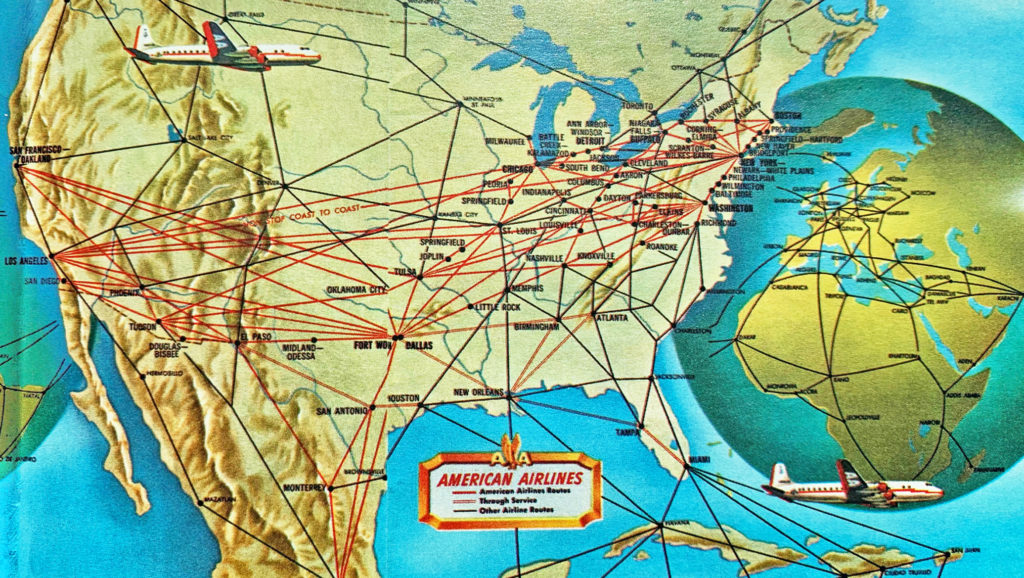
An American Airlines route map from 1954.
April 8, 2020
The COVID panic has reduced air travel to almost nothing. U.S. carriers have grounded up to 90 percent of their flights. Survival comes down to perseverance, bailout money, and innovation.
As to the latter, Alaska Airlines has a strategy to help it remain in markets where ridership has plummeted. Instead of relying on nonstop “spoke” flights from its Seattle hub, the airline will run consolidated, connect-the-dots style flights that take in multiple cities in a single run. For example, rather than operating one flight from Seattle to Pittsburgh, and another from Seattle to Baltimore, there’s now a single aircraft going Seattle-Pittsburgh-Baltimore. Seattle-Dallas-Houston and Seattle-Minneapolis-Columbus are two others.
It’s a useful way of adapting to the current environment. What it’s not, however, is new. Back in the proverbial day, this is what most cross-country flying looked like. Flights going coast-to-coast would often make two, three, possibly four stops along the way. I have a collection of timetables from the 60s and 70s; even then, well into the jet age, multiple-stop itineraries were common. A Boston to Miami flight with Eastern, for instance, might have stopped in Philadelphia and Atlanta. In PHL or ATL, passengers destined for those cities would disembark while additional Miami-bound passengers came aboard. “Through” passengers, as they were called, remained in their seats. The same thing was common in long-haul markets overseas. A flight from London to Singapore might have gone via Rome, Istanbul, Karachi and Bombay. How about: London-Rome-Khartoum-Nairobi-Johannesburng? In the 1940s, Qantas’ so-called “Kangaroo Route” made six stopovers between London and Sydney. When I traveled to Montana with my family in 1980, our Northwest flight went Boston-Detroit-Milwaukee-Minneapolis-Billings-Bozeman. The only change of planes was in in Minneapolis.
These were known as “direct” flights. Today the terms “direct” and “nonstop” are used interchangeably, but in the old days a “direct” flight merely meant there’d be no change of aircraft or flight number.
A lot of this was necessity. The range and payload constraints of older generation aircraft made nonstops unfeasible beyond a certain distance. But part of it, too, was efficiency. Carriers needed fewer planes and fewer crews.
Modern examples still exist. Southwest operates a number of multiple stop directs. Traveling to Bhutan in 2017, I boarded a direct flight from Bangkok to Paro. Along the way we spent 35 minutes on the ground in Gauhati, India, a city I had never heard of before. “Through” passengers like me stayed on board. On a recent flight from Phnom Penh to Doha on Qatar Airways, same thing, this time with a short stopover in Ho Chi Minh City. Ditto for an Emirates flight that went Phnom Penh-Yangon-Dubai. Plenty of examples are out there, but the remain-on-board option is increasingly rare.
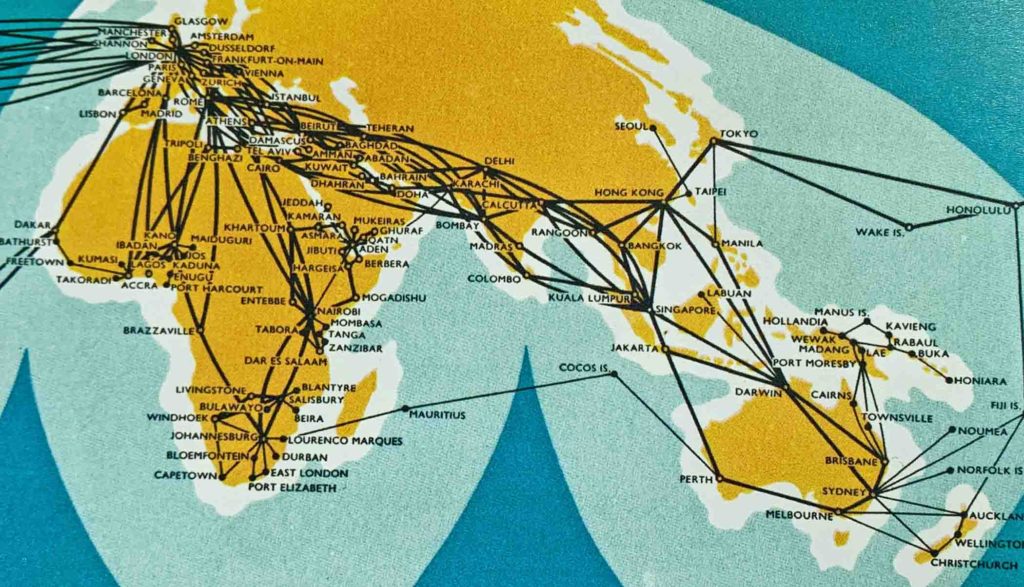
BOAC’s eastbound routes in 1958.
The maps above (and below) are lifted from “Airline Maps, A Century of Art and Design,” a new book by Mark Ovenden and Maxwell Roberts.
I’ve been infatuated by airline route maps my whole life. They are what turned my passion for commercial aviation into a love of travel as well: a way of graphically understanding the airplane as something bigger than a means to an end. There’s something oddly meditative and Zen about them. As a kid, whenever I got hold of an airline timetable (back when such things existed) the first thing I’d do is open to the route map. The best were the center fold-outs, with the extra third page. I could spend hours studying those those arcs and lines. “Next time you’re wedged in economy, flip to the map section in the back of the inflight magazine,” I write in the introduction to my book. “Those three-panel foldouts and their crazy nests of city pairs were, for me, a kind of junior pilot porno.”
Now there’s 140 pages of them, spanning nine decades.
As you’d maybe expect, the authors spend most of their time in the decades between 1930 and 1970, when airline iconography and graphic design became an artform all its own. The selections from this period range from cartoonish to elegant, many of them nothing short of cartographic marvels. Almost all of them are colorful, whimsical, and historically evocative. Now departing for Leopoldville, Leningrad and Calcutta: it’s the history of air travel, design, geography and geopolitics all at once.
Most carriers still produce route maps, viewable online or in their magazines. They’ve become a lot simpler, and the presentation can be confusing. Some have done away with lines and rely only color-coded dots for destination cities, giving you only half the story. Worse are the ones that include the flights of code share and joint-venture partners, leaving the maps so cluttered you can’t make sense of them.
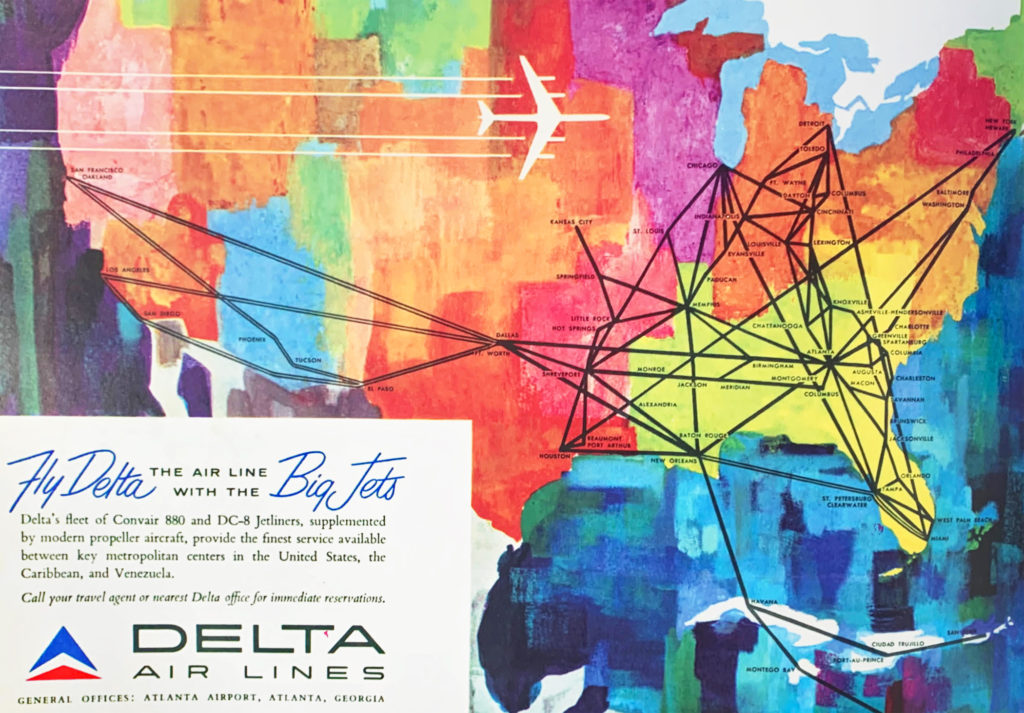
Delta Air Lines in 1960.
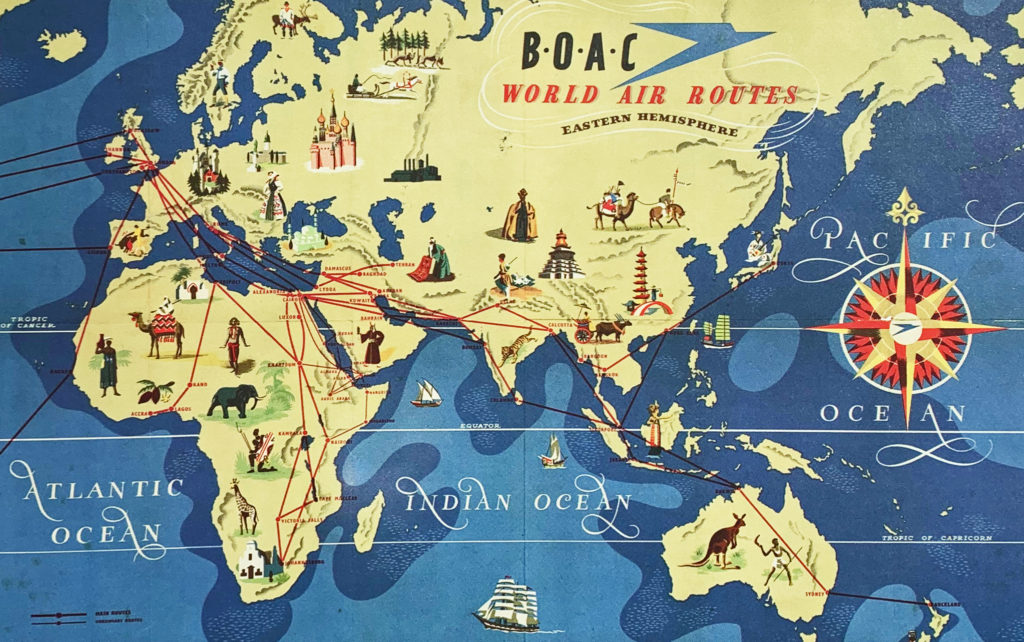
BOAC’s eastbound system shortly after World War 2.

Air France’s intercontinental routes, 1959.
Related Story:
The Airplane That Isn’t
Boeing bet the future on a 50 year-old design. Did it lose?
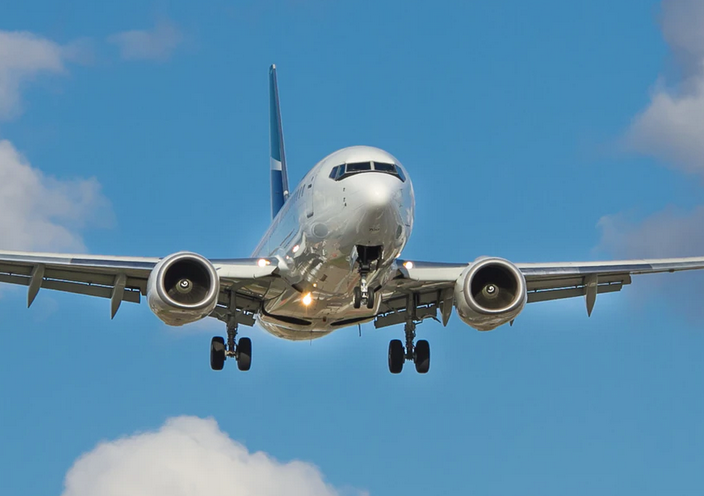
December 16, 2019
I’M DEPRESSED. I’m depressed because the word on the street has it that Boeing will not be moving forward with its so-called “new midsize airplane,” or NMA, also known as the 797. That’s the rumor, at any rate.
If built, the 797 would bridge the range and capacity gap between the narrow-body 737 family and the much larger 787 and 777 families — a slot occupied by the now-geriatric 757 and 767. The concept was formally unveiled at the Paris Air Show two years ago, and the planemaker has been mulling it over ever since. The uncertainty around the project has become a simmering backstory to the ongoing 737 MAX saga.
The two are not unrelated.
Back about fifteen years ago, Boeing had a decision to make. It’s popular 757 was getting long in the tooth. Orders were drying up and the company would need to develop a replacement. This wouldn’t be easy, because the 757 was, and still is, a very special machine. You might call it the most versatile jetliner Boeing has ever built: a medium-capacity, high-performing plane able to turn a profit on both short and longer-haul routes — domestic or international; across the Mississippi or across the North Atlantic.
And along the way it meets every operational challenge. Short runway? Stiff headwinds? Full payload? No problem. With 180 passengers, the plane can safely depart from a short runway, climb directly to cruise altitude, and fly clear across the country — or the ocean. Nothing else can do that. And it’s a great-looking plane to boot.
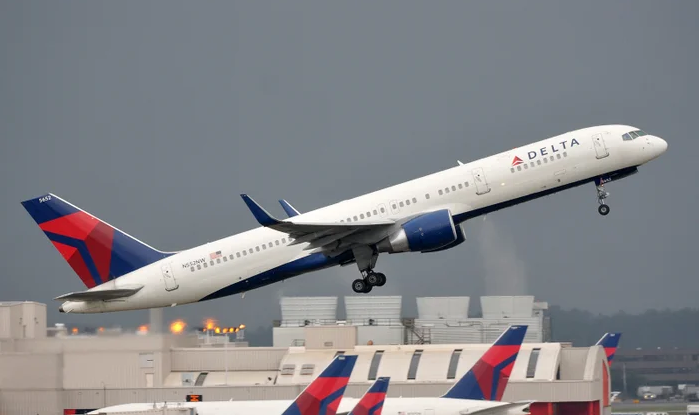
Essentially three options were on the table. The first was to come up with a plane from scratch — a brand-new jetliner of roughly the 757’s size and capabilities. A second, less expensive option would be to equip the existing airframe with new engines, modern avionics and other upgrades — a 757-X, if you will. Option three would be to abandon the 757 template altogether and, instead, turn to the company’s favorite cash-cow, the 737, and somehow push it, squeeze it, force it, into the role of the 757.
Although Boeing hasn’t — at least not yet — officially abandoned the idea of new airplane, it is option three, if only by default, that seems to have won. Production of the 757 ceased for good in 2004, and the 737 remains Boeing’s only non-widebdoy replacement option. Need a 180-ish seater? If you’re buying from Boeing, it’s a 737 or nothing: the -800, the -900, or the beleaguered MAX.
None of these, however, can do what the 757 does. The 737’s range allows U.S. coast-to-coast and limited transatlantic pairings, but anything further is out of the question. And what it can do, it doesn’t do particularly well. On longer routes it’s often payload and/or altitude restricted, and for a jet of its size it uses huge amounts of runway with startlingly high takeoff and landing speeds.
I was jammed into the cockpit jumpseat — more of a jump-bench, actually — on an American Airlines 737-800 not long ago, flying from Los Angeles to Boston. Man, if we didn’t need every foot of LAX’s runway 25R, at last getting off the ground at a nearly supersonic 165 knots. What would it be like on the westbound leg, I wondered — a longer flight, from a shorter runway, in the face of winter headwinds?
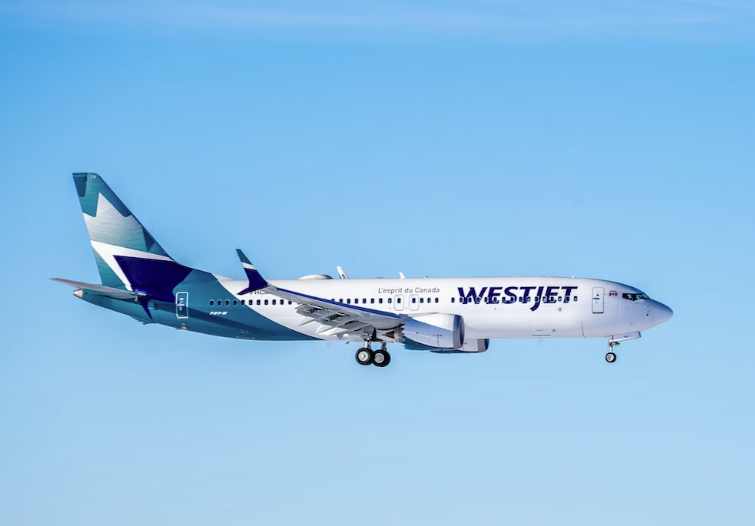
By contrast, I recently piloted a 757 from Boston to San Francisco. At flaps 20, we lifted off at a docile 130 knots from Logan’s stubby, 7000-foot runway 09, with nearly half the runway still remaining! With every seat full and seven hours’ worth of fuel, we climbed directly to 36,000 feet and flew all the way to California. That’s performance. A 737 cannot come close to that.
In the 737, Boeing took what essentially was a regional jet — the original 737-100 first flew in 1967, and was intended to carry a hundred or so passengers on flights of around 400 miles — and has pushed, pushed, and pushed the plane into roles it was never intended for. Bigger and bigger engines, fancier avionics, MCAS. Five decades and ten variants later, the MAX is a monsterized hybrid of a thing — a plane that wants, and needs to be something that it’s not: all muscle and power and advanced technology, jammed into the framework of a fifty year-old design.
From the other side of the Atlantic, meanwhile, the Airbus line features a similar gap. The A310 died away a long time ago, and size-wise there’s nothing between the A320 family and the long-haul A330.
Or is there? The biggest Airbus narrow-body is the A321 — a stretched-out version of the basic A320. Two upcoming variants, the A321LR (long range), and the A321XLR (extra long-range), are about to hit the market. With two-class seating for around 200 passengers and a range of almost 5,000 nautical miles, these aircraft have enormous potential. JetBlue is among airlines planning to use the LR on routes across the pond, serving Western Europe from New York and Boston.
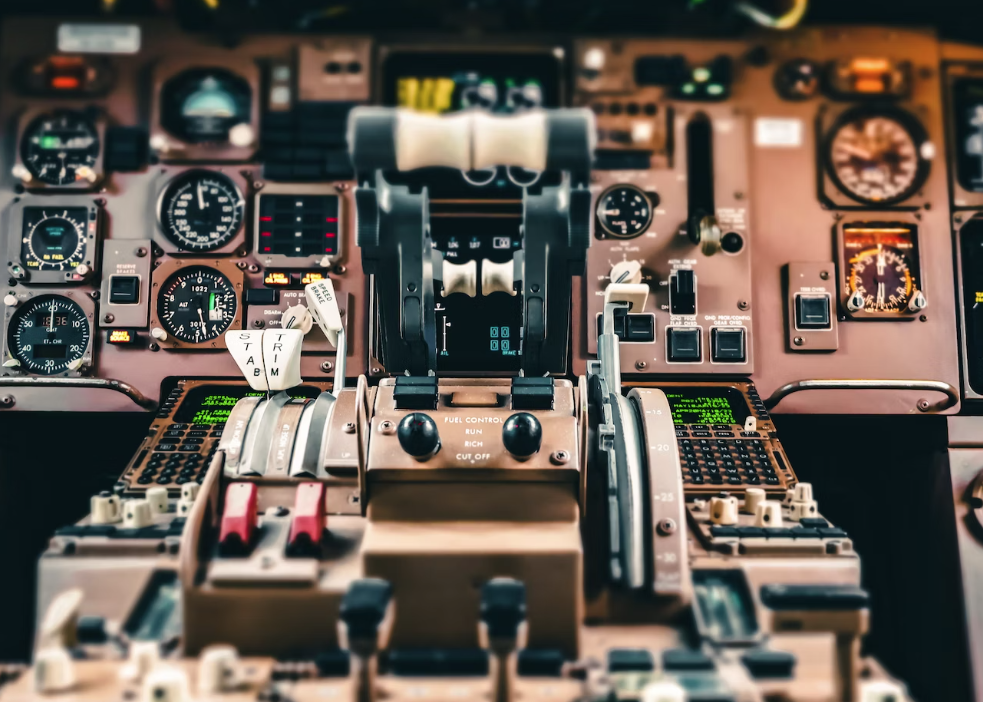
Whether you’re an airline CEO, a pilot, or a passenger, there’s a lot to like about the A320 family generally, certainly when matched against the 737. It requires less runway, for one, and uses tamer takeoff and landing speeds. On the inside it’s quieter and more spacious, A few weeks ago I rode aboard a 737 for the first time in a while. I normally find myself on an A320 or A321, and I was startled at how uncomfortable the 737 was. I had a window seat about a third of the way down, and the narrower cross-section meant my shoulder was pressed into the sidewall the entire time.
And the noise. The 737 is a loud airplane. On a two, three, or four-hour trip such comfort levels are acceptable. But six? How about a seven-hour nonstop from Gatwick or Shannon?
And if you think it’s noisy in the cabin, you should hear the cockpit, where the sound of the onrushing air must push a hundred decibels. Loud and tight, with barely enough room for the crew’s hand luggage. It’s interesting how both the A320 and the 737 families have roughly the same exterior dimensions, yet somehow the A320’s cockpit is three times roomier and five times quieter. How can that be? Well, look closely at the nose section of the 737. Do you recognize that? The old-fashioned flight deck windows, the shapes of the radome and fuselage? It’s the 707. Unchanged in over sixty years.
Take a MAX and put it next to an old 737-100 from the late sixties. It’s at once the same and yet completely different. You can virtually see the airplane straining, stretching, reaching — trying so hard to become something else. And therein is the problem. Boeing desires the commonality, the simpler training footprint and all the good things that the 737 family offers. But it also wants a plane that can take 200 people across the ocean. What it’s finding out is that perhaps, after all, they cannot be the same thing. You can only reinvent so many times.
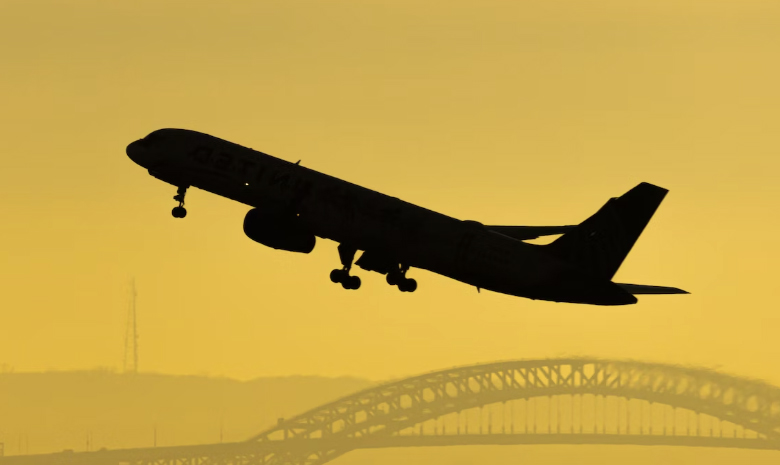
Indeed the A321LR will be the closest thing out there to a 757. Comfort-wise it’ll be equal, if not superior, with almost the range, almost the capacity, and almost the muscle. Sure, those are a lot of important almosts. Eventually, however, the last 757 will be put to pasture, and when that happens, the lack of a 797 all but assures the A321’s domination of the mid-market niche.
Until that day, U.S. carriers continue holding on to their 757s. Hundreds remain in service on trunk routes and transcons. United and Delta have flown 757s from their East Coast gateways on eight-hour services to Western Europe, Scandinavia, even Africa. Of course, you’ll also see it on 60-minute segments into Kansas City, Cleveland, Tucson and Tampa. Nothing can match it across such a wide swath of markets, with little or no concerns as to weather, payload or runway length.
As to its relunctance in committing to the 797, Boeing says that the sales potential for such a plane, estimated at anywhere from three-hundred to a thousand examples, is possibly too limited. As a point of comparison, the company claims that it won’t break even on its 787 program until at least 1,500 aircraft have been delivered. If true, that’s a sad testament to how expensive it has become to develop new aircraft. If a thousand airplanes can’t justify a new line, what can?
Still, it seems that filling such a niche should be well within the technical expertise, and certainly the imagination, of the world’s largest and most prolific plane-maker. Wouldn’t the 797 borrow much of the 787’s architecture, and thus be cheaper to produce? And isn’t this the same company that, fifty years ago, created the 747, an airplane more than double the size of any existing plane, taking it from a napkin drawing to an actual, in-the-air prototype in less than two years! Forgive me for looking at this romantically, but what happened to that sprit and vision?
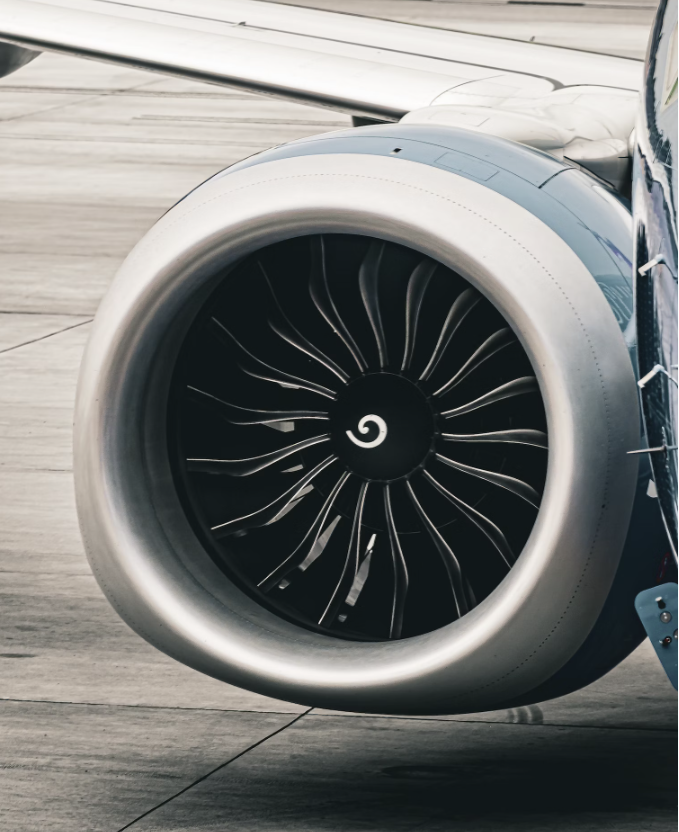
And if Boeing does press ahead with the 797, will they build the right plane? Preliminary renderings of the NMA from 2017 show us a jetliner seating between 220 and 270 passengers, with a composite fuselage and wings, and a range of around 5,000 nautical miles. Is it just me, or is this much too big? I like the twin-aisle idea; two aisles make for faster boarding and deplaning, and give the cabin a roomier feel overall. But, otherwise, how is this not just a 787 with a shorter range? A 757 replacement should be a plane that tops out at around 220 passengers, not one that starts there.
“It strikes me that the airplane Boeing ought to be putting out there is one that already exists, at least as a template,” I wrote on my website about a year ago. I was talking about the 767, Boeing’s venerable quasi-widebody that dates to the early 1980s. Although a passenger version hasn’t been ordered in years, the jet remains in production as a freighter and as a military midair refueler. Why not upgrade it, I asked in my article, with new engines, a new cockpit, and overhauled internal systems? Is that not a better option — especially considering the limited market that Boeing sees — than spending billions on an all-new airframe? “Call it the 767-X,” I wrote.
Well, in October of 2019 Boeing released a proposal for a 767 derivative called, guess what, the 767-X.
However, the 767 I had in mind as a baseline was the original -200. The -200, which debuted in 1982, is a long-since obsolete aircraft that, by today’s standards, would be laughably uneconomical. In terms of size, range, and capacity, however, it’d be just about perfect. Imagine a modernized, re-engined version delivering twin-aisle comfort for 180-200 people, containerized luggage and cargo, and all the range and unbeatable brawn of the 757. What’s not to like?
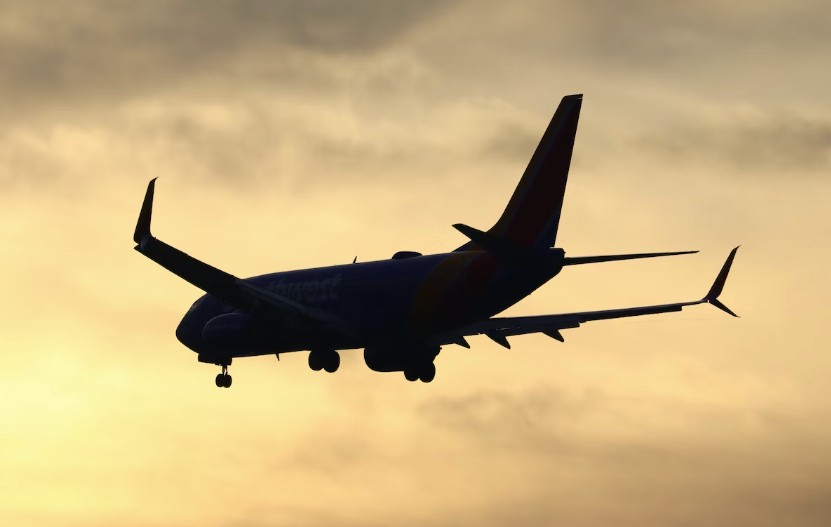
Boeing, though, says the -X would build not on the platform of the -200, but on that of the -400, and would be aimed at the cargo market. The -400, which sold very poorly, has seats for around 250 people. Again this is too big. In any case, Boeing eyes the 767-X chiefly as a freighter, not a passenger carrier.
Which leaves us… where?
While Boeing makes up its mind, the 737 MAX drama continues at center stage. And here’s the part we hate to ask but need to: why did the MAX need to exist in the first place?
What if, back in 2004, Boeing had gone ahead with the 797 in lieu of yet bigger and heavier 737s? And were the MAX tragedies, on some deep-down level, an inevitable result of Boeing’s decades-long obsession with its 737 — its determination to keep the production line going, variant after variant, seemingly forever? Where in the blame pie does poor corporate strategy and stubborness fall?
There’s a place for the 737 and always will be. I just don’t know if that place is as far and wide as Boeing would like it to be. And although you won’t see it any reports, but what happened in Africa and Indonesia is, maybe, fate’s way of telling Boeing that the time has come to move on.
This article appeared originally on The Points Guy website and is being used with permission.
Photos courtesy of Alberta Riva, Justin Hu, Daniel Shapiro, Nicholas Susilo, Joao Zymot, Bing Hui Yau and Unsplash.
Plane and Pilot

September 20, 2019
WHEN WILLIAM Langewiesche takes on an airplane crash, he almost always nails it. Nobody is better. His dissection of the Air France 447 disaster, for example, was brilliant, and his exploration of the 2007 midair collision over the Amazon is one of my all-time favorite aviation pieces. And just a couple of months ago I sang the praises of his conclusions on the Malaysia 370 mystery.
That doesn’t mean I always agree with him. He knows this. We’ve spoken a few times and argued a point or two. In no way does it diminish his journalist expertise or his understanding of aviation, but every so often, on this or that point, we see things differently.
Which takes us to Langewiesche’s feature in the most recent New York Times Magazine, looking into the 737 MAX disasters — the Lion Air crash in particular. It’s all the things it should be — exhaustively researched, technically accurate, eloquently written and styled — and getting a lot of attention. But it leaves me with a bit of a sour feeling. I’m just not sure the story is — what’s the best word here? — fair. It’s insulting to airline pilots in several spots: dismissive, condescending, even a little flip. In the end, the impression people are left with is that the MAX crashes — both of them — were more the result of operator error than a technical malfunction or defective design. I don’t believe the author intended this; the piece is very complex and nuanced. But Boeing certainly loves the idea, and based on mail I’ve received and comments I’ve heard, for many that’s the takeaway. This is compounded by the title: “What Really Brought Down the Boeing 737 Max.” While probably an editor’s pick, it’s misleading and inflammatory.
William is absolutely correct that the global pilot shortage is creating a hazard, in some cases putting woefully inexperienced crews at the helm of sophisticated jetliners. How and whether that plays into the MAX crashes, however, is maybe not as clear as he thinks. I also worry that the story will only serve to encourage the prejudiced subset of pilots out there who believe that non-Western pilots are categorically inferior. If only the two doomed planes had been crewed by U.S. or European pilots, their thinking goes, rather than pilots trained in Ethiopia or Indonesia, they wouldn’t have crashed.
Most of the author’s analysis involves the Lion Air flight. A case can be made that the crew of flight 610 turned a survivable situation into a non-survivable one through some poor decision making (specifically, by attempting to troubleshoot a control problem rather than immediately land). But it’s just that: a case. There were a lot of moving parts in that cockpit, both figuratively and literally, and what seems the safer choice in a tidy postmortem analysis isn’t always obvious in the heat of battle.
As to the pilots aboard Ethiopian flight 302, I’m not sure anything could have saved them. The issue that, to me, needs emphasis galore, is the aerodynamic lockout they purportedly faced…
The investigation shows the Ethiopian pilots did, as they should have, engage the plane’s pitch trim disconnect switches in a frantic attempt to regain control after a malfunctioning MCAS system forced the plane’s nose toward the ground. This pair of switches, on the center console near the thrust levers, killed power to the entire automatic pitch trim system, including MCAS, and should have allowed the pilots to maintain a normal flightpath using manual trim and elevator. Manual trim is applied by turning a large wheel mounted to the side of that same center console. Elevator is controlled by moving the control column forward or aft.
Yet they did not, could not, regain control. The reason, many now believe, is a design quirk of the 737 — an idiosyncrasy that reveals itself in only the rarest of circumstances. That is, when the plane’s stabilizers are acting to push the nose down, and the control column is simultaneously pulled aft, a sort of aerodynamic lockout forms: airflow forces on the stabilizers effectively paralyze them, making them impossible to move manually.
Aboard flight 302, the scenario goes like this: Commands of the faulty MCAS are causing the automatic trim system to push the nose down. The pilots, trying to arrest this descent, are pulling aft on the control column. The trim forces are stronger than the control column forces, which is why pulling back on the column has no effect. But now, with power to the trim system shut off, they should be able to lift the nose by manually by rotating the trim wheel aft, relieving that unwanted nose-down push. But the wheel won’t move. Believing the manual trim is itself broken, the pilots then reengage the auto-trim. MCAS then kicks in again, pushing the nose down even further. What’s worse, as the plane’s speed increases, the lockout effect intensifies. And so, with every passing second it becomes more and more difficult to recover.
The correct course of action would be to relax pressure on the control column, perhaps to the point of pushing the nose down even further. This will free the stabilizers of the aerodynamic weirdness paralyzing them, and allow the trim wheel to move, realigning the stabilizers to a proper and safe position. For the pilots, though, such a move would be completely counterintuitive. Instead, they do what any pilots, with pretty much any background and any level of experience, would be expected to do under the circumstances. Turns out it’s the wrong and deadly thing, but they have no way of knowing.
A friend and former colleague of mine — an experienced, American-trained pilot who spent most of his career at U.S. carriers — worked for a time as a training captain at Ethiopian Airlines. He knew the captain of flight 302 and has only the most positive things to say about his skills and professionalism. Maybe Langewiesche ought to have spoken to Seth. He at least could have spoken more of the 302 crash, the dynamics of which, unfortunate as they were, remind people that even the most talented and experienced pilots can find themselves in impossible situations. It would have rounded out the story and given it a more even-handed feel.
Additionally, I wish he’d more cleanly critiqued Boeing’s decades-long obsession with its 737 platform, and its determination to keep the production line going, variant after variant, seemingly forever. Instead of starting from scratch with a new airframe, they took what was essentially conceived in the 1960s as a regional jet, and have pushed and pushed and pushed the thing — bigger and bigger engines, fancier avionics, MCAS — into roles it was never intended for. At the heart of this whole fiasco, maybe, is bad corporate strategy and stubbornness.
Related Stories:
THE RIDDLE MAY NOT BE DEEP
ETHIOPIAN, LION AIR, AND THE 737 MAX
"I wish I could fold up Patrick Smith and put him in my suitcase."
- Stephen Dubner,
Coauthor of Freakonomics
"Always excellent."
– James Fallows,
The Atlantic



Subscribe to our mailing list
Subscribe