Archive for 1

What’s the Big Obsession With Doors?

February 3, 2026

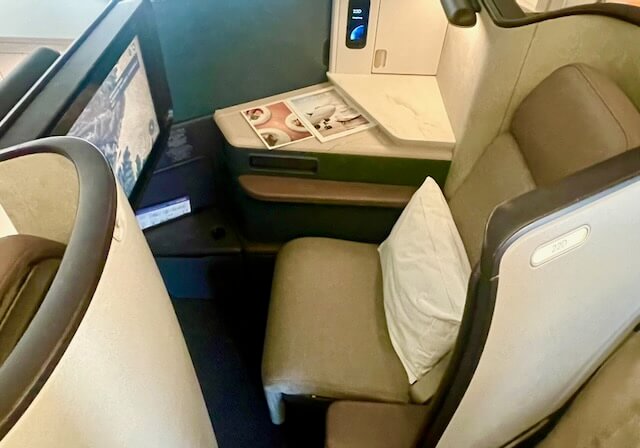
Flying from Bangkok to Hong Kong the other day, I had the pleasure of sampling one of Cathay Pacific’s new “Aria” suites on the Boeing 777-300. This is Cathay’s swanky new business class product, currently available on a limited number of routes. A shame it was only a two-hour flight.

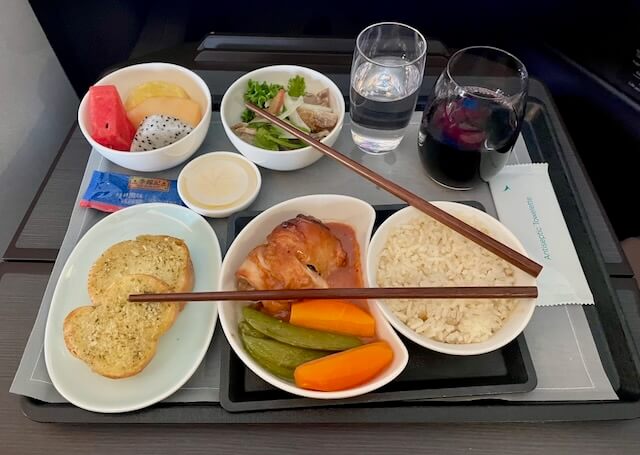
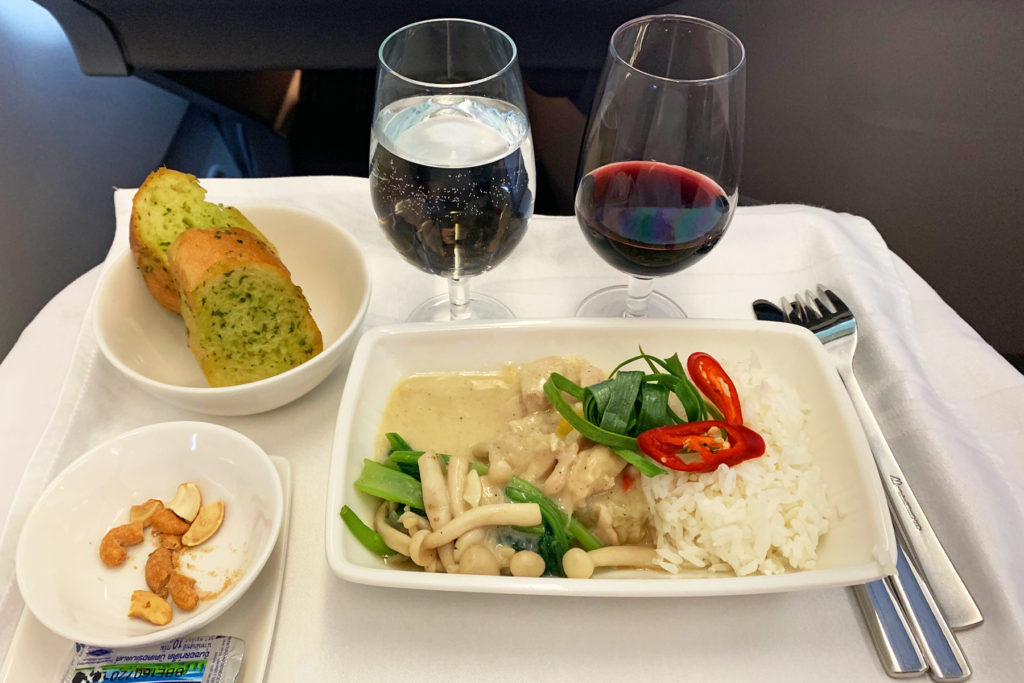
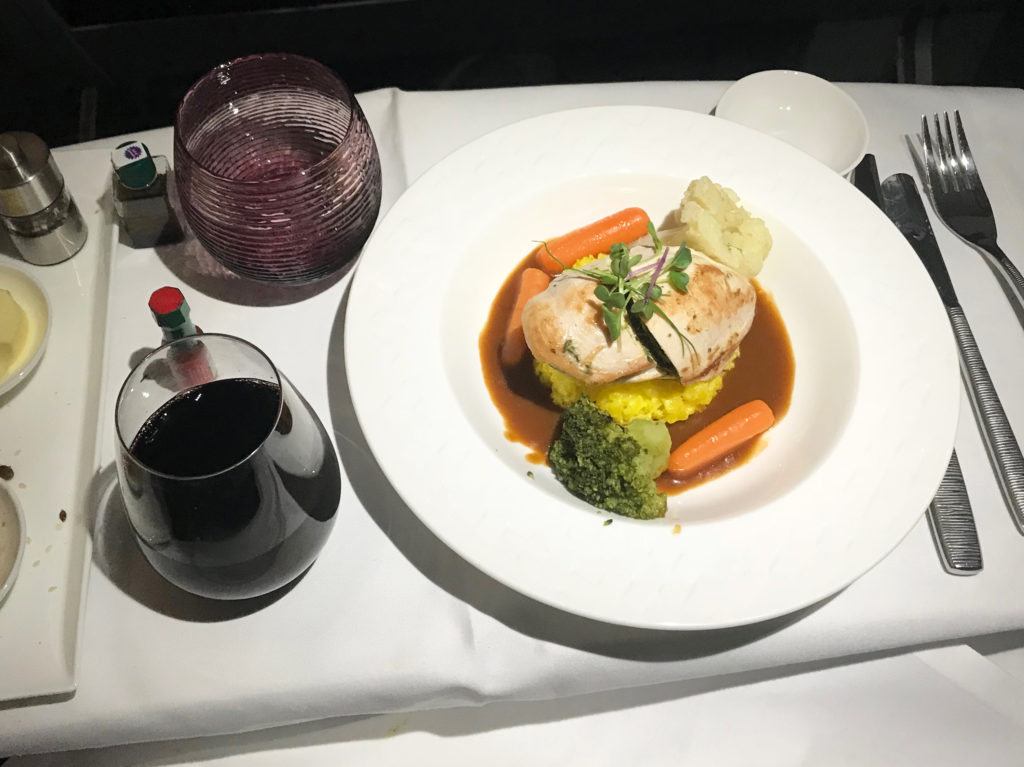
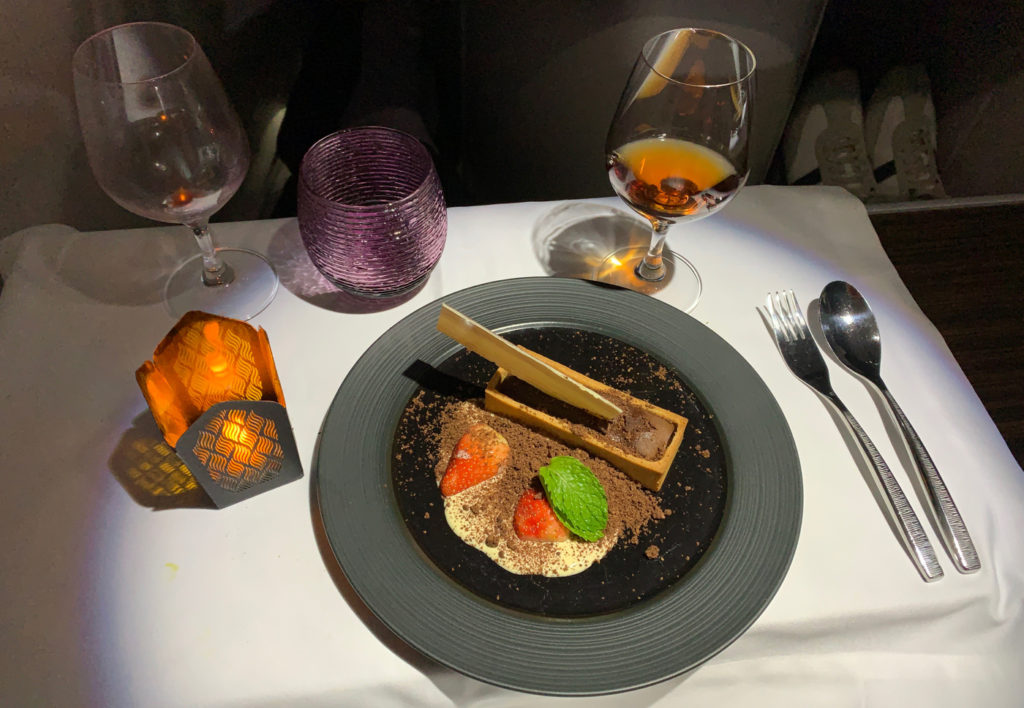
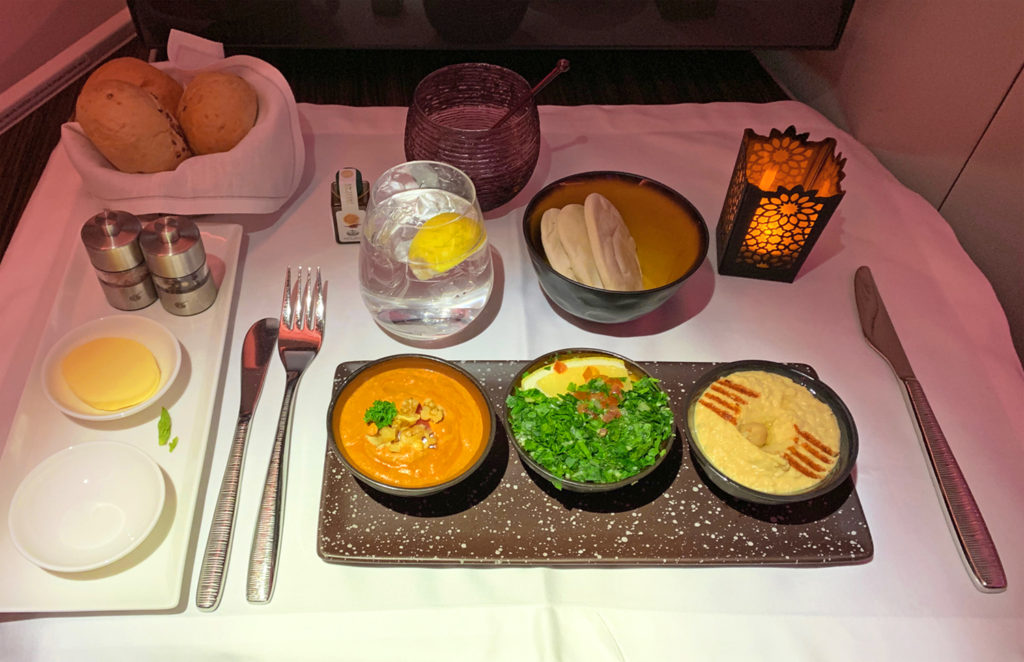
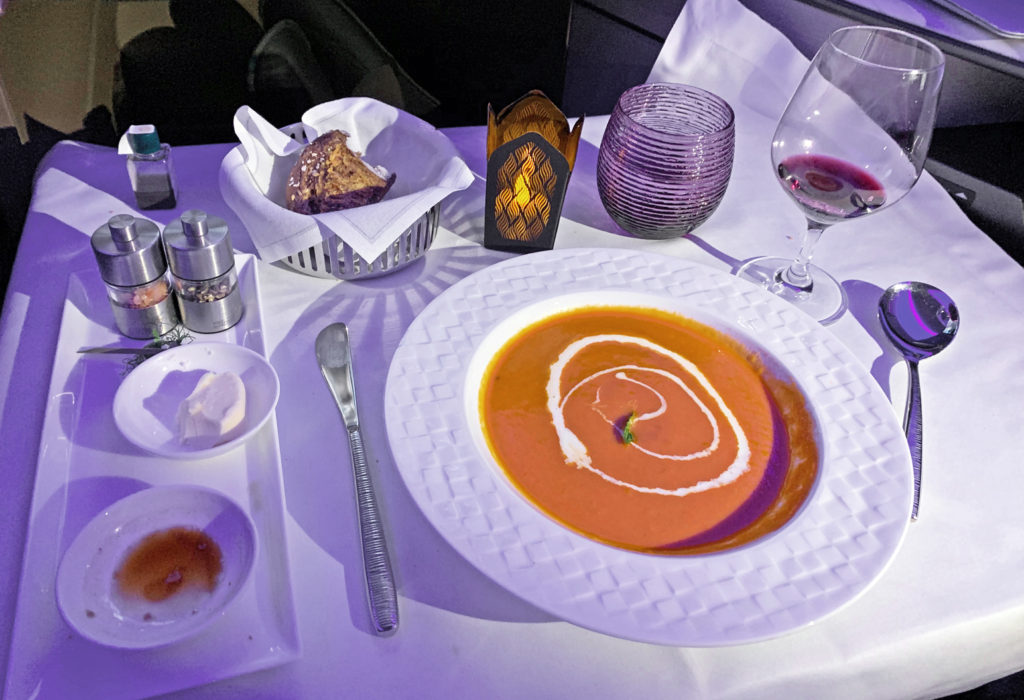
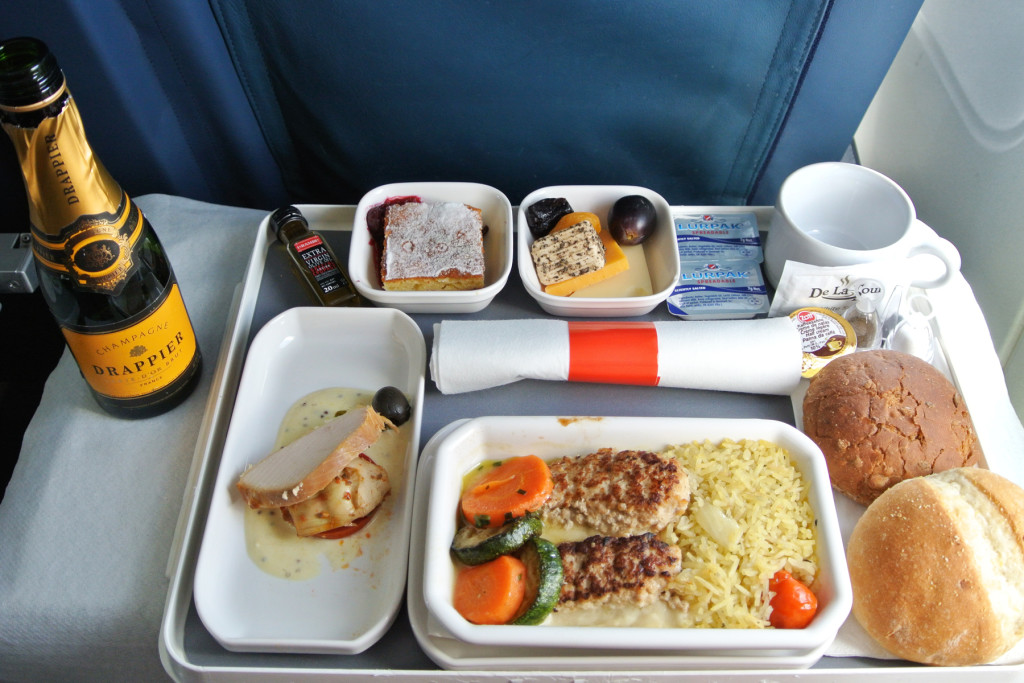
The food and wine were excellent — the service expedited for such a short ride. Find me a two-hour flight in the U.S. with a meal like the one below.

The “hard product,” to borrow industry parlance for the suite itself, was comfy and spacious. The layout is the common 1-2-1 herringbone, each seat with an oversized tray table and 24-inch video screen. (And I love the way Cathay’s headsets, while not bluetooth, are pre-plugged, with the attachment point hidden neatly away in a small amenities closet.)

What impressed me most, though, was the level of privacy. If you’re in the center section, as I was, a moveable panel closes you off from your neighbor, while on the aisle side your upper body sits deep within the sculpted shoulder wing.

It wasn’t until halfway through the flight that I realized there also was a sliding door. And I had to wonder, why bother? There was more than ample privacy as it was. With the seat in the bed position, there was barely two feet of open space, roughly at the position of your knees or mid-thigh. From Cathay’s point of view, is installing doors really worth the extra weight and mechanical complexity?

Looks like they’ve been bullied into it. For better or worse, doors are the industry standard these days. Indeed, airlines have gone sliding-door crazy. It’s become an arms race of sorts, and your first or biz class seat can’t be considered world class unless it comes with one, no matter how needless the amenity might be.

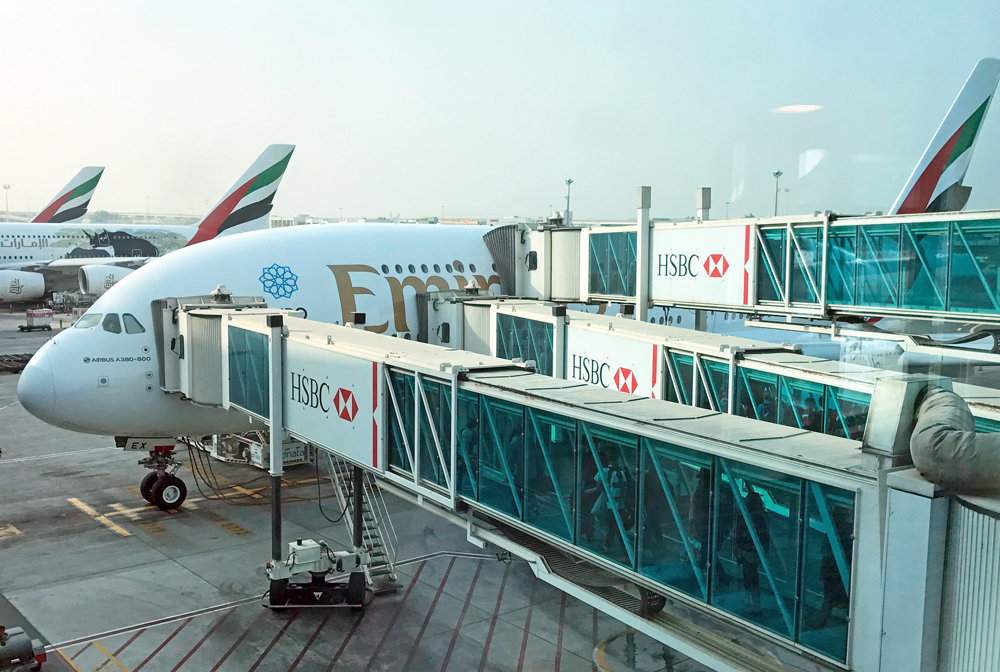
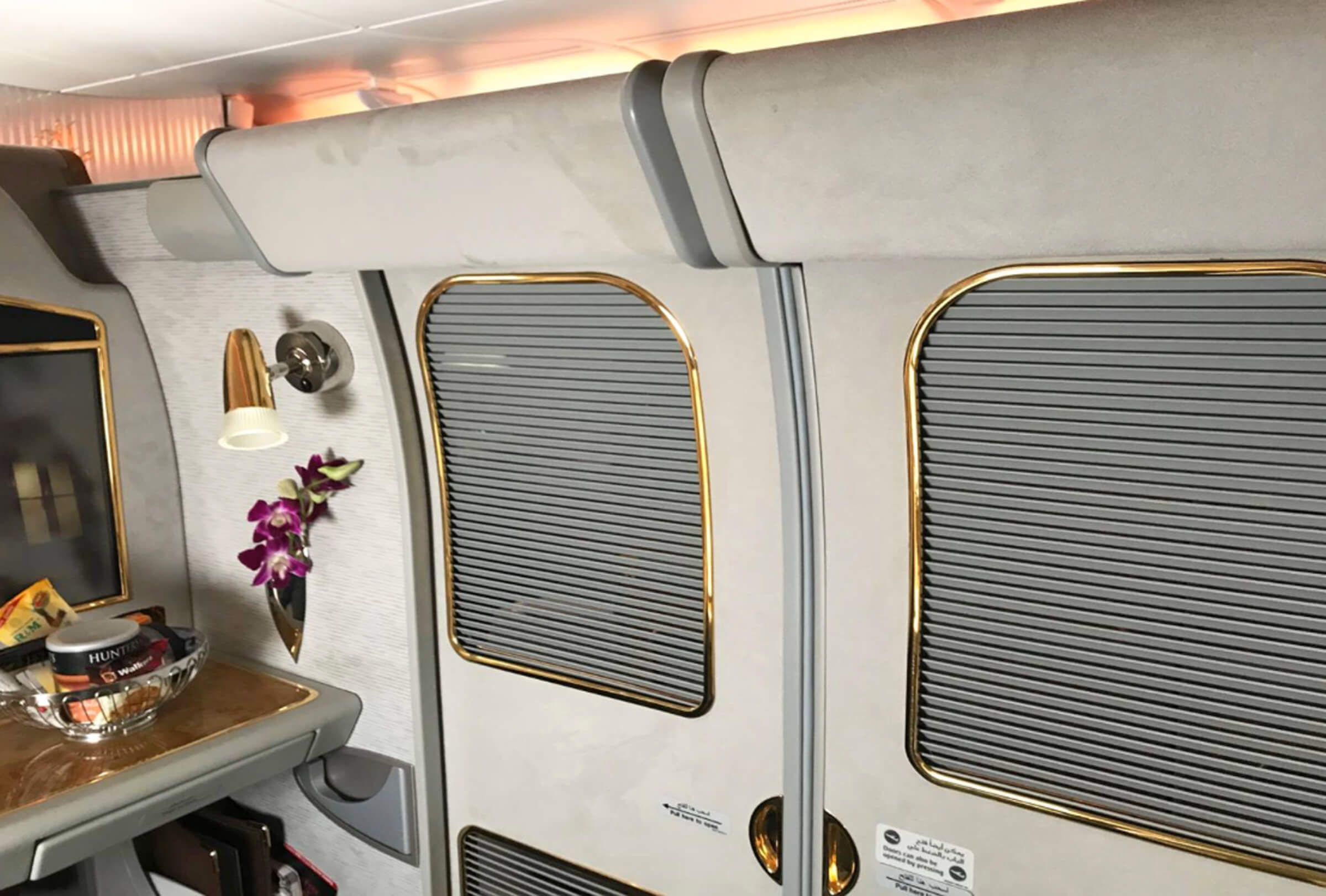
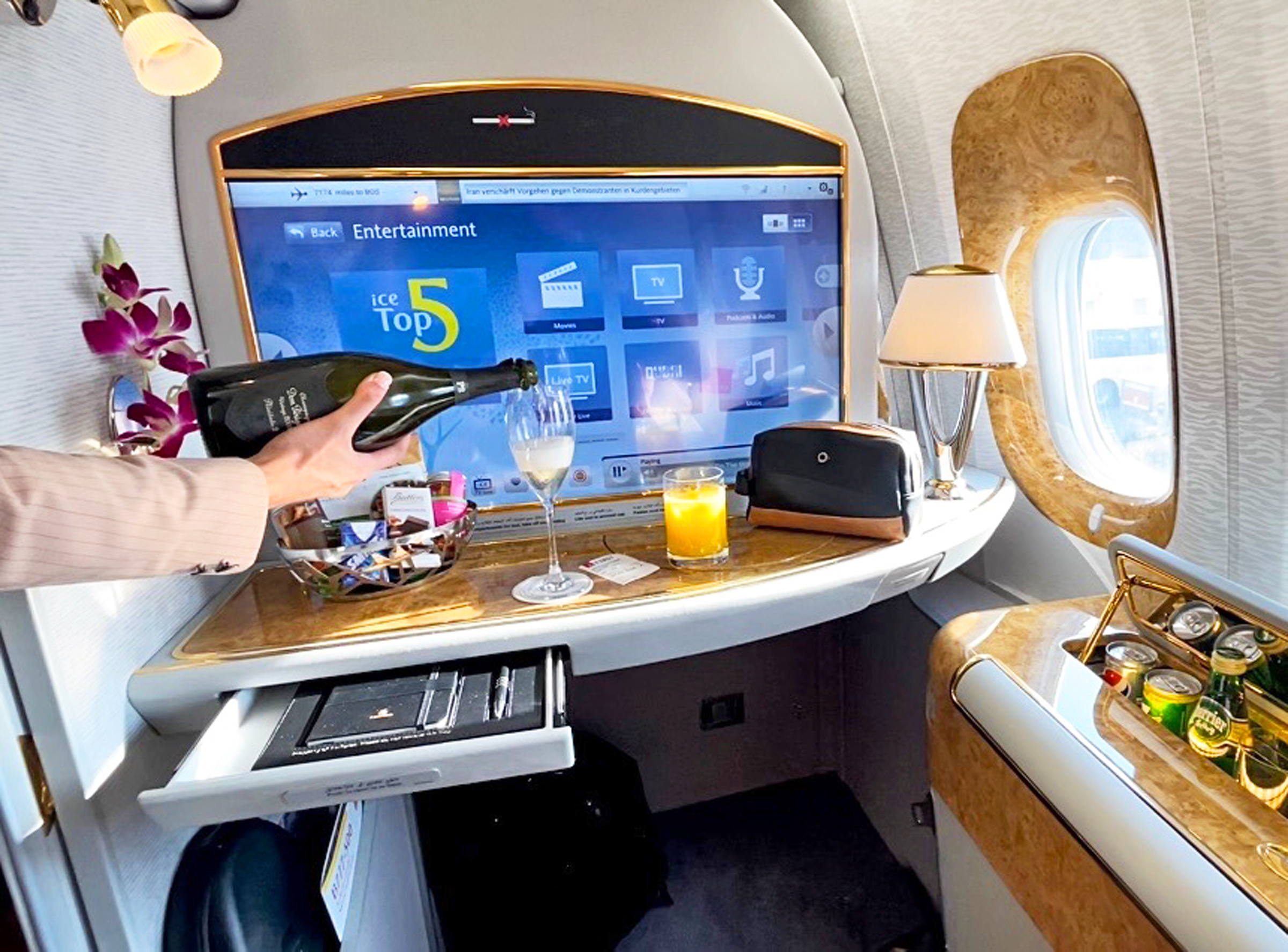
In some cases it makes sense. The geometry of a suite can be such that the lack of a door leaves you feeling exposed. The photo above, for example, shows the inside of an Emirates first class suite with its doors closed to the aisle (there are two that slide together). Without them, there’d be too much openness, too much clatter from outside.

But many are cozy enough to begin with, and the presence of a door feels gratuitous — even a little silly. They’re simply not needed.

If you insist, consider the way Air France does it, with a floor-to-ceiling curtain ensconcing each first class occupant. This is a simpler, less expensive, and much more elegant concept than the clunkiness of a door. (A curtain needs to be hung, however, which presents a problem for most cabin designs.)

How to define and quantify comfort? I reckon there are smarter ways for airlines to invest. We’re talking now about “soft product” enhancements, like better food or more gracious service. The worst thing a carrier can do is become hyper-focused on material aspects while the rest of its product deteriorates. I’d rather have a more attentive crew, a better meal presentation, or a less chaotic boarding experience, than some flimsy door.


Photos by the Author.

Comments (9)

Happy Birthday to the (Second) Greatest Album of All Time

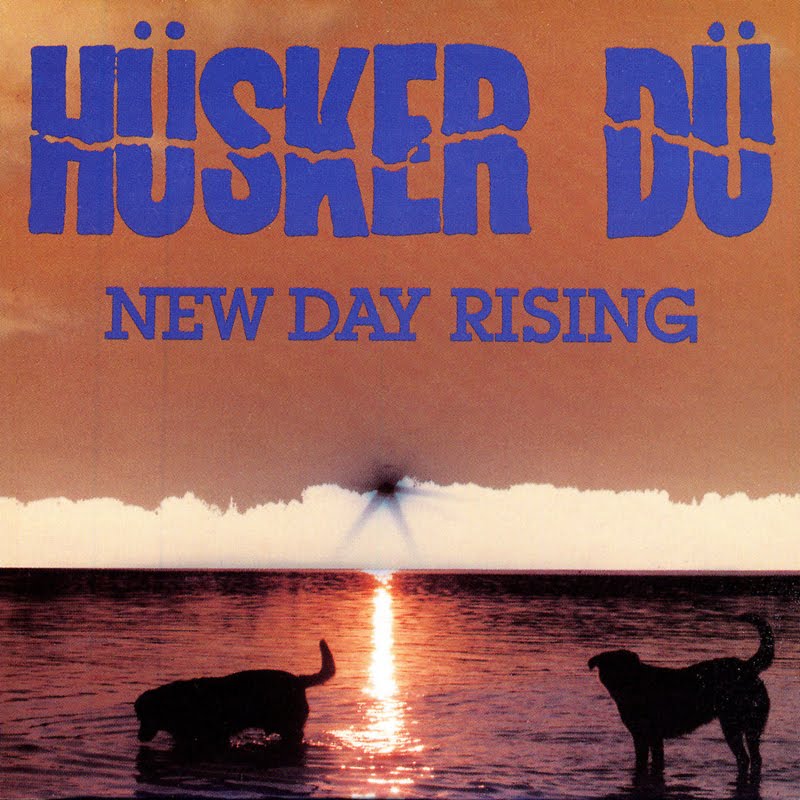
New Day Rising


IT WAS DECEMBER 30th, 1984, and Hüsker Dü were in from Minnesota again. They’d just wrapped up a show at a small auditorium in Concord, Massachusetts, and a small group of us were backstage talking to guitarist Bob Mould and drummer Grant Hart — the band’s co-vocalists and songwriters. A brand new album was due to hit the stores in only a week or two, and we all wanted to know: what was it going to sound like?

Zen Arcade had come out that past summer, and the indie rock world was still trying to absorb it. “Experimental” isn’t quite the right word, but Zen had played fast and loose with the boundaries of what punk rock, for lack of a better term, was supposed to sound like, bringing in acoustic guitar, piano, and a range of psychedelic effects. The upcoming project, it stood to reason, would take things ever further, would it not? Somebody — maybe it was me — brought this up.

“No way!” laughed Hart.

“Not at all,” added Mould. “This album is more like Land Speed Record than Zen Arcade!”

Land Speed, from way back in 1981, was a thrashy collection of hardcore songs played at nearly supersonic speed. Mould was being tongue-in-cheek — the album wouldn’t sound anything like Land Speed — but just the same he was dropping a hint: this wouldn’t be a record for the squeamish.

It was called New Day Rising — a remarkable fifteen-song LP that would wake the country from its winter freeze in January of ’85. There is nothing subtle or subdued about this album. There are no touchy-feely instrumentals, no acoustic time-outs — enjoyable as those things were on Zen. Sure, the melodies and catchy choruses are there beneath it all, in typical Hüsker fashion, but New Day Rising is power from start to finish; forty fearless minutes of ferocious exuberance.

I’m not going to argue that Zen Arcade isn’t the better or more important album. It’s all the things the pundits have called it from the start: monumental, groundbreaking, a reevaluation of everything we thought punk rock could or should be. It’s a masterpiece. But almost too much of one, moody and broody at times, and a little too — what’s the way to put it? — serious. New Day is the brasher and looser album, with Mould and Hart clearing out the pipes, with nothing left to prove and absolutely hitting their strides. It is, if nothing else, the most supremely confident-sounding album of all time.

And it’s made all the more so through a daring, some might say controversial sound mix. There’s a very particular sound to this album — a treble-heavy mix that is like nothing before or since, in which every song is enveloped in a fuzzy, fizzing, needles-pegged curtain of sound. Many people — including the band members themselves, reportedly — have always rued this peculiar mix, but to me it’s the ideal vehicle for the group’s sound. Here is the “Hüsker buzz,” as I call it, naked and cranked to eleven. (What I wouldn’t give to hear some of the cuts from Zen Arcade or Flip Your Wig remixed like this.) The style is “hot” in soundboard lingo, but to me it has a crystalline, sub-zero quality: it sounds like ice. The songs are as melodically solid as any top-40 hits of the time, but all whipped up in a great Minnesota blizzard.

Greg Norton, Grant Hart, and Bob Mould, in 1984.
Photo by Naomi Petersen.

First time listeners will know exactly what I mean within the first ten seconds of the title cut. “New Day Rising,” the song, begins with a lead-in of anxious drumming — Hart pounding away, as if to say “Let’s this this fucking thing started!” — and then comes the crescendo, a guitar-blast washing over you in a huge squalling wave: equally furious and melodic; chaotic yet strangely orchestral. It’s a breathtaking opening and the perfect pace-setter for the rest of the record. (Robert “Addicted to Love” Palmer once found it a compelling enough song to cover.)

Next up Hart’s “Girl Who Lives on Heaven Hill.” There’s something sour and vaguely out of tune about this song that for years I could never get past. Until one day it hit me: it’s supposed to be like that. Hart takes the all the nicety and sing-songy pleasures of “It’s Not Funny Anymore” or “Pink Turns to Blue” — songs that are almost too easy to like — and twists and bends and sets fire to it. Then, between the second and third stanzas, Mould comes in with a guitar solo that tears the rest of it — along with your eardrums — to pieces. It’s a haunting, mesmerizing, and a little bit frightening three minutes.

The third cut is Mould’s “I Apologize.” This is arguably the best song he ever wrote, perhaps outclassed only by the “Eight Miles High” cover, or “Chartered Trips” from side one of Zen Arcade. Here is the song Green Day and its ilk only wish they could have made: poppy and powerful, but without the slightest hint of heavy metal pretension. And is it just me, or you can you almost hear Michael Stipe singing this one? The chorus is uncannily infectious in the style of old REM songs of the same era. It’s as if you took a song like “South Central Rain” and split every atom of it: all that sweet Georgia lilac exploded into a sort of nuclear ice storm. (Putting Hüsker Dü and REM in the same sentence might seem incongruous, but it’s not by accident that they once toured together.)  Listen to “I Apologize” here. Don’t skip the final fifteen seconds, and play it loud.

Further along is one of the great sleepers in the Hüsker Dü canon: Mould’s “Perfect Example.” This is the record’s only true “slow” moment — the band’s idea of a tearjerker. It closes out side one, sung by Mould in a kind of passive-aggressive whisper, with Hart (barefoot no doubt, as he always played) double-thumping the bass drum in perfect synchronicity to a human heartbeat. The song clashes to a close on the word “perfect.” Had the album ended right there, already it’d be a classic. Except that’s only the first side.

Although only two of the cuts are his, Grant Hart effectively owns side two. This is by virtue of “Terms of Psychic Warfare” and “Books About UFOs,” both of which are unforgettable. Listen to “Terms of Psychic Warfare” here, with its signature bass riff and beautifully cascading vocals.

The better one, though, is “Books About UFO.” Equal parts deafening, frenetic, melodic and catchy, the track is backed with piano. From any other band, in any other context, this effect would probably sound gimmicky. Not so here. Indeed, it’s almost as if this song were written for piano from the start. “For all the speed and clamor of their music,” the music journalist Michael Azerrad once wrote, “Hüsker Dü was perhaps the first post-hardcore band of its generation to write songs that could withstand the classic acid test of being played on acoustic guitar.” That’s an excellent point, but the heck with that, I want to hear Grant playing an all piano version of “Books About UFOs.”

“I’d also recorded a slide guitar on ‘Girl Who lives on Heaven Hill,'” Grant Hart remembers. “But when I showed up after that session, Spot [the album’s co-engineer] and Bob issued an ultimatum: either the piano goes from ‘UFOs’ or the guitar goes from ‘Heaven Hill.’ After stating my case, which was ‘what does one have to do with the other?’ I relented and said if one had to go, let it be the slide guitar.

Probably the right decision. “UFOs” is one of the most furiously pretty, and downright interesting songs you’ll ever hear.

Norton, Hart, and Mould.
Photo by Daniel Corrigan.

To the end, Hart, who passed away in 2016, held some strong resentment against the way Spot, who’d been sent to Minneapolis from Los Angeles by SST Records to oversee the project, handled his duties. Spot shared the engineering tasks with the band members and their longtime collaborator Steve Fjelstad, but as Hart once explained it, “SST decided that we were not to be the masters of our own destiny, and sent Spot to babysit/spy/sabotage our record. He did not give Steve Fjelstad the respect he deserved, treating him as an assistant.””Another thing I remember,” said Hart, “was not being allowed to make my own choices as far as re-doing vocals that I thought I could better. On ‘Heaven Hill’ you could hear the sound of some lumber, that had in been in the booth during remodeling, falling to the floor!”

Well, all of that aside, it’s tough to have too much issue with the finished product.

The album comes to an end with the charging, spiraling, sonic immolation of Bob Mould’s “Plans I Make.” Fasten your seatbelts for this one. It’s not the jammy, psychedelic marathon of “Reoccurring Dreams,” the 14-minute instrumental that closes Zen Arcade, but it’s a wringer, an earsplitter that, when it finally crunches to its conclusion, leaves the listener with no choice but to sit spellbound for a time.

If it seems like only yesterday that I was writing about the 30th anniversary of Zen Arcade, which had been released in June of 1984. It’s fascinating testament to Hüsker Dü’s talent and tireless work ethic that two such brilliant albums could have been released within a mere seven months of each other. And these were bookended, I should add, by two other highly impressive records — Metal Circus and Flip Your Wig, from October of ’83 and September of ’85 respectively. A spectacular four-record punch in a span of under two years.

And if forced to choose, I’d say New Day Rising sits the pinnacle of that run. This is Hüsker Dü at the very apex of its career, and one of the finest moments in the whole history of what used to be called underground rock.

Meanwhile, unless I’ve missed something, none of the big music magazines or websites gave New Day so much as a mention on its 20th, 15th, or 30th birthdays. For that matter, do younger music fans have any sense of what the 1980s truly were like? This was the richest and most innovative period in the whole history of independent music, but rarely is it acknowledged as such. As popular culture has it, serious rock music skipped the 80s entirely. When pundits do take the decade seriously, we tend to see the same names over and over. It’s both frustrating and unjustified that Hüsker Dü never developed the same posthumous cachet that others of their era did. Like the Replacements, for example, or Sonic Youth. Hüsker Dü could run circles around either of those two, but never became “cool” in quite the same way.

I suppose it’s due to a total absence of what you might call sex appeal? To say that Hüsker Dü never cultivated any sort of image, in the usual manner of rock bands, is putting it mildly. For one, they never looked the part. These were big, sweaty, chain-smoking guys who, it often seemed, hadn’t shaved or showered in a while. Norton, trimmest and most dapper of the threesome, wore a handlebar mustache many years before such things were trendy among hipsters. It wasn’t cool; it was odd. And not until their eighth and final album that the band include a photo of itself on an album cover (the scratched-out images on Zen Arcade notwithstanding).

This modesty, for lack of a better description, was for some of us a part of what made Hüsker Dü so special. But it has hurt them, I think, in the long run.

The idea that the Replacements (much as I loved their debut album, which I consider the best garage-rock record of all time, and which includes a shout-out called “Somethin’to Dü”) were in any way a better or more influential band than Hüsker Dü is too absurd to entertain. Meanwhile the beatification of Sonic Youth, maybe the most overrated outfit of the last forty years, goes on and on. Not long ago Kim Gordon got a profile in the New Yorker. I’m still waiting for one of the writers there to devote a story to Bob Mould.

Or better yet, to Grant Hart. Twenty-five years, more or less, that’s how long it took me, to realize that it was Grant, not Bob, who was the more indispensable songwriter and who leaves the richer legacy. In the old days it was trendy to claim that Grant was the real genius behind Hüsker Dü. You’d be at a party and some asshole would say, “Those guys would be nothing without that drummer.” I’d always scoff that off. The mechanics of the band, for one, made it difficult to accept: Grant was the drummer, after all, and drummers are never the stars. And there was Bob, right at the front of the stage with that iconic Flying-V. But those assholes were on to something.

That shouldn’t be an insult to Mould. Not any more than saying Lennon was a better songwriter than McCartney. Both were brilliant. But when I flip through the Hüsker canon, I can’t help giving Hart the edge. There’s a soulfulness to his songs sets them apart. They’re not necessarily “better” so much as they resonate in a different and deeper way. On New Day Rising, Mould gave us “I Apologize” and “Celebrated Summer.” But Hart gave us “Terms of Psychic Warfare” and “Books About UFOs.” On earlier records it was “It’s Not Funny Anymore,” “Diane,” “Pink Turns to Blue,” the list goes on. Hart’s “She’s a Woman (And Now He is a Man”) from the often intolerable Warehouse album is, to me, a classic sleeper and the most under-appreciated Hüsker song of them all.

His solo work, too, was at least as robust as that of Mould. Songs like “The Main” and “The Last Days of Pompeii” are as good or better than anything Mould has given us post-Hüsker. But while Mould went on to some notoriety and commercial success, Hart labored in comparative obscurity. This was always irritating and unfair.

But Grant, maybe, was all right with this. “I have always based my movements on those of fugitives or criminals,” he once said to me. “The less attention you attract, the freer you remain! I wish to be an artist, not a celebrity.”


Related Story:
Now and Zen. The Greatest Album of All Time Turns 40

Comments (4)

Haystack Revisited

January 5, 2026

The hunt is on again for Malaysia Airlines flight 370, the Boeing 777 that vanished somewhere in the Indian Ocean more than twelve years ago.

I don’t know where Vegas has the odds, but I wouldn’t expect the plane to be found. There’s just too much ocean, and not enough data telling the searchers where to focus. Whatever advanced technology is at their disposal, they’ll need to be very lucky. They’re looking for an object about two-hundred feet long, thousands of feet down in the dark, somewhere in an immense expanse of ocean.

One thing that might help them is that the jet is likely in one or two large pieces. Its profile should be distinct, even from far above. We know this because there was no debris field. It’s nearly certain that the plane didn’t crash. Rather, it was “landed” on the water, and subsequently sank, more or less intact.

A Boeing 777 in an out-of-control impact — or even a semi-controlled one — would have broken up and produced thousands of fragments: aircraft parts, human remains, luggage, and so on. Much of this debris would have sunk, but plenty would not have. Eventually, borne by currents, it would’ve washed up.

But it didn’t. And the small number of pieces that did wash ashore are consistent not with a crash, but with a controlled and deliberate ditching. The flaperon discovered in 2015 on Reunion Island, for example, and the trailing edge flap that washed up on Mauritius. These parts themselves are evidence enough; a thorough post-mortem on them reveals even more. The forensics are complicated, but they’re solid. Use your Google and check out the analysis by former Canadian crash investigator Larry Vance. These pieces tell a story.

Early on, I was open to a number of theories popular at the time: fire, fumes, depressurization, and so on. Accidents. I’ve come around since then. My opinion is based on the evidence, both as it exists and, more importantly, doesn’t exist. The absence of the myriad flotsam a full-on crash would have produced is to me the smoking gun. The only plausible explanation for a lack of debris is that the plane was purposely scuttled, presumably by the captain.

Which, to be honest, makes me wonder: why spend all this time and money? What do we learn by locating the wreckage? It all seems pretty clear.

I’ve been saying from the start that we should prepare for the possibility of it not being found. It happens this way sometimes. If it helps you feel better, the air crash annals contain numerous unsolved accidents.

What makes this one different, maybe, is how we’ve come to expect easy and fast solutions to pretty much everything these days, with a fetishized belief that technology can answer any question and fix any problem. Oh sure, radios, transponders, emergency locator transmitters, GPS, real-time position streaming, satellite tracking. But all of that is fallible, one way or another.

Sometimes nature wins. And that’s what this is about, ultimately: nature. The immensity of the ocean versus the comparative speck of a 777. It’s out there somewhere, in the ink-black darkness beneath thousands of feet of seawater. We’ll probably never find it.


Related Story:
THE RIDDLE MAY NOT BE DEEP

Photos courtesy of Unsplash.

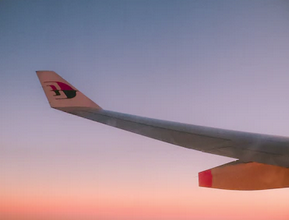
People say the Malaysia Airlines logo looks like a tropical fish. In fact the design is inspired by the “wau,” a traditional Malaysian kite. Specifically it’s the “wau bulan,” or moon kite.


Comments (19)

Q&A With the Pilot, Volume 7

AN OLD-TIMEY QUESTIONS AND ANSWERS SESSION.

Eons ago, in 2002, a column called Ask the Pilot, hosted by yours truly, started running in the online magazine Salon, in which I fielded reader-submitted questions. It’s a good idea, I think, to touch back now and then on the format that got this venerable enterprise started. It’s Ask the Pilot classic, if you will.

Q: I was on a jet with five seats across: two on one side, three on the other. Does an asymmetrical configuration like this have any bearing on flight? What if all the seats on one side were full, and empty on the other side?

Lateral balance is wingtip to wingtip, not cabin wall to cabin wall. In other words, for purposes of this discussion, a 747 isn’t 20 feet wide, it’s 200 feet wide.

Imagine an airplane as a see-saw. The ends of the see-saw, where the kids are sitting, are the wingtips. The fulcrum, in the center, is the cabin. The leverage is coming from the distance between the wingtips and the fulcrum. Shifting weight from one or two inches left of the fulcrum, to one or two inches right of it, makes no measurable difference.

Longitudinal balance, front-to-back, is a bit more important, though still less than you’d think. Passengers will occasionally be asked to move forward, or rearward, depending on the situation, to help fine-tune the plane’s center of gravity. Cargo and fuel are usually part of this equation. Are you going to crash if people aren’t in the correct rows? Of course not, but technically the plane might be nearing its CG limits.

Passengers and their bags account for a surprisingly small portion of a plane’s overall weight. The jet I fly has a maximum takeoff weight of about 500,000 pounds. A full load of people and their bags weighs around 55,000 pounds, or a bit more than ten percent of the total. Where they’re sitting doesn’t make much difference.

Q: Coming in to land one day, we were just about on the pavement when suddenly we shot back up again. A few minutes later the pilot said, “The plane in front of us missed its turn-off and was still on the runway.” Which sounds terrifying… though I know from reading your site that sometimes pilots say things that sound scarier than they are.

True, and what you describe isn’t terribly uncommon.  Was it a “near miss”?  No. The go-around was initiated to prevent one. 

Runways at big airports usually have multiple turn-off points.  You take the one that is safest to take, based on your speed, regardless of which one the controllers want you to take. You might be planning for particular turn-off point, and/or ATC might ask you to minimize your time on the runway because of traffic following you, but it doesn’t always work out. You’re not going to force the turn and risk skidding or sliding or putting undue loads on the landing gear. If need be, you keep going and take the next exit.  If the plane behind you needs to go around, so be it.  

Q: As an international pilot, you obviously fly to many non-English speaking countries, which got me thinking about air traffic control protocols. Are communications with pilots conducted in English, or do American pilots have to be fluent in the native language of the places they fly to?

If so, I’d be fluent in about 20 languages. As it happens, English is the lingua franca of commercial aviation, and except perhaps for remote corners of China or Russia, all controllers and pilots are required to speak it.

But, depending on the country, they might also use their local language. In Brazil, for example, you’ll hear both English and Portuguese over the radio; controllers talk in English to foreign crews, but in Portuguese to local crews. France is another one. There are several.

I don’t like these multiple language airports because it’s harder to keep track of which planes are where. Pilots listen not only for their own instructions, but for those of other pilots as well. By creating a mental picture of what other aircraft are doing, they can orient themselves in the choreography of a crowded sky (or tarmac). This is more difficult when instructions and clearances are being given, and acknowledged, in a tongue you can’t understand.

Comments (7)

A Toast to Iran Air

September 8, 2025

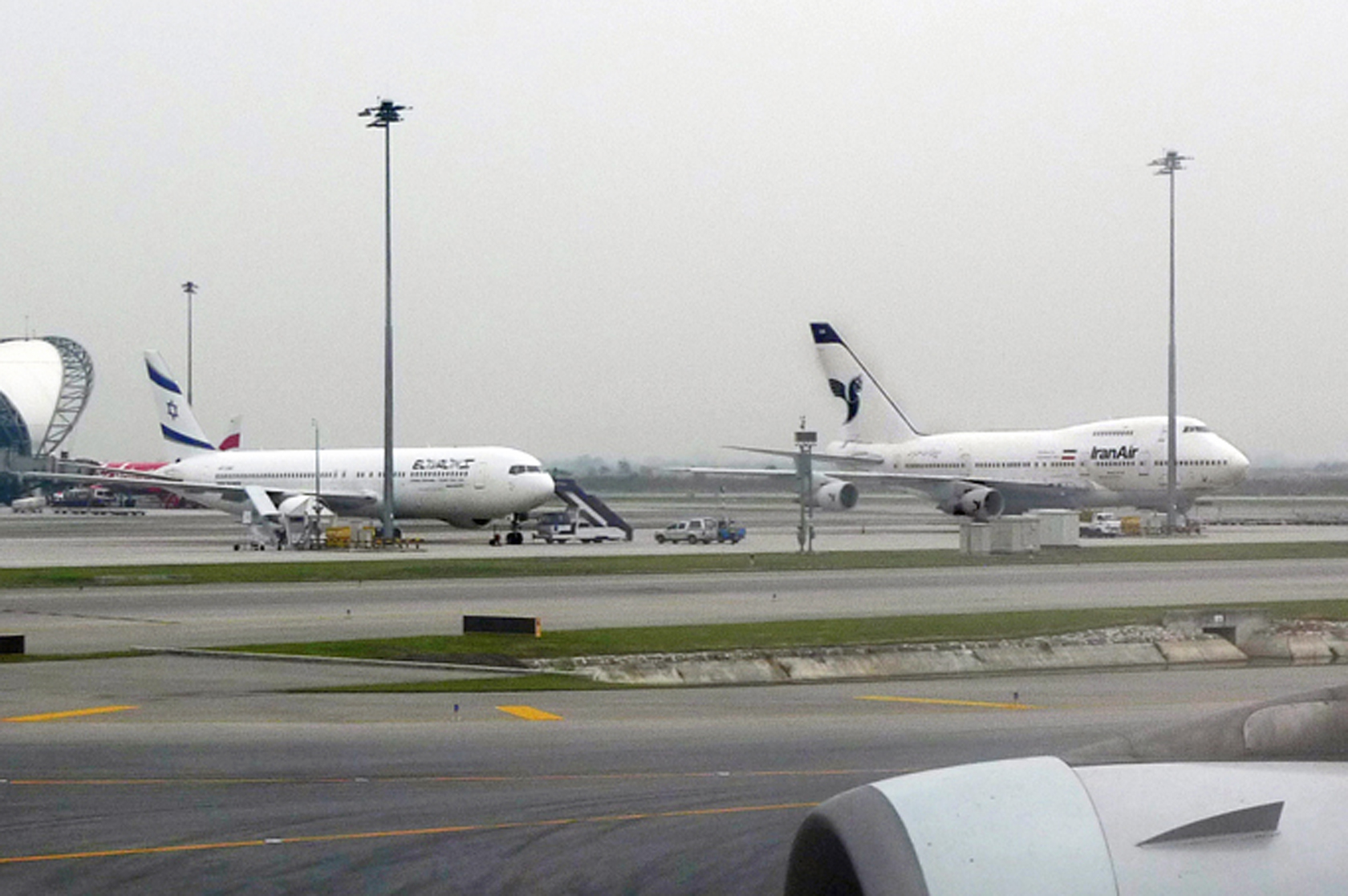
It’s remarkable how often geopolitics and aviation intersect. I snapped the above photo a dozen or so years ago at the airport in Bangkok, Thailand. That’s an El Al 767 buddy-buddy with an Iran Air 747SP. At the time it drew a chuckle. Today it’s more of a gasp.

Was this by accident, do you think, or were the authorities at BKK pushing for a sort of tarmac detente?

It’s maybe hard to imagine, but in the days before the Iranian revolution, El Al flew scheduled services between Tel Aviv and Tehran. Iran Air, for its part, was a world-class airline with routes from New York to Tehran via London and Paris. Somewhere in a box at my father’s house is a picture of an Iran Air 747 that I took at Kennedy Airport in 1979, using an old Kodak Instamatic.

In some other reality, Iran Air’s hub at Tehran became a global aviation crossroads, akin to what happened in Dubai and Doha. But the regime had other plans, and today the carrier flies a skeleton fleet of around 20 jets.

Iranian aviation has been hemmed in under sanctions, and the difficulty of obtaining new aircraft has forced carriers to keep older models in service much longer than is customary. As of this year, four Airbus A300s remain on Iran Air’s roster — among only a handful in the world still carrying passengers. Iran Air was the final commercial operator the 747SP, the jet you see above. This was the short-bodied, extra long-range 747 variant developed in the 1970s. A different Iranian carrier, Saha Airlines, was the last to fly the 707.

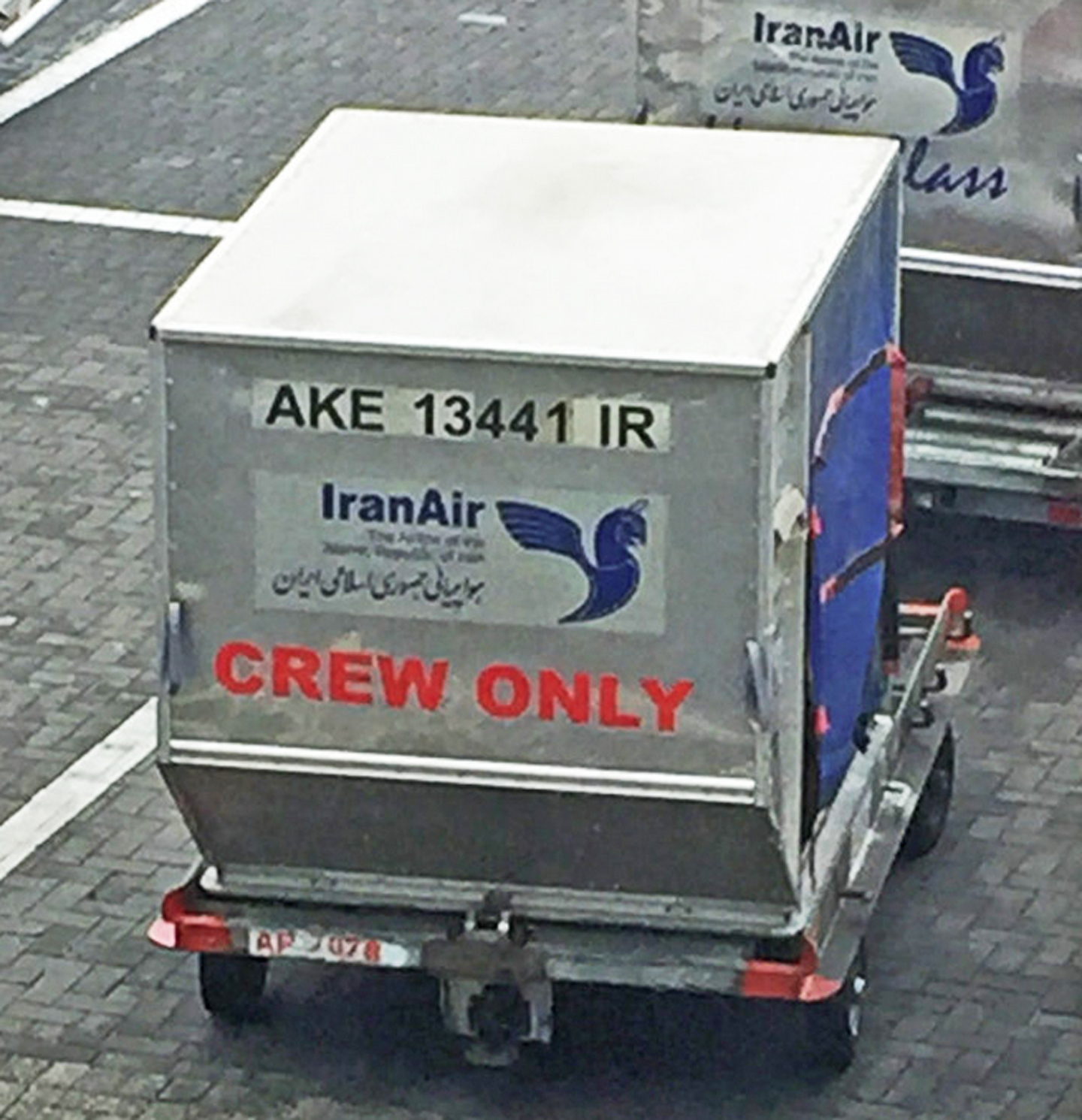
This second photo I took at Amsterdam-Schiphol…

Man, Iran Air pilots have it tough. It must be claustrophobic in there.

Very funny. That’s not for the crew, of course. It’s for their luggage. Outside the United States, air crews embarking on multi-day assignments travel with large, hard-side suitcases, which they check in prior to flight. The bags are then loaded into designated containers like this one. Hauling a week’s worth of clothes around in a roll-aboard bag is mostly an American thing.

The picture gives you a good view of Iran Air’s peculiar logo. The insignia is inspired by the character of Homa, a kind of bird-horse-cow griffin, seen carved on the columns at the ancient Persian site of Persepolis. It was designed 1961 by a 22 year-old art student named Edward Zohrabian, and has been used ever since.

It’s an old-fashioned design for sure. It’s also vaguely fetal and creepy-looking. But here’s hoping they keep it around, if only for posterity. It’s just a matter of time, I worry, before this enduring mark is dustbinned for some stupid swooshy thing.

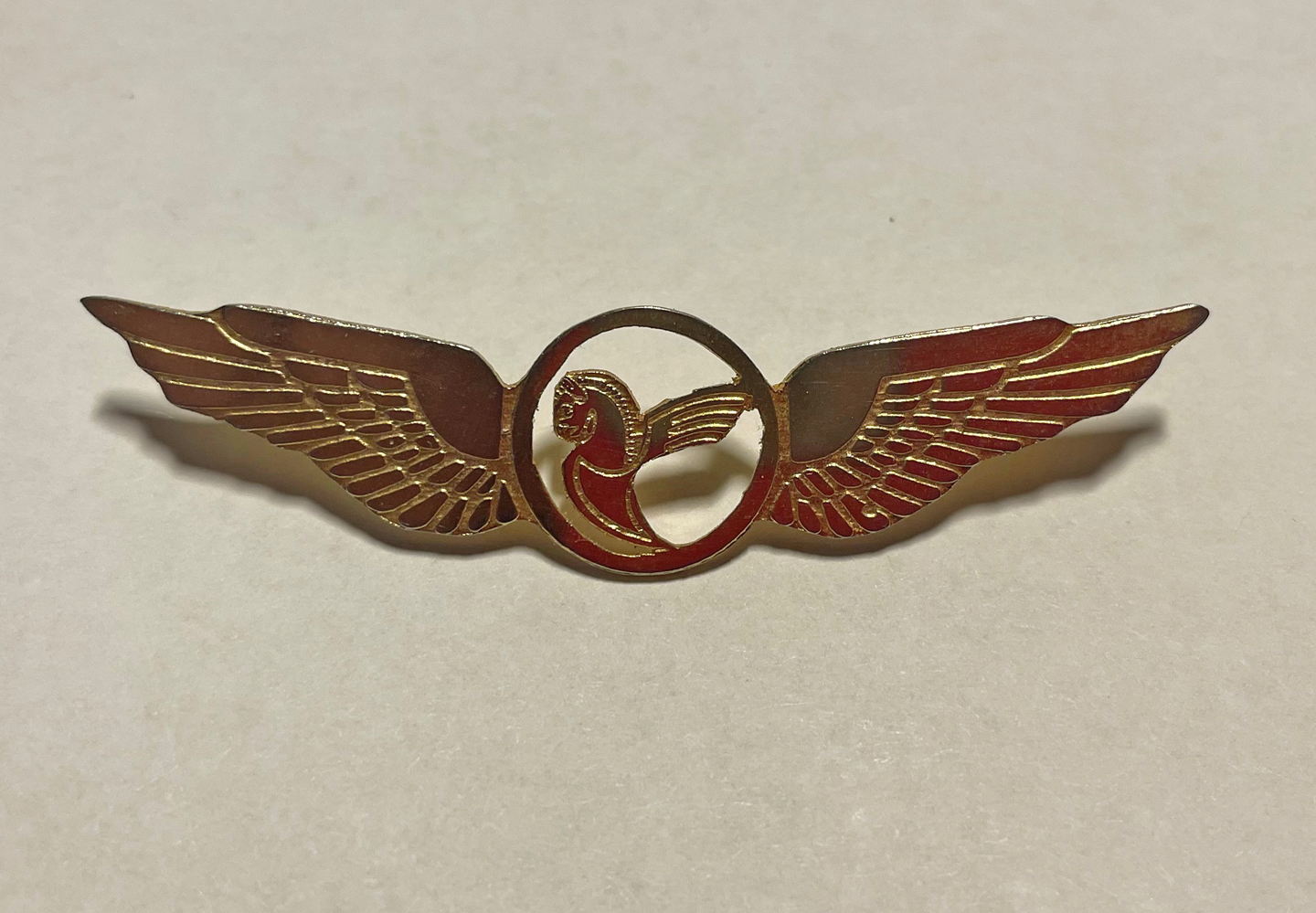
I once met an Iran Air crew in the terminal at Schiphol. They were gracious and polite, and gave me a pair of souvenir wings, which I still have…


Comments (5)

A Gourmet Diversion. Savory Snapshots From 30,000 Feet.

March 20, 2025

HERE ARE some pictures of airline food. Pardon such a vapid diversion, but most aviation news these days is depressing. Plus, I’m hungry.

Before the coronavirus madness began, we’d reached a point where the food in international premium class could rival that of a fancy restaurant. Carriers took pride in their onboard product: the food itself, the presentation, choreography — the whole indulgent kabuki of premium class, from the menus to each carrier’s signature cutlery. It could be pretentious, but always fun. The pandemic wiped that out, but things have since bounced back. An airplane ride no longer feels like a medical evacuation and flight attendants have stopped dressing like the firemen at Chernobyl.

Here, in no special order, are some examples. New and old, fancy and not so fancy.

These weren’t employee freebies. I’ve spent a lot of money on these seats. Maybe let me flex a little…

ALL PHOTOS BY THE AUTHOR

Philippine Airlines

A business class meal aboard a Philippine Airlines A330, Singapore to Manila. Adequate if underwhelming. This was a three-hour, intra-Asia service; presumably the airline’s long-haul routes have a more lavish spread. Not visible are my second and third helpings of garlic bread.


China Airlines

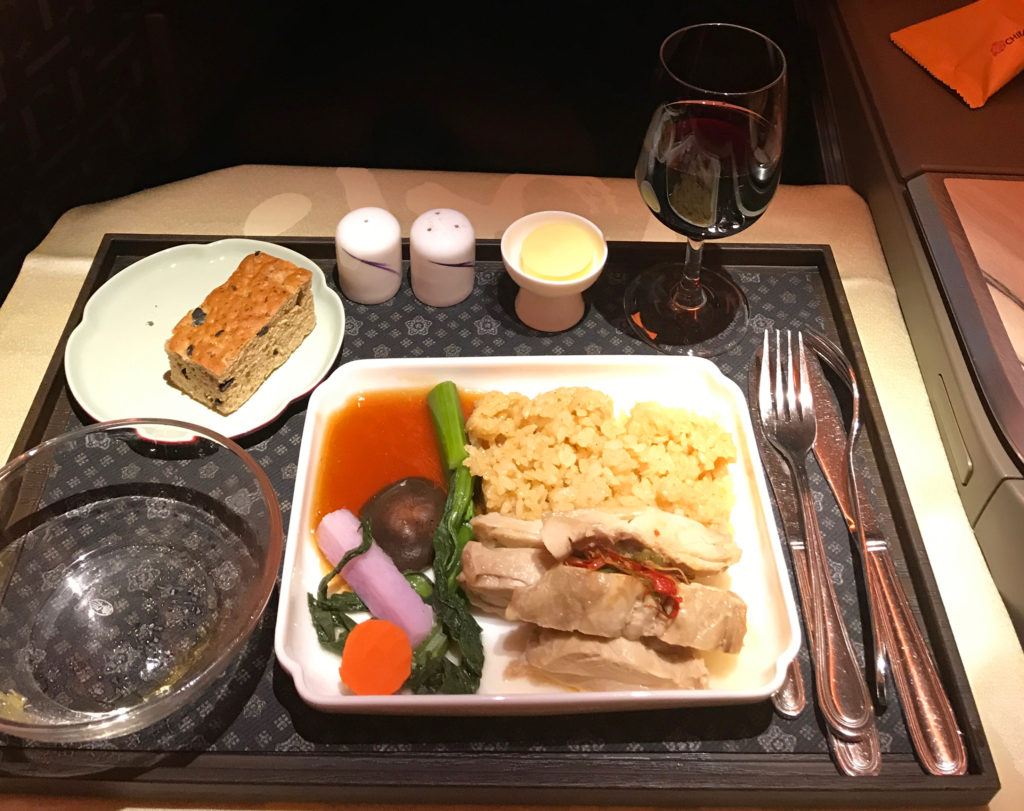
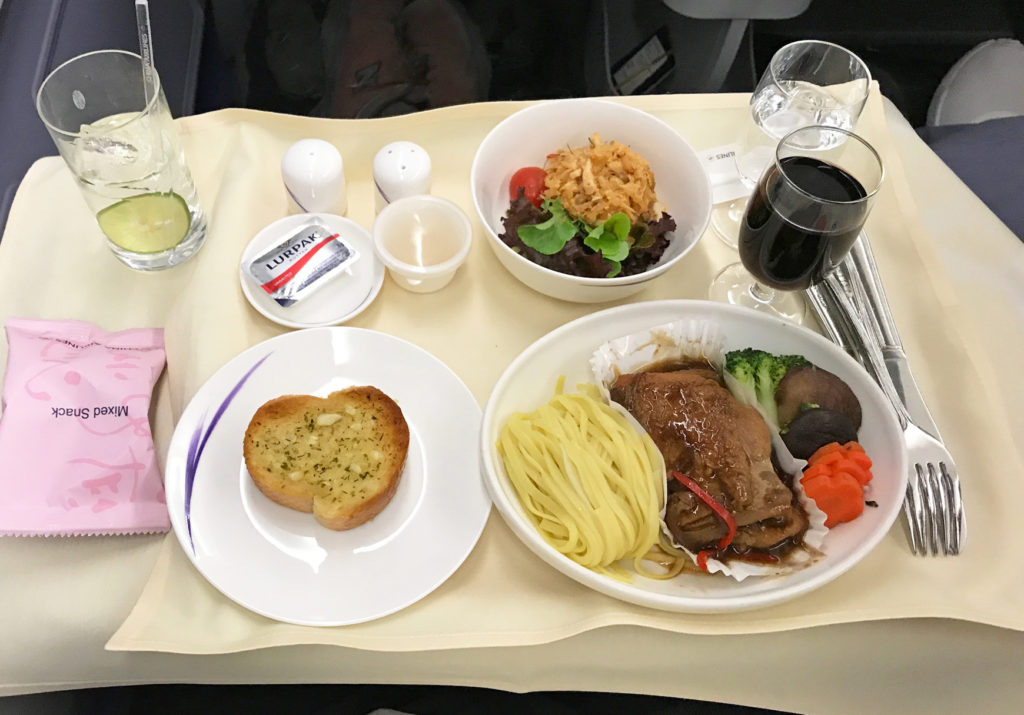
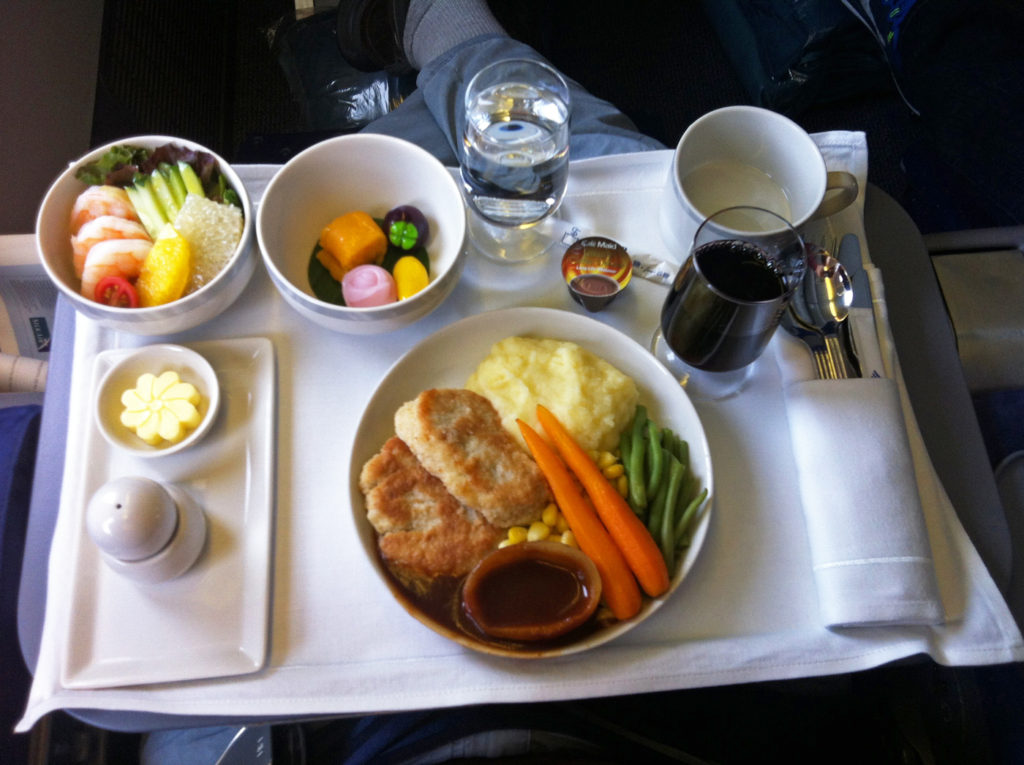
The upper photo shows a business class dinner en route from Taipei to Amsterdam. The cabin decor on this Airbus A350 was strikingly handsome, gold highlights and elegant wood tones. The food was less impressive, and they were super stingy with the wine. The lower pic showcase the carrier’s shorter-haul service on the A330.


South African Airways

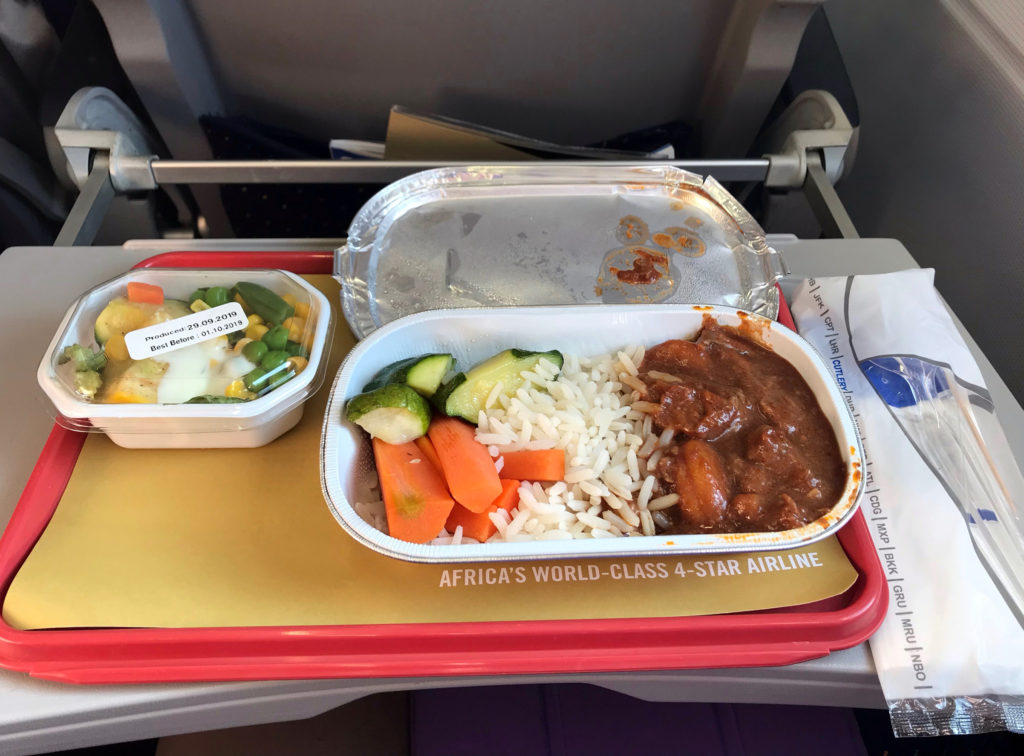
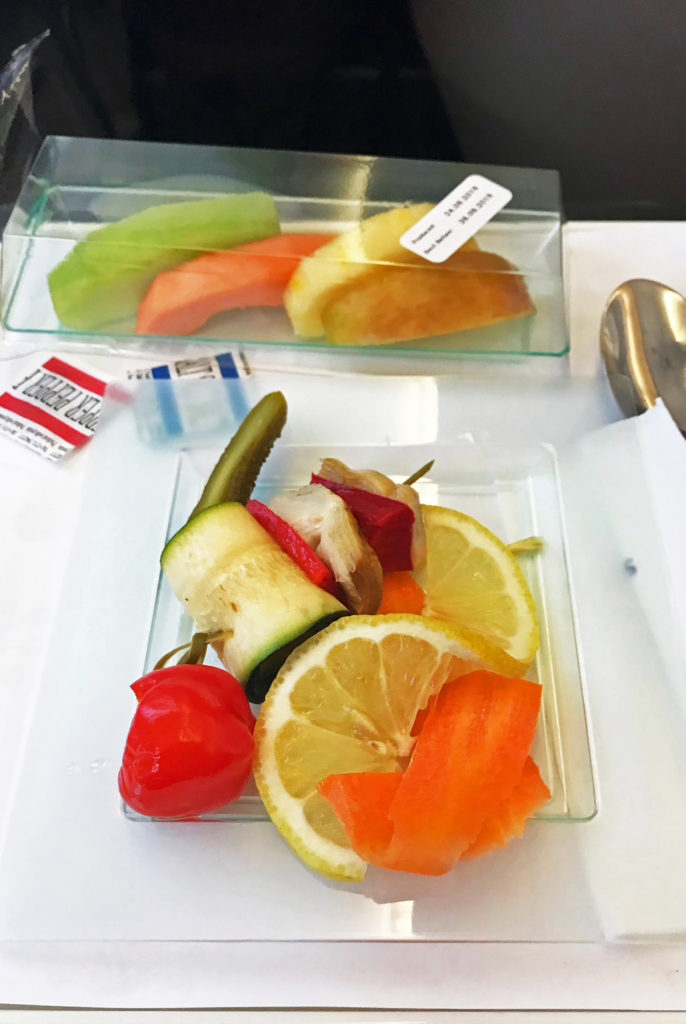
Economy class dinner on the quick jump from Lusaka, Zambia, to Johannesburg. The second pic beholds one of the sadder things I’ve seen on a plane. Believe it or not, this was the business class vegetarian entree, served on the Johannesburg-Victoria Falls route. Click here for a detailed review of this flight.


Qatar Airways

Qatar’s business class food is arguably the best in the world. It’s served on-demand, meaning you order whatever you want, whenever you want it. There’s no scripted service, per se, with trays or carts coming down the aisle.


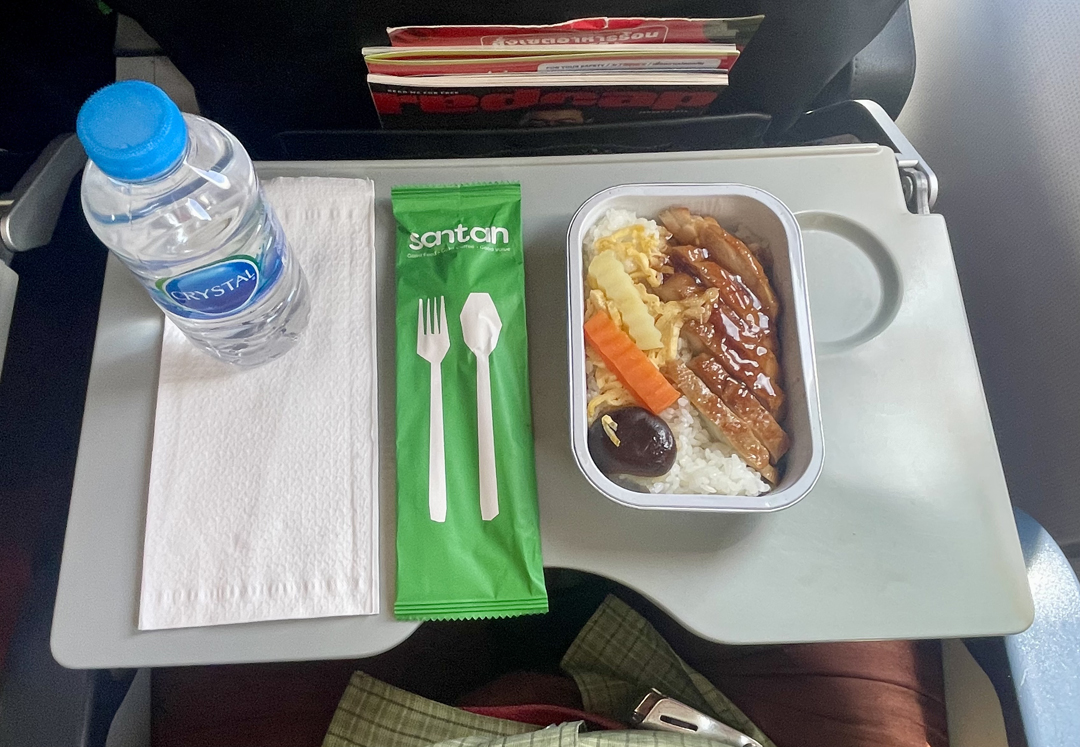
Air Asia

At the other end of the spectrum, here’s what low-cost carrier Air Asia has for you on the 60-minute run between Bangkok and Phuket. This was a buy-on-board option that cost about ten dollars.


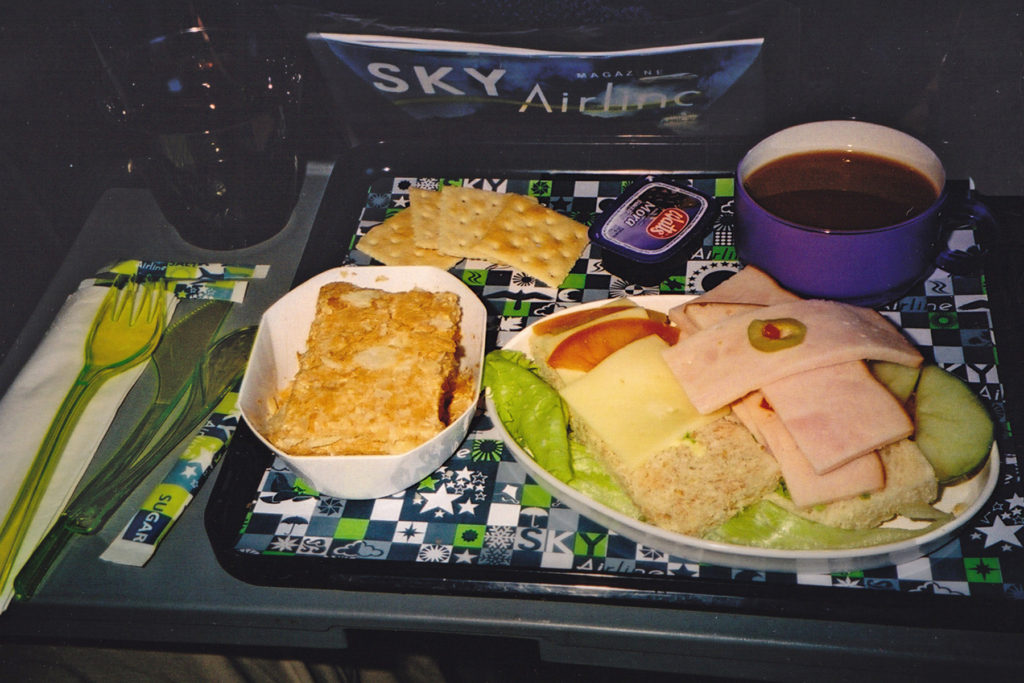
Sky Airline

Sky Airline (there is no “s”) is a Chilean carrier, and this was the economy meal on a 737 between Santiago and Punta Arenas. Let’s just say that I loved the paper tray liner, and leave it there. The green plastic silverware was a curious, some would say unappetizing touch.


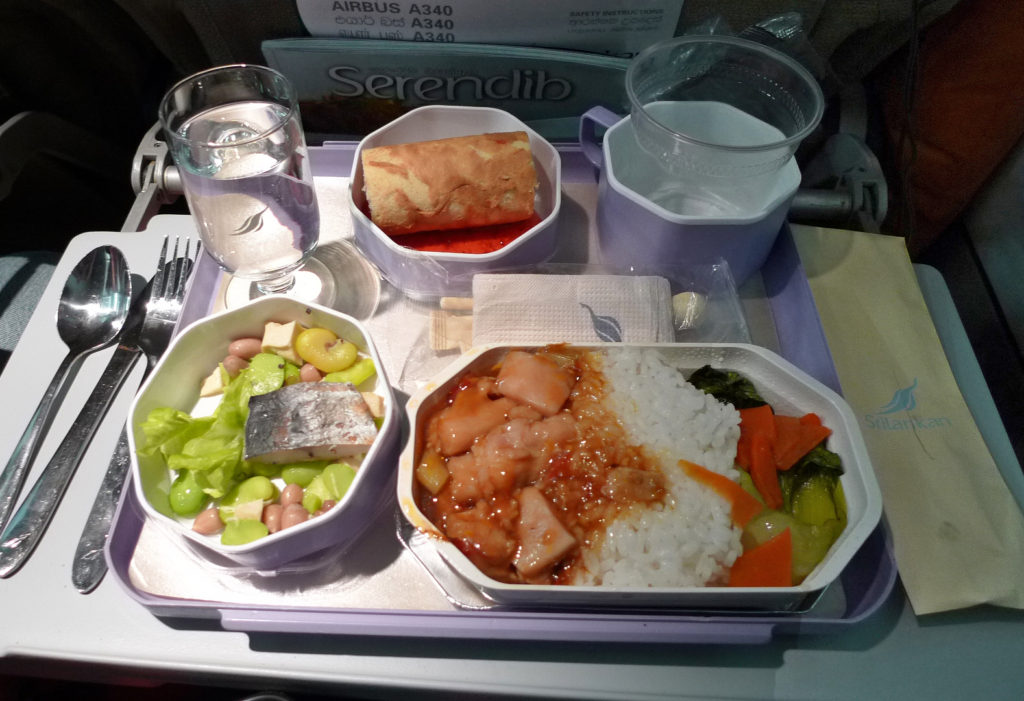
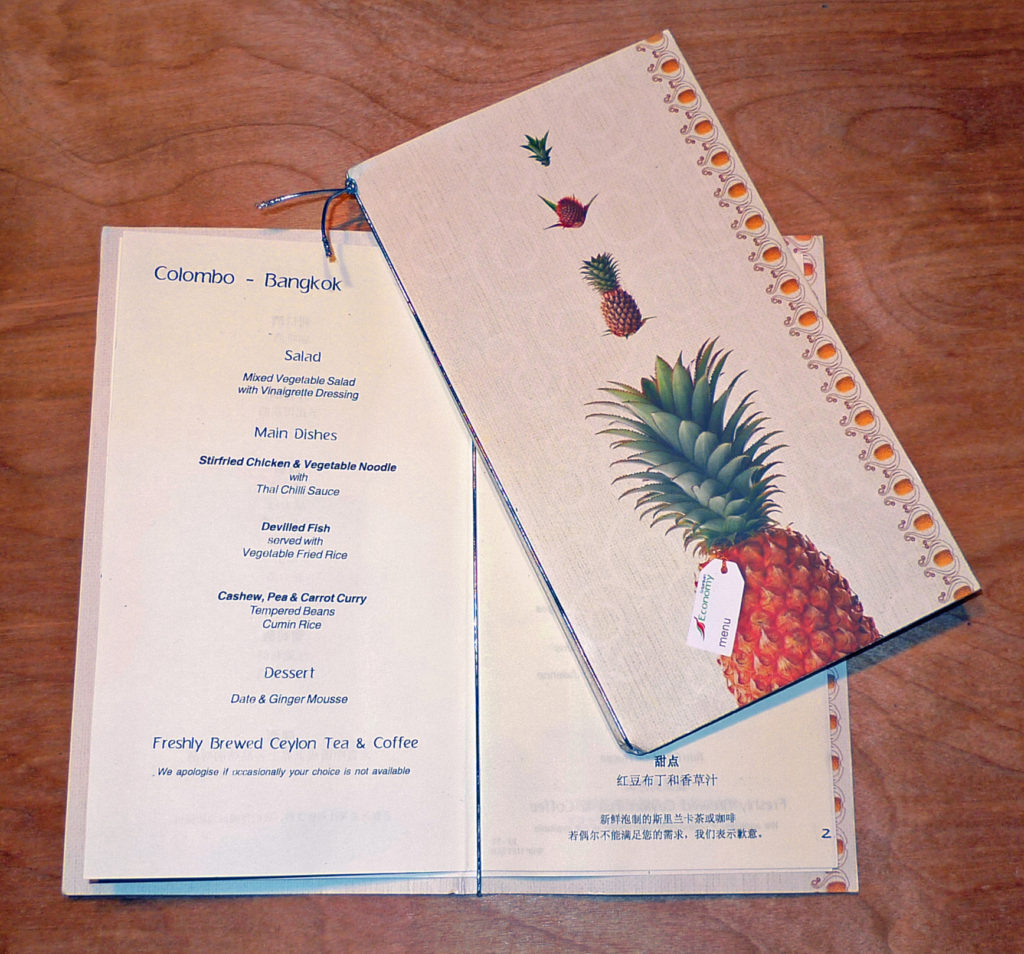
Sri Lankan Airlines

A beautiful little menu to whet your appetite on the way from Bangkok to Colombo. The meal itself was standard economy fare. Maybe the best thing you can say about economy class food is to call it “uneventful,” and this was no exception. The seat-pocket magazine is called Seredib — a sanskrit term from which the word “seredepity” comes from.


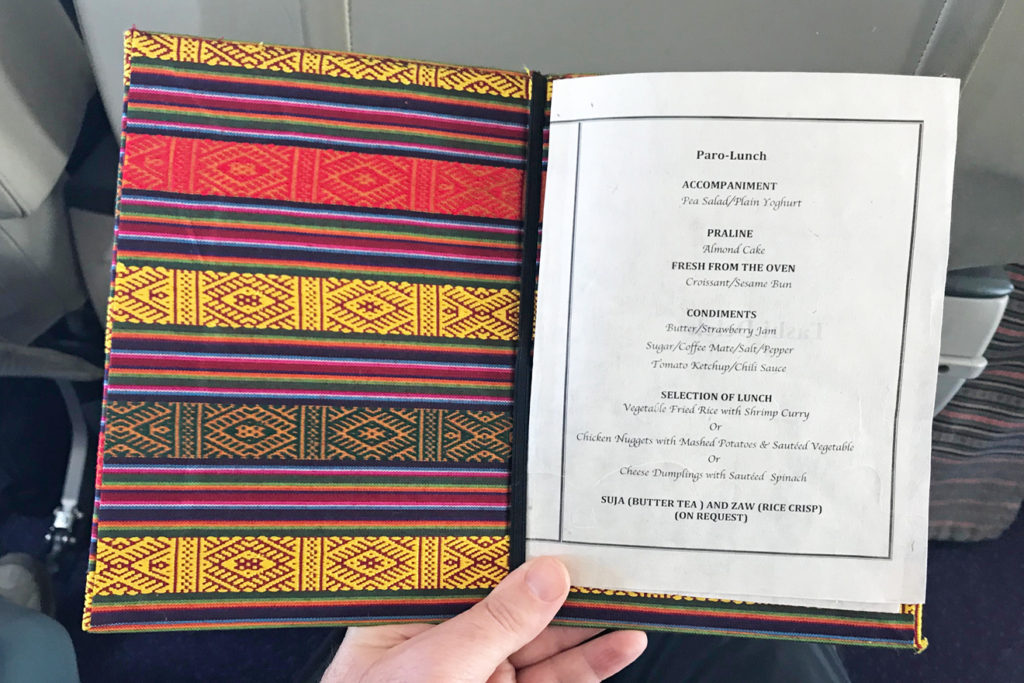
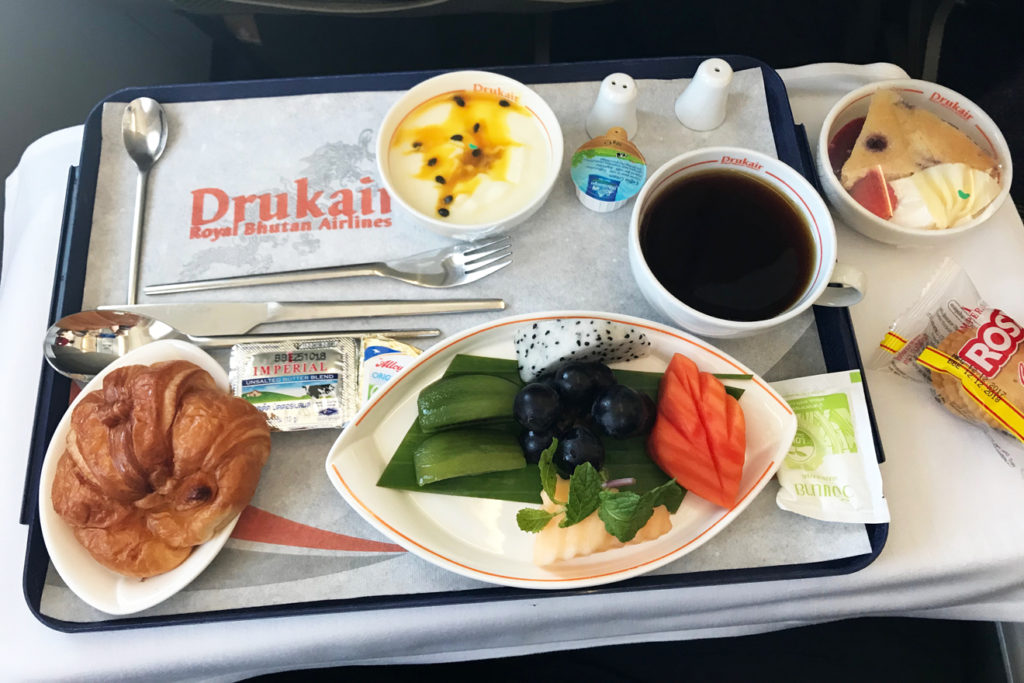
Drukair

One of Bhutan’s two airlines, Drukair flies smaller planes and offers a limited, if tasty business class menu. Here you see the lunch options on the daily run from Paro to Bangkok. This flight is further reviewed here.


Korean Air

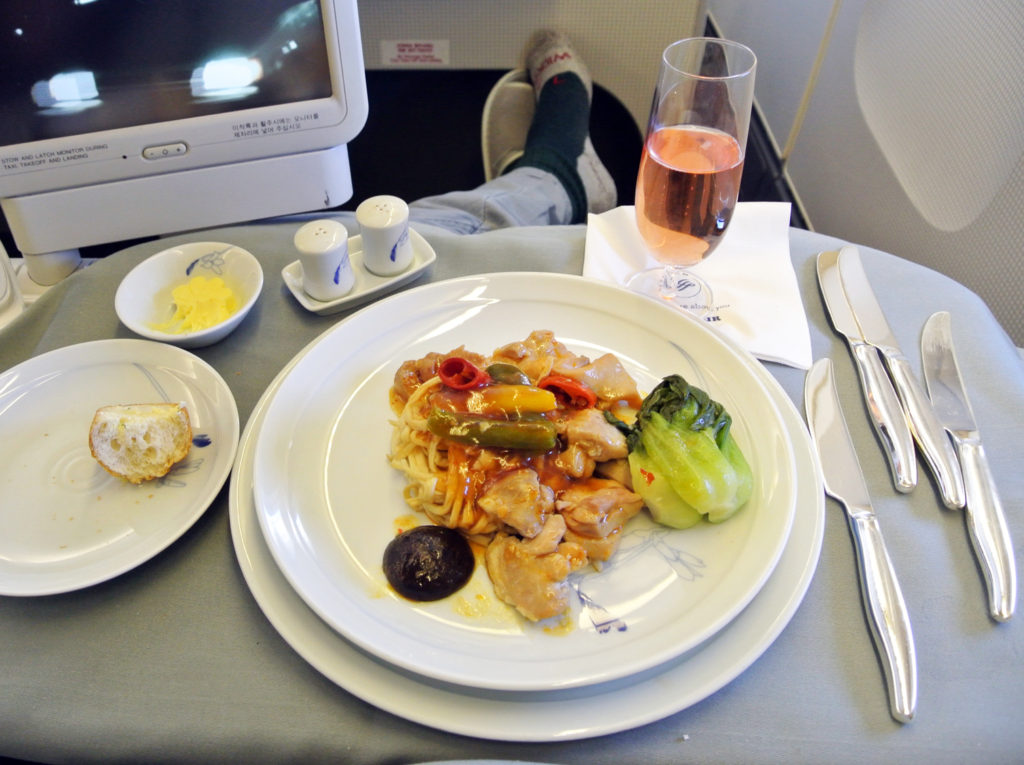
This was first class from Incheon to Bangkok in one of Korean’s inter-Asia 747s with an older configuration that is no longer used. Notice the pull-out style entertainment screen and non-sleeper seat. Talk about slumming it! And if that noodle concoction looks a little too sloppy and greasy, it was.


Singapore Airlines

For whatever reason, I failed to keep any photos of the business class delectables I enjoyed one night on the long ride from Singapore to Amsterdam. Instead I have this less interesting picture from a shorter flight. This is what you get on an A330 between Singapore and Japan.


Kenya Airways

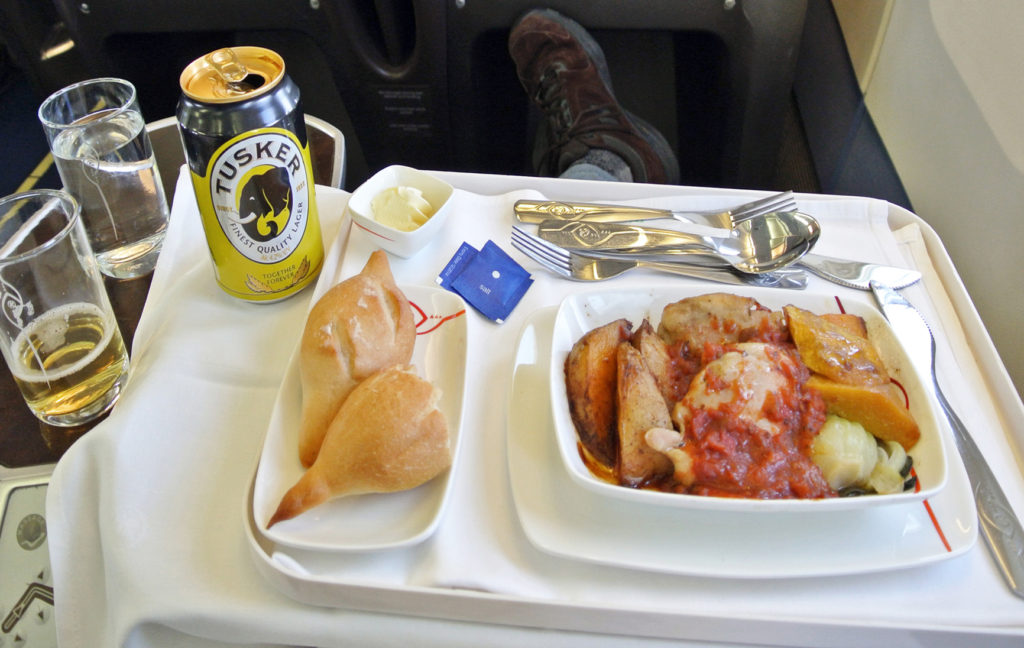
Bangkok to Hong Kong with Kenya Airways. A decent lunch and a can of Tusker. What’s not to like? And although you can’t see it here, this airline provides the world’s most luxurious fleece blankets. The crew even let me abscond with one, and today it resides on my couch. What they didn’t have, at least on this vintage 767 (since retired), is an entertainment system. I spent several perplexed minutes trying to locate my screen before realizing there wasn’t one.


Thai Airways

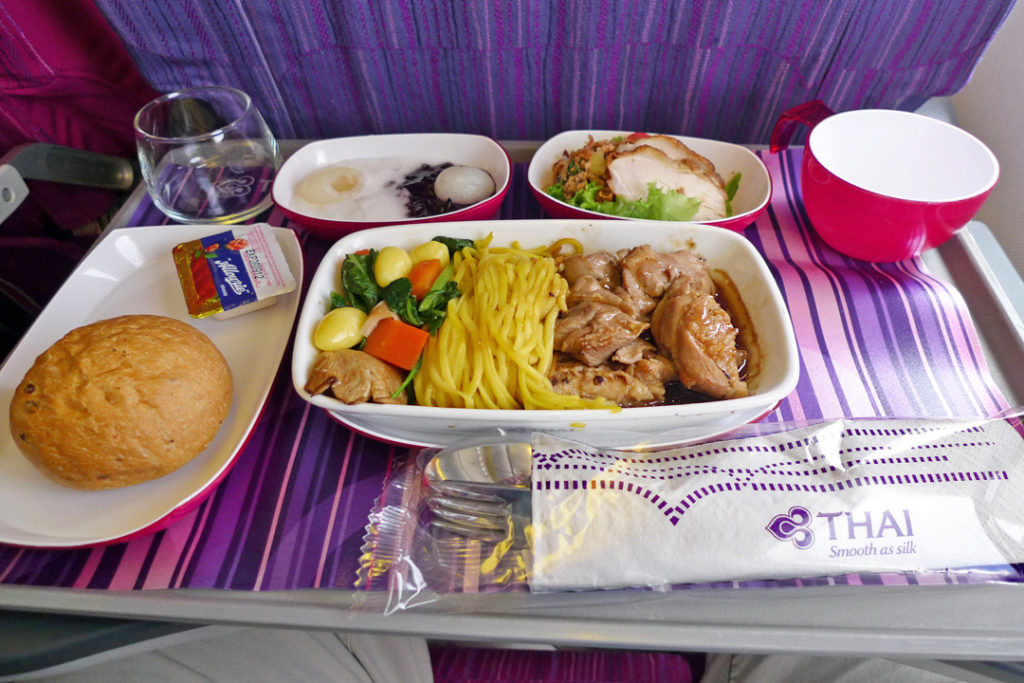
On the red-eye from Bangkok to Incheon. Another satisfying, if unspectacular, economy dinner.


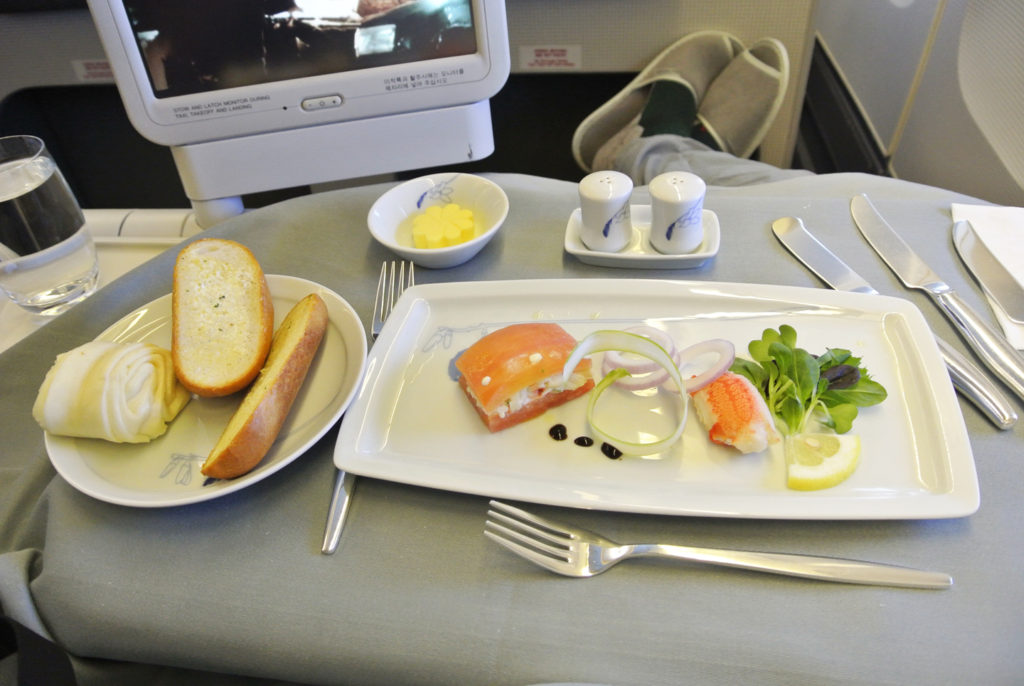
Cathay Pacific

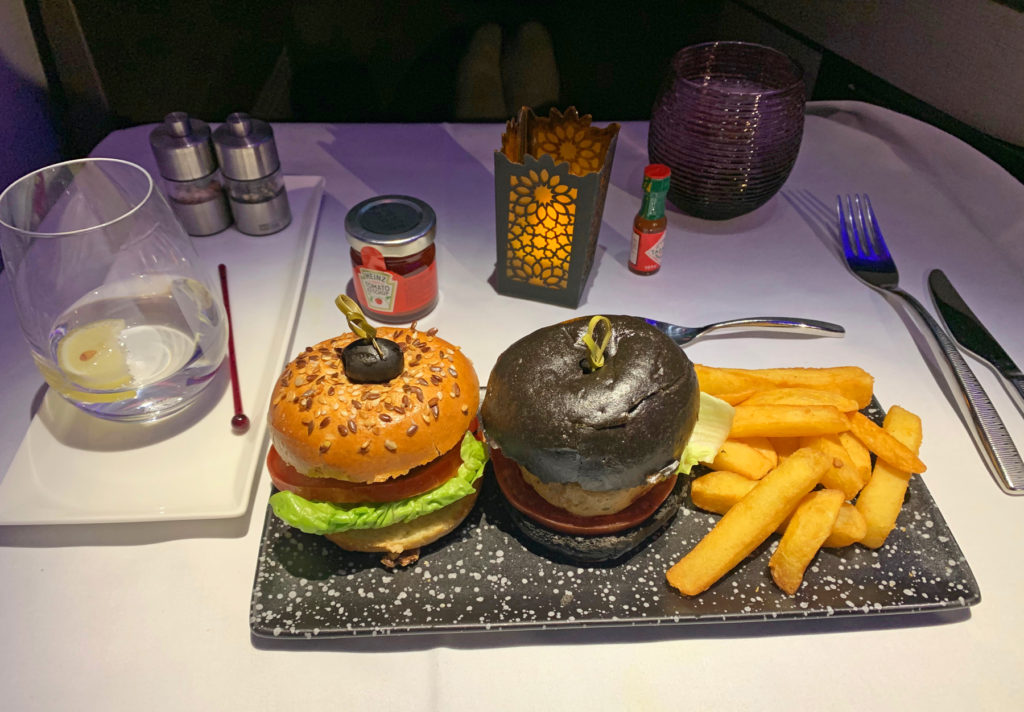
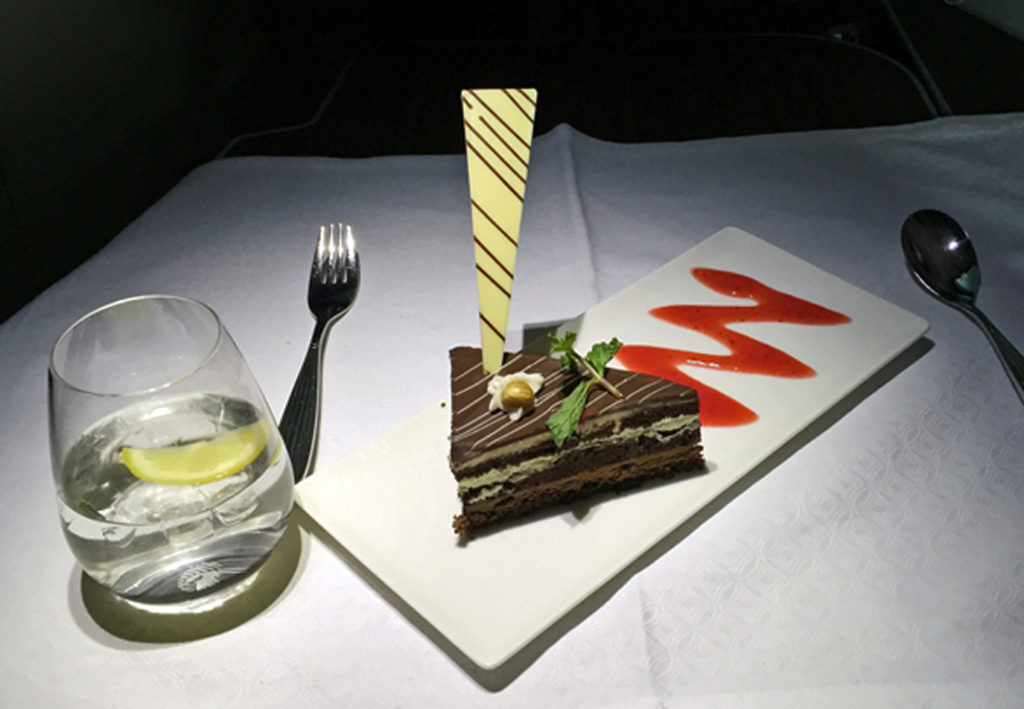
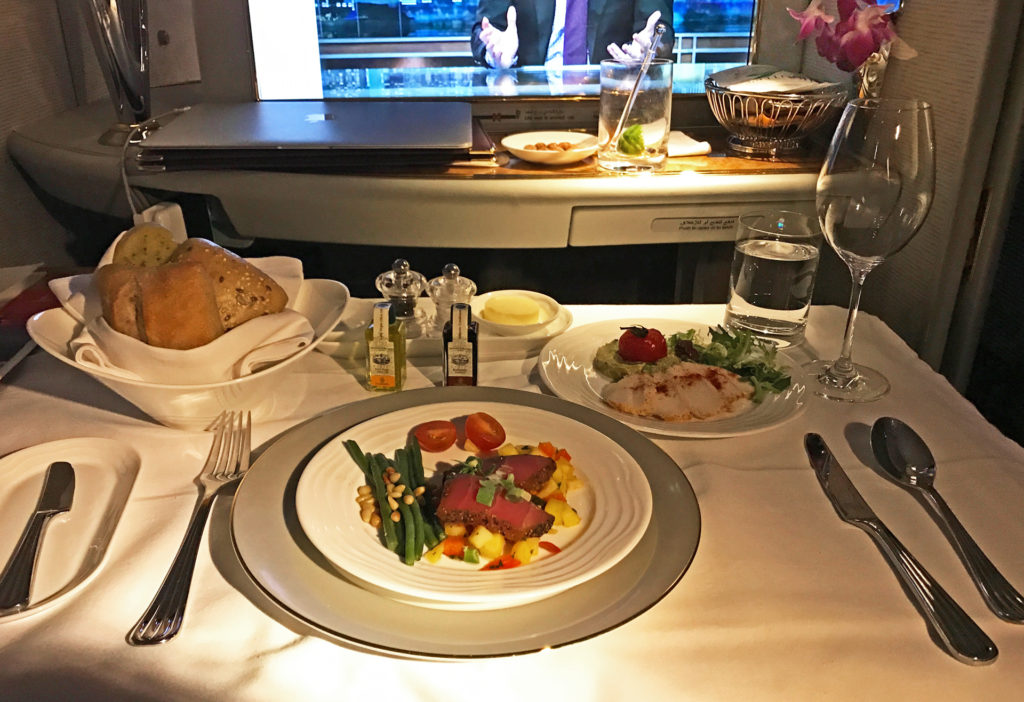
As good as it gets on a two-hour hop. Business class from Bangkok to Hong Kong. Find me a U.S. carrier that would offer something like this on such a short ride.


Air Malta

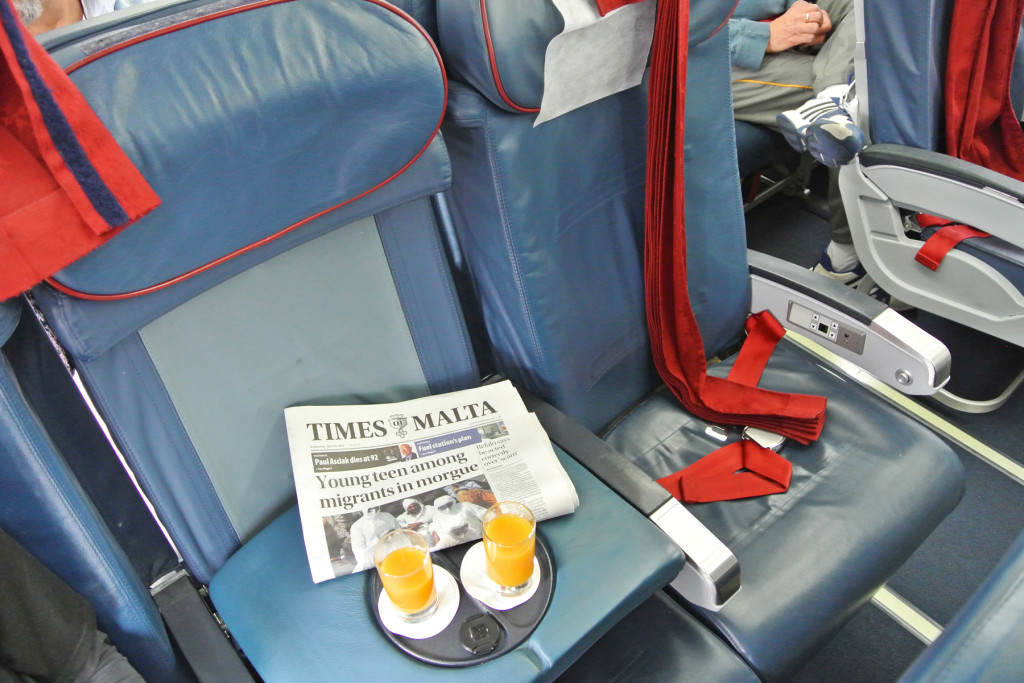
Air Malta is not longer in business, but like the aforementioned Drukair, they operated only shorter routes using narrow-body planes (pictured is Heathrow to Valetta), doing what they could with limited time and space. This involved some improvising, such as folding down the center seat to create a kind of instant business class. The result, all things considered, was surprisingly pleasant.


Emirates

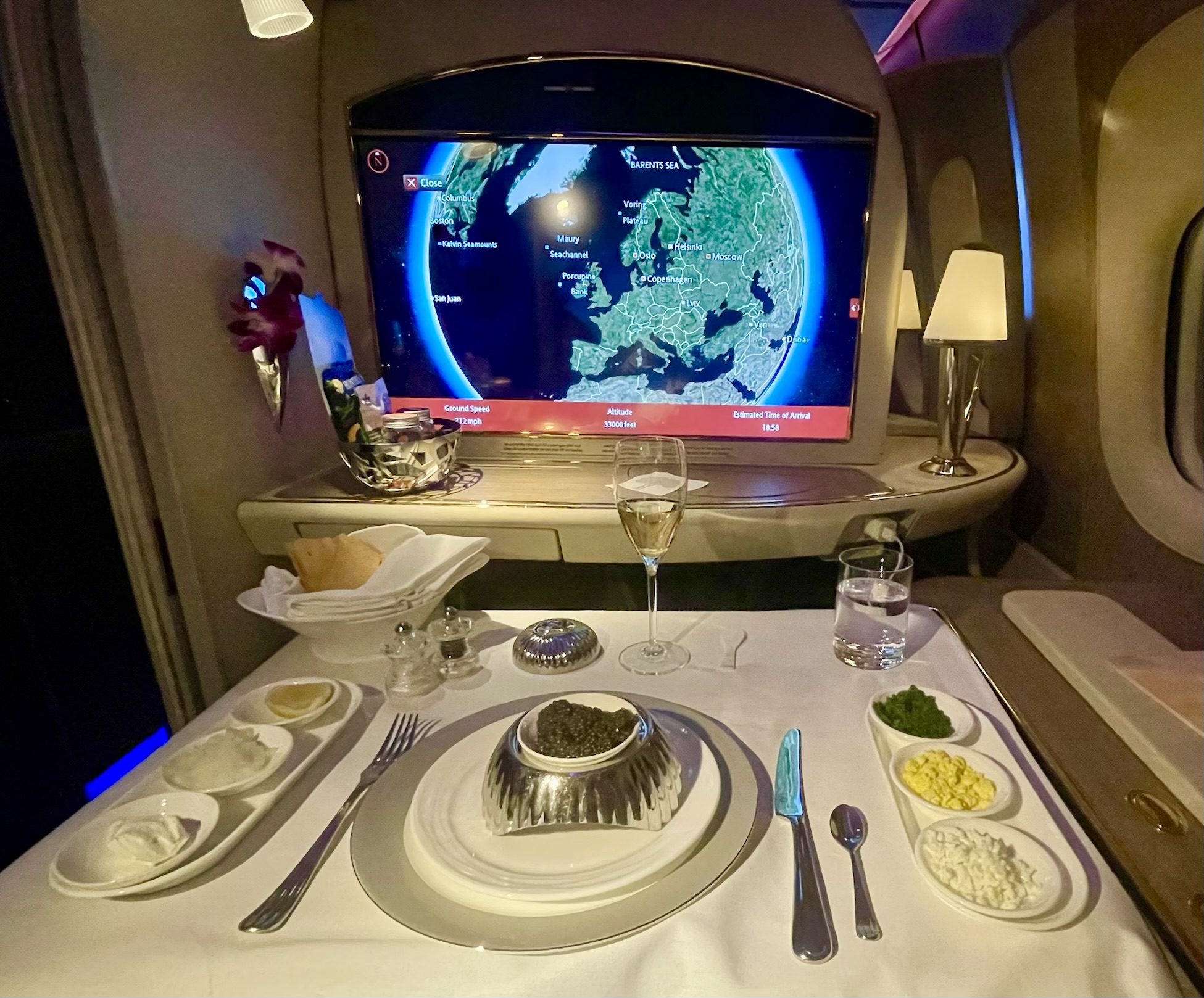
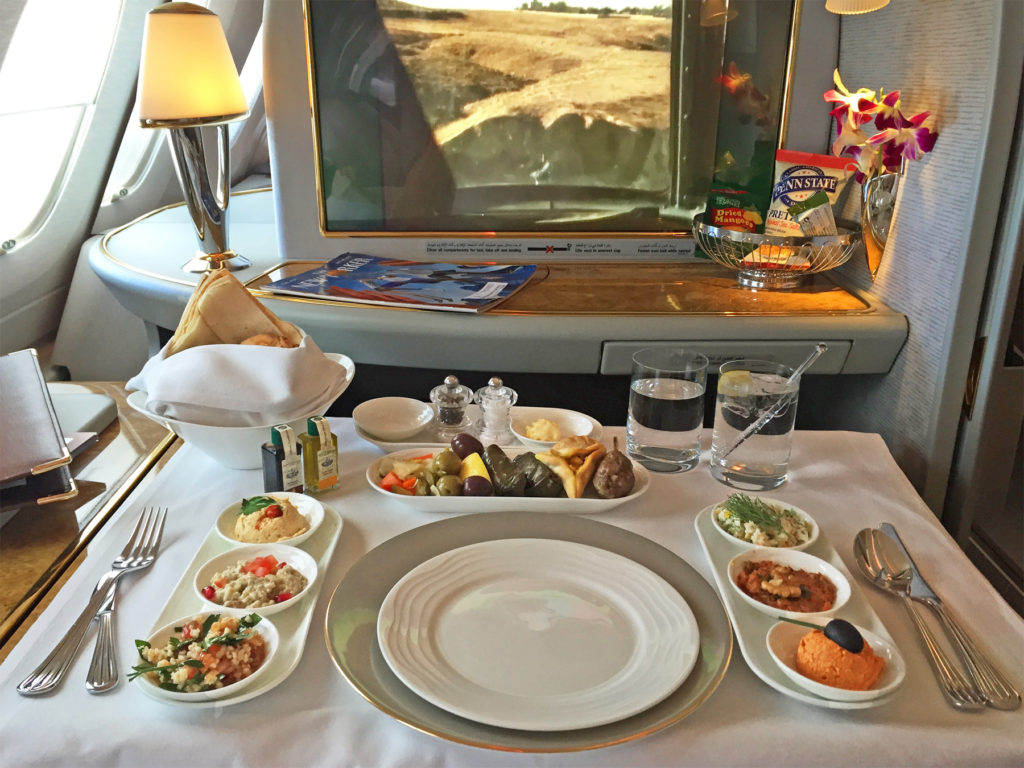
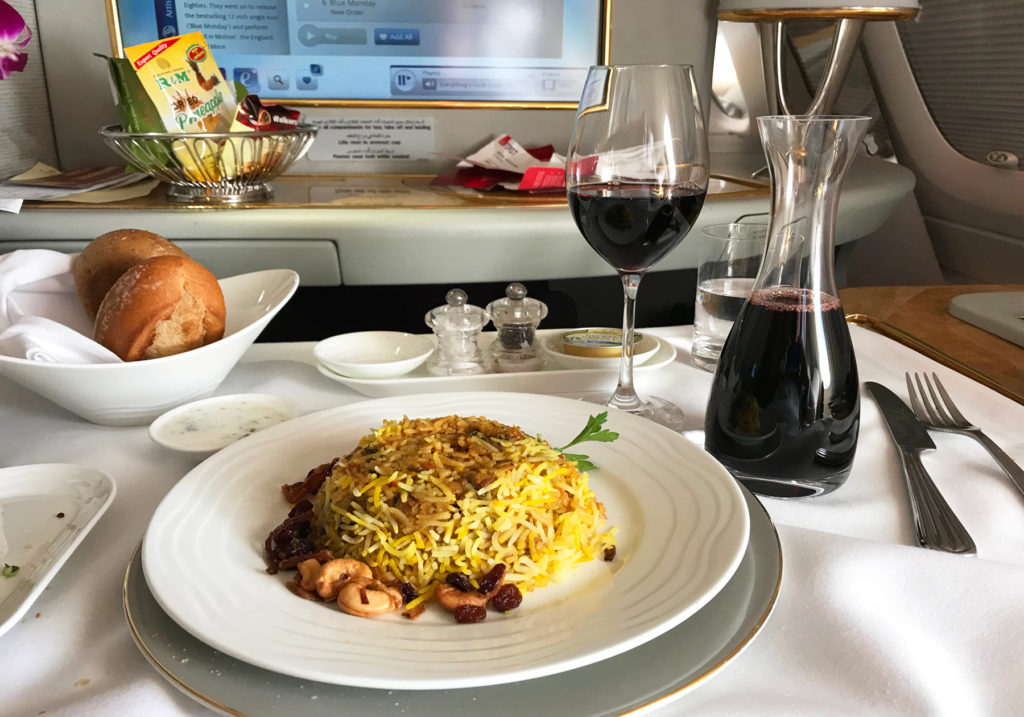
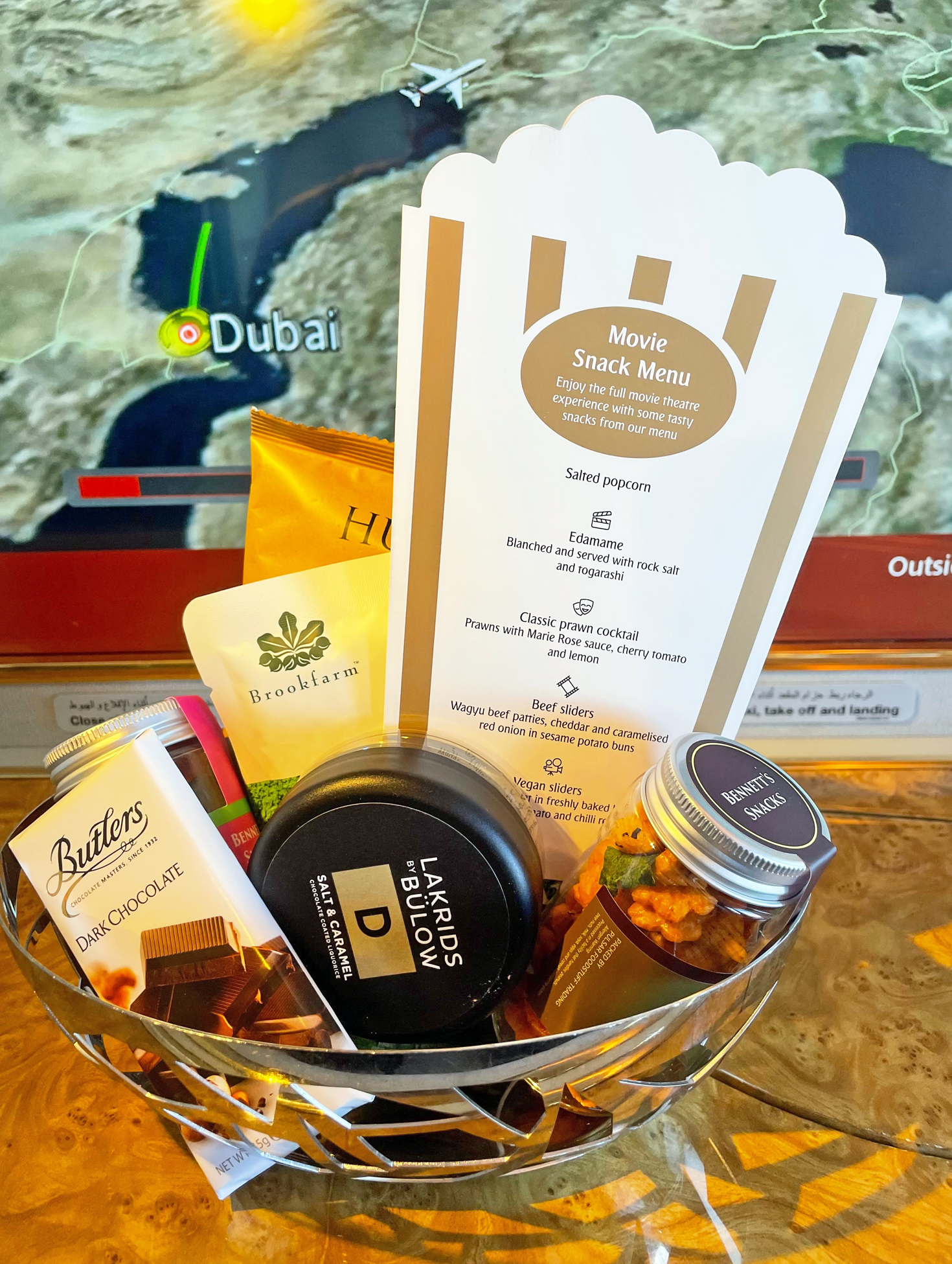
Emirates first class is… well. You’re looking at flights to Mauritius, Johannesburg, and Bangkok. Similar to Qatar Airways, this is dine-on-demand, and you’re free to mix and match entrees, appetizers, and desserts to your heart’s content. We start with a welcome-aboard glass of Dom Perignon followed by the airline’s signature caviar; then we see a mezze appetizer spread (yes that’s an appetizer), a shockingly delicious chicken biryani, and a tuna dish. Mind you this is first class; Emirates business is less lavish.


KLM

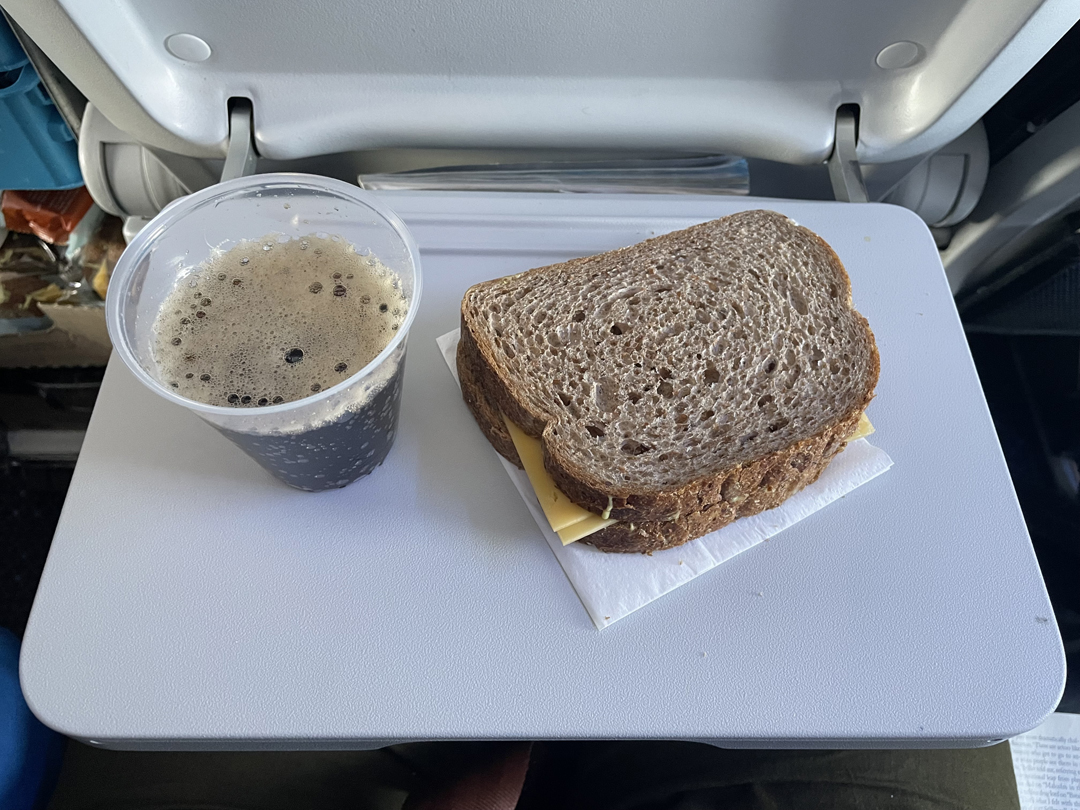
Or, you can fly KLM economy class from Dubrovnik to Schiphol and savor this.


Battle of the Bars

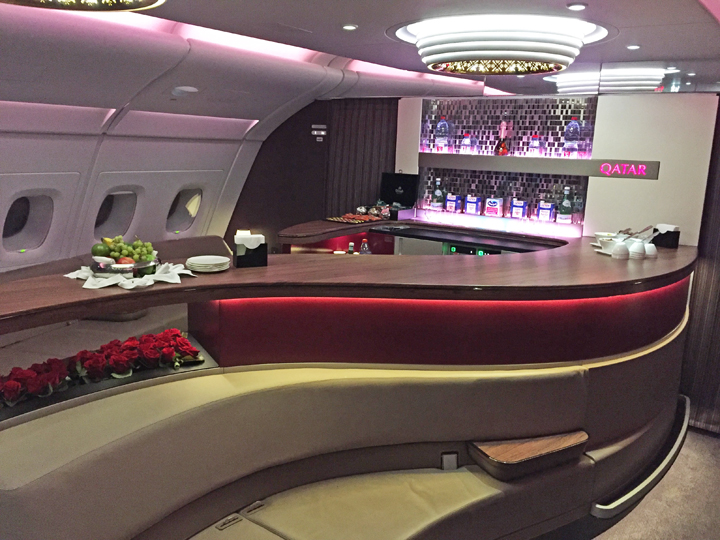
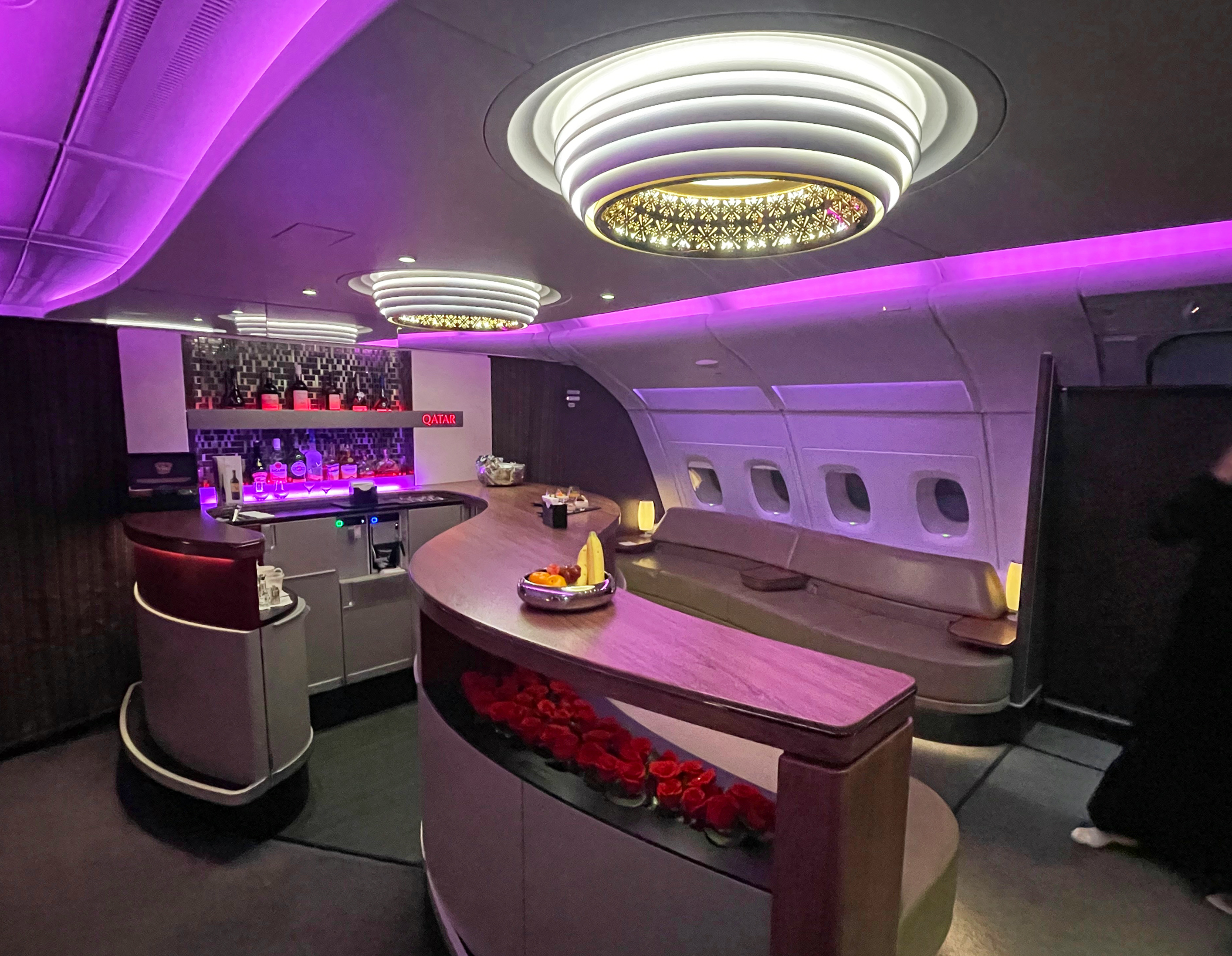
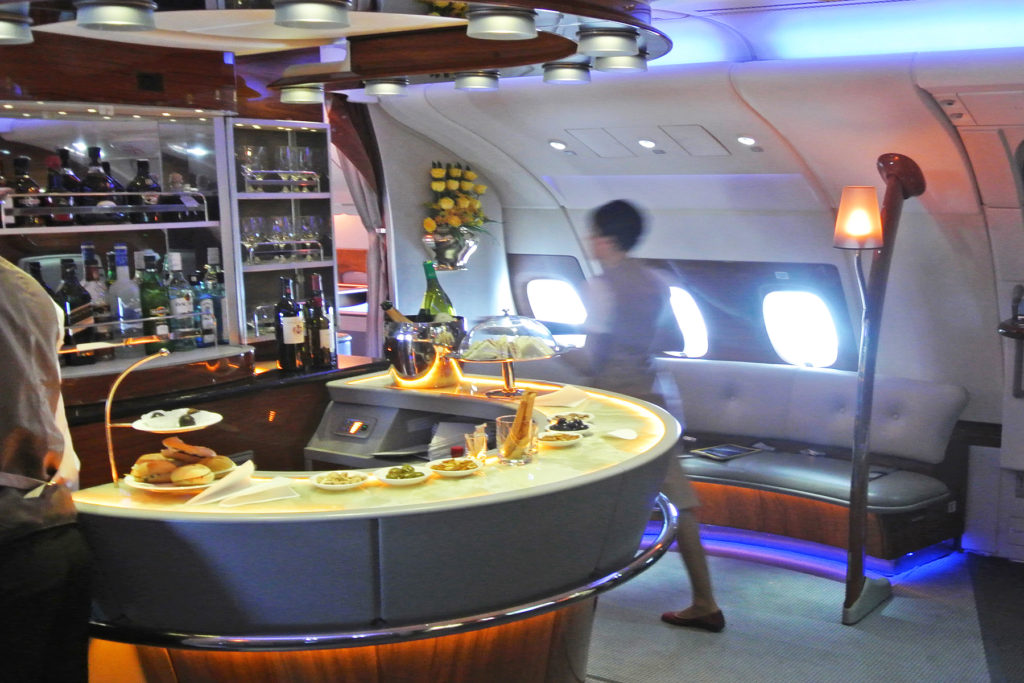
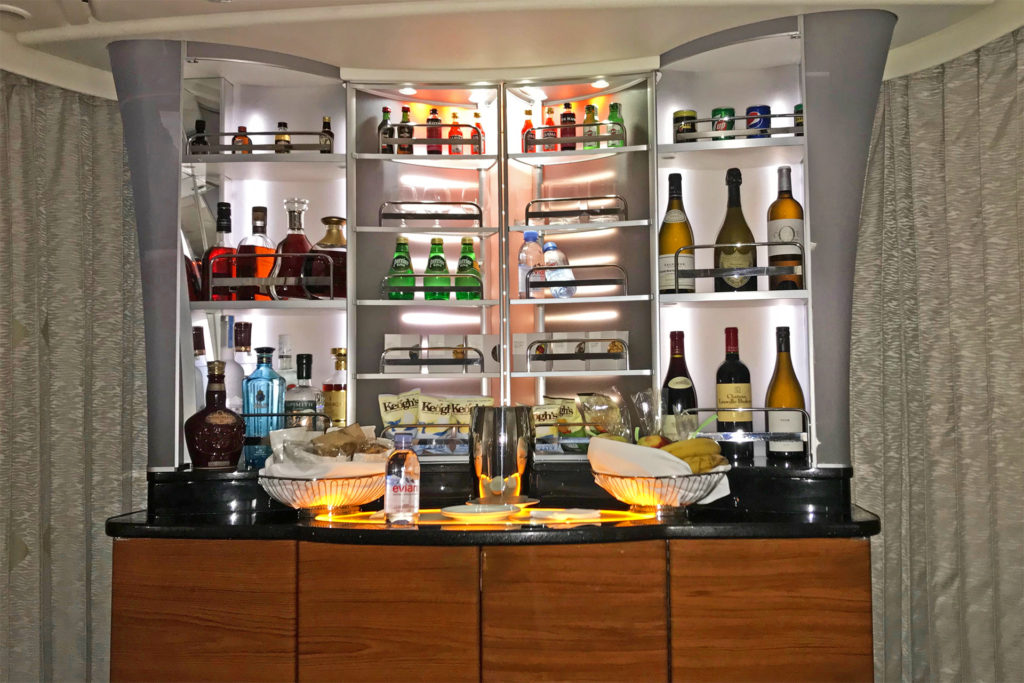
The Airbus A380s at Emirates and Qatar both have onboard lounges. Qatar’s is situated in the center of the upper-deck. The Emirates version is also upstairs, but in the back, behind business class. Emirates also has an exclusive upper-deck bar only for first class customers, located at the forward bulkhead between the shower spas. The lounge is staffed by a bartender, while the forward bar is serve-yourself.


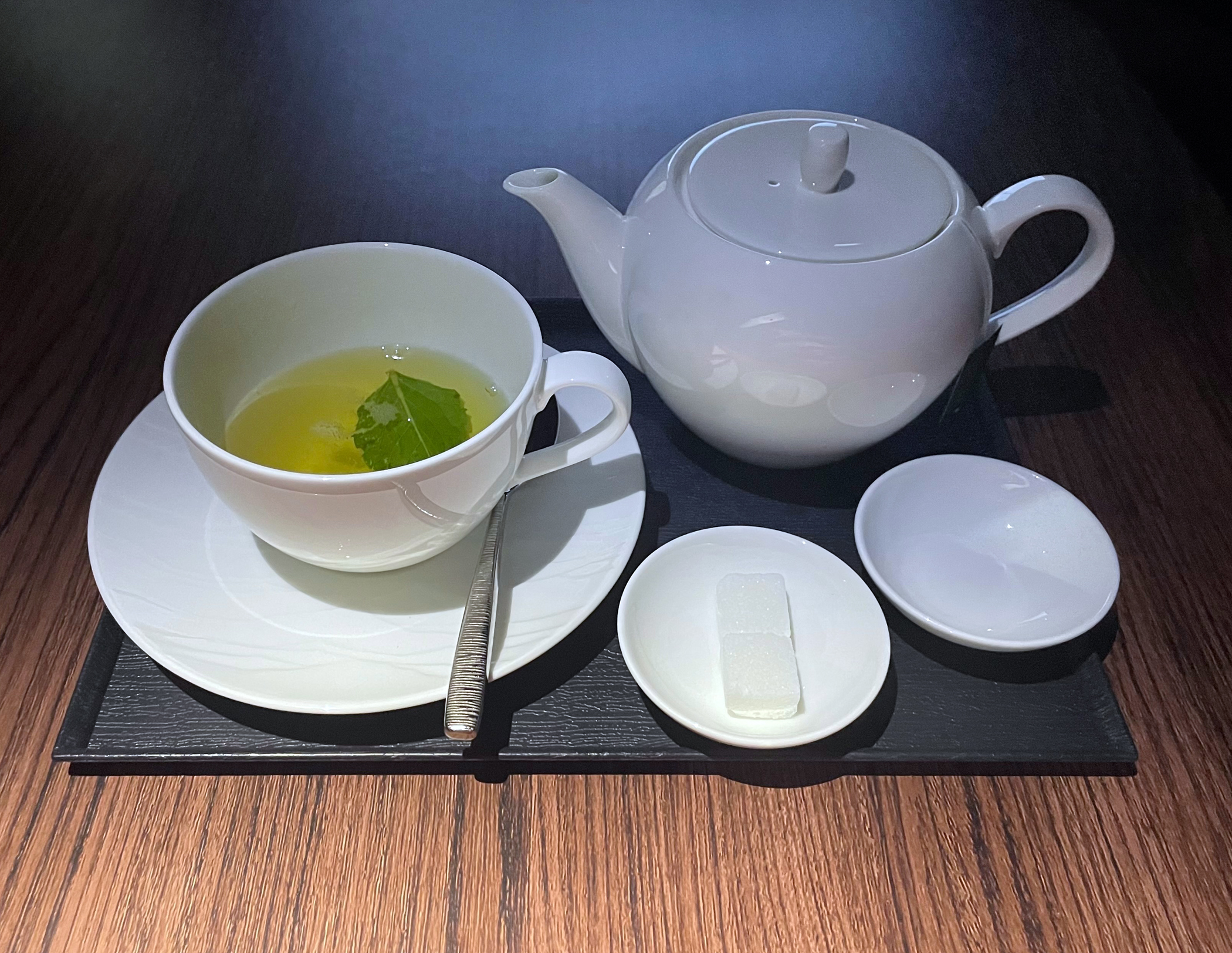
Tea Time

At the top, tea service on Qatar. On Emirates, the forward bar is taken down prior to arrival and a tea station is arranged in its place, backdropped by ornamental stones and waterfall. I mean, it’s hardly an airplane without rocks and a waterfall.


The Quiet Americans

Looking at those photos from the Gulf carriers, it’s easy to see that none of this is fair. Competing with heavily subsidized, government-owned airlines is pretty much impossible for American, European, and even most Asian carriers. Which isn’t to say their onboard products aren’t good. None of the U.S. carriers have returned quite to where they were pre-pandemic, but they’ve come a long way since the early 2000s, when broken seats, lousy food and terrible service were the standard.


Comments (19)

A “Life List” of Planes

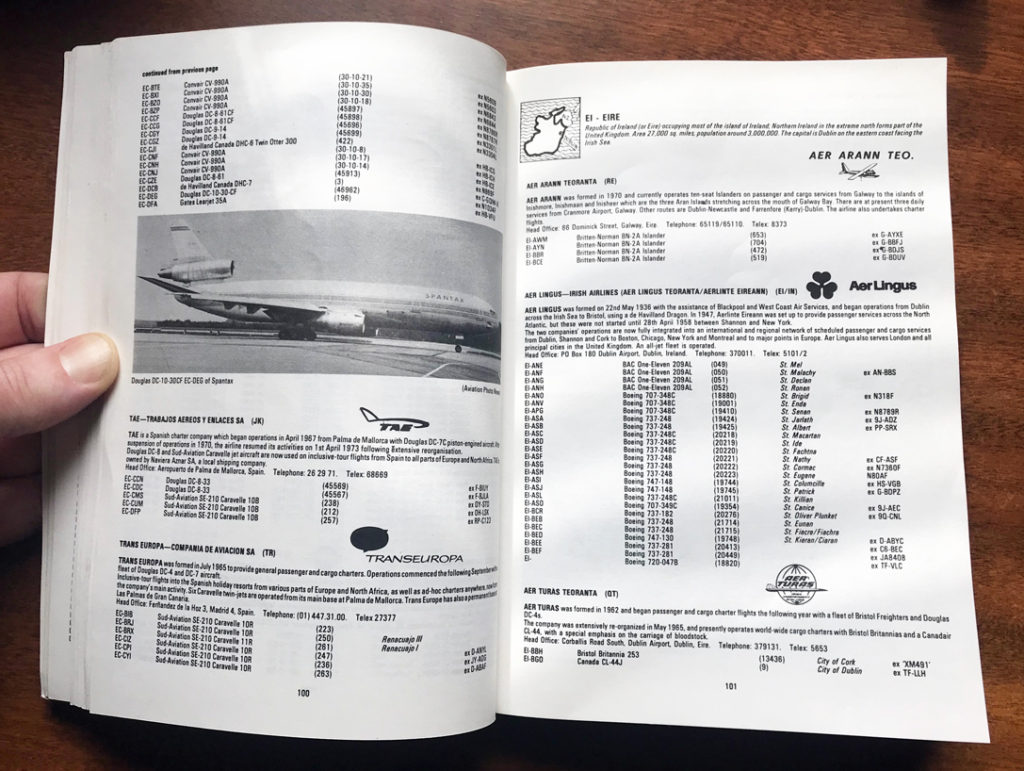
Pages from “World Airline Fleets, 1980.”  


UPDATE: March 1, 2026

AIRLINER ENTHUSIASTS are like birdwatchers in a lot of ways. We dress funny and tend to own expensive binoculars. And, we’re into lists.

As I kid I was a planespotter. I’d spend entire weekends holed up in the 16th-floor observation deck at Logan Airport, logging the registration numbers of arriving and departing jets. There were books you could buy — annual global fleet directories with the registrations and specs of every commercial plane in the world, arranged alphabetically by country and airline. There were little boxes where you could check off each plane once it was “spotted,” or, you could just line through the listing with a highlighter.

World Airline Fleets, I remember, was one of these books. It came from the U.K. and was edited by a fellow named Gunter Endres (who, the Interweb tells us, is still writing aviation books). An even bigger volume, published in Switzerland, was called J.P. Airline Fleets. The idea was to mark off as many planes as you could.

Up there on the 16th floor, things could get competitive. I’ll never forget the jealousy I felt toward a legendary Boston spotter named Barry Sobel, because he’d been there to record a Pakistan International 707 freighter that landed unexpectedly one weekday while I was in school.

At one point, way back when, I could have told you the model and airline of every commercial plane I’d ever seen. Birders have tallies like this, too. They call them “life lists.” Braniff DC-8, El Al 707, Aeroflot IL-62… check, check, check. There were hundreds. Somewhere along the way I stopped keeping track, and all these years later I couldn’t begin to reconstruct such a catalog.

What I can do, however, easily and accurately, is present a slightly different life list: a record of each airplane type, and each airline, that I have flown aboard. It appears below. I’ll also include which classes I’ve sat in, using the traditional industry codes:

F = First
C = Business
Y = Economy

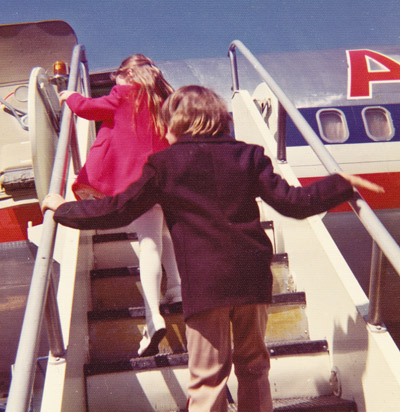
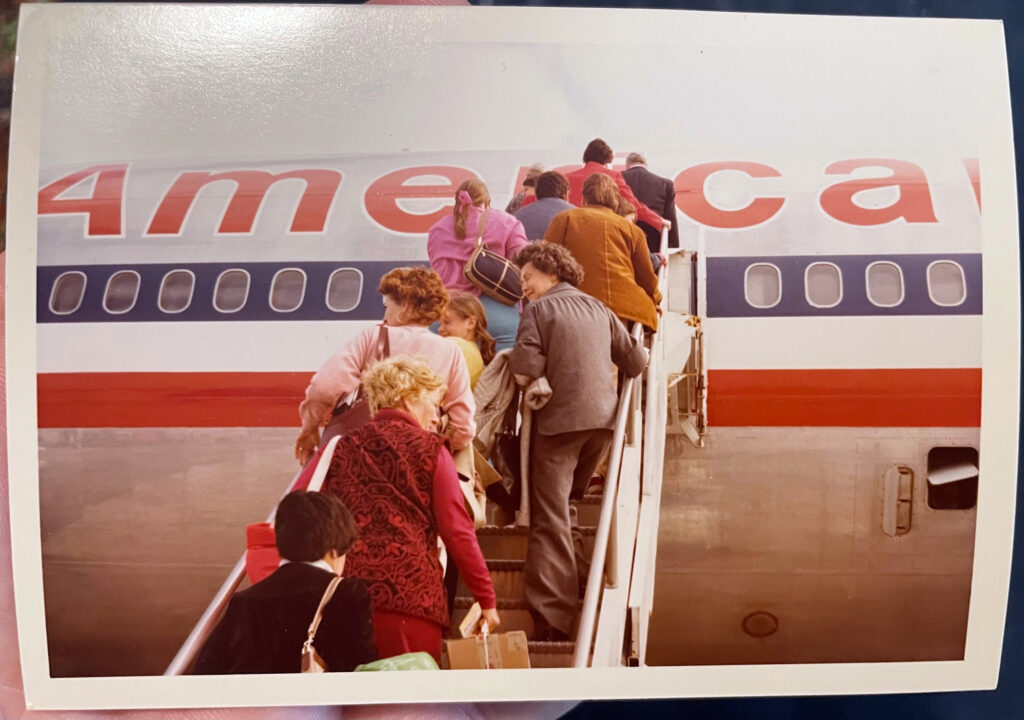
The accompanying photo is from April, 1974. That’s my sister and me walking up the stairs to an American Airlines Boeing 727, on our way to Washington, D.C. This was the first airplane, large or small, that I ever set foot in. I’m fortunate to have the moment preserved like this.

Even then, at eight years-old, I knew it was a 727.

BOEING 727

American   F,Y
Northwest   F,Y
Eastern   Y
Delta   F,Y
Pan Am   Y
TWA   F,Y
USAir/US Airways  Y
Trump Shuttle   Y
Fawcett (Peru) Y
Aeroamericana (Peru)  Y
DHL (cargo, cockpit jumpseat)


BOEING 707

TWA Y


BOEING 737 CLASSIC

Piedmont  Y
USAir   Y
United  Y
Delta  Y
Aloha Y
Rutaca (Venezuela)  Y
Cayman Airways Y
Sky Airline (Chile)  Y
PLUNA (Uruguay) Y


BOEING 737 (Next Generation)

American Y
United  Y
Delta   F,Y
Southwest  Y
KLM  C,Y
Malaysia Airlines  Y
SAS  Y
South African Airways  Y
Jet Airways (India) C
Turkish Airlines  Y
Thai Lion Air Y

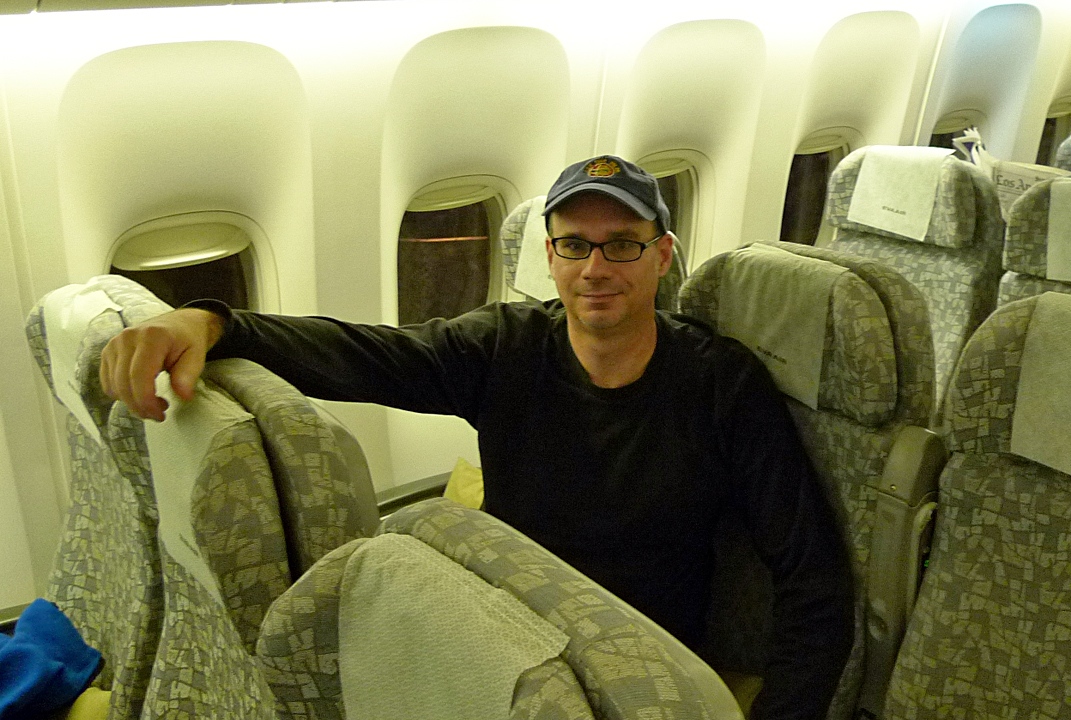
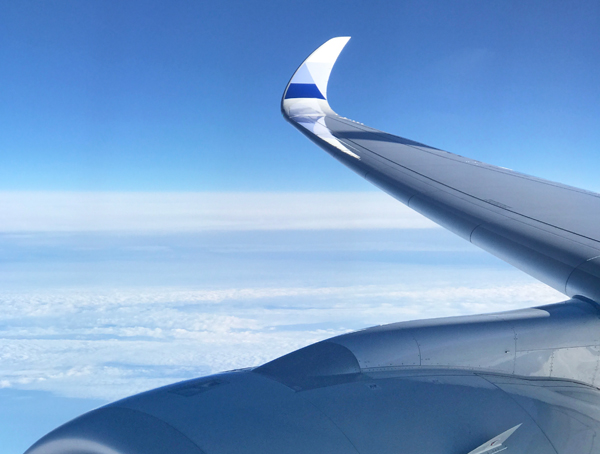
En route to Taipei on an Eva Air 777.

BOEING 747 (All series)

Pan Am Y
Northwest F,C,Y
El Al  Y
United  C
British Airways  C,Y
Air France  Y
Qantas  Y
Singapore Airlines  Y
Thai  C
Delta  C,Y
Korean Air  F,C
Royal Air Maroc Y
South African Airways  Y


BOEING 757

Northwest  Y
American  F,Y
United  F,Y
Delta  F,C,Y
British Airways  Y
Icelandair  Y


BOEING 767

United F,C,Y
Delta  F,C,Y
TWA C
All Nippon  Y
Kenya Airways  C


BOEING 777

United  Y
American C
Delta  C,Y
Emirates  F,C,Y
Malaysia Airlines  Y
Thai  C,Y
Eva Air  Y
Korean Air Y
Royal Brunei  Y
Cathay Pacific  C
Qatar Airways C
Singapore Airlines  C
Jet Airways (India) F
China Eastern C

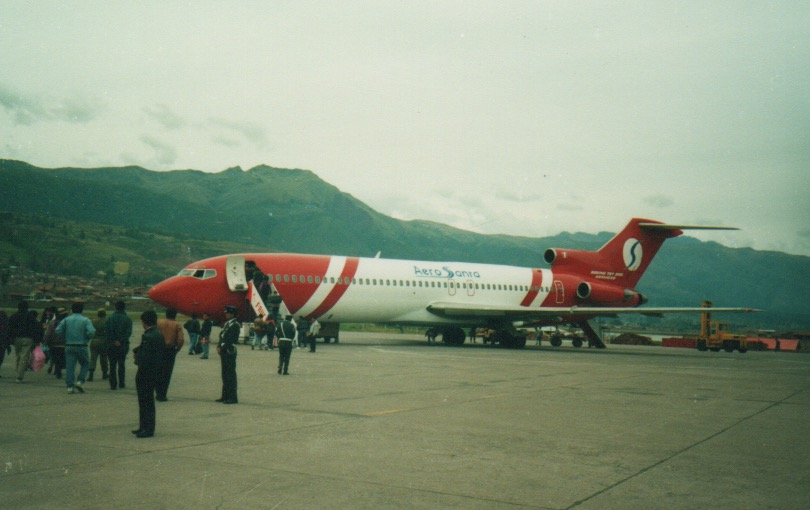
AeroSanta 727 at Cuzco, 1994.   Author’s photo.

BOEING 787

Japan Airlines  Y
Qatar Airways C
Virgin Atlantic C
Korean Air C


DOUGLAS DC-8

Air Canada  Y
DHL (cargo, cockpit jumpseat)


McDONNELL DOUGLAS DC-9 (Classic)

Northwest Y
USAir  Y
Delta  F,Y
Air Canada  Y
Finnair  Y
Aeropostal (Venezuela)  Y
ValuJet  Y


McDONNELL DOUGLAS MD-80 Series (DC-9 Super 80, MD-88/83/87, etc.)

TWA  F,Y
Delta  F,Y
American F,Y
New York Air  Y
Continental  F
Austral (Argentina)  Y


McDONNELL DOUGLAS MD-90 Series (MD-90, Boeing 717)

Delta  F,Y
Bangkok Airways  Y
Uni Air (Eva Air)  Y


McDONNELL DOUGLAS DC-10

American  F,Y
Northwest  F,C,Y
Aeromexico Y
Finnair  Y
British Airways  C
Continental  Y


McDONNELL DOUGLAS MD-11

Delta  C,Y

Boarding a DC-10 in Bermuda, 1979.   Author’s photo.

LOCKHEED L-1011

Eastern F,Y
Pan Am  Y
Delta  Y


FOKKER F-28

USAir  Y


AIRBUS A300

Eastern  Y
American  Y
Thai  Y
DHL (cargo, cockpit jumpseat)


AIRBUS A310

Lufthansa  Y


AIRBUS A320 Series (A319, A320, A321)

United F,Y
Delta  F,Y
America West F
US Airways Y
British Airways  Y
Air France  Y
Lufthansa Y
TAP Y
Royal Brunei Y
Air Malta   C
SAETA (Ecuador) Y
LanPeru  Y
AirAsia  Y
JetBlue  Y, C
China Eastern F
Drukair (Royal Bhutan Airlines) C
Avianca C
VietJet Y
Qatar Airways C
South African Airways Y
Aegean Airlines Y


AIRBUS A330

Air France  Y
Sabena  Y
Delta  C,Y
Cathay Pacific  C,Y
Thai  Y
Asiana  C
Singapore Airlines  C
Turkish Airlines C
China Airlines  C
Philippine Airlines C
Qatar Airways C
South African Airways C

On board a China Airlines A350.   Author’s photo.

AIRBUS A340
Air France  C,Y
EgyptAir  Y
SriLankan  Y
Cathay Pacific Y
China Airlines Y
Qatar Airways C


AIRBUS A350
Qatar Airways  C
China Airlines   C
Cathay Pacific C
Delta C, Y
Thai Airways C
Qatar Airways C


AIRBUS A380

Emirates  F,C
Qatar Airways C
Asiana  C


AIRBUS A220 (Bombardier C-Series)

Delta  F,Y
airBaltic Y


EMBRAER 190

JetBlue Y
American  Y
US Airways  Y
Aerorepublica (Colombia)  Y


EMBRAER 190

JetBlue Y
American Y
US Airways Y
Aerorepublica (Colombia)   Y


TUPOLEV Tu-134

Aeroflot  Y


TUPOLEV Tu-154

Aeroflot Y


As you’ve probably noticed, I’ve left out regional jets and turboprops. Partly because they’re boring, and partly because, for that same reason, I can’t remember them all. Highlights would include a Pan Am Express Dash-7, an Air New England FH-227, an Aeroperlas (Panama) Shorts 360, and a cargo-carrying Twin Otter in which I sat on the floor during a hop from St. Croix to San Juan.

The winners, if we can call them that, are the 737 and A320, predictably enough. That’s not very exciting, and it’s pleasing to see the infinitely more impressive 747 coming in third place. Somehow I’ve managed to fly aboard 747s from 13 different carriers.

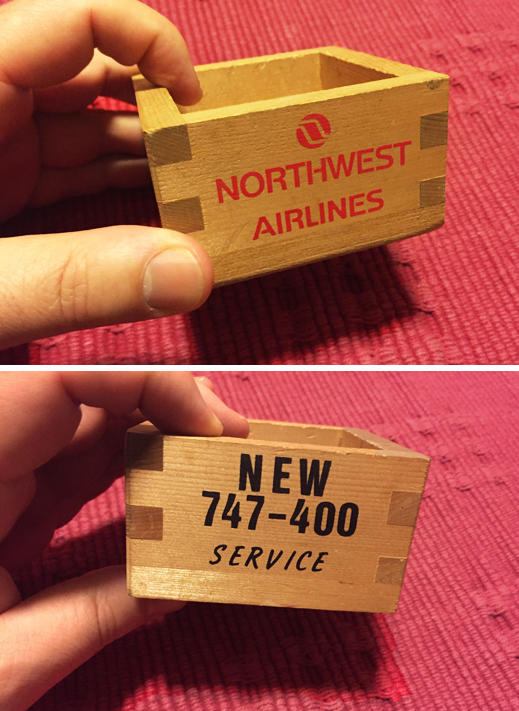
Northwest Airlines, some of you might recall, was the launch customer for the 747-400, back in 1989. That spring, they had been using the jet on domestic “proving runs” mainly between Minneapolis and Phoenix. Finally on June 1st, they inaugurated international service. The first departure was flight NW 47, from JFK to Narita. My friend Ben and I were passengers on that flight. It was the day after my 23rd birthday. I still have one of the commemorative sake cups that they handed out.

747SakeCup

Of all the planes that ought to be on the list, but aren’t, the most painful example is the Concorde. Years ago, when I was a regional airline pilot, British Airways used to offer a special “interline” Concorde fare to London, available only to industry employees. It cost $400, and it was what we call “positive-space” — as opposed to standby.

A remarkable bargain, looking back on it. But when you’re a young pilot making twenty grand a year, $400 is a lot of money, and so I kept putting it off, putting it off. I’ll do it later, I promised myself. Next year.

And then it was gone.


Comments (74)

The De-Ice Man Cometh

Snow, Ice, and Airplanes. Everything You Need to Know About the Travails of Winter Flying.

2025 Version.

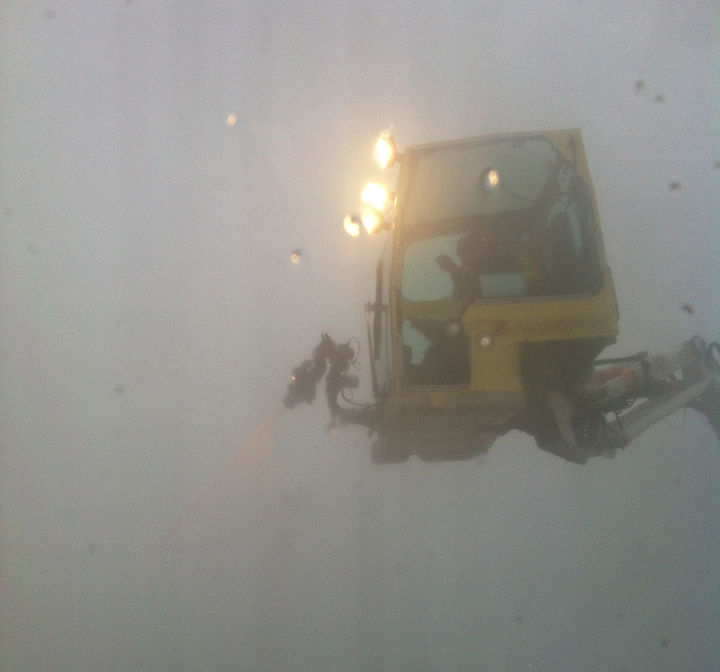
Deiceman

“You’re sitting on the tarmac while a guy in a hovering pod floats over you, twin beams of light piercing the murk of de-icing fluid. That’s my airplane fantasy. I want to be that guy!”

— Peter Hughes


IT’S THAT TIME OF YEAR AGAIN: snowstorms, cancellations, delays, and the sights and sounds of that weird fluid splattering off the fuselage. Here’s some intel…

On the Ground:

Parked at the terminal, ice, snow, or frost accumulates on a plane the same way it does on your car. But while a cursory brushing or scraping is a safe-enough remedy for driving, it doesn’t work for flying, when even a quarter-inch layer of frozen material can alter airflow around the wing—highly important during takeoff, when speed is slow and lift margins are thin. The delicious-looking spray used to clean it away is a heated combination of propylene glycol alcohol and water. Different mixtures, varying in temperature, viscosity, and color, are applied for different conditions, often in combination: a plane will be hit with so-called Type I fluid (orange) to get rid of the bulk of accumulation, then further treated with Type IV (greenish), a stickier substance that wards off additional buildup.

While it might appear casual to the passenger, the spraying procedure is a regimented, step-by-step process. Pilots first follow a checklist to ensure their plane is correctly configured. Usually the flaps and slats will be lowered to the takeoff position, with the APU providing power and the main engines shut down. The air-conditioning units will be switched off to keep the cabin free of fumes. When deicing is complete, the ground crew tells the pilots which types of fluid were used, as well as the exact time that treatment began. This allows us to keep track of something called a “holdover time.” If the holdover time is exceeded before the plane has a chance to take off, a second round of spraying may be required. The length of the holdover depends on the kind of fluids used, plus the rate and type of active precipitation (dry snow, wet snow, ice pellets; light, moderate, heavy). We have charts to figure it all out.

Deicing fluid isn’t especially corrosive, but neither is it the most environmentally friendly stuff in the world. And although it resembles apple cider or a tropical fruit puree, I wouldn’t drink it; certain types of glycol are poisonous. At upward of $5 a gallon, it is also very expensive. When you add in handling and storage costs, relieving a single jet of winter white can cost several thousand dollars. A growing number of airports recycle deicing fluid. It’s a complicated process, but it beats letting the goop seep into the water table or drain into lakes and rivers.

Another method is to tow aircraft into specially built hangars equipped with powerful, ceiling-mounted heat lamps. JetBlue has such a hangar at JFK. In some ways this is a greener technique, though it uses hideous amounts of electricity.


In the Air:

Under the right combination moisture and temperature, icing also can occur during flight. It tends to build on the forward edges of the wings and tail, around engine inlets, and on various antennas and probes. Left unchecked, it can damage engines, throw propeller assemblies off balance, and disrupt the flow of air over and around the wing. In a worst-case scenario, it can induce a full-on aerodynamic stall.

The good news is that all commercial aircraft are equipped with devices to keep these areas clean. On propeller-driven planes, pneumatically inflated “boots” will break ice from the leading edges of the wings and horizontal tail. On jets, hot air from the engine compressors is ducted to the wings, tail, and engine intakes. Windshields, propeller blades, and the different probes and sensors are kept warm electrically. These systems use redundant power sources and are separated into independently functioning zones to keep any one failure from affecting the entire plane.

Airframe ice comes in three basic types: rime, clear, and mixed. Rime is the most frequent one, appearing as a sort of white fuzz. The rate at which ice accretes is graded from “trace” to “severe.” Severe icing, usually associated with freezing rain, can be a killer. It’s also very rare, and it tends to exist in thin bands that are easy to avoid or fly out of. On the whole, inflight icing is considerably more of a threat to smaller, noncommercial planes than it is to airliners. Even in the heaviest precipitation, seeing more than a trace amount of rime on a jet is uncommon.

Planes also have sophisticated anti-skid systems to help deal with slick runways. And if you’ve looked closely, you’ve seen that most runways are cut laterally by thousands of thin grooves, spaced inches apart, to help with traction. When it’s icy or snowy we get braking reports, graded 1-5, or from “good” to “nil,” prior to taking off or landing. Anything below a 2, or if described as worse than “poor,” and the runway essentially becomes unusable. Slippery conditions reduce the amount of crosswind we’re allowed to take of or land with, and a runway will be further off-limits if the depth of snow or slush exceeds a certain value. It varies by aircraft type and carrier-specific rules, but more than about three inches of dry snow on a runway, or a half-inch of the wet stuff, and you aren’t going anywhere until it’s plowed.

I’ve made my share of wintry-weather landings. One thing that always surprises me is the way in which fresh snowfall can make a runway difficult to see and align yourself with. In normal conditions the runway sits in stark contrast to the pavement, grass, or whatever else is around it. When it’s snowing, everything is white. Runways are outfitted with an array of color-coded lighting. Most of the time you pay only cursory attention to these displays. That is, until the moment you break from a low overcast, just a few hundred feet over the ground with a half-mile of visibility, and find yourself confronted with a landscape of undifferentiated whiteness. Those lights and colors are suddenly very helpful.


Accidents and Incidents:

There have been tragedies over the years in which planes attempted takeoff with iced-over wings. Most infamous was the 1982 Air Florida disaster in Washington, DC, when in addition to ignoring buildup on the wings, the crew failed to run the engine anti-ice system, allowing frozen probes to give faulty thrust readings. On Halloween night in 1994, sixty-eight people died aboard American Eagle flight 4184 — a crash attributed to a design flaw, since rectified, in the ATR-72’s deicing system.

Other planes have gone skidding off the end of snowy runways. Culprits have included erroneous weather or braking data, an unstable approach continued when it should have been broken off, the occasional malfunction, or any combination of those things.

I can’t tell you there will never be another ice-related accident. But I can assure you that airlines and their crews take the issue a lot more seriously than they used to. We’ve learned a lot — much of it the hard way — and this has carried over into a mindset, and more careful procedures, that leave little to chance.

If it seems like the effects of winter weather have become worse, that’s because they have. When I was a kid growing up near Boston, a few inches of snow at Logan Airport meant almost nothing. In the 1990s, when I flew for the regionals, I remember going to work in snowstorms all the time. We’d de-ice and depart, no big deal. Sure, things got slowed down, but nothing like the way it happens today. Nowadays, two inches of snow and airports go bonkers with cancellations and delays.

One night in 1992 a snowstorm hit New York, and a USAir jet crashed off the runway at La Guardia. The next morning I flew from LGA to Boston on the Trump Shuttle. My flight left on time. That wouldn’t be the case in 2025.

What’s happened, mainly, is that the amount of air traffic has more than doubled since then. In those days, closing a runway for 35 minutes for plowing didn’t really disrupt much. Today, hundreds of flights are impacted.

Airlines also have become more conservative when bad weather looms, preemptively readjusting their schedules before the brunt of any storm moves in. This is unfortunate if you’re one of those whose flight is canceled in advance, but things would be a lot worse, for a lot of people, had the airline attempted to push through. And what’s happening in one part of the country affects flights, and their passengers, further down the chain, in cities across the nation and the world. Drawing down the operation in one location protects passengers elsewhere.

When it gets bad, airline workers don’t enjoy the chaos any more than passengers do. Pilots and flight attendants often live in cities far from their crew bases, and have to fly in to catch their assignments. With a storm looming, that means leaving many hours early — sometimes a day or more ahead of schedule. Or, on the back end, we can find ourselves unable to get home again until things return to normal.

Once in a while, though, the timing works to our advantage. How do you turn what was supposed to be a 24-hour European layover in into a six-day vacation, as happened to me a couple of winters ago? Easy, just send a snow hurricane roaring through the Northeast. While the rest of you were stranded on tarmacs, sleeping under benches and sucking on discarded Chick-fil-A wrappers, I was sightseeing and sipping hot chocolate.

Not to rub it in or anything.


Iceman photo by the author.

Comments (51)