Author Archive

What’s the Big Obsession With Doors?

February 3, 2026

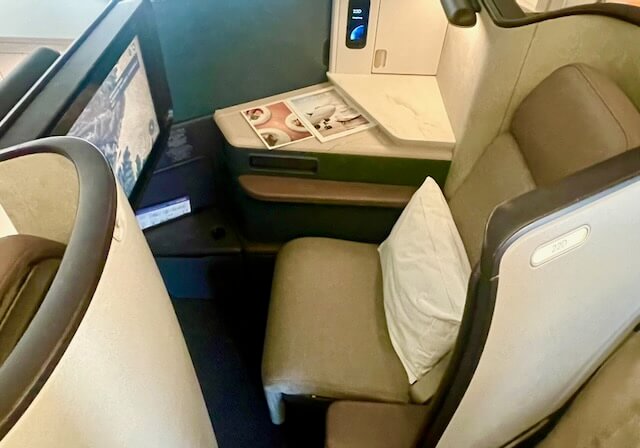
Flying from Bangkok to Hong Kong the other day, I had the pleasure of sampling one of Cathay Pacific’s new “Aria” suites on the Boeing 777-300. This is Cathay’s swanky new business class product, currently available on a limited number of routes. A shame it was only a two-hour flight.

The food and wine were excellent — the service expedited for such a short ride. Find me a two-hour flight in the U.S. with a meal like the one below.

The “hard product,” to borrow industry parlance for the suite itself, was comfy and spacious. The layout is the common 1-2-1 herringbone, each seat with an oversized tray table and 24-inch video screen. (And I love the way Cathay’s headsets, while not bluetooth, are pre-plugged, with the attachment point hidden neatly away in a small amenities closet.)

What impressed me most, though, was the level of privacy. If you’re in the center section, as I was, a moveable panel closes you off from your neighbor, while on the aisle side your upper body sits deep within the sculpted shoulder wing.

It wasn’t until halfway through the flight that I realized there also was a sliding door. And I had to wonder, why bother? There was more than ample privacy as it was. With the seat in the bed position, there was barely two feet of open space, roughly at the position of your knees or mid-thigh. From Cathay’s point of view, is installing doors really worth the extra weight and mechanical complexity?

Looks like they’ve been bullied into it. For better or worse, doors are the industry standard these days. Indeed, airlines have gone sliding-door crazy. It’s become an arms race of sorts, and your first or biz class seat can’t be considered world class unless it comes with one, no matter how needless the amenity might be.

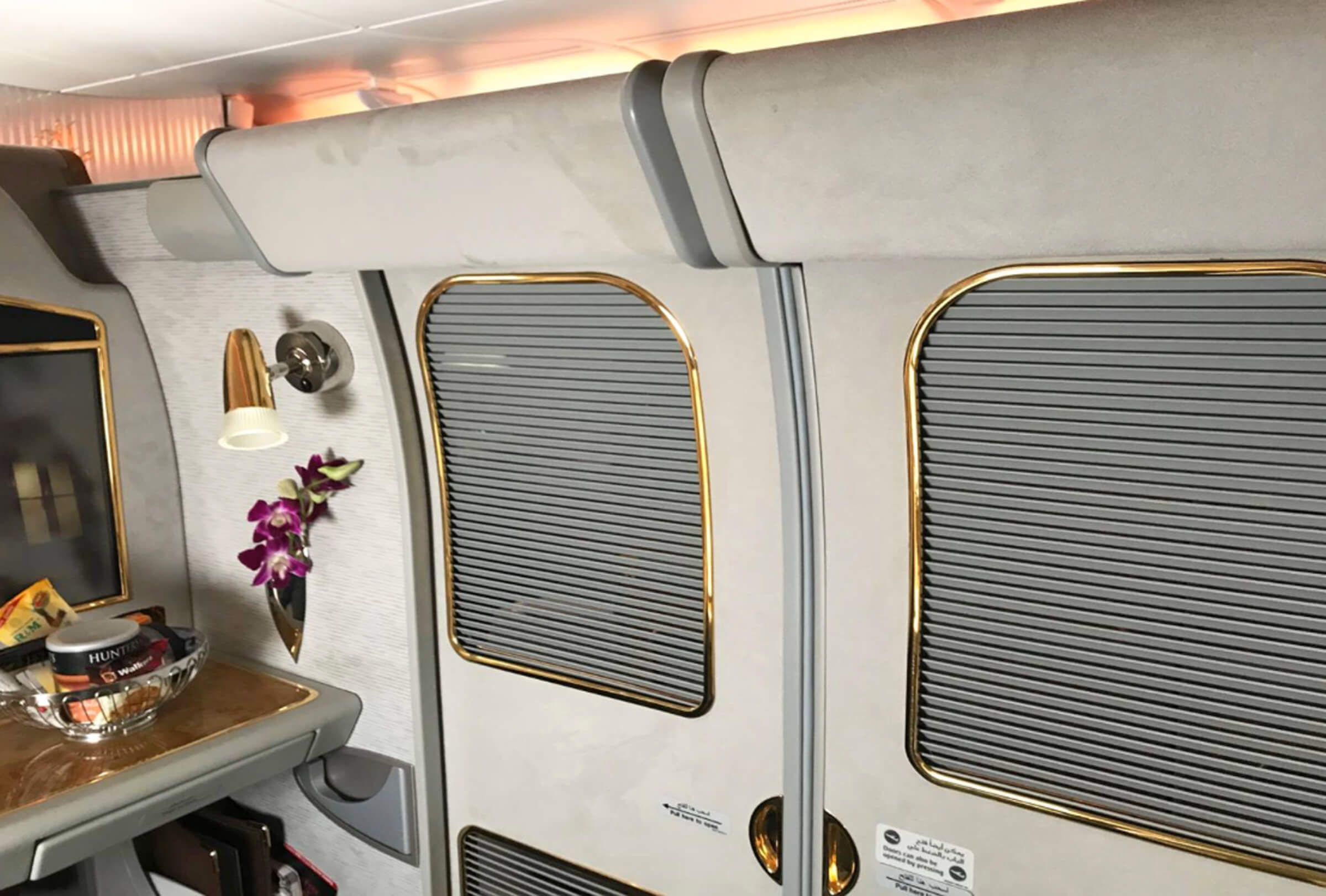
In some cases it makes sense. The geometry of a suite can be such that the lack of a door leaves you feeling exposed. The photo above, for example, shows the inside of an Emirates first class suite with its doors closed to the aisle (there are two that slide together). Without them, there’d be too much openness, too much clatter from outside.

But many are cozy enough to begin with, and the presence of a door feels gratuitous — even a little silly. They’re simply not needed.

If you insist, consider the way Air France does it, with a floor-to-ceiling curtain ensconcing each first class occupant. This is a simpler, less expensive, and much more elegant concept than the clunkiness of a door. (A curtain needs to be hung, however, which presents a problem for most cabin designs.)

How to define and quantify comfort? I reckon there are smarter ways for airlines to invest. We’re talking now about “soft product” enhancements, like better food or more gracious service. The worst thing a carrier can do is become hyper-focused on material aspects while the rest of its product deteriorates. I’d rather have a more attentive crew, a better meal presentation, or a less chaotic boarding experience, than some flimsy door.


Photos by the Author.

Comments (9)

Happy Birthday to the (Second) Greatest Album of All Time

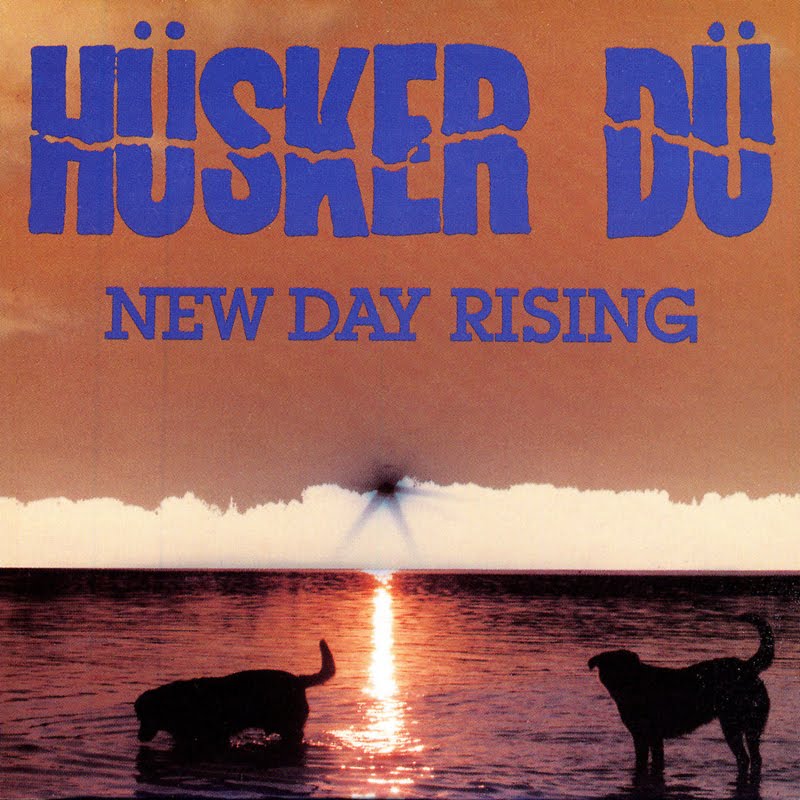
New Day Rising


IT WAS DECEMBER 30th, 1984, and Hüsker Dü were in from Minnesota again. They’d just wrapped up a show at a small auditorium in Concord, Massachusetts, and a small group of us were backstage talking to guitarist Bob Mould and drummer Grant Hart — the band’s co-vocalists and songwriters. A brand new album was due to hit the stores in only a week or two, and we all wanted to know: what was it going to sound like?

Zen Arcade had come out that past summer, and the indie rock world was still trying to absorb it. “Experimental” isn’t quite the right word, but Zen had played fast and loose with the boundaries of what punk rock, for lack of a better term, was supposed to sound like, bringing in acoustic guitar, piano, and a range of psychedelic effects. The upcoming project, it stood to reason, would take things ever further, would it not? Somebody — maybe it was me — brought this up.

“No way!” laughed Hart.

“Not at all,” added Mould. “This album is more like Land Speed Record than Zen Arcade!”

Land Speed, from way back in 1981, was a thrashy collection of hardcore songs played at nearly supersonic speed. Mould was being tongue-in-cheek — the album wouldn’t sound anything like Land Speed — but just the same he was dropping a hint: this wouldn’t be a record for the squeamish.

It was called New Day Rising — a remarkable fifteen-song LP that would wake the country from its winter freeze in January of ’85. There is nothing subtle or subdued about this album. There are no touchy-feely instrumentals, no acoustic time-outs — enjoyable as those things were on Zen. Sure, the melodies and catchy choruses are there beneath it all, in typical Hüsker fashion, but New Day Rising is power from start to finish; forty fearless minutes of ferocious exuberance.

I’m not going to argue that Zen Arcade isn’t the better or more important album. It’s all the things the pundits have called it from the start: monumental, groundbreaking, a reevaluation of everything we thought punk rock could or should be. It’s a masterpiece. But almost too much of one, moody and broody at times, and a little too — what’s the way to put it? — serious. New Day is the brasher and looser album, with Mould and Hart clearing out the pipes, with nothing left to prove and absolutely hitting their strides. It is, if nothing else, the most supremely confident-sounding album of all time.

And it’s made all the more so through a daring, some might say controversial sound mix. There’s a very particular sound to this album — a treble-heavy mix that is like nothing before or since, in which every song is enveloped in a fuzzy, fizzing, needles-pegged curtain of sound. Many people — including the band members themselves, reportedly — have always rued this peculiar mix, but to me it’s the ideal vehicle for the group’s sound. Here is the “Hüsker buzz,” as I call it, naked and cranked to eleven. (What I wouldn’t give to hear some of the cuts from Zen Arcade or Flip Your Wig remixed like this.) The style is “hot” in soundboard lingo, but to me it has a crystalline, sub-zero quality: it sounds like ice. The songs are as melodically solid as any top-40 hits of the time, but all whipped up in a great Minnesota blizzard.

Greg Norton, Grant Hart, and Bob Mould, in 1984.
Photo by Naomi Petersen.

First time listeners will know exactly what I mean within the first ten seconds of the title cut. “New Day Rising,” the song, begins with a lead-in of anxious drumming — Hart pounding away, as if to say “Let’s this this fucking thing started!” — and then comes the crescendo, a guitar-blast washing over you in a huge squalling wave: equally furious and melodic; chaotic yet strangely orchestral. It’s a breathtaking opening and the perfect pace-setter for the rest of the record. (Robert “Addicted to Love” Palmer once found it a compelling enough song to cover.)

Next up Hart’s “Girl Who Lives on Heaven Hill.” There’s something sour and vaguely out of tune about this song that for years I could never get past. Until one day it hit me: it’s supposed to be like that. Hart takes the all the nicety and sing-songy pleasures of “It’s Not Funny Anymore” or “Pink Turns to Blue” — songs that are almost too easy to like — and twists and bends and sets fire to it. Then, between the second and third stanzas, Mould comes in with a guitar solo that tears the rest of it — along with your eardrums — to pieces. It’s a haunting, mesmerizing, and a little bit frightening three minutes.

The third cut is Mould’s “I Apologize.” This is arguably the best song he ever wrote, perhaps outclassed only by the “Eight Miles High” cover, or “Chartered Trips” from side one of Zen Arcade. Here is the song Green Day and its ilk only wish they could have made: poppy and powerful, but without the slightest hint of heavy metal pretension. And is it just me, or you can you almost hear Michael Stipe singing this one? The chorus is uncannily infectious in the style of old REM songs of the same era. It’s as if you took a song like “South Central Rain” and split every atom of it: all that sweet Georgia lilac exploded into a sort of nuclear ice storm. (Putting Hüsker Dü and REM in the same sentence might seem incongruous, but it’s not by accident that they once toured together.)  Listen to “I Apologize” here. Don’t skip the final fifteen seconds, and play it loud.

Further along is one of the great sleepers in the Hüsker Dü canon: Mould’s “Perfect Example.” This is the record’s only true “slow” moment — the band’s idea of a tearjerker. It closes out side one, sung by Mould in a kind of passive-aggressive whisper, with Hart (barefoot no doubt, as he always played) double-thumping the bass drum in perfect synchronicity to a human heartbeat. The song clashes to a close on the word “perfect.” Had the album ended right there, already it’d be a classic. Except that’s only the first side.

Although only two of the cuts are his, Grant Hart effectively owns side two. This is by virtue of “Terms of Psychic Warfare” and “Books About UFOs,” both of which are unforgettable. Listen to “Terms of Psychic Warfare” here, with its signature bass riff and beautifully cascading vocals.

The better one, though, is “Books About UFO.” Equal parts deafening, frenetic, melodic and catchy, the track is backed with piano. From any other band, in any other context, this effect would probably sound gimmicky. Not so here. Indeed, it’s almost as if this song were written for piano from the start. “For all the speed and clamor of their music,” the music journalist Michael Azerrad once wrote, “Hüsker Dü was perhaps the first post-hardcore band of its generation to write songs that could withstand the classic acid test of being played on acoustic guitar.” That’s an excellent point, but the heck with that, I want to hear Grant playing an all piano version of “Books About UFOs.”

“I’d also recorded a slide guitar on ‘Girl Who lives on Heaven Hill,'” Grant Hart remembers. “But when I showed up after that session, Spot [the album’s co-engineer] and Bob issued an ultimatum: either the piano goes from ‘UFOs’ or the guitar goes from ‘Heaven Hill.’ After stating my case, which was ‘what does one have to do with the other?’ I relented and said if one had to go, let it be the slide guitar.

Probably the right decision. “UFOs” is one of the most furiously pretty, and downright interesting songs you’ll ever hear.

Norton, Hart, and Mould.
Photo by Daniel Corrigan.

To the end, Hart, who passed away in 2016, held some strong resentment against the way Spot, who’d been sent to Minneapolis from Los Angeles by SST Records to oversee the project, handled his duties. Spot shared the engineering tasks with the band members and their longtime collaborator Steve Fjelstad, but as Hart once explained it, “SST decided that we were not to be the masters of our own destiny, and sent Spot to babysit/spy/sabotage our record. He did not give Steve Fjelstad the respect he deserved, treating him as an assistant.””Another thing I remember,” said Hart, “was not being allowed to make my own choices as far as re-doing vocals that I thought I could better. On ‘Heaven Hill’ you could hear the sound of some lumber, that had in been in the booth during remodeling, falling to the floor!”

Well, all of that aside, it’s tough to have too much issue with the finished product.

The album comes to an end with the charging, spiraling, sonic immolation of Bob Mould’s “Plans I Make.” Fasten your seatbelts for this one. It’s not the jammy, psychedelic marathon of “Reoccurring Dreams,” the 14-minute instrumental that closes Zen Arcade, but it’s a wringer, an earsplitter that, when it finally crunches to its conclusion, leaves the listener with no choice but to sit spellbound for a time.

If it seems like only yesterday that I was writing about the 30th anniversary of Zen Arcade, which had been released in June of 1984. It’s fascinating testament to Hüsker Dü’s talent and tireless work ethic that two such brilliant albums could have been released within a mere seven months of each other. And these were bookended, I should add, by two other highly impressive records — Metal Circus and Flip Your Wig, from October of ’83 and September of ’85 respectively. A spectacular four-record punch in a span of under two years.

And if forced to choose, I’d say New Day Rising sits the pinnacle of that run. This is Hüsker Dü at the very apex of its career, and one of the finest moments in the whole history of what used to be called underground rock.

Meanwhile, unless I’ve missed something, none of the big music magazines or websites gave New Day so much as a mention on its 20th, 15th, or 30th birthdays. For that matter, do younger music fans have any sense of what the 1980s truly were like? This was the richest and most innovative period in the whole history of independent music, but rarely is it acknowledged as such. As popular culture has it, serious rock music skipped the 80s entirely. When pundits do take the decade seriously, we tend to see the same names over and over. It’s both frustrating and unjustified that Hüsker Dü never developed the same posthumous cachet that others of their era did. Like the Replacements, for example, or Sonic Youth. Hüsker Dü could run circles around either of those two, but never became “cool” in quite the same way.

I suppose it’s due to a total absence of what you might call sex appeal? To say that Hüsker Dü never cultivated any sort of image, in the usual manner of rock bands, is putting it mildly. For one, they never looked the part. These were big, sweaty, chain-smoking guys who, it often seemed, hadn’t shaved or showered in a while. Norton, trimmest and most dapper of the threesome, wore a handlebar mustache many years before such things were trendy among hipsters. It wasn’t cool; it was odd. And not until their eighth and final album that the band include a photo of itself on an album cover (the scratched-out images on Zen Arcade notwithstanding).

This modesty, for lack of a better description, was for some of us a part of what made Hüsker Dü so special. But it has hurt them, I think, in the long run.

The idea that the Replacements (much as I loved their debut album, which I consider the best garage-rock record of all time, and which includes a shout-out called “Somethin’to Dü”) were in any way a better or more influential band than Hüsker Dü is too absurd to entertain. Meanwhile the beatification of Sonic Youth, maybe the most overrated outfit of the last forty years, goes on and on. Not long ago Kim Gordon got a profile in the New Yorker. I’m still waiting for one of the writers there to devote a story to Bob Mould.

Or better yet, to Grant Hart. Twenty-five years, more or less, that’s how long it took me, to realize that it was Grant, not Bob, who was the more indispensable songwriter and who leaves the richer legacy. In the old days it was trendy to claim that Grant was the real genius behind Hüsker Dü. You’d be at a party and some asshole would say, “Those guys would be nothing without that drummer.” I’d always scoff that off. The mechanics of the band, for one, made it difficult to accept: Grant was the drummer, after all, and drummers are never the stars. And there was Bob, right at the front of the stage with that iconic Flying-V. But those assholes were on to something.

That shouldn’t be an insult to Mould. Not any more than saying Lennon was a better songwriter than McCartney. Both were brilliant. But when I flip through the Hüsker canon, I can’t help giving Hart the edge. There’s a soulfulness to his songs sets them apart. They’re not necessarily “better” so much as they resonate in a different and deeper way. On New Day Rising, Mould gave us “I Apologize” and “Celebrated Summer.” But Hart gave us “Terms of Psychic Warfare” and “Books About UFOs.” On earlier records it was “It’s Not Funny Anymore,” “Diane,” “Pink Turns to Blue,” the list goes on. Hart’s “She’s a Woman (And Now He is a Man”) from the often intolerable Warehouse album is, to me, a classic sleeper and the most under-appreciated Hüsker song of them all.

His solo work, too, was at least as robust as that of Mould. Songs like “The Main” and “The Last Days of Pompeii” are as good or better than anything Mould has given us post-Hüsker. But while Mould went on to some notoriety and commercial success, Hart labored in comparative obscurity. This was always irritating and unfair.

But Grant, maybe, was all right with this. “I have always based my movements on those of fugitives or criminals,” he once said to me. “The less attention you attract, the freer you remain! I wish to be an artist, not a celebrity.”


Related Story:
Now and Zen. The Greatest Album of All Time Turns 40

Comments (4)

Haystack Revisited

January 5, 2026

The hunt is on again for Malaysia Airlines flight 370, the Boeing 777 that vanished somewhere in the Indian Ocean more than twelve years ago.

I don’t know where Vegas has the odds, but I wouldn’t expect the plane to be found. There’s just too much ocean, and not enough data telling the searchers where to focus. Whatever advanced technology is at their disposal, they’ll need to be very lucky. They’re looking for an object about two-hundred feet long, thousands of feet down in the dark, somewhere in an immense expanse of ocean.

One thing that might help them is that the jet is likely in one or two large pieces. Its profile should be distinct, even from far above. We know this because there was no debris field. It’s nearly certain that the plane didn’t crash. Rather, it was “landed” on the water, and subsequently sank, more or less intact.

A Boeing 777 in an out-of-control impact — or even a semi-controlled one — would have broken up and produced thousands of fragments: aircraft parts, human remains, luggage, and so on. Much of this debris would have sunk, but plenty would not have. Eventually, borne by currents, it would’ve washed up.

But it didn’t. And the small number of pieces that did wash ashore are consistent not with a crash, but with a controlled and deliberate ditching. The flaperon discovered in 2015 on Reunion Island, for example, and the trailing edge flap that washed up on Mauritius. These parts themselves are evidence enough; a thorough post-mortem on them reveals even more. The forensics are complicated, but they’re solid. Use your Google and check out the analysis by former Canadian crash investigator Larry Vance. These pieces tell a story.

Early on, I was open to a number of theories popular at the time: fire, fumes, depressurization, and so on. Accidents. I’ve come around since then. My opinion is based on the evidence, both as it exists and, more importantly, doesn’t exist. The absence of the myriad flotsam a full-on crash would have produced is to me the smoking gun. The only plausible explanation for a lack of debris is that the plane was purposely scuttled, presumably by the captain.

Which, to be honest, makes me wonder: why spend all this time and money? What do we learn by locating the wreckage? It all seems pretty clear.

I’ve been saying from the start that we should prepare for the possibility of it not being found. It happens this way sometimes. If it helps you feel better, the air crash annals contain numerous unsolved accidents.

What makes this one different, maybe, is how we’ve come to expect easy and fast solutions to pretty much everything these days, with a fetishized belief that technology can answer any question and fix any problem. Oh sure, radios, transponders, emergency locator transmitters, GPS, real-time position streaming, satellite tracking. But all of that is fallible, one way or another.

Sometimes nature wins. And that’s what this is about, ultimately: nature. The immensity of the ocean versus the comparative speck of a 777. It’s out there somewhere, in the ink-black darkness beneath thousands of feet of seawater. We’ll probably never find it.


Related Story:
THE RIDDLE MAY NOT BE DEEP

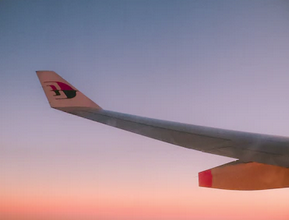
Photos courtesy of Unsplash.

People say the Malaysia Airlines logo looks like a tropical fish. In fact the design is inspired by the “wau,” a traditional Malaysian kite. Specifically it’s the “wau bulan,” or moon kite.


Comments (19)

Q&A With the Pilot, Volume 7

AN OLD-TIMEY QUESTIONS AND ANSWERS SESSION.

Eons ago, in 2002, a column called Ask the Pilot, hosted by yours truly, started running in the online magazine Salon, in which I fielded reader-submitted questions. It’s a good idea, I think, to touch back now and then on the format that got this venerable enterprise started. It’s Ask the Pilot classic, if you will.

Q: I was on a jet with five seats across: two on one side, three on the other. Does an asymmetrical configuration like this have any bearing on flight? What if all the seats on one side were full, and empty on the other side?

Lateral balance is wingtip to wingtip, not cabin wall to cabin wall. In other words, for purposes of this discussion, a 747 isn’t 20 feet wide, it’s 200 feet wide.

Imagine an airplane as a see-saw. The ends of the see-saw, where the kids are sitting, are the wingtips. The fulcrum, in the center, is the cabin. The leverage is coming from the distance between the wingtips and the fulcrum. Shifting weight from one or two inches left of the fulcrum, to one or two inches right of it, makes no measurable difference.

Longitudinal balance, front-to-back, is a bit more important, though still less than you’d think. Passengers will occasionally be asked to move forward, or rearward, depending on the situation, to help fine-tune the plane’s center of gravity. Cargo and fuel are usually part of this equation. Are you going to crash if people aren’t in the correct rows? Of course not, but technically the plane might be nearing its CG limits.

Passengers and their bags account for a surprisingly small portion of a plane’s overall weight. The jet I fly has a maximum takeoff weight of about 500,000 pounds. A full load of people and their bags weighs around 55,000 pounds, or a bit more than ten percent of the total. Where they’re sitting doesn’t make much difference.

Q: Coming in to land one day, we were just about on the pavement when suddenly we shot back up again. A few minutes later the pilot said, “The plane in front of us missed its turn-off and was still on the runway.” Which sounds terrifying… though I know from reading your site that sometimes pilots say things that sound scarier than they are.

True, and what you describe isn’t terribly uncommon.  Was it a “near miss”?  No. The go-around was initiated to prevent one. 

Runways at big airports usually have multiple turn-off points.  You take the one that is safest to take, based on your speed, regardless of which one the controllers want you to take. You might be planning for particular turn-off point, and/or ATC might ask you to minimize your time on the runway because of traffic following you, but it doesn’t always work out. You’re not going to force the turn and risk skidding or sliding or putting undue loads on the landing gear. If need be, you keep going and take the next exit.  If the plane behind you needs to go around, so be it.  

Q: As an international pilot, you obviously fly to many non-English speaking countries, which got me thinking about air traffic control protocols. Are communications with pilots conducted in English, or do American pilots have to be fluent in the native language of the places they fly to?

If so, I’d be fluent in about 20 languages. As it happens, English is the lingua franca of commercial aviation, and except perhaps for remote corners of China or Russia, all controllers and pilots are required to speak it.

But, depending on the country, they might also use their local language. In Brazil, for example, you’ll hear both English and Portuguese over the radio; controllers talk in English to foreign crews, but in Portuguese to local crews. France is another one. There are several.

I don’t like these multiple language airports because it’s harder to keep track of which planes are where. Pilots listen not only for their own instructions, but for those of other pilots as well. By creating a mental picture of what other aircraft are doing, they can orient themselves in the choreography of a crowded sky (or tarmac). This is more difficult when instructions and clearances are being given, and acknowledged, in a tongue you can’t understand.

Comments (7)

Ask the Pilot Christmas, 2025

December 22, 2025

Welcome to the 2025 installment of “An Ask the Pilot Christmas.”

In years past I would start off with gift suggestions, but this time I don’t have any, save a tedious plug for my book. It’s in dire need of updating, but I suppose it makes a good stocking-stuffer.

You can expect chaos at the airports, as always. According to the International Air Transport Association (IATA), roughly 62 billion people are projected to fly between now and New Year’s Eve, 96 percent of them connecting through Atlanta.

In fact I don’t know how many people might fly. I haven’t been listening. In any case, it’s the same basic story every year: the trade groups put out their predictions, and much is made as to whether slightly more, or slightly fewer, people will fly than the previous year. Does the total really matter? All you need to know is that lines will be long and flights full. Any tips I might offer are simple common sense: leave early, and remember that TSA considers fruitcakes to be hazardous materials (no joke: the density of certain baked goods causes them to appear suspicious on the x-ray scanners).

For years I made a point of working over the holidays. When I was a bottom-feeder on my airline’s seniority list, it was an opportunity to score some of those higher-quality layovers that were normally out of reach. Other pilots wanted to be home with their kids or watching football, and so I was able to spend Christmas in Cairo, Edinburgh, Budapest, Paris.

That’s how it works at an airline: every month you put in your preferences: where you’d like to fly, which days you’d like to be off, which insufferable colleagues you hope to avoid, and so on. There are separate bids at each base, for each aircraft type and for each seat – i.e. captain and first officer. The award process then begins with the most senior pilot in the category and works its way down. The lowest-rung pilots have their pick of the scraps.

Festifying my hotel room. Accra, Ghana, 2014.

One of my favorite holiday memories dates back to Thanksgiving, 1993. I was captain of a Dash-8 turboprop flying from Boston to New Brunswick, Canada, and my first officer was the always cheerful and gregarious Kathy Martin. (Kathy, who also appears in my “Right Seat” essay, was one of at least three pilots I’ve met who’d been flight attendants at an earlier point in their careers.)

There were no meal services on our Dash-8s, but Kathy brought a cooler from home, jammed with food: huge turkey sandwiches, a whole blueberry pie and tubs of mashed potatoes. We assembled the plates and containers across the folded-down jumpseat. The pie we passed to the flight attendant, and she handed out slices to passengers.

Quite a contrast to Thanksgiving Day in 1999, when I was working a cargo flight to Brussels. It was custom on Thanksgiving to stock the galley with a special meal, and the three of us were hungry and looking forward to it. Trouble was, the caterers forgot to bring the food. By the time we noticed, we were only minutes from departure and they’d split for the day. I thought I might cry when I opened our little fridge and saw only a can of Diet Sprite and a matchbook-size packet of Tillamook cheese.

The best we could do was get one of the guys upstairs to drive out to McDonald’s. He came back with three big bags of burgers and fries, tossing them up to us just as they pulled the stairs away. Who eats fast food on Thanksgiving? Pilots in a pinch.

Fireworks explode only a few hundred feet from the ground, but when enough of them are going off at once, it’s quite the spectacle when seen from a jetliner. On New Year’s Eve, 2010, I was en route to Dakar, passing over the city of Bamako, Mali, in West Africa. At the stroke of midnight, the capital erupted in a storm of tiny explosions. The sky was set aglow by literally tens of thousands of small incendiaries — bluish-white flashes everywhere, like the pulsing sea of lights you see at concerts and sporting events. From high above, this huge celebration made Bamako look like a war zone.

Christmas Eve, Paris, 2017.

I’ve also spent a number of holidays traveling on vacation. Thanksgiving in Armenia, for instance. Another Thanksgiving in Timbuktu.

And with that in mind, here’s some advice…

Do not, ever, make the mistake that I once made and attempt to enjoy Christmas at a place in Ghana called Hans Cottage, a small hotel situated on a lagoon just outside the city of Cape Coast.

They love their Christmas music at the Hans Cottage, you see, and the compound is rigged end-to-end with speakers that blare it around the clock. And although you can count me among those people able to tolerate Christmas music (in moderation, and so long as it isn’t Sufjan Stevens) there is one blood-curdling exception. That exception is the song, “Little Drummer Boy,” which is, to me, the most cruelly awful piece of music ever written. (It was that way before Joan Jett or David Bowie got hold of it.)

It’s a traumatic enough song in any rendition. And at the Hans Cottage Botel they have chosen to make it the only — only! — song on their Christmastime tape loop. Over and over it plays, ceaselessly, day and night. It’s there at breakfast. It’s there again at dinner. It’s there at three in the morning, seeping through the space under your door. And every moment between. I’m not sure who the artist is, but it’s an especially treacly version with lots of high notes to set one’s skull ringing.

“Ba-ruppa-pum-pum,ruppa-pum-pum…” as I hear it today and forever, that stammering chorus is like the thump-thump of chopper blades in the wounded mind of a Vietnam vet who Can’t Forget What He Saw. There I am, pinned down at the hotel bar, jittery and covered in sweat, my nails clattering against a bottle of Star lager while the infernal Drummer Boy warbles into the buggy air.

“Barkeep!” I grab Kwame by the wrist. “For the love of god, man, can’t somebody make it stop?”

Kwame just smiles. “So lovely, yes.”


Related Story:
LETTER FROM GHANA: WELCOME TO ROOM 420.

Photos by the author.

Comments (9)

The See-Through 747

December 8, 2025

In the first grade, my two favorite toys were both 747s.

The first was an inflatable replica, similar to those novelty balloons you buy at parades, with rubbery wings that drooped in such violation of the real thing that I’d tape them into proper position. To a six-year-old it seemed enormous, like my own personal Macy’s float.

The second toy was a plastic model about twelve inches long. Like the balloon, it was decked out in the livery of Pan Am. One side of the fuselage was made of clear polystyrene, through which the entire interior, row by row, could be viewed. I can still picture exactly the blue and red pastels of the tiny chairs.

Also visible, in perfect miniature near the toy plane’s nose, was a blue spiral staircase. Early 747s were outfitted with a set of spiral stairs connecting the main and upper decks – a touch that gave the entranceway a special look and feel. Stepping onto a 747 was like stepping into the lobby of a fancy hotel, or into the grand vestibule of a cruise ship. In 1982, on my inaugural trip on a 747, I beamed at my first real-life glimpse of that winding column. Those stairs are in my blood — a genetic helix twisting upward to a kind of pilot Nirvana.

That’s a passage found in chapter two of my book.

It’s that second toy, the one with the transparent fuselage, that I bring to your attention. As it happens, I discovered a photograph, buried in an old family album, in which you can see it. While I’ve always remembered the toy, I had no idea that a picture of it existed.

That’s me holding the plane, of course, with my sister and my mother in front. It’s Christmas morning, 1972.

Look closely and you can see the rows of seats, sectioned into different colors. The first class seats look red. On the left wing it says “Pan Am.” You can’t see the spiral stairs, but they’re in there, in the middle of that blue part. It appears the entire fuselage was look-through, not just half of it, as I’d written.

One wonders what sorts of shitty toys are available these days for first-grade airplane buffs.

That plastic plane is long gone, sadly. I’m not saying you should save all of your childhood toys, but be careful. This one, surely, deserved to be set aside. Even so young, I already has aspirations of becoming a pilot. It would’ve made a meaningful keepsake.

The picture, at least, remains.

Last Thursday, by the way, marked the 34th anniversary of the demise of Pan American World Airways. The company ceased operations on December 4th, 1991. I remember watching it on the news, in a hotel room in Burlington, Vermont.

I was fortunate enough to fly twice on an actual Pan Am 747. From Rio de Janeiro to New York, in 1982, and from Frankfurt to New York in the fall of 1991, shortly before the end.


(Note: A number of readers have pointed me to 747 toys for sale on eBay similar to the one I’ve described. These are not the same; they’re flimsier and cheaper than the one I had. The colors are different too.)


Comments (16)

Meditations on a Coaster

November 22, 2025

You’re in a hotel room in London. There’s a coaster on the desk in the design of a Union Jack (or half of one, at any rate).

Very British, very typical. But you see something else. You cover part of the flag with your hand, revealing a different design.

Then you cover it a slightly different way, revealing yet a third design. Like this…

What you’ve created are the 1970s-era logos of British European Airways (BEA) and British Airways.

BEA was a mainstay U.K. carrier that flew throughout Europe. Its “speedjack” logo was a segmented Union Jack. In 1974 BEA merged with B.O.A.C to form British Airways. The first tail livery worn by British Airways also was a segmented Union Jack, a version of which is still used today. They looked like this…

The fact you noticed this with hardly a glance makes you both pleased and uneasy.

On the one hand, you take pride in a level of knowledge that some might call encyclopedic. On the other hand, you suspect there are better things for your mind to concern itself with. Your talents of perception, you worry, are badly off-balance, hijacked by frivolous aviation esoterica. Take it easy, man. Sometimes a Union Jack is just a Union Jack.

So it goes when you’re an air travel nerd. You can’t help yourself. The world is always more interesting when something, anything, relates back to airlines or planes. And it happens a lot. Maybe it’s a tangible item, like a coaster. Maybe it’s something you saw in the news; something cultural, political, or a current event. Almost always there’s a connection.

This is a testament to your passion. It’s also a testament to the significance, and ubiquity, of commercial air travel. The world would be very, very different without it. Probably less fun, too.


Related Story:

RISE AND WHINE. MEDITATIONS ON A MILK CARTON.

Comments (7)

Toys in the Attic

November 11, 2025

Today’s topic is supposed to be the U.S. government shutdown. I’m supposed to offer “hacks” (a gruesomely overused term these days) that’ll help you deal with the delays and long lines, and assure you that the skies remain safe.

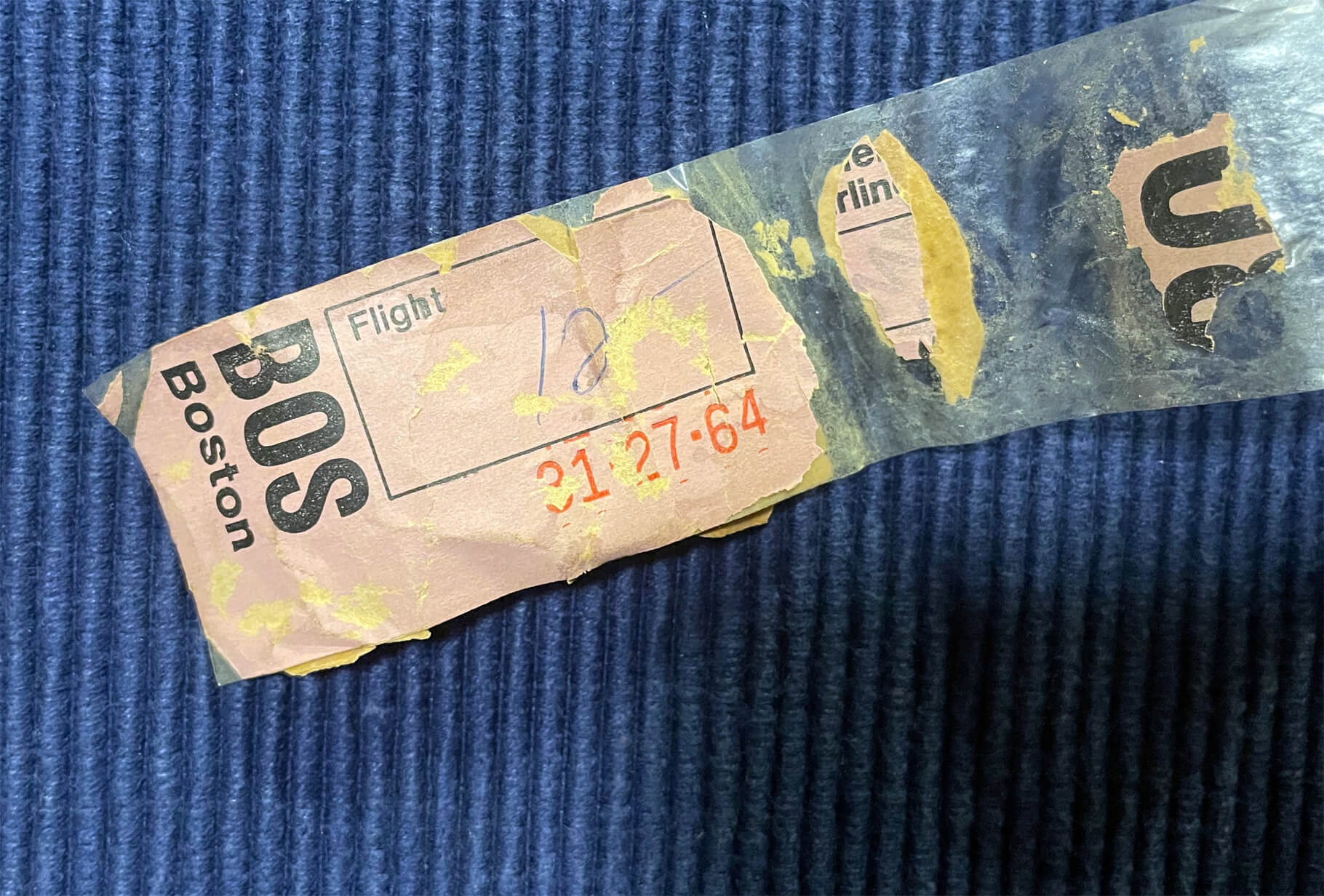
I can’t think of anything more boring, however, so instead I’m going to talk about this vintage American Airlines luggage tag that I found in the attic at my father’s house.

The tag — what’s left of it — was affixed to a suitcase that belonged to my mother in the 1960s, when she worked briefly as a flight attendant for American. An address on the suitcase is hers from before she was married.

I’m pretty certain the tag is from 1964. This jibes with both the address and her dates of employment. There’s also a “64” as part of the coding, visible in red.

You also can see where the flight number, 12, has been inked in by hand.

Flight 12 was, for decades, American’s Los Angeles-Boston nonstop. The reciprocal, flight 11, left Boston for Los Angeles each morning.

In the late 60s, flights 11 and 12 would’ve been run with a Boeing 707. Later it was a DC-10, and a 767 after that. I remember flying to LAX on flight 11 in 1980, when I was a freshman in high school.

The pairing no longer exists. These flight numbers were retired as of September 12th, 2001, the day after flight 11 crashed into the World Trade Center.

There’s a science of sorts to flight numbers that you probably didn’t know about:

Ordinarily, flights going eastbound are assigned even numbers; those headed westbound get odd numbers. Another habit is giving lower, one- or two-digit numbers to more prestigious or long-distance routes. If there’s a flight 1 in an airline’s timetable, it’s the stuff of London–New York.

Numbers might also be grouped geographically. At United, transpacific flights use three-digit numbers beginning with 8, which is considered a lucky number in some Asian cultures. Four-digit sequences starting with a 3 or higher are, most of the time, indications of a code-share flight.

Technically, a flight number is a combination of numbers and letters, prefaced with the carrier’s two-letter IATA code. Every airline has one of these codes. For Delta, American, and United, it’s DL, AA, and UA, respectively. Lufthansa uses LH; Emirates uses EK. Often they’re intuitive, other times they’re mysterious. British Airways is BA, while jetBlue uses the alphanumeric B6.

If you didn’t know about this practice, you no doubt got familiar with it after the disappearance of Malaysia Airlines flight 370, which from the start was referred to as “MH370.”

All this inspired by some fragments of a sixty year-old luggage tag.

Air travel forensics, you could call it. I’m good at it.

And I imagine you can find thousands of these sorts of curiosities — numbers and codes that tell a story — sitting in attics and basements all over the world.


Related Stories:
THE DAY OF THE COCKROACH
THE WEIRD WORLD OF AIRLINE COLLECTIBLES


Photo by the author.

Comments (12)

Thoughts on the UPS Crash.

UPDATE: November 16, 2025

Investigators are looking into the possibility that a structural failure — a fracture in the pylon that connects the engine to the wing — may have caused the engine separation that struck UPS fight 2976 on November 4th.

Shortly after the accident, the FAA grounded all MD-11 jetliners. This weekend they extended that emergency order to all remaining DC-10 jets. The MD-11 is a derivative of the DC-10 and shares many structural components.

Very few DC-10s remain active. Fewer than ten survive, used as freighters or as specialty firefighting planes.

In 1979 the FAA grounded all U.S.-registered DC-10s, and banned the plane from U.S. airspace, following the horrific crash of American Airlines flight 191 in Chicago (see below). Then, as now, the culprit was engine pylons. Airline maintenance procedures were blamed for causing cracks, but investigators criticized the pylon design as well. Did this issue rear its head again, all these decades later, in Louisville?

The poor DC-10 was beset by a slew of design shortfalls that contributed to several accidents. Cargo doors, floors, hydraulics, pylons. The Chicago disaster killed 273 people. Five years earlier, a faulty cargo door led to the crash of a Turkish Airlines flight outside Paris, in which 346 were killed.

So far as I know, the DC-10 becomes the only commercial jet to be grounded twice. A jinxed machine that can’t escape its fate. Here it is, with only the tiniest number still in service, yet its bad luck continues.


November 6, 2025

You’ve all seen the footage by now. Late on Tuesday afternoon, a UPS MD-11 freighter crashed off the runway in Louisville, Kentucky, erupting into a wall of fire. All three pilots perished, as did several people on the ground.

For reasons unclear, the left-side engine of the three-engine widebody jet separated from the wing before liftoff. Beyond that, there’s not a lot we know.

A commercial jet is, by regulation, able to safely take off and climb with a failed or detached engine. That doesn’t guarantee success, however. Everything must be done right, procedurally. It’s something pilots train for all the time, but when you’ve got a widebody jet at max takeoff weight, there’s nothing easy about it.

And there was more going on. From the video, it appears that the left wing was on fire. It’s possible the wing, or its critical control surfaces (flaps and slats), were damaged.

We can’t help thinking of American Airlines flight 191, a DC-10 that lost its left engine on liftoff at Chicago in 1979. The engine rolled over the top of the wing and tore out hydraulic lines, causing the flaps and slats on that side to retract. These devices are crucial for maintaining lift at low speeds. Without them, the wing stalled; the plane rolled over and crashed into a fireball killing 273 people. Indeed, the sequence that befell AA 191 isn’t at all unlike the one in Louisville.

It’s also possible that the MD-11’s center engine, located at the base of the tail, may have ingested debris or hot gasses from the wing fire, causing that engine to suffer a power loss, or fail completely, as well. A jet can take off with a lost engine. It cannot take off with two lost engines.

This brings to mind the Concorde disaster at Charles de Gaulle Airport in 2000. With one engine already failed, a wing fire fed by leaking fuel caused the adjacent engine to quit as well.

A derivative of the star-crossed DC-10, the MD-11 was developed by McDonnell Douglas in the late 1980s. It didn’t sell particularly well. Long since retired from passenger service, a few remain in service as freighters, mostly with UPS and FedEx. The plane has a reputation for being difficult to handle in certain situations, such as when landing in gusty winds. MD-11s were involved in at least three landing rollovers. Whether or how its characteristics played a role in Tuesday’s disaster is unknown. It’s not likely.

At least four different videos of the MD-11 crash have been making the media rounds, each of them pretty gruesome. In the old days it was rare for crashes to be caught on film, be it photographs or video. Someone had to have a camera handy at exactly the right second. The few that were captured became iconic images, such as the photo of the PSA 727 in San Diego in 1978, its wing afire after colliding with a Cessna, and the aforementioned DC-10 at Chicago, rolled onto its side and out of control.

Nowadays, with cameras everywhere and a public starving for sensational images, a plane goes down and the footage is bouncing around social media within minutes.

I’m not sure how I feel about that.


Photo by Lukas Souza, courtesy of Unsplash.

Comments (20)

Why Does Flying Suck?

October 28, 2025

There’s that expression, “pissing into the wind.”

Since I began writing about commercial aviation, over twenty years ago, my foundational motive has been an evangelical one: encouraging people to rediscover the greatness of air travel. I’m well acquainted with the hassles and indignities of flying, and these too I’ve discussed at length. But what underlies my work is a seldom heard plea to reevaluate, and maybe even savor, the idea of getting on a plane. A newspaper once described me as “an air-travel romantic.” I can’t deny it.

“As a writer-pilot,” I said to an interviewer in 2004, “I hope to restore an appreciation for the airplane as part of the greater experience of travel.” Perhaps that’s too tall an order, but can’t we at least acknowledge the impressiveness of it? We live in an age when people can travel halfway around the world in a matter of hours, in almost absolute safety, at a cost of pennies per mile. Spend a little more to sit up front, and you relax in stupendous comfort. How is this not remarkable?

Well, remarkable as it might be, I worry it’s not enough. I’m afraid the bad simply outweighs the good, never giving people the chance to consider another perspective. They just don’t have the patience. My mission is a failed one, I suspect.

And I shouldn’t be surprised. We’ve worked pretty damn hard to make flying as tedious and infuriating as possible.

Our propensity to sabotage what could be, and should be, an enjoyable experience, seems to worsen every year. And the saddest part is, it doesn’t need to be this way. The lines don’t have to be so long. The delays don’t have to be so frequent. The security rules don’t have to be so stupid, or the noise levels so aggravating. But we make them so. Flying doesn’t have to suck, yet we insist on it.

What’s the most dreadful part? That’s subjective, I suppose, but I can offer you an opinion on what, to me, are the three worst things to happen to commercial air travel since the dawn of the Jet Age:

REGIONAL JETS

Number three on my list is the advent of the regional jet. Starting in the 1990s, advances in engine efficiency meant that smaller jets with a few as 50 seats could now be operated profitably. This changed the way airlines did business, farming out huge swaths of domestic capacity to contract carriers (the various “Express” and “Connection” outfits) flying what came to be called “RJs.” These planes have always been reliable, safe, and technologically sophisticated, but they’re a sub-par product compared to mainline jets, with tight cabins, limited luggage space and minimal onboard service.

In the old days, turboprop “commuter” planes, as we called them, fed passengers into the big hubs from outlying satellite cities. Suddenly, with the longer range and higher speeds of RJs at their disposal, carriers began deploying them even on mainline routes. Why use a Boeing or an Airbus when you could throw a couple of RJs on a route, flown by a contractor that paid its workers next to nothing?

Their proliferation dragged down wages for tens of thousands of employees. RJ pilots often earned less than $20,000 annually, and working conditions at many regional carriers were dire. Things have improved significantly over the last few years, but an entire generation of workers suffered.

And while those commuter turboprops could fly at low altitudes and use shorter runways, more or less staying out of the way, RJs share the sky with the big jets. Thus they’ve been a huge contributor to delays and congestion — maybe the biggest. At the height of RJ mania in the early 2000s, these mini-jets came to account for close to 50 percent of all commercial flights in the United States. That’s half of the flights carrying maybe twenty percent of the passengers — a terribly inefficient use of airspace and runways. Thankfully these numbers are more reasonable today, but hundreds of RJs are still out there.

TERMINAL RACKET

Next we have airport noise levels. This is the intangible one, but a big one nonetheless. It’s chiefly, but not exclusively, a U.S. phenomenon, and it’s gotten worse in recent years.

Beyond cellphone chatter and the occasional screeching kid, the typical airport terminal should be a relatively quiet place — no noisier than, say, a shopping mall. But we’ve managed to make it hellishly loud thanks to an infatuation with public address announcements, very few of which serve a useful purpose. It didn’t used to be this way.

The din starts in the concourse, where travelers are bombarded with music, promotional announcements, and pointless security advisories. Then, at the gate, at least a dozen mostly redundant PAs accompany the boarding process. There’s little relief on the plane, with cabin crew yapping orders as passengers stow their bags and settle in. Then comes the interminable safety demo, and yet another flurry of announcements. Your first thirty or so minutes onboard is spent being lectured to and barked at.

If even half of this clamor were helpful or informative, it could be excused. But it’s not. It’s nothing but noise, making an already stressful experience that much worse.

Corrosive as it is to travelers’ nerves, the effects can be subtle. You might not realize how loud the average U.S. airport is until you experience one of the more peaceful European or Asian ones. Something feels different… and then it dawns on you: it’s quiet. Some European terminals ban public address announcements completely, and most non-U.S. carriers, too, take it a lot easier with PAs on the plane.

Congrats to the few U.S. airports who’ve restricted the use of PAs. San Francisco, for one. Hopefully more will join.

SECURITY THEATER

But probably the single worst thing to happen to flying is post-9/11 airport security, and all of its foibles and foolishness. In the United States our punching bag is the TSA, but really this is global.

I’m in full agreement that some type of passenger screening is necessary. The monster we created, however, is not the answer. A system that treats every last passenger as a potential terrorist, and everything they carry as a potential weapon, is a ludicrous one, but that’s what we’ve got; an approach we’ve barely budged from in all the years since the attacks of 2001. The exasperating irony being that none of the checkpoint protocols in place today would have prevented the 9/11 hijackers from doing what they did.

I’ve written volumes on all the things wrong and wasteful about airport security. Most of it is obvious, and we’ve gotten so used to it that it hardly warrants repeating. But every now and then, the audacity of it hits you. The other day, watching a TSA guard confiscate someone’s toothpaste, I got to thinking: Have you ever considered the thousands of tons of supplies that are trucked into airports every single day? Food, beverages, alcohol, and endless amounts of retail inventory: all the crap for sale on the concourse. It’s verboten for a passenger to carry through a tube of toothpaste, yet mountains of goods aren’t given more than a cursory inspection.  

Which is to be expected, because it’d be impossible to screen even half a percent of it with the same level of scrutiny we devote to passengers. Dare I suggest that a team of terrorists, with someone on the inside, working at a duty free shop or in a restaurant, could easily smuggle in something deadly, then pass it along to someone getting on a plane?

This is only one example of the holes in our security logic. The scenarios are endless. Meanwhile, TSA is micro-inspecting your toiletries. The whole thing is completely insane.

As I’ve always maintained, the true nuts and bolts of keeping terrorists away from planes takes place backstage, as it were, far from the airport. It’s the job of law enforcement and intelligence and international collaboration. It’s not the job of guards on the concourse. What the perfect checkpoint might look like is hard to say, but surely it’s not what we have.
 
Imagine a journey free of these three scourges. How different it all would feel.


Related Stories:
THE REGIONAL RECKONING
TERMINAL RACKET
WHAT IS AIRPORT SECURITY?

Photos by Daneil Shapiro, Aaskash Dhage, and Scott Fillmer, courtesy of Unsplash.

Comments (39)