





The Collision at La Guardia
April 1, 2026
So far I haven’t had much to say about the deadly collision at La Guardia airport on March 22nd, when a Jazz Aviation (operating as Air Canada Express) regional jet collided with a fire truck seconds after touching down. The truck had been cleared by air traffic control to cross the active runway.
The most obvious question is why the controller permitted the truck to cross. How did he forget, or not notice, that the RJ was, at that moment, barreling down the same runway? The airport was busy and the tower had been dealing with a different flight declaring an emergency. Maybe that explains a few things, but how is it, in a time of high workload and high distraction, that a single controller is empowered to make a life-or-death decision without a second controller’s scrutiny, especially at night?
ATC understaffing, I’m sure, has a role here. Otherwise, as a pilot-pundit I’m supposed to have answers. I’m afraid I don’t.
What I can tell you, though, is only a few days before the accident I’d remarked to a friend about how the proliferation of vehicles at busy airports felt unsafe to me. Not so much the myriad cars, trucks, and tugs that work the inner ramps, shuttling around luggage and whatnot, but the ones with authorization to operate on active runways and taxiways. These include airport maintenance vehicles, plows, emergency vehicles, and so on.
What training do these drivers receive? Listening over the radio, I sometimes shake my head. Their clearance read-backs, for instance, often sound tentative or uncertain. What sort of situational awareness do they have? In the cockpit, pilots listen out not only for the own instructions, but for those of other aircraft as well, allowing us to paint a mental picture of the movement around us. The importance of this would seem self-evident, but does the man or woman steering a fire truck think this way too?
And couldn’t the driver have seen the regional jet? A pilot will never cross a runway without double-checking, visually, for oncoming traffic. This isn’t possible in low visibility, but most of the time it is. The weather at LGA wasn’t great, but it wasn’t terrible either. As a motorist who’s been broadsided at intersections knows, putting your trust in a stoplight isn’t enough. You don’t cruise through a green without making sure that someone isn’t running the red. The truck, responding to an emergency, approached the runway at an angle. It may have been hard for the driver to see. Was his view obstructed, or did he merely take the controller’s word that the runway was safe?
And what of the Jazz pilots? It’s possible they heard the controller issuing that ill-fated crossing clearance. But they were already on the ground with only a few seconds to react.
The plane hit the truck straight on, nose-first, and both pilots were killed. Everyone else survived. It’s interesting to wonder what the outcome might’ve been had the pilots swerved to avoid the collision. There wasn’t enough time to turn clear; either way they were going to hit. And had they swerved, the point of impact would have been closer to the plane’s midsection, or even at the wing root, resulting in an explosion and many more deaths. The lack of a fire saved the passengers.
Most likely, once the investigation is complete, the La Guardia controller will receive brunt of the blame. This won’t tell the whole story. Understaffing, darkness, urgency, distraction, and ATC protocols all had roles to play, creating a situation where one small mistake proved fatal.
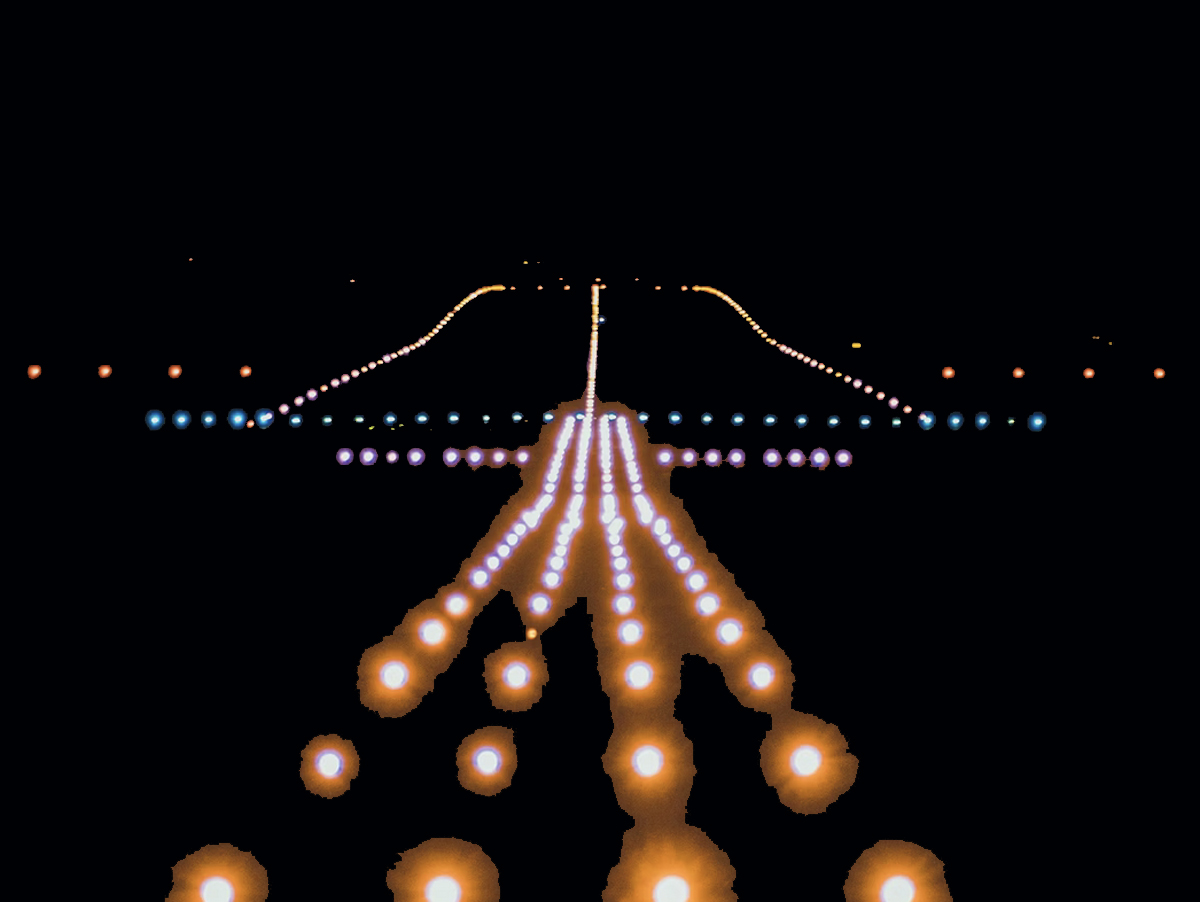
Photo by Jordi Moncasi, courtesy of Unsplash.

Leave a Comment
Maximum 1500 characters. Watch your spelling and grammar. Poorly written posts will be deleted!
14 Responses to “The Collision at La Guardia”
You are viewing newest comments first. Click to reverse order
@Roger Wolff
I think the understaffing concern is less about “there should have been more people there at that specific time” and more about “understaffing leads to overwork, which leads to tiredness, which can lead to carelessness”.
Obviously all we have to go on is the ATC recording, but _could_ the ATC controller have more ‘actively’ warned the ARFF vehicle not to cross the runway? I think the answer is Yes.
But this is all 20/20 hindsight – I don’t want to pile on the ATC controller or the vehicle occupants. It was a tragic horrific thing, but it wasn’t an ‘accident’ – there was a causal chain, and I think understaffing MAY well have been a link in that chain.
The ATC is short ~3800 people and suffers from chronic understaffing. This was almost certainly a contributing factor in this accident. Of course, one might ask why they can’t just hire more:
https://nypost.com/2025/02/10/us-news/air-traffic-controller-shortage-of-3800-due-to-dei-practices/
So tragic. I think most of us have exp at LGA, it is a small piece of real estate and any aircraft awaiting Tkoff clearance were abeam rnwy 4 on “B” the right taxi way – so no room to “steer right”. In a NYT recreation presented by the NTSB the truck was cleared to cross as CRJ automated call outs “100” “50” approximately.
Even with a curved taxiway “D” every single vehicle should know to look “clear left” “clear right” There is no excuse. This is the world of high speed aircraft not the vehicle environment – that CRJ had 2 bright lights @wing and the nose taxi light on.
Hindsight- if only that Capt had looked just a little further down the runway @“100” and seen those rotating lights he would have a chance. In another life we always practiced “Go Around” at50-100ft and don’t you know it was “a truck on the runway”. The CRJ has a GE engine with “approach Idle” with full flaps & gear extended. That means the FADEC has full power immediately available regardless of full flap and gear down. The jet would continue its immediate downward trajectory but it would have been a bounce and go.round in 2?seconds. The size of the aircraft doesn’t matter.
Going forward I think every pilot that spies an emergency vehicle waiting to cross gets a pass for canceling a landing with a “Go around”.
I don’t know if another Twr controller was needed departing 13 and landing 4. unless one for landing and another for tkoff – or simply more breaks on shift.
I don’t think that “understaffing” has anything to do with this. There is one controller doing the runways, and at best there is a supervisor who is looking along with everybody (i.e. at least ground and tower). That person has a very boring job if there would be nothing else to do. They probably take the phonecalls (“Possible pilot deviation, I have a phone number for you to call”).
The ONE controller is doing an important job. Just like the one pilot flying the plane during landing: It’s a life-or-death job. Pilot is a good example. command max roll when at say about 10m and the other pilot is helpless before “everybody dies” is inevitable. Less extreme examples are possible.
In general people are pretty reasonable at such jobs.
Patrick, I’m somewhat surprised not to read anything in either your article or others comments relating to Runway Status Lights. If I missed them, I apologize. I believe I heard from the NTSB briefings that both the Runway Entrance Lights (RELs) and Takeoff Hold Lights (THLs) were active at the time of the accident. It is my understanding that ground vehicles must honor those status lights that they should have seen above any verbal ATC clearances to cross an active runway.
Comment?
I also feel like these kinds of errors are often unrealistic workload, staffing issues leading to fatigue and an unfortunate sense of urgency that leads to tragedy. Sad all around for everyone involved.
Without adding comment, I thought you might get a chance a look at the NYT visual recreation of the incident from the pilot’s and firefighter’s vantage. It may clear up the who saw what and when. They also did this type of simulation after the Potomac accident. Worth a look.
Regarding the notion of the ARFF (Airport Rescue Fire Fighting) vehicle ‘shotgun’ driver acting as an additional lookout: the majority of US commercial airport ARFF vehicle are staffed by ONE driver/operator. While the largest/busiest US airports usually have two per ARFF-specific vehicle, the vast majority have one.
Not only does this impact vehicle operator situational awareness, it impacts greatly the ability to initiate critical initial fire suppression and rescue duties. Most airports must wait for off-site resources to arrive to reach the staffing levels needed to perform adequate fire/rescue/medical operations.
This is an issue that’s mostly ‘under the radar’ but one that the flying public and aviation professionals need a greater understanding of.
There has been a lot of discussion about a lack of vehicle transponders, and no doubt they are important, but it’s also true that thousands of transponder-less vehicles have crossed thousands of runways and thousands of airports thus far without incident – this isn’t the first plane-vehicle collision, but those are vanishingly rare, especially at major airports.
As an armchair pilot, it seems to me that PROXIMATE ‘blame’ (which sounds awful to say about anyone involved in a fatal collision), goes 75% to the vehicle driver and 25% the ATC controller on duty. The ATC controller should have done a better job, and the vehicle driver should have been much more aware of what was going on around them, and, if in ANY doubt, not to cross an active runway.
Obviously then we work back to look at the lack of training for vehicle drivers and the overworkedness of ATC controllers, which then goes back to the underhiring of ATC, which goes back to financial constraints etc., which can be traced to a lack of mandatory federal budget for ATC…
“That said, whomever was riding shotgun on the fire engine had been paying attention to activity on the runway…”
That should have read “That said, whomever was riding shotgun on the fire engine should have been paying attention to activity on the runway…” It apparently isn’t possible to edit a post to correct an error. 🙂
I’d say understaffing is a large part of the causal chain that led to this collision.
It seems that every major airport in the country has unfilled controller positions, and that probably applies to smaller airports as well. I don’t know what can be done to get controller staffing levels up to where they need to be, but an active runway incursion is totally inexcusable and in this case, likely would not have happened had there been more eyes on the ground traffic.
As to whether there was anything to be done in this particular case to avert tragedy, the angle in which the fire engine entered the runway appeared to have placed the oncoming plane in the driver’s blind spot. That said, whomever was riding shotgun on the fire engine had been paying attention to activity on the runway—the RJ might have been seen soon enough for the driver to be told to immediately stop.
That sort of what-if thinking, of course, goes back to what training is given to vehicle operators with regards to crossing/entering runways and taxiways. I suspect any such training is perfunctory.
As a faithful reader of your blog I have been checking regularly hoping that you would write a post on this tragedy. I live in Montreal, where the plane originated, so it has made lots of headlines here, but I am always curious to hear what your thoughts are as a pilot. You raise some points I haven’t seen elsewhere like the increase of vehicles with access to the runways. I wonder how many of your fellow pilots also have those same concerns. Thank you for another informative post as always.
As is usual, there were multiple contributors. The ground vehicles did not have transponders, despite recommendations and funding for them to do so. US control practice is to give landing clearance when planes are a lot further away, and then cancel it if needs be when the plane is closer. This means they have to work a lot further ahead of current reality, making things a lot more complex. Firefighters have restricted range of motion due to their kit, and were at an angled approach to the runway. US control are very understaffed for the amount and complexity of traffic they handle, as are their systems. And it was dark and gloomy.
The USA should do a lot better than this at all airports.
Hi Patrick, the tragedy at LGA is one of those things that as a layman “armchair” pilot I am having a hard time understanding. I have watched countless aviation videos from inside the cockpit. Almost without exception before an airplane crosses a taxiway or runway the Captain will say “clear left” and the First Officer will say “clear right”. I have often wondered if the drivers of the myriad ground vehicles follow the same protocol, including AFRR. If not, perhaps they should, perhaps it might build in another layer of safety/redundancy in the event ATC/ground controllers may have inadvertently approved a procedure that shouldn’t have? There is just way too much complexity on the airfield for just the ATC/ground controller personnel to keep track of. Every entity working on the airfield needs to have situational awareness, including every pilot, ground crew and the driver of every type of vehicle. This includes AFRR…particularly so during times of high stress, like in this instance when they were responding to an emergency. I am in no way shape or form placing blame on any one person/entity for the accident that night in LGA. I am only saying that had there been greater situational awareness on the part of everyone, perhaps this accident could have been avoided.