






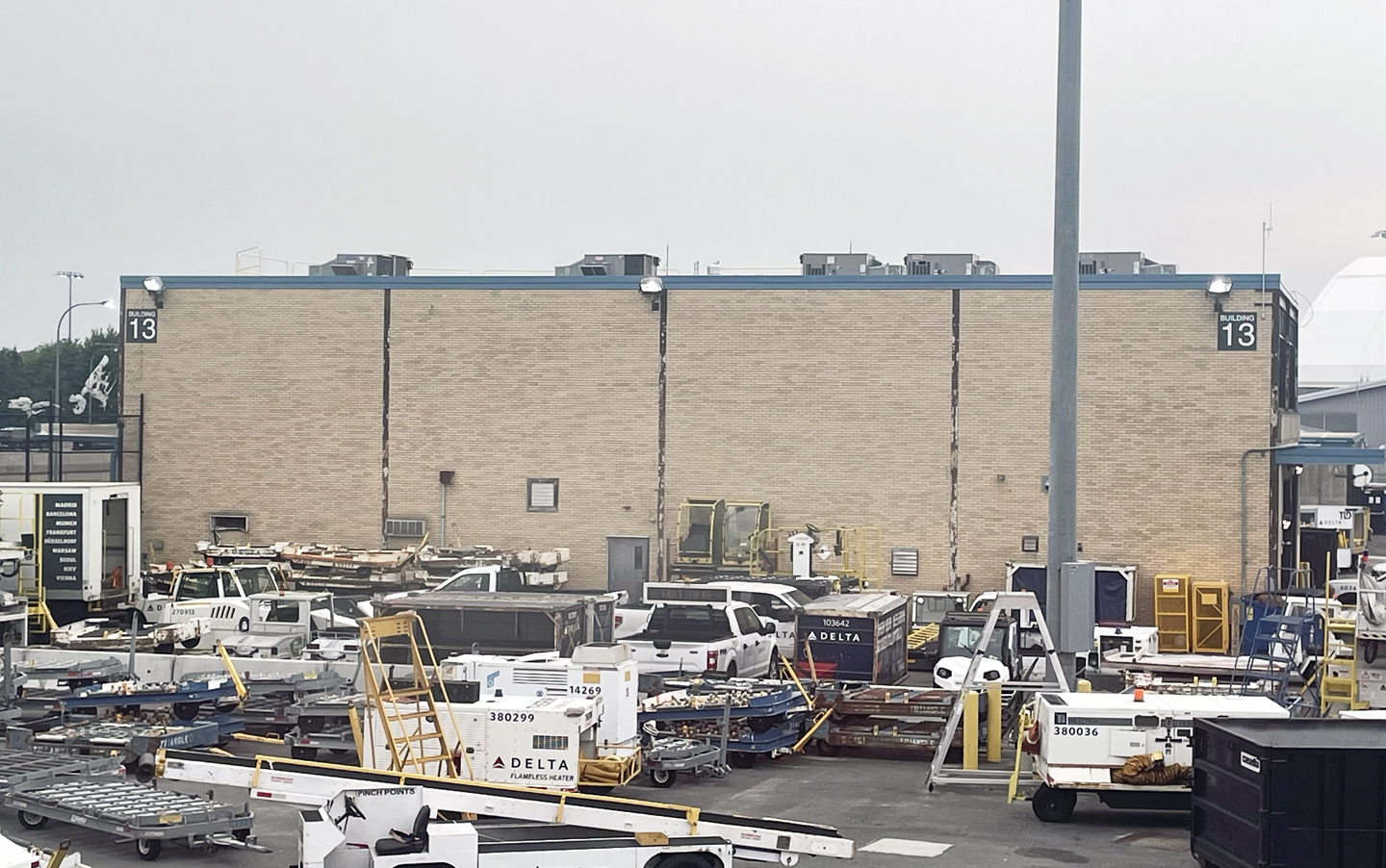
Building 13
We were parked at the gate in Boston, over at terminal E. I was in the cockpit, setting things up for departure, when I glanced to my right. Next to us was a nondescript building, a small rectangular structure of dirty yellow brick with blue trim, old and anachronistic-looking amidst all the modern build-up at Logan. A holdout from the ’50s or ’60s maybe? A sign said “Building 13.”
Something about it kept nagging me, until all at once I remembered.
I remembered walking below a Boeing 707, all in polished silver, running my hands along engines and landing gear. We sat in the cockpit too. Me and my father and my friend from school, Peter O’Leary. It was cloudy, drizzly. The year would’ve been 1977, I think. We were in sixth grade.
Building 13, I now recalled, had been the American Airlines cargo building. A 707 freighter would park behind it, just a few feet to the right of where I sat in my Airbus nearly fifty years later. My dad knew someone who worked inside and was able to set up a visit.
I forget who the worker was. It may have been a relative — a grand-uncle or some such whose name has escaped me. Whoever he was, he took us out to the apron and gave us run of that 707 for at least an hour.
Today a thrill like that would be documented by two dozen iPhone photos. But as so often is the case for those of us of a certain age, nothing of that day exists except my memory of it.
Back in the 1970s, most of the major airlines had cargo divisions with dedicated freighter fleets — cargo jets that hauled only pallets, not passengers. There, out on the back side of the airport, there was no sort of security clearance. You just walked out to the plane. Nobody batted an eye.
It’s funny how much of Logan has changed over the decades. Although it’s kept a degree of character, of local “feel” that most big airports lack, a lot of it is new, shiny, glass-and-steel generic. But tucked-away pockets remain just as they were when I was eleven years-old.
There’s talk of extending terminal E further to the west, which would put Building 13 in the target of a wrecking ball. Sooner rather than later, I’m sure, it will go the way of Minoru Yamasaki’s stately old Eastern terminal and all the old hangars that were knocked down.
I don’t know what it’s used for. American hasn’t flown freighters in eons. I could call Massport and ask. But I don’t want to. It really doesn’t matter. For me it will always be the AA cargo building, as it was that day in ’77, sitting in the cockpit with my father and my friend.
Photo by the author.

Leave a Comment
Maximum 1500 characters. Watch your spelling and grammar. Poorly written posts will be deleted!
8 Responses to “Building 13”
You are viewing newest comments first. Click to reverse order
I have similar security memory from Logan in the mid to late 1970s. When you are in terminal C – there is a downhill ramp that leads to a jetblue counter – then you can go right or left to the various gates. Behind that counter is a door. In the 1970s that door was unlocked and anyone could go out to a roof top over the gates. The view of the apron was incredible. I remember Dad took me there one Friday night in the summer and there was just incredible stuff…there were t-storms at JFK and an ATC strike in Canada…we saw numerous TWA and Pan Am 747s – as well as SP 747s from Iran Air and Iraqui that were diverted for those above reasons. Obviously this had to be prior the overthrow of the Shah. As you mentioned…no photographs sadly.
Having been a child back in the 1940s and 1950s, old railroad buildings are to me as Logan’s Building 13 is to you. I was a young lad when I was taken on a tour of the Canadian National’s roundhouse in Toronto in 1951—smoke seemed to issue from every crack and open window of that edifice as gigantic steam locomotives were building boiler pressure in preparation for a run. I also had visited a smaller engine house in Gananoque (ON) that year—back then, that engine house was part of the Grand Trunk system, later to be subsumed by the Canadian National.
In both places, there was no shiny aluminum and fancy livery, only the black steel of immensely powerful machines. There was also the inescapable “fragrance” of burnt coal and fuel oil, the latter from those new-fangled Diesel-electric units that were about to put steam out of business.
The Toronto roundhouse is now only a memory…a chapter of Canadian railroad history, and the Gananoque engine house has been repurposed. Perhaps Building 13 will be repurposed as well, although airport construction tends to be dismissive of old buildings that still have stories to tell. One thing for sure: whatever befalls Building 13, the folks who work on or demolish it will not be getting a whiff of coal dust or combusted fuel oil. 🙂 Too bad…those aromas still linger in my mind after some 75 years and when I smell them today, fond memories are triggered.
I grew up on the South Shore in the ‘60s. Our neighbor worked in the old control tower at Logan, and took me up there a couple of times. No pesky security checks. It was wicked cool.
From an American 1976 timetable, freight system schedules. Flight 865 left JFK at 8:45pm, arrived BOS at 9:45, left at 11:45, then stopped in Cleveland at 1:30am then DFW at 4:30am then arrived LAX at 6:50. Flight 832 left LAX at 11:35pm then ORD at 5:10 arriving Boston at 9:05.
Patrick,
I agree that there are pockets here and there that have not changed much in the last few decades. Walking down a hall , passing a certain luggage carousel , plane spotting on the roof of Terminal B, (who knew you could go ‘fishing: on the roof of Terminal B. LOL)often onvkoe even more memories.
Peter
After American, the building was apparently used by UPS, and it may currently be empty. Listed as “UPS (Building 13) – currently vacant – out to RFP” on page 72 of Appendix H in Massport’s most recent Environmental Status and Planning Report.
Many airlines operated combi and/or QC aircraft in the 1960s and 1970s that could switch from passenger to cargo configurations and some could carry both freight and passengers simultaneously in the cabin. AA apparently did not operate combi or QC aircraft. Solved.
I’m long-time reader going back to your Salon days. I haven’t thought about this in years, but my first job in the 90’s after college was as temp for a few months in the ground transportation unit at Logan. I haven’t been back to Boston in over 20 years, but your post reminded me of the long commute on the T to the airport shuttle to the weird back offices you don’t see when you’re just an airline passenger and wandering the terminals during lunch break. The woman I was temping for was the (Boston-accented) voice on the shuttles announcing airline stops. If I make it back to Boston, I’ll see if I can remember where the ground transportation office is.