Author Archive

A Ride on the 787

Boeing’s new jetliner is quiet, sleek, and comfortable. Now, if they could please fix the windows…
December 16, 2012

It’s the pointy end of a spiffy new jet that piques the interest of most pilots. There’s no denying that the 787 has a great-looking cockpit and some fascinating systems architecture. I can’t imagine there’s a pilot out there who wouldn’t want to fly one.

However, I figure the various aviation magazines and websites have the jet’s gizmos and plumbing well-enough covered.  (Plus, I’m protesting the glacially slow progress of cockpit ergonomics.  It’s been how many years, and we still don’t have an FMS or ACARS interface with a QWERTY keyboard?)

So, instead, here’s a critique of the 787 from a passenger’s point of view.  A few weeks ago I was fortunate to catch a ride from Boston to Tokyo-Narita on one of Japan Airlines newly delivered ships.

JAL’s BOS-NRT flights were launched last spring; the first-ever nonstop service between Boston and Asia, and the first scheduled 787 service anywhere in North America.  (United has since taken delivery of its first of several 787s, and Ethiopian Airlines will soon launch the plane on its popular route between Washington-Dulles and Addis Ababa.)

Some impressions…

First, the airport. Call me a hometown cheerleader (I grew up in the Boston area and live there still), but Boston-Logan has to be the one of the most underrated airports in the country. It wasn’t always this way, but following a decade of major renovations, including an expanded Terminal E and the construction of Delta’s Terminal A, Logan has emerged as one of the most modern and functional major airports in North America.  It’s clean, bright, easy to navigate, and who doesn’t love the inter-terminal connector walkways, with their skyline views and inlay sea-life mosaics?

JAL’s flight 007 leaves from Terminal E.   When I was a kid, this was called the “John A. Volpe International Terminal,” named after the former Massachusetts governor.  Then, as now, it is the only terminal at the airport with customs and immigration facilities, and it is home to all of Logan’s overseas carriers. Though not exclusively: the cluster of gates at the eastern tip, once the home of Braniff and later Northwest, are today used by AirTran and Southwest.

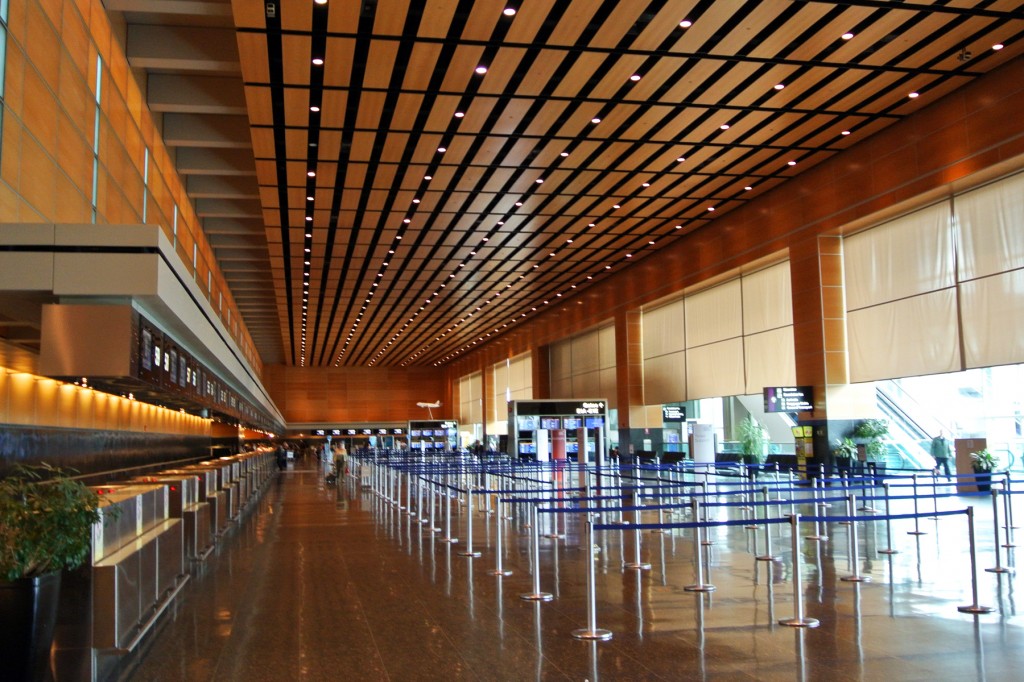
The building has doubled in size.  The check-in hall is entirely new and arguably the airport’s handsomest spot.  The spacious, wood-panel interior is softly lit and, unlike most US airports, blissfully quiet — free of the incessant PA announcements and infernal CNN monitors that plague most of America’s terminals.  Passing the TSA checkpoint one enters the building’s older section, which is more or less as I remember it from years ago, with lots of gray aluminum and segmented windows staring towards Revere.  Flight 007 left from gate 8, at the far western end.
Somehow the JAL staff managed to begin boarding a fairly full, 13-hour flight only 25 minutes prior to departure, and actually pushed back early.  There wasn’t even a bottleneck in the jetway.  I was in 23A, a window seat in the second row of economy.

The 787 isn’t as large as other long-haul widebodies. I was a surprised by the stubbiness of the cabin.  In terms of range and capacity, the plane falls between the 767 and 777.  But it feels a lot closer to the former, albeit with 777-style overhead bins and a bevy of new accouterments.

Though it can hold up to 300 passengers, JAL uses a roomy, two-class layout, with extended legroom in economy, for a total of only 186 seats — about 20 fewer than the average 767.

The sidewalls and consoles are sculpted in that rounded, organic, vaguely futuristic style that reminds me of the caves of Turkish Cappadocia (think of Eero Saarinen’s landmark TWA terminal at JFK).  The mid-cabin lavatory is big enough to hold a party in — with cool blue moodlighting to boot.

JAL’s Recaro economy chairs have generous legroom,11-inch video screens (Ethiopian’s are 15 inches!) cup holders, coat hooks, AC power ports and a USB connection.
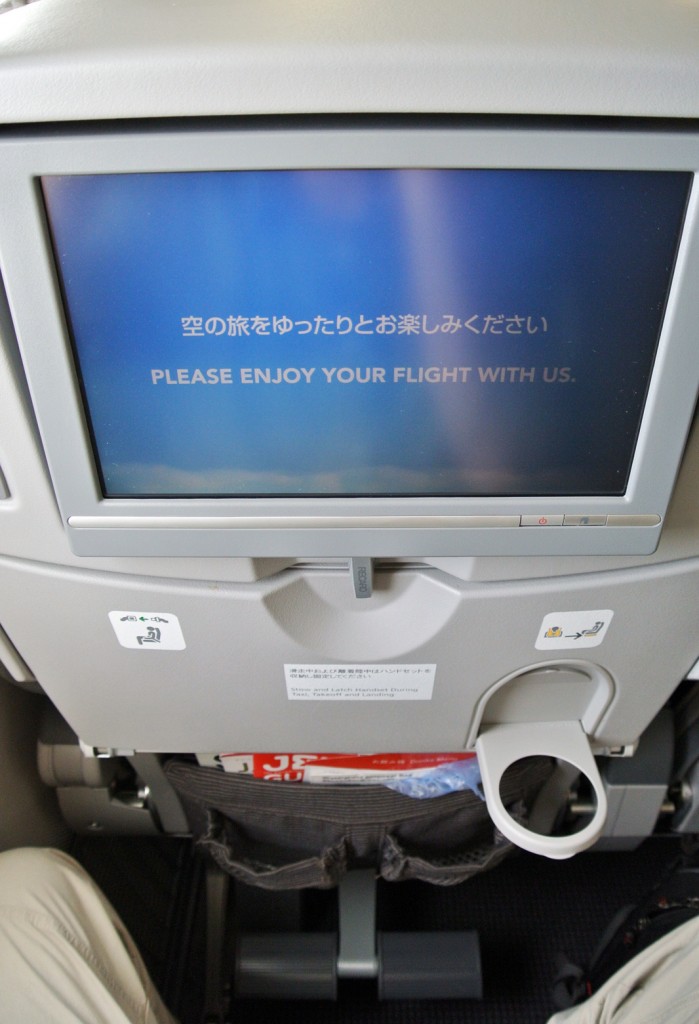
Despite these goodies, I wondered how many of the passengers had any idea they were riding on the world’s newest and most sophisticated jetliner.  It’s different, but it’s not that different.

If one thing gives it away, it’s the windows.  The 787’s cabin windows are a good 40 percent bigger than normal.  They’re of equal width, but almost double the height of typical windows.  These skinny ovals are perhaps the most distinctively shaped cabin windows since those of the DC-8 or the Caravelle, 45 years ago.

Instead of a traditional draw-down shade, the glass is tinted electronically, with a push-button.  It never fully opaques, and at full tint the effect is a bit like being under water: you can make out certain details, but most of the color and sunlight are filtered away.  The world is rendered in a leaden bluish-gray, similar to the way things look under a very bright full moon.

It’s a nice idea in that you always have a view.  Unfortunately, in direct sun, much of the heat still leeches through, even at maximum tint.  My window pane became painfully hot to the touch, and the radiant heat grew uncomfortable.  At one point I stuck one of the seat-pocket briefing cards into the frame to help stay cool.  When a flight attendant saw this, she came over and gave me a black, self-stick window blotter.  Apparently I’m not the only one to find this bothersome.

In addition, the tinting is not instantaneous.  When the plane banks and suddenly you’ve got the sun bearing down on you, it takes several seconds for the glass to go dark.
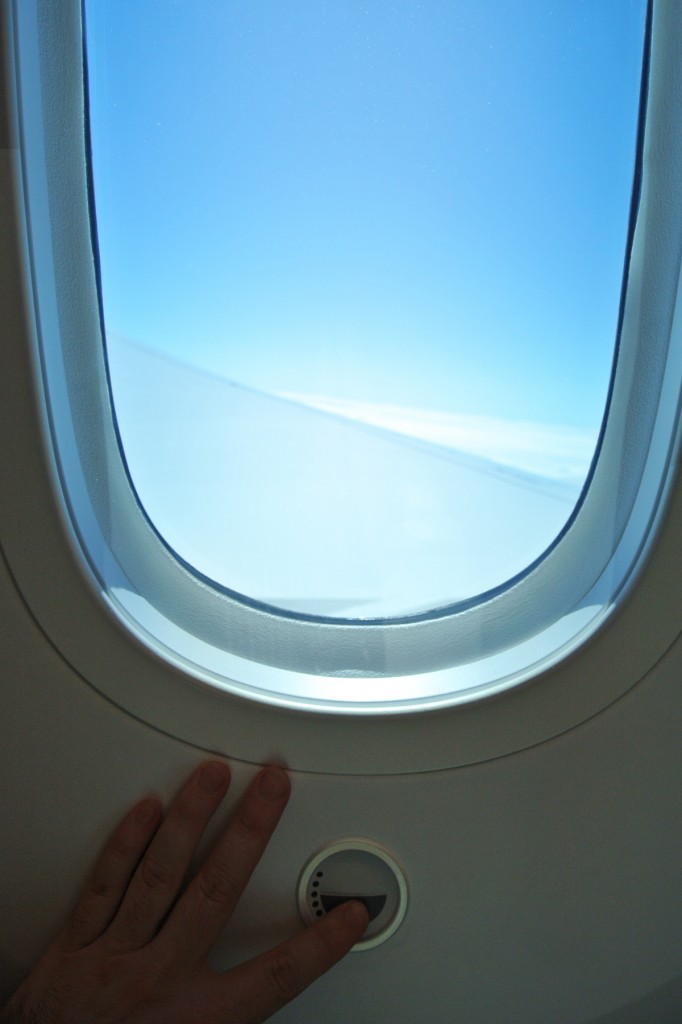
All Nippon Airways, the launch customer of the 787, has reportedly complained to Boeing about the heat issue and malfunctioning of the tinting mechanisms. The electronic system struck me as a novelty – technology for the sake of itself — and something that, in the end, isn’t as useful or reliable as the good old manual version.

On the brighter side, as it were, the 787’s cabin is whisper-quiet thanks to advanced insulation and an active noise reduction system.  This makes long flights less fatiguing, saves battery life on your iPod, and makes it easier to hear the movies.  It also amplifies the conversations of your neighbors and the wails of nearby children.

The pressurization and air recirculation systems, meanwhile, are designed to maintain higher humidity levels and lower cabin altitudes than are customary.  (The plane’s composite construction ensures that moisture levels won’t be corrosive.)  These are welcome changes, but after landing at Narita I’m not sure that I felt any less weary or dehydrated than I normally do after a 13-hour journey.

JAL’s onboard service was very good overall, if not quite on the level of other leading airlines from Asia, Europe, or the Middle East.  There were two hot meals and a snack service. During the in-between hours, a buffet was set up in the mid and rear galleys with snacks and bottled water. The lavatories were stocked with toothbrushes and other amenities.
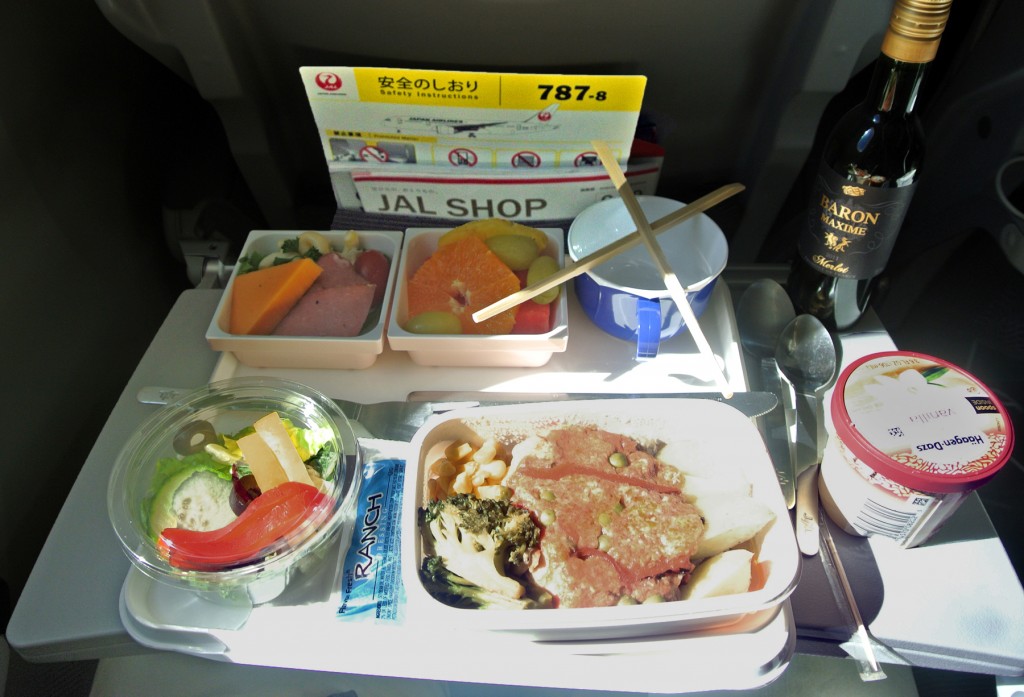
One thing that JAL and most other foreign airlines understand better than their US counterparts, is that service is a continuous thing.  Whether it’s premium or economy class, you don’t hand out a meal and then go hide for seven hours.  JAL’s flight attendants made continuous rounds, serving beverages, collecting trash, etc.

There were two hot towel services: one after takeoff and a second one about an hour before landing.  Yes, in economy.

One complaint is that JAL’s inflight entertainment options could use an upgrade.  That big video screen is only useful if there’s something worth watching.  Delta offers a far better choice of movies and TV, even in economy.  Also, the video handset controls are inset into the armrests in such a way that your elbow digs painfully into the well.

But if you ask me, the coolest thing about JAL’s 787 isn’t on the inside, but on the outside.  I’m talking about the airline’s reintroduction of the tsurumaru, the circular red-and-white logo used since 1960.  Possibly the most elegant airline logo ever conceived, it’s a stylized depiction of the crane, lifting its wings into the circular suggestion of the Japanese rising sun.  Beginning in 2002 this ageless symbol was phased out in what had to be the most regrettable makeover in the history of airline identity, replaced by a “rising splotch” – a blood-red blob that evoked pretty much nothing at all.  It was a terrible decision on aesthetic merits alone, and still worse considering the crane’s cultural importance in Japan.  Apparently enough people complained, however, and the tsurumaru has since been resurrected.

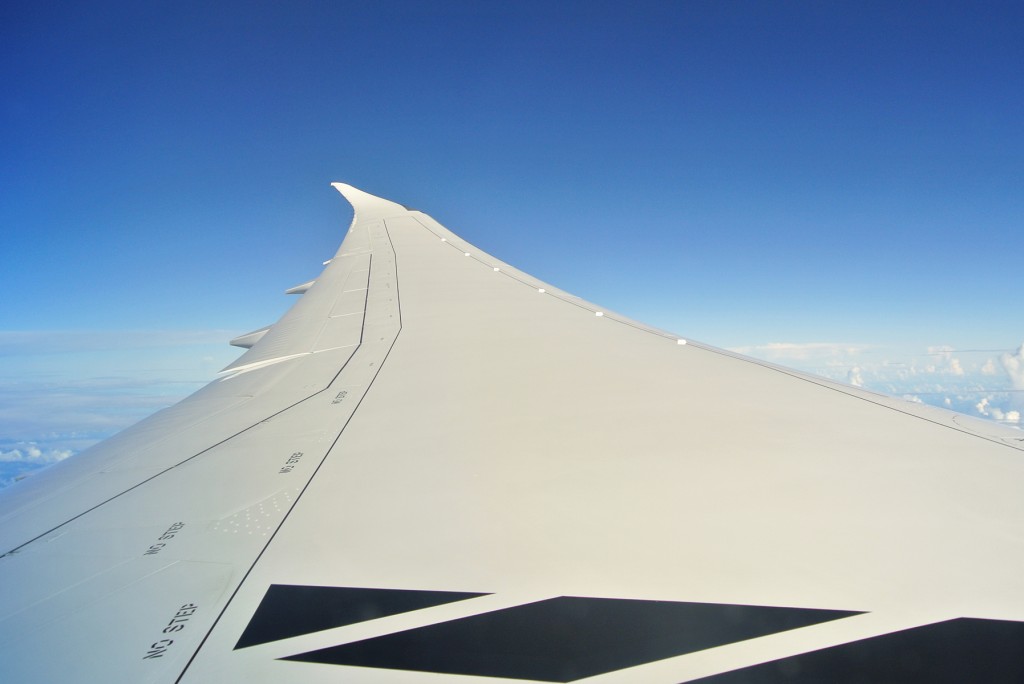
Similar to the A380, the lines of the 787 give it a somewhat anthropomorphic profile.  But while the A380 looks like a steroidal beluga, the 787 is a sleeker species. The tail is awkwardly undersized, but those scalloped engine nacelles (for noise reduction; similar to those on the new 747-8) and sharply tapered wingtips are definitely cool.

As for the name, kudos to Boeing for sticking with the numerical sequencing that began 60 years ago with the 707.  However, I’m not especially fond of the “Dreamliner” designation.  Somehow the imagery there is a little too wobbly and ethereal.  People don’t want their planes (or their pilots) nodding off.

It could have been worse.  Initially, before Boeing had settled on a name, Dreamliner was in contention with three other possibilities.  They were: Global Cruiser, Stratoclimber, and eLiner.  Global Cruiser sounds like a yacht, or a really big SUV.  Stratoclimber sounds like an action hero, and eLiner is almost too awful to contemplate — sort of like “iPlane.”

If you haven’t caught a glimpse of the 787 yet, you will soon.  Boeing’s order book stands at more than 800.


PHOTOS BY THE AUTHOR

Related Story:

LOGAN REDUX: THE PILOT GOES HOME AGAIN

 

Comments (44)

How to Speak Airline: A Glossary For Travelers

Crosscheck? Ramp? Ground stop? Who comes up with these things? Finally, a code to the insufferable jargon of air travel.

THE EXPERIENCE OF AIR TRAVEL IS UNIQUE in that people subject themselves to a long string of mostly anonymous authorities. From the moment you step through the terminal doors, you’re hit with orders — stand here, take your shoes off there, put your seat belt on, do this, put away that — and a flurry of information. Most of it comes not face-to-face, but over a microphone, delivered by employees, seen and unseen, in a tautologically twisted vernacular that binges on jargon, acronyms, and confusing euphemisms.

The ways in which airline workers can bend, twist, and otherwise convolute the English language is nothing if not astonishing. For reasons unknown, it is impossible for a crew member to simply say, for instance: “I am driving my car to work.” Instead, he or she must say, “At this time, I am operating my vehicle to my location of employment.” This stylistic overkill is designed, I think, to get your attention, and to make a particular statement sound extra-important. All it actually does, though, is burden your synapses by forcing them to deal with far more words than they need to. The phrasing is often so strained and heavy-handed that you can almost hear the sentences crying out in pain.

There are people who make dozens of air journeys annually and still have only a vague understanding of many terms. To help, I’ve compiled a glossary, focusing on those expressions most easily misunderstood, or not understood at all. In no special order:


• DOORS TO ARRIVAL AND CROSSCHECK

Meaning: Occasionally heard as “disarm your doors and crosscheck,” and announced by the lead flight attendant or purser as a plane approaches the gate. The intent is to verify disarming of the emergency escape slides attached to the doors. When armed, a slide will automatically deploy the instant its door is opened. Disarmed, it needs to be deployed manually. On departure the slides are armed to facilitate an emergency evacuation. (You might hear this as “doors to automatic.”) Upon docking, they’re disarmed to keep them from billowing into the boarding tunnel or onto the apron during servicing.

Crosscheck is a generic term used by pilots and flight attendants meaning that one person has verified the task of another. In the cabin, flight attendants crosscheck one another’s stations to make sure the doors are armed or disarmed as necessary.


• ALL-CALL   “Flight attendants, doors to arrival, crosscheck and all-call.”

Meaning: Often part of the arming/disarming procedure, this is a request that each flight attendant report via intercom from his or her station — a sort of flight attendant conference call.


• LAST MINUTE PAPERWORK   “We’re just finishing up some last minute paperwork and should be underway shortly…”

Meaning: Everything is buttoned up and the flight is ready for pushback. Then comes the wait for “last minute paperwork,” which winds up taking half an hour. Usually it’s something to do with the weight-and-balance record, a revision to the flight plan, or waiting for the maintenance guys to deal with a write-up and get the logbook in order.


• FLIGHT DECK

Meaning: The cockpit.


• FIRST OFFICER (also, COPILOT)

Meaning: Second in command on the FLIGHT DECK. The first officer sits on the right and wears three stripes. He or she is fully qualified to operate the aircraft in all stages of flight, including takeoffs and landings, and does so in alternating turns with the captain.


• FLIGHT LEVEL   “We’ve now reached our cruising altitude of flight level three-three-zero. I’ll go ahead and turn off the seat belt sign…”

Meaning: There’s a technical definition of flight level, but I’m not going to bore you with it. Basically this is a fancy way of telling you how many thousands of feet you are above sea level. Just add a couple of zeroes. Flight level three-three zero is 33,000 feet.


• HOLDING PATTERN

Meaning: A racetrack-shaped course flown during weather or traffic delays. Published holding patterns are depicted on aeronautical charts, but one can be improvised almost anywhere.


GROUND STOP   “Sorry folks, but there’s a ground stop on all flights headed south from here.”

Meaning: The point when departures to one or more destination are curtailed by ATC, usually due to a traffic backlog.


• EFC TIME   “Good news, we’ve been given an EFC time of 30 minutes after the hour.”

Meaning: The expect further clearance (EFC) time, sometimes called a release time, is the point at which a crew expects to be set free from a HOLDING PATTERN or exempted from a GROUND STOP.


WHEELS-UP TIME

Meaning: Similar to the EFC TIME, except it refers to the point when a ground-stopped plane is expected to be fully airborne. The crew and ground team must be sure to get the flight boarded and pushed in order to be at or near the runway as close to this time as possible.


• AREA OF WEATHER   “Due to an area of weather over New Jersey, we’ll be turning southbound toward Philadelphia…”

Meaning: This typically means thunderstorms or a zone of heavy precipitation.


• AIR POCKET

Meaning: This is merely colloquial for a transient jolt of turbulence; there is no formal meteorological definition.


• FINAL APPROACH   “Ladies and gentlemen, we are now on our final approach into Miami.”

Meaning: For pilots, an airplane is on final approach when it has reached the last, straight-in segment of the landing pattern — that is, aligned with the extended centerline of the runway, requiring no additional turns or maneuvering. Flight attendants speak of final approach on their own more general terms, in reference to the latter portion of the descent.


• THE FULL, UPRIGHT AND LOCKED POSITION

Meaning: Upright.

• TAMPERING WITH, DISABLING, OR DESTROYING   “Federal law prohibits tampering with, disabling, or destroying a lavatory smoke detector.”

Meaning: Tampering with.


• THE OFF POSITION

Meaning: Off.


• FLOOR AREA “Please check the floor area for any personal items before deplaning.”

Meaning: The floor. This is a common one from the flight attendants as part of their after-landing spiel. I mean, who talks like this? When you’re at home, do you say, “I need to vacuum the floor area”? Or, “Look at that, Brendan, you’ve spilled cereal all over the floor area!”


• DEPLANE

Meaning: Deplane is used to describe the opposite of boarding an aircraft. There are those who feel the root “plane” should not be used as a verb, fearing a chain-reaction of abominable copycats. Imagine “decar” for getting out of your car, or “debed” for waking up. In fact, dictionaries date “deplane” to the 1920s, and while it’s not the slickest sounding word, it’s a term of occasional convenience. There aren’t any PA-friendly options with the same useful meaning. “Disembark” is the most elegant one, and it’s clumsy.


• DEADHEAD

Meaning: A deadheading pilot or flight attendant is one repositioning as part of an on-duty assignment. This is not the same as commuting to work or engaging in personal travel.


• EQUIPMENT   “Due to an equipment change, departure for Heathrow is delayed three hours.”

Meaning: An airplane. You might also hear a pilot ask of another pilot, “What equipment are you on?” What he means is, “What kind of plane do you fly?” Yes, I agree, there is something decidedly strange about the refusal to call the focal object of the entire industry by its actual name?


• DIRECT FLIGHT

Meaning: Technically, a direct flight is a routing along which the flight number does not change; it has nothing to do with whether the plane stops. This is a carryover from the days when flights between major cities routinely made intermediate stops, sometimes several of them. Most airline staff are smart enough to realize that if a passenger asks if a flight is “direct,” he or she wants to know if it stops, but check the fine print when booking.


• NONSTOP

Meaning: That’s the one that doesn’t stop.


• GATEHOUSE “If there is a passenger Patrick Smith in the gatehouse, please approach the podium?”

Meaning: An idiosyncratic way of saying the gate area or boarding lounge. Gatehouse has a folksy touch that I really like. They should use it more often.


• PRE-BOARD   “We would now like to pre-board those passengers requiring special assistance.”

Meaning: This one, on the other hand, has no charm. It means to board. Except, to board first.


• FINAL AND IMMEDIATE BOARDING CALL

Meaning: A flamboyant way of telling slow-moving passengers to get their asses in gear. It provides more urgency than just “final call” or “last call.”


• TICKETED AND CONFIRMED PASSENGERS   “We invite all ticketed and confirmed passengers to board through the gate marked five.”

Meaning: Passengers. As if, by not specifying “ticketed and confirmed,” random ticketless people might wander onto the plane.

• MARKED   “…the gate marked five.”

Meaning: As opposed to the gates that have no numbers. Of which, of course, there are none.


• IN RANGE   “The flight has called in range, and we expect to begin boarding in approximately 40 minutes.

Meaning: This is a common GATEHOUSE announcement during delays, when the plane you’re waiting to board hasn’t yet landed. Somewhere around the start of descent, the pilots will send an electronic “in range” message to let everybody know they’ll be arriving shortly. How shortly is tough to tell, as the message is sent prior to any low-altitude sequencing and assumes no inbound taxi congestion. What they’re giving you at the gate is a best-case time for boarding. As a rule of thumb, add twenty minutes.


• RAMP   “We’re sorry, your suitcase was crushed by a 747 out on the ramp.”

Meaning: Ramp refers to the aircraft and ground vehicle movement areas closest to the terminal — the aircraft parking zones and surrounds. In the early days of aviation, many aircraft were amphibious seaplanes or floatplanes. If a plane wasn’t flying, it was either in the water or it was “on the ramp.”


• ALLEY   “It’ll be just a second, folks. We’re waiting for another aircraft to move out of the alley.”

Meaning: A taxiway or passageway between terminals or RAMPS.


• APRON

Meaning: Similar to RAMP, above, this is basically any expanse of TARMAC that is not a runway or taxiway — i.e. areas where planes park or are otherwise serviced.


• TARMAC

Meaning: A portmanteau for “tar-penetration macadam,” a highway surfacing material patented in Britain in 1901. Eventually it came to mean any sort of asphalt or blacktop. You hear it in reference to airports all the time, even though almost no ramp, apron, runway or taxiway is actually surfaced with the stuff. Real tarmac becomes soft in hot weather, and would turn to mush under the wheels of a heavy jet. (I think of Paul Weller’s invocation of “sticky black tarmac” in the gorgeous Jam song “That’s Entertainment!”) Like many words, it has outgrown its specificity, and there are linguistic traditionalists who are bothered by this. I am not one of them.


• AT THIS TIME   “At this time, we ask that you please put away all electronic devices.”

Meaning: Now, or presently. This is air travel’s signature euphemism.


• DO   “We do appreciate you choosing American.” Or, “We do remind you that smoking is not permitted.”

Meaning: An emphatic, otherwise with no grammatical justification. What’s wrong with, “Thank you for choosing American” or “Smoking is not allowed”? People wonder if this is how airline employees talk to one another. “I do love you, Steve, but I cannot marry you at this time.”

Comments (5)

The Journey of the Potato

THE MYSTERY OF THE HARVARD PARODY BOOKLET IS SOLVED AT LAST

December 22, 2017

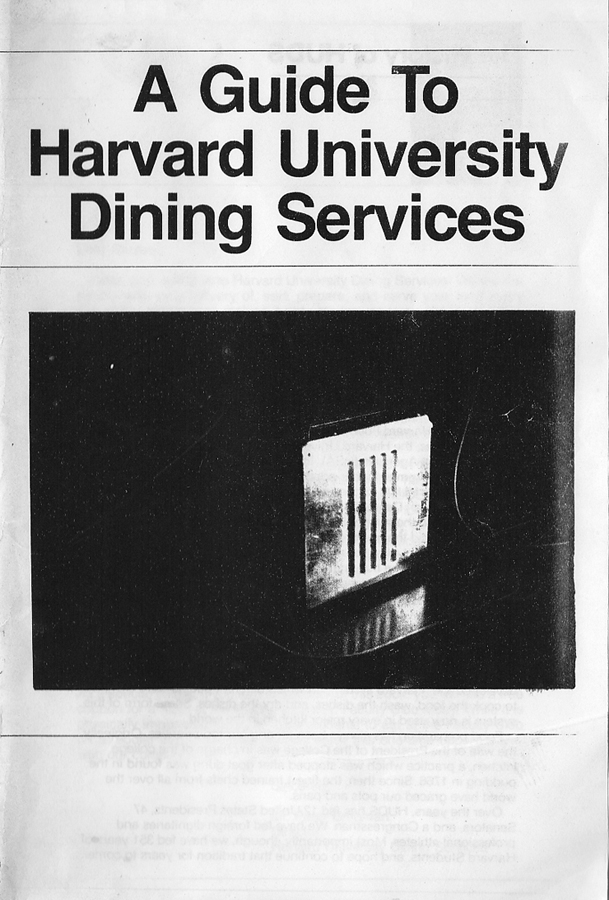
For thirty years I’ve been infatuated with a 34-page pamphlet.

It’s called A GUIDE TO HARVARD UNIVERSITY DINING SERVICES. It was slipped into the welcome packets for incoming Harvard freshmen in 1988 by folks at the Harvard Lampoon.

It’s one of the funniest things I have ever seen — if not the funniest.

It was given to me by my old friend Dave Blakney back in ’88, and I’ve held onto it ever since. (Blakney is also the person who, circa 1985, turned me on to the work of the great B. Kliban, whose single-panel cartoons are also in my Pantheon of things funniest-ever.) It’s highly possible that you won’t find it nearly as funny as I do — that’s humor for you — but I’ve gone ahead and scanned and uploaded each page, below.

I can quote much of the booklet verbatim. Bits of it — hundreds of tiny snippets — are permanently embedded in my consciousness. They arise from time to time as comic hiccups. If I’m in a restaurant, for example, I might ask the waitress if “blanched hagfish” is available, or if “grape-flavored apple pie” is on the dessert menu.

“Chinese-style Delvecchio chips”? I have no idea what in the world that that means, if anything, but it’s just plain funny.

And the whole potato thing. I hardly know where to begin: “raspberry potato shuffle,” “hot potato sandwich with liniment.” It goes on and on. (See pages 16-17, and the list on page 27).

And excerpts like, from page 17: “This painstakingly maintained original uses 40,000 ordinary 3-watt light bulbs.” How is that not the funniest thing in the world? Or, “On cracker day, every dish is served on a cracker.”

It’s all so subtle and pitch-perfect, yet completely bananas at the same time.

But I never knew who, exactly, was responsible for it. The names “Sanders Metcalf” and “Samuel David,” and the words “a Graphex Production,” appear at the bottom of the inside cover. These were the only clues.

A few years back I wrote about the booklet as an addendum to one of my columns at Salon, hoping to flush out its authors. With thousands of people reading my column and sharing links, I thought for sure the authors would be revealed.

But they weren’t. Nobody knew anything.

Then, months later, I got an email. And some of the details, I discover, are these:

It turns out the “Sanders Metcalf” is none other than Ben Metcalf, who became a senior editor at Harper’s Magazine. Back in ’88 he wrote for the Lampoon.

“Samuel David” is David Samuels, another well-known Harper’s writer.

I’d been reading Samuels’ and Metcalf’s stuff in Harper’s for years. That they would be the co-conspirators of my parody booklet is startling to say the least. (Samuels wrote one of my favorite political essays, “The Changeling: The Content of His Character,” about Barack Obama, which I had been emailing to everybody I know, partly because it was so damn funny.)

“Graphex Productions” was a tag used by a guy at the Lampoon named Glenn McDonald. He was responsible for the booklet’s photography and the “Journey of the Potato” section. He is the one who filled me in. McDonald still lives in Cambridge, where he’s a critic and author of the online music column, The War Against Silence.

“Twas, as you say, many years ago,” says McDonald. “And of the various things with which I have been involved, this is not exactly the one I would most have expected to occupy a place of honor in anybody’s personal canon! But very cool that it does, and I will tell you what I can!

“We did a lot of parodies at the Lampoon. Most often they were declared and labeled as parodies, but every once in a while we did one intended to pass, at least initially, for the real thing. Parody issues of the Harvard Crimson or other campus periodicals, mostly. But as you know, this Guide was slipped in amongst actual college material on student doorsteps. I remember racing up and down residence stairways performing the insertions.

“As with most things at the Lampoon, this one was a large group effort to write, and a small group effort to edit and actually assemble and print. Editorial authority for projects went around in a rotation weighted by seniority, and I’m pretty sure this one was done when David Samuels and I were juniors, and Ben Metcalf was a senior.

“I must have done the layout and design, although I no longer remember whether it was one of the last things we produced on physical layout boards with line-tape and rubylith and so forth, or one of the first things we did with the then-new-and-novel Macintosh computer. I took most of the pictures that weren’t stolen from old yearbooks.

“Other than David and Ben and I, two people who I’m pretty certain were involved were Stacie Lipp, who went on to a successful career in comedy, and Matt Leibowitz, who is now a doctor and medical researcher at UCLA.”

McDonald says that several others may also have collaborated, a few of whom went on to comedic renown. Among these are Bill Oakley, David Cohen, and Rachel Pulido, all of whom became early writers and producers of The Simpsons. Reportedly it is Oakley who coined “blanched hagfish.” Oakley was one of the writers of the Simpsons’ “legalized gambling” episode (December 16, 1993) which, in my opinion, is the greatest Simpsons show of all time.

As for those Chinese-style Delvecchio chips?

“This is an example of the collective Lampoon penchant for lists of structurally plausible but otherwise unintelligible phrases,” explains McDonald. “Especially in large batches, these start to take on their own internal logic, which makes them one of the few forms of humor that are almost as funny while you’re writing them as when you read them.”


CLICK ON EACH PAGE TO ENLARGE


One ASK THE PILOT reader did some sleuthing and discovered that the photos from the “Dining Hall Heroes” section are yearbook pictures of Harvard students who had graduated in 1980. Here are the originals….


Comments (8)