





Toys in the Attic
November 11, 2025
Today’s topic is supposed to be the U.S. government shutdown. I’m supposed to offer “hacks” (a gruesomely overused term these days) that’ll help you deal with the delays and long lines, and assure you that the skies remain safe.
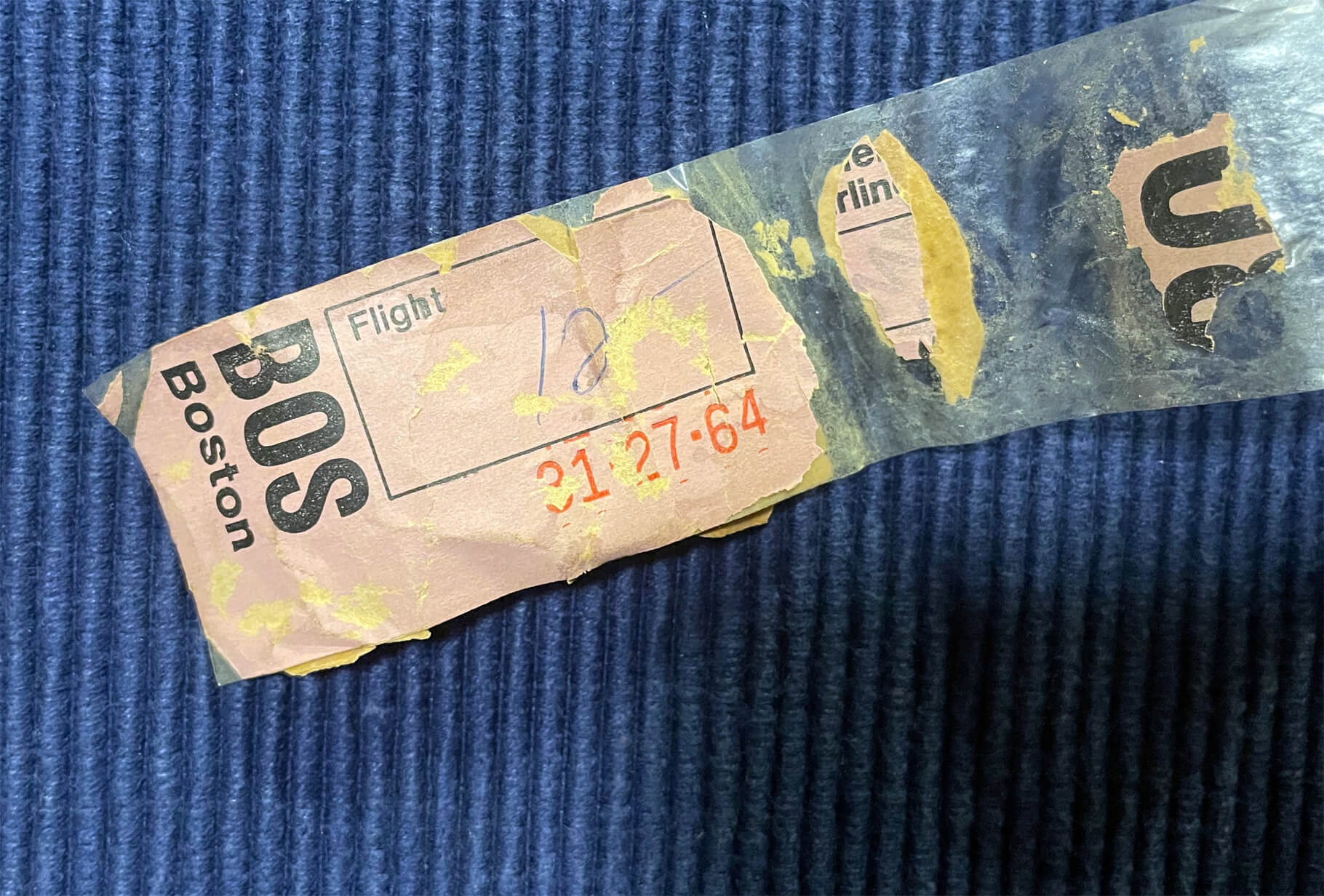
I can’t think of anything more boring, however, so instead I’m going to talk about this vintage American Airlines luggage tag that I found in the attic at my father’s house.
The tag — what’s left of it — was affixed to a suitcase that belonged to my mother in the 1960s, when she worked briefly as a flight attendant for American. An address on the suitcase is hers from before she was married.
I’m pretty certain the tag is from 1964. This jibes with both the address and her dates of employment. There’s also a “64” as part of the coding, visible in red.
You also can see where the flight number, 12, has been inked in by hand.
Flight 12 was, for decades, American’s Los Angeles-Boston nonstop. The reciprocal, flight 11, left Boston for Los Angeles each morning.
In the late 60s, flights 11 and 12 would’ve been run with a Boeing 707. Later it was a DC-10, and a 767 after that. I remember flying to LAX on flight 11 in 1980, when I was a freshman in high school.
The pairing no longer exists. These flight numbers were retired as of September 12th, 2001, the day after flight 11 crashed into the World Trade Center.
There’s a science of sorts to flight numbers that you probably didn’t know about:
Ordinarily, flights going eastbound are assigned even numbers; those headed westbound get odd numbers. Another habit is giving lower, one- or two-digit numbers to more prestigious or long-distance routes. If there’s a flight 1 in an airline’s timetable, it’s the stuff of London–New York.
Numbers might also be grouped geographically. At United, transpacific flights use three-digit numbers beginning with 8, which is considered a lucky number in some Asian cultures. Four-digit sequences starting with a 3 or higher are, most of the time, indications of a code-share flight.
Technically, a flight number is a combination of numbers and letters, prefaced with the carrier’s two-letter IATA code. Every airline has one of these codes. For Delta, American, and United, it’s DL, AA, and UA, respectively. Lufthansa uses LH; Emirates uses EK. Often they’re intuitive, other times they’re mysterious. British Airways is BA, while jetBlue uses the alphanumeric B6.
If you didn’t know about this practice, you no doubt got familiar with it after the disappearance of Malaysia Airlines flight 370, which from the start was referred to as “MH370.”
All this inspired by some fragments of a sixty year-old luggage tag.
Air travel forensics, you could call it. I’m good at it.
And I imagine you can find thousands of these sorts of curiosities — numbers and codes that tell a story — sitting in attics and basements all over the world.
Related Stories:
THE DAY OF THE COCKROACH
THE WEIRD WORLD OF AIRLINE COLLECTIBLES
Photo by the author.

Leave a Comment
Maximum 1500 characters. Watch your spelling and grammar. Poorly written posts will be deleted!
12 Responses to “Toys in the Attic”
You are viewing newest comments first. Click to reverse order
British Airways flight 1 used to be LHR to JFK by Concorde. Flight 2 was the return trip.
Later those flight numbers were assigned to the little Airbus that BA flew between London City Airport and JFK.
This post really brings back a lot of memories. I flew AA #11 and #12 several times back in the day…beginning in 1979. A quick check of the AA website shows that Flight #12 still exists today as the LAX to BOS flight. I still keep my bag tags to this day. With almost 800 flown flights (the majority of which I had a checked bag), my “archives” are bursting at the seams! Thank you Patrick for the great piece.
So glad you wrote this. I’ll pay more attention. I still sort of regret giving away a vintage suitcase (perhaps 1950s) with a PanAm tag on it.
This makes very interesting reading indeed.
Traditionally, the Aerolíneas Argentinas isologo showed a condor and two big letters: AA.
Which is sometimes confusing, given that AA can easily be mistaken for American Airlines. And while the former’s flight numbers are preceded by “AR”, it’s all too common to see news headlines using AA for Aerolíneas Argentinas.
There may only be one flight per day with one flight number departing from one airport, but there can be shenanigans where you have, for instance, AC33 YYZ-YVR and then AC33 YVR-SYD. Most often these are operated by the same aircraft and so they can’t be in the air simultaneously. But this is not always true! So you can potentially indeed have two AC33s in the air when there is a delay on the YYZ-YVR (AC33 Alpha) and the YVR-SYD (AC33 Beta) takes off before the YYZ-YVR lands.
Of course our author has to know this, but maybe others don’t.
I’ve also noticed that non-US carriers have more conventions for flight numbers. US carriers seem to use arbitrary numbers these days. Air Canada uses first digit 0 for Asian flights, first digit 8 for Europe flights, etc.
AC1 is thus Toronto to Haneda these days.
NZ1 currently connects JFK to AKL, though it’s been AKL-LAX-LGW/LHR (and flown the Queen).
I’ve flown NW1776 to PHL, NW1492 to CMH, NW711 to LAS, all from DTW.
Besides the origin of flight numbers, I’m pretty sure that a given flight number can only depart from a given airport once per day. A decade or so ago, I was on a redeye SFO-IAD whose departure was delayed past midnight, necessitating a flight number change (which is why I think the rule above exists, which would make some sense). I (and presumably 200 other pax) then had to fight United for the miles, since they managed to completely lose track of the flight! They never admitted it existed, finally said they were crediting the miles as a “goodwill gesture”. This can’t be the only such incident…
One of the “prestigious” routes I have been familiar with is QF1/QF2, which Qantas have used for their flagship Sydney to London service for a very long time. It’s been interesting to watch the evolution of its routing over the years. When I was a kid in the 1970s it was SYD-SIN-BAH-LHR. Then it became SYD-SIN-LHR (and at times SYD-BKK-LHR) once the 747-400 came along, then SYD-DXB-LHR for a while when Qantas became close with Emirates, then back to SYD-SIN-LHR. I flew an unusual SYD-DRW-LHR routing with a QF1 flight number during COVID. This flight number will presumably reach its culmination in a year or two when it finally becomes nonstop.
Qantas used QF1 since well before that though. They have flown to London since 1947 (and in partnership with other airlines since 1935) and the number of stops has been steadily dropping throughout that time. I am not sure when they started using QF1 / QF2 though. I’d love to know.
Flight 1 famous Pan Am flight London/JFK ,terminal 3 (the flying saucer )continuing around the world
The real question is why Southwest is WN. I’ve heard a rumor that it’s because the founder liked Willie Nelson, but I haven’t seen that verified.