





A Toast to Iran Air
September 8, 2025
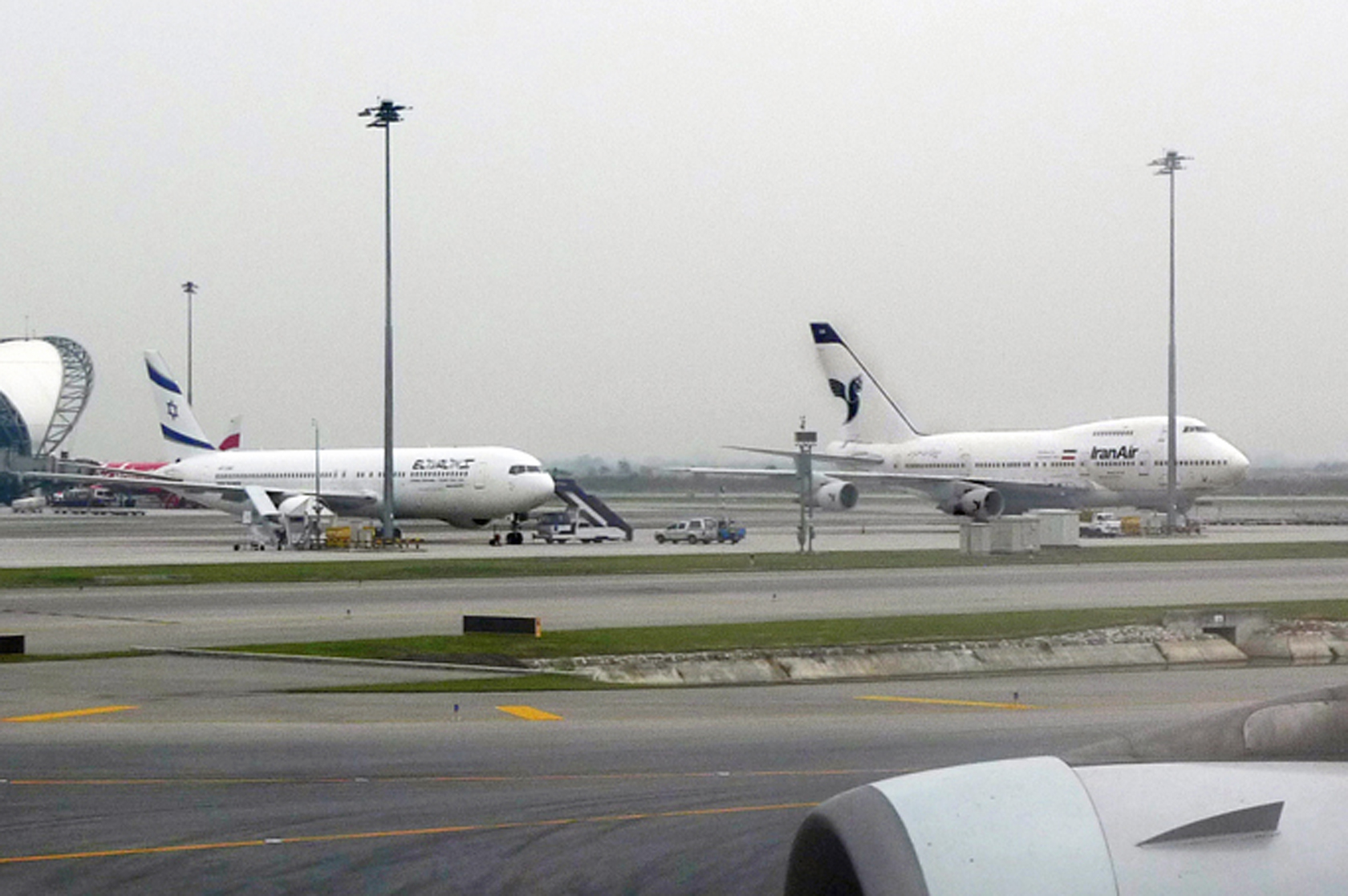
It’s remarkable how often geopolitics and aviation intersect. I snapped the above photo a dozen or so years ago at the airport in Bangkok, Thailand. That’s an El Al 767 buddy-buddy with an Iran Air 747SP. At the time it drew a chuckle. Today it’s more of a gasp.
Was this by accident, do you think, or were the authorities at BKK pushing for a sort of tarmac detente?
It’s maybe hard to imagine, but in the days before the Iranian revolution, El Al flew scheduled services between Tel Aviv and Tehran. Iran Air, for its part, was a world-class airline with routes from New York to Tehran via London and Paris. Somewhere in a box at my father’s house is a picture of an Iran Air 747 that I took at Kennedy Airport in 1979, using an old Kodak Instamatic.
In some other reality, Iran Air’s hub at Tehran became a global aviation crossroads, akin to what happened in Dubai and Doha. But the regime had other plans, and today the carrier flies a skeleton fleet of around 20 jets.
Iranian aviation has been hemmed in under sanctions, and the difficulty of obtaining new aircraft has forced carriers to keep older models in service much longer than is customary. As of this year, four Airbus A300s remain on Iran Air’s roster — among only a handful in the world still carrying passengers. Iran Air was the final commercial operator the 747SP, the jet you see above. This was the short-bodied, extra long-range 747 variant developed in the 1970s. A different Iranian carrier, Saha Airlines, was the last to fly the 707.
This second photo I took at Amsterdam-Schiphol…
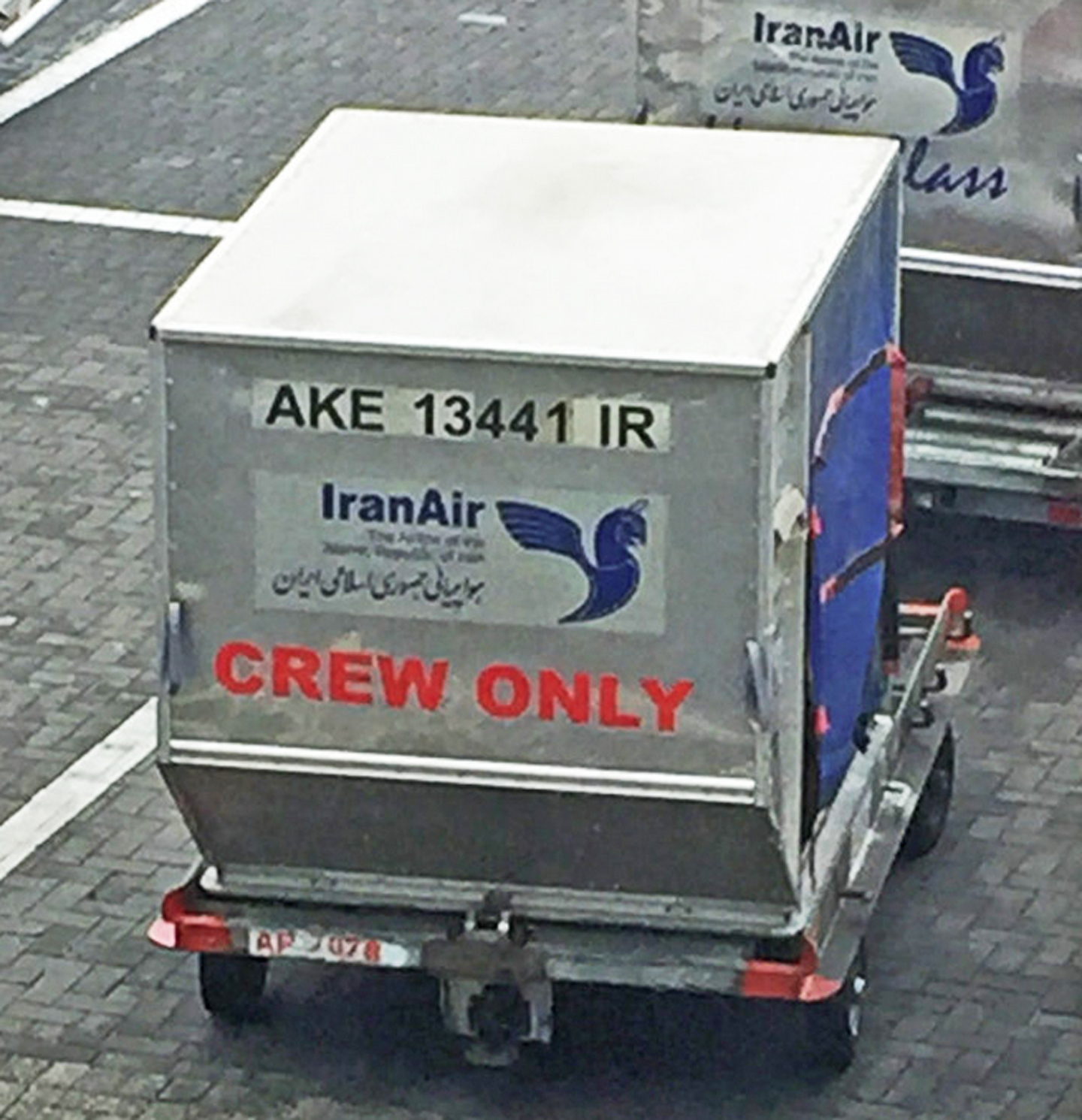
Man, Iran Air pilots have it tough. It must be claustrophobic in there.
Very funny. That’s not for the crew, of course. It’s for their luggage. Outside the United States, air crews embarking on multi-day assignments travel with large, hard-side suitcases, which they check in prior to flight. The bags are then loaded into designated containers like this one. Hauling a week’s worth of clothes around in a roll-aboard bag is mostly an American thing.
The picture gives you a good view of Iran Air’s peculiar logo. The insignia is inspired by the character of Homa, a kind of bird-horse-cow griffin, seen carved on the columns at the ancient Persian site of Persepolis. It was designed 1961 by a 22 year-old art student named Edward Zohrabian, and has been used ever since.

It’s an old-fashioned design for sure. It’s also vaguely fetal and creepy-looking. But here’s hoping they keep it around, if only for posterity. It’s just a matter of time, I worry, before this enduring mark is dustbinned for some stupid swooshy thing.
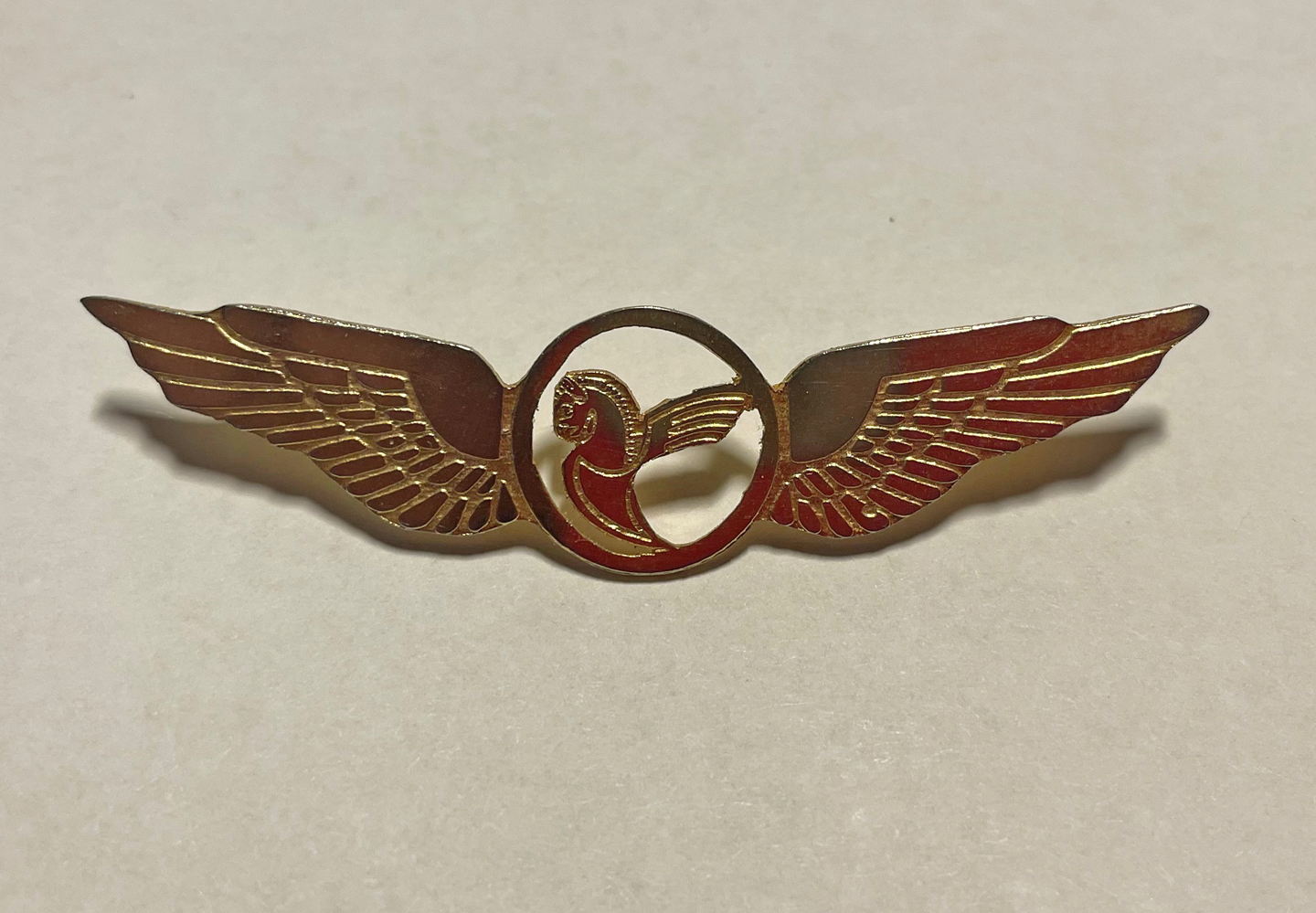
I once met an Iran Air crew in the terminal at Schiphol. They were gracious and polite, and gave me a pair of souvenir wings, which I still have…

Leave a Comment
Maximum 1500 characters. Watch your spelling and grammar. Poorly written posts will be deleted!
5 Responses to “A Toast to Iran Air”
You are viewing newest comments first. Click to reverse order
Your Iran Air wings remind me of the ancient Zoroastrian figure of the fravashi – something that looks for all the world like a man flying an aircraft: https://www.tasteiran.net/stories/5/fravashi-faravahar
That meeting of El Al and Iran Air at BKK was probably a common thing for a while–I saw and noted (but didn’t photograph) that scene around the same time (who knows? Maybe we walked past each other in the concourse)
I have flown on Iran Air. Just the once – a 90-minute domestic hop from Tehran to Tabriz on a Fokker 100.
It was… actually really good. Service was fantastic: staff were friendly and helpful and very professional. And even though it was a short flight, they served a really good hot meal.
I do really like the logo. I still have the purloined sick bag somewhere.
I remember radio ads for Iran Air ca. 1970 on the AM-only radio in my dad’s truck. This was in the Los Angeles area, so I guess Iran Air also served LAX? Maybe they went THR/NYC/LAX and back? LA area has a big Persian diaspora.
Always good to meet citizens of a country – sometimes helps separate the people from the politics.