Thoughts and Theories on the Air India Disaster
UPDATE. July 14, 2025
The preliminary crash report on Air India flight 171 is out, and what it says is startling.
It contends that at the moment of takeoff, both fuel control switches “transitioned” from the RUN to CUTOFF positions, essentially killing both engines.
One of the pilots is then heard asking the other why he did this. The second pilot responds that he did not. (Which pilot was speaking to whom is not specified.)
A few seconds later the switches transitioned back into the RUN position. The engines began spooling up again, but there was nowhere near enough time for them to produce adequate power.
In other words, it seems that one of the pilots switched off the fuel intentionally.
Or did he? Notice the investigators’ use of the word “transitioned.” The report is not fully clear as to whether the data recorder was tracking the flow of fuel independent of the switch position, or if it shows the switches themselves were, in fact, physically moved by hand. If they weren’t, it remains possible that an electronic glitch in the plane’s digital engine control system could be the culprit.
But if the switches were moved to CUTOFF manually, the billion-dollar question is why? Were they moved by accident, or nefariously? Was it an act of absurd absent-mindedness, or one of willful mass murder, a la EgyptAir, Germanwings, and (almost certainly) MH370.
As preposterous as the idea of a pilot mistakenly shutting off the engines sounds, I’ll note that it’s happened before. Consensus, however, is trending toward premise number two.
At least to me, though, the dynamics of the crash don’t really fit the suicide theory. You’re saying that the pilot’s plan was to cut both engines and let the plane glide into the ground? That seems an awfully conservative scheme. There would be a lot of unknowns in such a scenario, and no guarantee that the ensuing impact would be as disastrous as it turned out to be.
Just to the left of the impact zone was an area with no buildings and fewer obstructions. Perhaps with just a little more altitude they could’ve reached it, resulting in a crash that was partly survivable. Calculating the exact impact point ahead of time would’ve been nearly impossible.
Further, the second pilot denied shutting off the engines when queried by the first one. Why?
Rumors are circulating that the captain was going through a divorce and had been treated for depression. Whether or not this turns out to be true, just keep in mind that although depression sometimes turns people suicidal, only in the rarest cases does it also turn them murderous.
One thing that should pique interest is the report’s inclusion of a Boeing service bulletin issued a few years ago. The concern was fuel control switches failing to properly lock. The bulletin pertained to 737s, but the same basic switch is used on the 787 as well. Is it possible the fuel switches on Air India 171 were defective, and were moved from RUN to CUTOFF by nudge or vibration?
UPDATE. July 9, 2025
The focus now is on the fuel control switches. These are a pair of manually positioned cockpit controls that effectively turn the engines on or off.
These switches lever-lock into place cannot move automatically. Whichever position investigators say they were in, a pilot had to put them there.
If an engine fails during flight, one of the steps in securing that engine is to shut off its fuel control. In the case of Air India, what’s being whispered is that an engine may have failed on takeoff, and one of the pilots then grabbed the wrong switch, thus rendering both engines inoperative only a few hundred feet over the ground.
The biggest problem with this idea is that engine failures aren’t handled this way. All pilots are trained to wait until a safe altitude — usually at least a thousand feet — before commencing any steps to secure or troubleshoot a malfunctioned engine. You don’t start moving critical controls until there’s adequate time and altitude. Additionally, any time a fuel control switch is lifted out of the RUN position, both pilots must verbally confirm the correct one is being manipulated.
Is it possible a pilot could’ve have reacted in a panic and done exactly the wrong and catastrophic thing? Yes, and it’ll be quite troubling if it turns out one fuel control switch was found in RUN, with the other in CUTOFF.
And what if they were both found in CUTOFF? Well, putting aside the a possibility that the plane was crashed on purpose, this would make some sense. One of the steps addressing a dual engine failure — rare as such things are — is to cycle both fuel control switches. That is, move them from RUN to CUTOFF, then back again.
If something in the plane’s electronics went haywire and caused the engines to lose power simultaneously, we can imagine a desperate crew, with only seconds to spare, attempting the re-start process, with both fuel controls repositioned to CUTOFF and not enough time to get them on again.
Nothing in the preliminary report will be definitive, but if the switches were found in different positions from one another, this hints at pilot error. If both were found in CUTOFF, this hints at a dual failure and a last-ditch re-start effort.
UPDATE. June 24, 2025
It’s looking more and more likely that flight 171’s ram air turbine (RAT) was indeed deployed just prior to the crash. If so, this more or less confirms a loss of power in both engines.
Why it lost power is another issue altogether, and a potentially calamitous one for Boeing.
See below for more.
June 15, 2025
AIR INDIA flight 171 plunged into a neighborhood seconds after takeoff from Ahmedabad airport on Thursday afternoon, killing more than 270 people. The exact death toll is uncertain, as the search for bodies continues. One passenger survived.
My rule this soon after an air disaster is to avoid conjecture. Crash investigations can run for months before causes are nailed down, and first-glance theories, however convincing they seem in the moment, often turn out to be wrong.
That being said, evidence suggests the Boeing 787 suffered either a loss of thrust in both engines, or an inadvertent retraction of the plane’s flaps and slats before reaching sufficient speed.
The plane climbed to only about 400 feet above the ground (the 650 feet being reported by the media is the altitude above sea level), leaving the pilots no time to troubleshoot or turn back. All they could do was glide straight ahead. The flight path was stable, but the jet slammed into buildings at over 150 miles-per-hour, exploding into a fireball.
The loss of thrust theory is evidenced a few different ways. Most notably, one of the pilots, in a mayday call to air traffic control, reported power loss to air traffic control. In addition, some of the video footage appears to show deployment of the 787’s ram air turbine (RAT), a device that extends from the fuselage automatically, triggered by the loss of both engines, to provide flight control power. The “bang” heard by the surviving passenger could have been the RAT dropping into place, and the buzzing noise in one of the videos could be the sound of the device doing its thing (it’s essentially a propeller driven by the oncoming air). The footage is grainy and unclear, however.
Engine failures are rare. A loss of both engines is exceptionally rare. A bird strike, a la Captain Sullenberger, would be one possible culprit, but so far nothing points to this. Other possibilities include a malfunction of the 787’s electronic engine controls, fuel contamination, or ingestion of runway debris. There’s also the chance, however far-fetched, that a pilot shut the engines down, either out of carelessness, or, in a worst-worst-worst case situation, deliberately.
Getting back to those grainy videos, it’s hard to see much detail, but the wings look strikingly “clean,” which is to say the flaps appear retracted. Flaps, which extend from the trailing edge of the wing, together with slats, which extend from the front, provide critical lift at low speeds. Jetliners almost always take off with these devices extended (the particular setting varies with weight and runway length). The pilots then retract them incrementally as speed increases. Perhaps in this case they were brought up inadvertently — or by way of some bizarre malfunction — immediately after takeoff, resulting in a loss of lift without enough altitude for recovery.
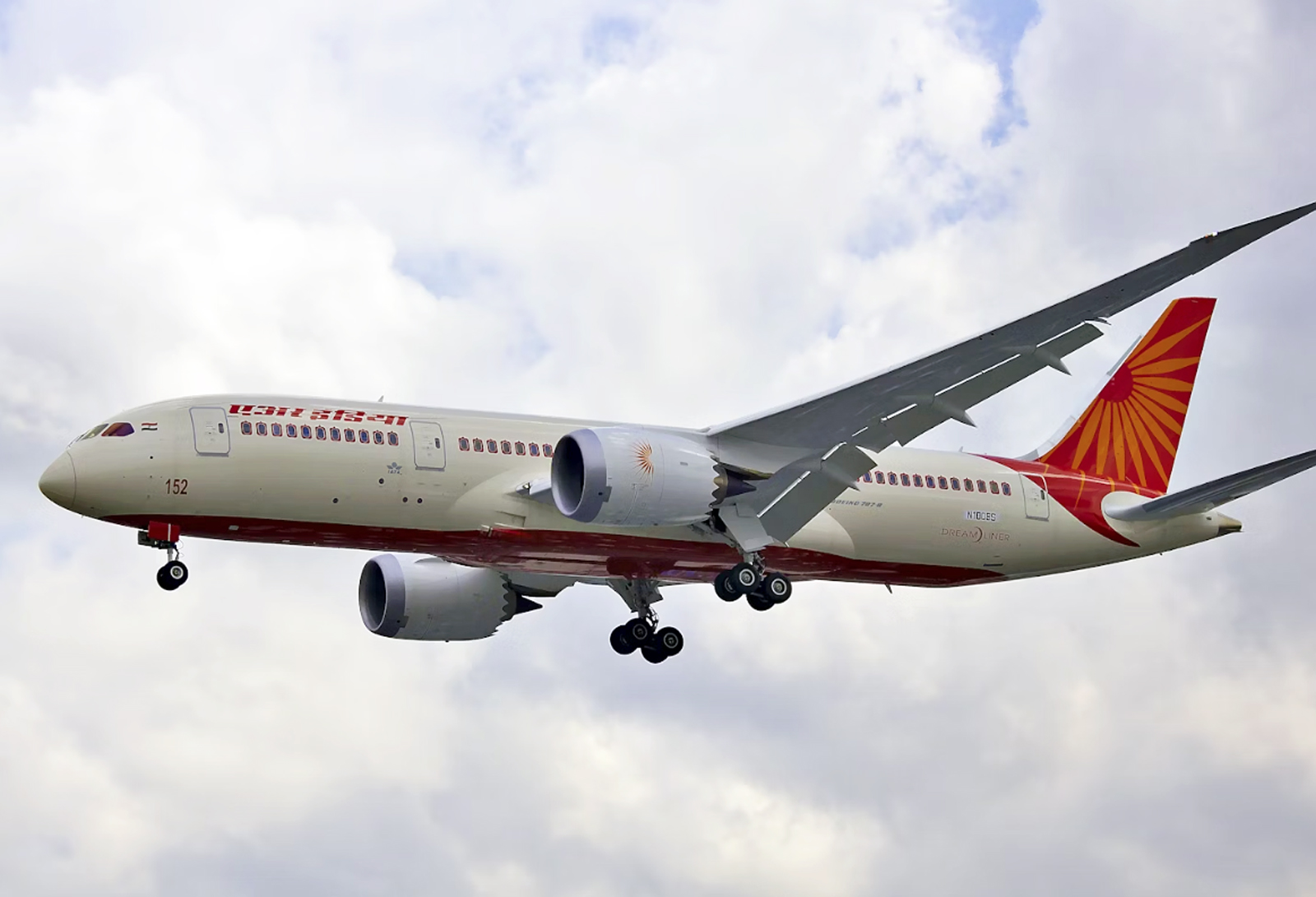
An Air India 787.
Then we have the landing gear. It was not retracted after liftoff, as normally would be the case. Curiously, this hints at either of the two scenarios just discussed. In the first one, we imagine the pilots, distracted by engine warnings and a sudden loss of power at the worst possible time, simply neglecting to raise it. In the other, a pilot mistakenly retracts the flaps rather than landing gear. The probability of such a mistake is absurdly low, but it’s bigger than zero.
On the other hand, the 787’s aerodynamics are uniquely sculpted, and when the flaps are extended the wings take on a camber, a smoothly downward curve, front-to-back, that makes the flaps less conspicuous than they are on other airplanes. Looking at videos of 787s taking off under normal circumstances, loads of which can be viewed online, those wings, too, look very clean. And photos from the crash site show a wing with flaps and slats that appear to be extended, at least partly.
The stronger evidence points towards power loss. My hunch is that something went wrong with the jet’s digital-electronic engine management system.
Whatever it was, the data and voice recorders will tell us shortly. That would be the how. Figuring out the why might take more time. For Boeing’s sake, let’s hope it’s not a design flaw buried in the plane’s high-tech architecture.
This is the worst crash since the downing of Malaysia Airlines flight MH17 in 2014, more than a decade ago. As of June 20th the body count is 274 people, including dozens killed on the ground.
The media keep reminding us how terrible the last twelve months have been for aviation, with at least four high-profile accidents. It hasn’t been a good run, but as I underscored in a recent post, historical perspective and context are important. Even including the past year’s spate, we see far fewer plane crashes than we used to. Heck, in 1985 there was a serious accident every 13 days, on average (including the bombing of an Air India 747 that killed 329 people). Multiple deadly disasters were once the norm, year after year. This is no longer the case, despite the number of commercial flights more than doubling since the 1980s.
Related Stories:
MH370: A STORY IN PIECES
PILOTS AND MENTAL HEALTH
WHAT’S GOING ON?
Photo courtesy of Unsplash.