






Don’t Look Up
April 30, 2026
It’s 1990 and I’m in a yellow taxi. Manhattan at night.
The car speeds and I turn. Behind us the lights of Park Avenue rush away in a narrowing, incandescent ribbon. In the receding distance is Grand Central Terminal, above which rises a monolithic skyscraper. There’s something brazen about the tower, the way it sits perpendicular to the grid. At the top it says PAN AM.
The sight thrills me. I’m twenty-three years-old, unworldly and naive, a kid from an ugly Boston suburb who hasn’t seen or done much. But I’m an airline buff, and here I am in Manhattan with the Pan Am Building framed in the rear windshield. The moment gives me a rush of satisfaction. It feels so exciting, so sophisticated, so New York.
Thinking back to that night, nobody was less New York than me. But the view of that building gave me an energy.
Pan Am had been founded in Florida, but as it grew into a de-facto national carrier and one of the world’s most recognized brands, its identity became enmeshed with that of New York City. Nothing made this more clear than its 59-story skyscraper in Midtown. Pan Am was New York. New York was Pan Am.
The Pan Am Building wasn’t the prettiest of the city’s towers (barely a block away soars the Art Deco splendor of the Chrysler Building). Built in the International Style, it embodied a rational, workmanlike confidence. It was handsome, no-nonsense. One of its architects was Walter Gropius, the modernist pioneer and founder of the Bauhaus.
And then it was something different.
I remember the day Pan Am went Chapter 7 and ceased operations. December, 1991. I was in a hotel room in Burlington, Vermont, when it came on the news.
The logo stayed at the top for a while, but the Pan Am Building became the MetLife Building.
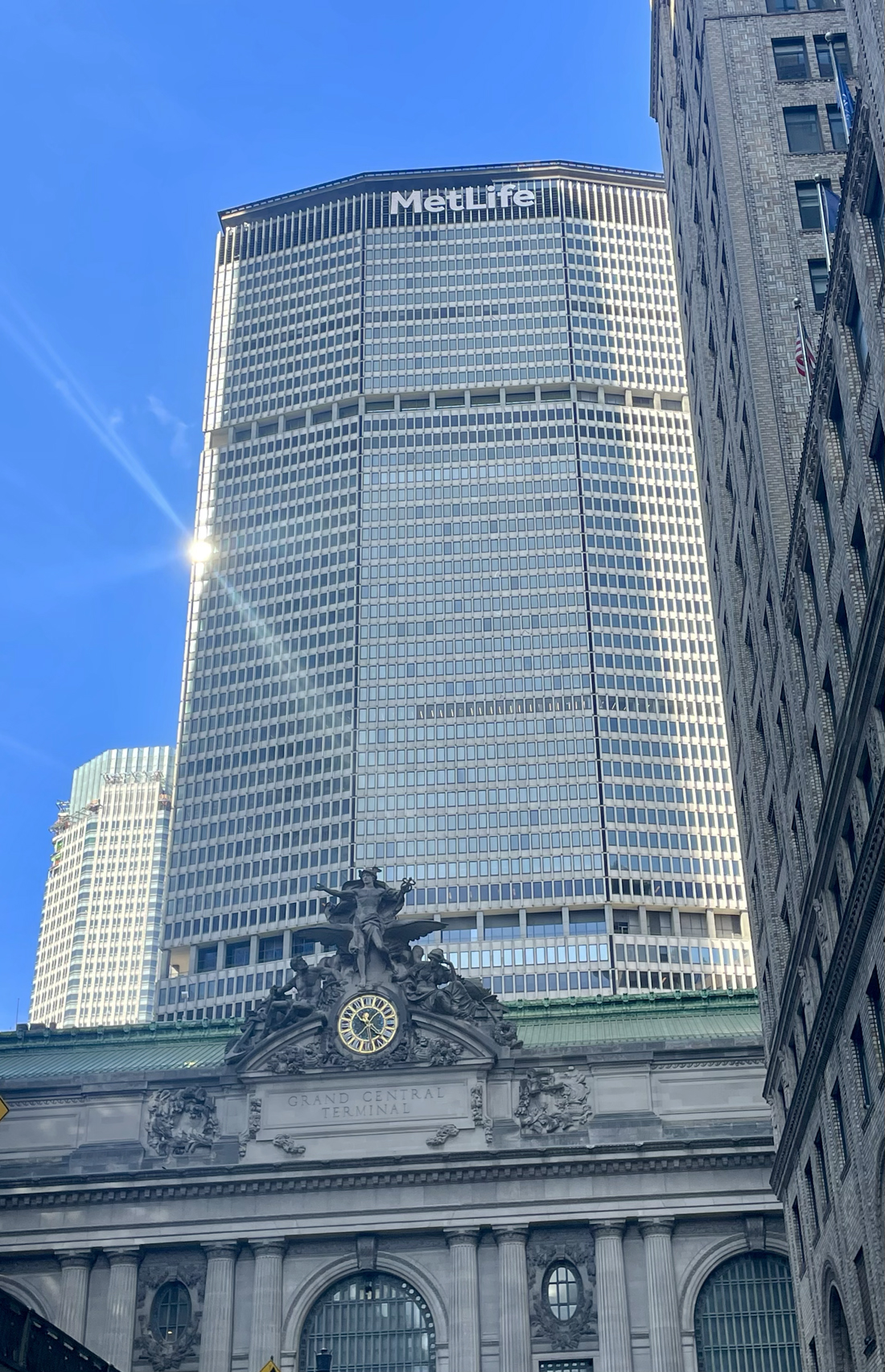
The skyscraper itself remains, unchanged save for the signage. But gone is the romance and much of the New York-ness that made it special. Pan Am was history’s most storied airline and the nation’s commercial ambassador. MetLife’s thing is what, I hardly even know. Insurance?
A few days ago, almost four decades after my giddy taxi ride, I was walking down Park Avenue towards Grand Central. The MetLife logo loomed above me. Nothing is sacred, I thought.
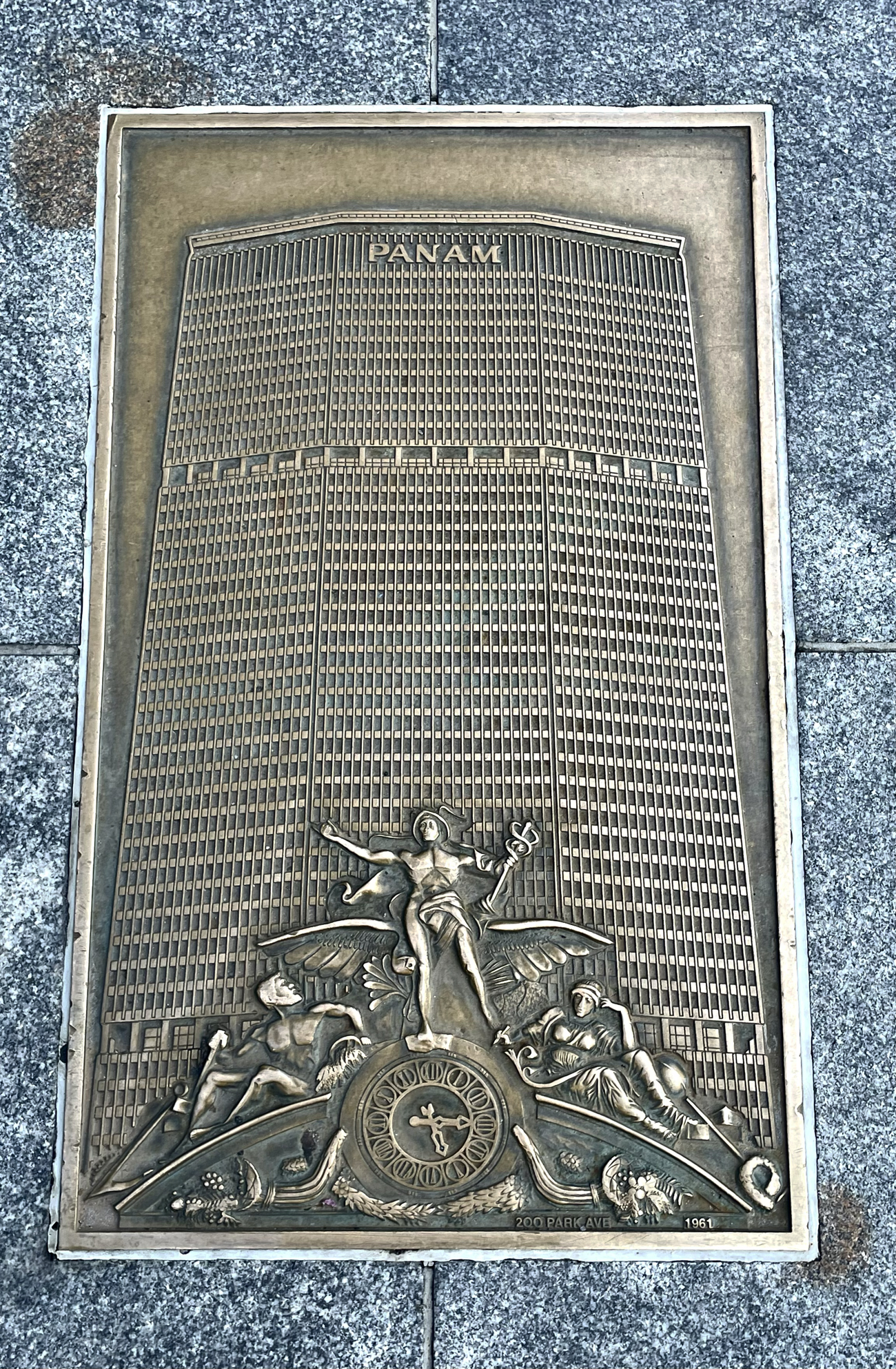
Then I looked at my shoes. And I’m glad I did, because embedded there in the sidewalk was the plaque you see up top. I took its picture. I then walked a few steps further and took a photo of the actual tower.
Things are always changing, whether you want them to or not.
A helicopter crashed up there once, on the rooftop helipad. In 1977. New York Airways. Debris fell all the way to the ground and killed a pedestrian.
Bauhaus. Form follows function and all that. It was also the name of a band. Among the members of Bauhaus the band was David J., who later became a cohort and collaborator with Pat Fish, a.k.a. the Jazz Butcher, a rock musician of the 80s and 90s of whom I became a devotee of the highest order.
Buildings, music, flying machines. They flow and intermingle. One thing leads to another. “Airlines are everywhere,” is a go-to saying of mine. Here you see how that works.
Later, I noticed something. Look at the clock on the statuary facade of Grand Central. In both of my pictures it displays almost the same time.
Photos by the author.

Leave a Comment
Maximum 1500 characters. Watch your spelling and grammar. Poorly written posts will be deleted!
10 Responses to “Don’t Look Up”
You are viewing newest comments first. Click to reverse order
I remember going to the Savarin Coffee Shop in the lobby.
Immortalized way back when in a Joni Mitchell song…
He opens up his suitcase
In the continental suite
And people twenty stories down
Look like colored currents in the street
A helicopter lands on the Pan Am roof
Like a dragonfly on a tomb
And business men in button downs
Press into conference rooms
I remember when I was a kid, so details are hazy, my dad who did not like going to NYC at all and only did so when he had to arranged a trip specifically so he could helicopter from JFK to the Pan Am building. He was extremely juiced for a while afterwards.
I love your writing style. And I love the memories that you recounted here. Thanks for sharing.
That is all.
I remember visiting NYC in 1983 as a prospective foreign student who was also an airplane nut. One of the first things I did was to go to the Pan Am building and hope for some goodies from the airline. The fellow who assisted me handed me stickers of the Pan Am/National merger (a kind of ring-ynag combination of the two logos.) Little else was available, due to cut-back, Yet looking back, I can say I visited the place when the airline still lived! Regarding 1991: I flew out to the US in August 1991 for a semester of graduate studies: the plane was a Pan Am A310. When I flew back to Geneva in December , the A310 bore a Delta livery.
You taught me something
I didn’t know that Gropius was the architect that build the Pan Am building
I visited his modernist style house in Lincoln MA he was a Harvard architect moving to the US before the 2nd WW sure saved his life. He ended up the rest of his life in MA.
(sorry, can’t resist) You went there:
Why don’t they do what they say?
Say what you mean
Oh, baby, one thing leads to another
In January, my wife and I took a trip to Key West, and stopped in the First Flight Restaurant at 301 Whitehead St, where several signs note it was the first ticket office for Pan Am. It was fun find a piece of aviation history there.
I flew Pan Am for the first of many trips, in 1972. We flew from New York to Dakar and then on to Monrovia. We were going to Sierra Leone and after a day’s rest in Liberia we went on a Ghana airways puddle jumper to Freetown. Four years later we flew to what was then called Ivory Coast (Cote d’Ivoire). Between the two trip Pan Am’s service was already on the decline–I still remember the canned beef stew entree. Too much debt. And over the next years until it’s bankruptcy the airline sold off all it’s assets until at the end it was a hollow shell of itself.
“One Thing Leads To Another”
Is that a subtle nod to that The Fixx song, what with your occasional ruminations on 80’s music?
And your recent post about The Cars. I spaced out and forgot one of my faves, “Since You’re Gone”.
The opening and backing instrument track of “clack-clack-clack-clack”, simple as it is, I have never heard in any other song.
And it IS a solid rocker.
Also, you’re from Boston. That’s a lot closer to New York than me, a lifelong Californian. Who would not set foot in New York City until 1997. Came via a Continental 757, LAX-EWR. I was 24 at the time.