





Let the Stories Be Told
April 1, 2026
It’s the fall of 1981. Specifically it’s October — or, “Rocktober” in the lingo of the big local rock station, WCOZ, a monthlong event highlighting a different band each day.
Today is “Cars Day,” and I’ve set my alarm extra early. I’m yet to own a stereo, so next to the radio I’ve placed a cheap old cassette player, my finger ready on the RECORD button. The instant I hear the opening of a Cars song, I’ll press.
I’ll do this multiple times, and by the end of the day I’ll have a muffled analog catalog of my favorite tunes, all with the first two seconds missing.
Long before Husker Du and the Jazz Butcher, my big musical infatuation was the Cars, the Boston-based quintet fronted by co-singers Ric Ocasek and Ben Orr. I can’t recall when or why, exactly, I got hooked on their music, but the Cars were my soundtrack through my first two years of high school.
According to the desks at St. John’s Prep, vandalized by bored tenth-graders like me, the most popular bands in the world were Rush and maybe Van Halen. I’d leave Cars graffiti, adding a little prog-rock flourish to the artwork. I’d draw a checkered flag, like the one on the Panorama album.
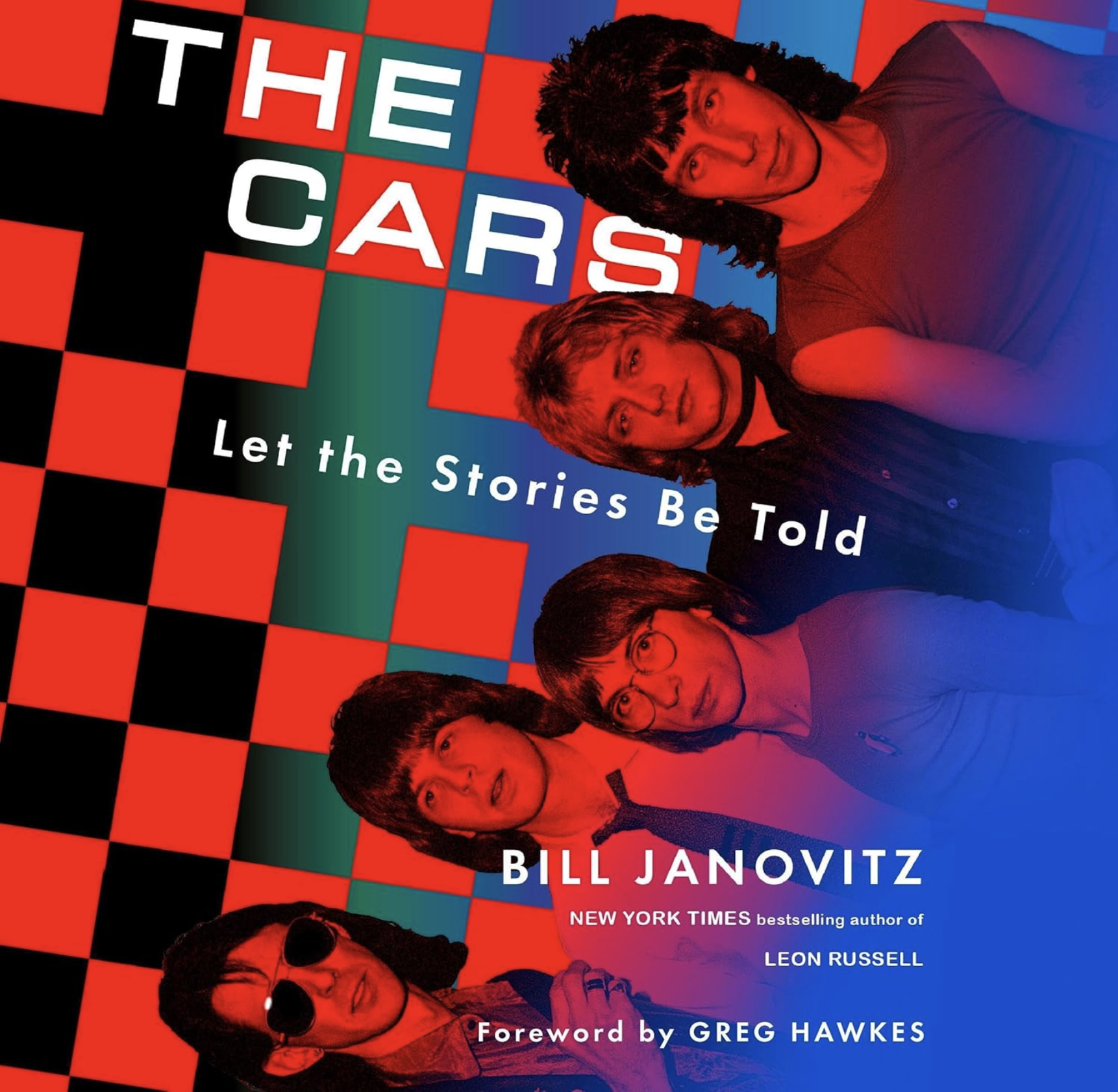
I mention all of this because of a new book, “The Cars: Let the Stories be Told”, authored by Bill Janovitz, himself a musician from Boston.
The title borrows from “Let the Good Times Roll,” the unforgettable kickoff cut from the group’s eponymous debut, released in 1978.
The author had to be from Boston. Nothing else would be right, or fair. And if one person in the world was gonna read his book, if only for old times’ sake, well that would have to be me.
I seldom read music biographies from start to finish. Often they’re too too bogged down, hyper-detailed and meandering (Chris Salewicz’s bio of Joe Strummer runs for 650 pages). So I pick around for the good parts. This one, though, I took in cover-to-cover, straight through.
It’s exhaustive, comprehensive, painstakingly researched… all the things good music journalism should be. It’s unpolished in parts, but luckily for us Janovitz is a decent writer as much as a thorough historian, bringing us not just a chronicle, but one that’s fun to read.
Sadly neither Ric Ocasek nor Ben Orr are still with us. The surviving three bandmembers, however, are generous and gracious with their contributions.
The author reintroduced me to a band that, as a young teenager, I thought I’d known so well. Turns out there was plenty I missed. Some of it basic, but much of it those nuance-y sort of details that, as youngster, were bound to go over my head. I knew what I liked, but my knowledge and understanding of music was, let’s be honest, pretty unsophisticated.
I’d never appreciated the brilliance of Elliot Easton’s song-within-a-song guitar solos, for example, or the fire of his rockabilly-style leads in the song “My Best Friend’s Girl.” I’d never noticed those bass licks at the beginning of “Bye Bye Love.” And I had no clue that when Ben Orr repeats the word “time” during that verse in “Just What I Needed,” it’s a nod to the Velvet Underground’s “Sister Ray.”
Of course it is, but at fifteen it skipped right past me. All these things did. Heck, I was into my 20s before I knew, or cared, that David Robinson had been the drummer in the Modern Lovers.
As I read, I found myself highlighting pages, then throwing on my headphones, listening and re-listening to this or that highlight that Janovitz points out. In doing so, I rediscovered my love for the Cars.
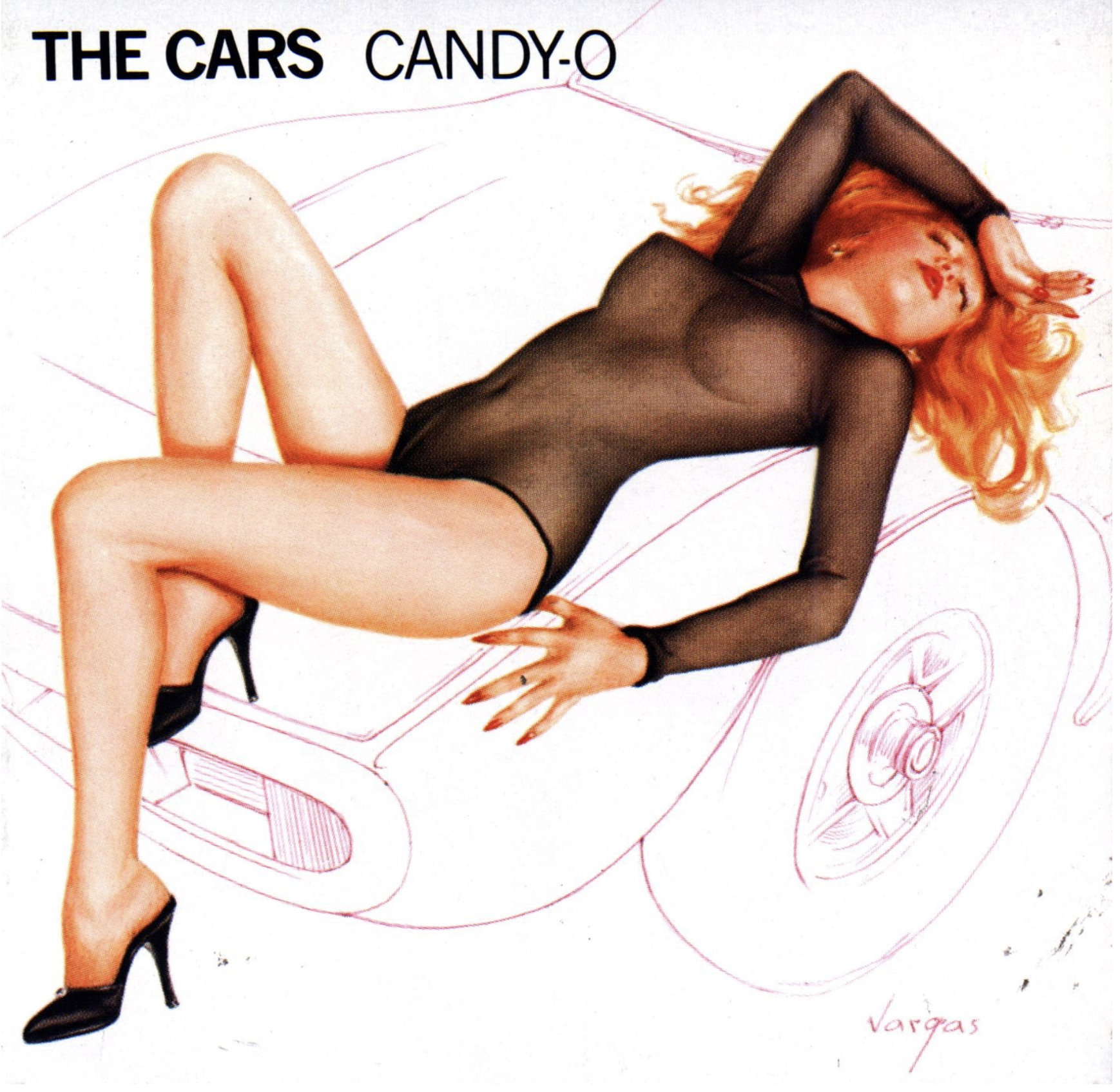
Their first two albums, anyway: the self-titled debut and its follow-up, Candy-O. That aforementioned Panorama, while its checkered flag motif looked cool on a desk, never did much for me, and neither did anything afterward. If the author fails at one thing, perhaps, it’s helping me realize, all these years later, that the Cars’ hadn’t, in fact, jumped the shark. But save for a song or two, I can’t agree.
That first pair of records, though, is unmatchable. There will never be music like that again.
To what decade this music belongs is open to argument. The second album, Candy-O — the one with the famous pin-up girl by Alberto Vargas — was released in 1979. But to consider it a 70s record (or to call the Cars a “70s band”) would be ridiculous. Stylistically it was way ahead of their time. If 80s music ever needed a formal introduction, let it be the opening 25 second of the song “Let’s Go.”
The dropoff following Candy-O is part of the reason my obsession with the group waned. By late 1982 I’d left the Cars behind, drifting away from mainstream music altogether.
Funny, a bit later on, during my punk rock years, I would often see Ric Ocasek, mantis-like and unmistakable, perusing the record bins in Newbury Comics. He was still a giant to me, but I was too shy ever to say hello.
This book, and the memories it brings back, makes me wish I had.
Related Stories:
ZEN ARCADE, FOUR DECADES ON
HAPPY BIRTHDAY TO THE (SECOND) GREATEST ALBUM OF ALL TIME
KEEPING THE CURTAINS CLOSED

Leave a Comment
Maximum 1500 characters. Watch your spelling and grammar. Poorly written posts will be deleted!
14 Responses to “Let the Stories Be Told”
You are viewing newest comments first. Click to reverse order
Tenth grade, riding to high school in a friend’s sister’s old Datsun (NOT Nissan) B210 at 7:30 in the morning and hearing on the mighty WHBQ-AM in Memphis (with Rick Dees deejaying, no less) the beginning of “Best Friend’s Girl”…truly life-changing (at least musically)…
The Cars were always (and still are) my desert island band and I haven’t stopped loving them all these years later. Say what you will about their mid-to-late period output, but Panorama was adventurous for a popular, commercial band, Shake It Up was catchy, and Heartbeat City was full of earworms, for better or worse. Yes, they should have stayed with Roy Thomas Baker, but Mutt Lange made records that you couldn’t get out of your head, even if you wanted to. Door to Door was a band on fumes, but it was still better than 90 percent of the other stuff out there, even if it was a shadow of their former selves.
I got to see the original band in 1979 on the Candy-O tour and I saw The New Cars (with Todd Rundgren, Kasim Sulton, and Prairie Prince) nearly 30 years later. Both shows were highly entertaining, if for no other reason than they were playing The Cars songs.
Thanks for taking the time to talk about the book and the band. That’s why I love this blog, Patrick. Two of my favorite things – airlines/airports and music!
Thanks for the tip, Patrick, I’m ordering the book. Absolutely loved those first three albums, the sound of my high school years on the west coast. Great production by Roy Thomas Baker, and Elliott Easton is one of my favorite guitarists; so fast, so tasteful, so melodic. Have practiced for years to learn his incredible solo on “Touch and Go” and still can’t do it cleanly.
They’re also one of the few ‘70s-‘80s bands I loved that I never got to see live. However, around 1990 I was visiting a buddy at Harvard B-school and he took me to lunch at a bougie place in Back Bay with patio seating on a beautiful spring day. The hostess seats a couple right next to us, a 6’5” scarecrow with a beautiful woman. They smiled and said hi (the tables were about a foot apart), and finally I had to ask Ric “‘I wanna float like Euripides, all visions intact, I’m alright with Fellini fiends, trippin over the track’ – where the hell does that come from?” He just laughed and said, “I don’t know, man, it just sounded good” I told him I loved his work and then left them alone, but he was very friendly and un-celebrity-like.
Later I had to tell my buddy later that his wife was one of the top supermodels of the day (Paulina Porizkova); she wasn’t all glammed up and we barely noticed her.
After Translator’s gig at The Roxy, we repaired to the Rat for drinks and had a fun evening hanging out with Elliot Easton. Nice to see him get some deserved kudos! Great player, cool guy.
I’m glad the author mentioned Easton for something other than simply his technical ability (which is certainly notable). I’ve long pointed out to people that the guy is the absolute KING of the 8-bar guitar solo. He gets in, kicks a** for exactly 8 measures, and gets the F out. Brilliant.
Growing up in Boston, I too, recall hearing the Cars often. In high school, taking the school bus to and from our baseball games, an older student named George would blast their music from his boombox. To this day, when I hear any song from that first album, I’m back in high school and on that bus as an underclassman…
I was at the pre-release book event, the Author, Greg and David were there answering questions and telling stories, was hosted by legendary Boston DJ Oedipus.
David and Greg hung around for quite awhile after signing everyone’s copy, and the author had already signed them.
I’ve been to all of their houses, knew Ric’s sister and parents, Ben was the one that got me drinking Bacardi….
Greg plays with a band called Eddie Japan, playing songs by the cars.
To me, the first 3 albums were them getting stalking steadily more weird and interesting, then their record label told them to make something that sells, do the interesting stuff as other projects.
But, Candy Apple Grey is my favorite Hüsker Dü album.
Call me an old stick-in-the-mud, but none of those rock bands did anything for me.
To my (musically trained) ears, listening to them is the audio equivalent of being mugged on a Chicago street, their “music” being a cacophonous mixture of wailing vocals about who-knows-what, screeching guitars being played through 1000-watt amps full of harmonic distortion, and bowel-blockage-clearing bass—also played through a 1000-watt amp full of distortion, with the mugging being perpetrated by alarming-looking dudes who you might not want near your daughter. 🙂
I grew up back when rock ’n roll was rock ’n roll, not a source of permanent otitis. Give me Buddy Holly, Fats Domino and Elvis any time. And a pox on so-called “classic rock.” Ain’t nothing classic about that racket!
FM and The Cars extinct soon. Good.
I first saw the Cars at the Rat in Kenmore Sq. during the 70’s and promptly wore out two copies of their first record due to extreme overplaying.
During the 80’s, I played in a Boston band wherein the guitarist was married to David Robinson’s sister. He and she lived in a carriage house on David’s property on the North Shore where I spent numerous weekend afternoons playing croquet and barbecuing. David was a consummate host, an extremely nice guy, and possessed a large collection of original Vargas paintings displayed in his lovely home.
David was a consummate musician, and was largely responsible for the amazingly sparse, but utterly perfect early new wave drumming. He was no slouch programming early drum machines either.
I always felt like I was visiting a hero when I was there. Interestingly, I was there the night of the Perfect Storm that sank the Andrea Gail; the road to his property got washed out and we had to drive across a nearby golf course to get back to Boston.
I discovered The Cars when I first saw the video for You Might Think on NBC’s Friday Night Videos in early 1984 at age 14. Became an instant fan. Went out and bought a cassette of Heartbeat City. The song Drive still reminds me of my early days as a high school freshman in fall 1984. As I got older I discovered their earlier work and their debut album The Cars became my favorite. And who cannot hear Moving In Stereo without thinking of Phoebe Cates in Fast Times at Ridgemont High!
The entirety of their first album is for sure a classic. Both sides, start to finish.
After that, much of their music was, in my opinion, hit or miss.
On the follow up album, my fave is “It’s All I can Do”. Love the drumming and the rhythm carried with the high hat and mid-song guitar solo.
Other greats are of course “Magic”, “Drive”, and the quirky, “Touch And Go”. The title at least should resonate with you in some way.
I always kinda liked “Touch and Go.” It’s about the only song from Panorama that I ever could get into.
If I had to pick one, “Double Life” is my gun-to-the-head favorite Cars song.
I too loved The Cars as a young man before I discovered punk and hardcore. And to keep the comments on a pilot’s blog travel related, this column reminded me of the Summer of 1984.
My parents had travelled back to their hometown of Deer Lodge, Montana and we spent the summer out there. My older sister had brought a cassette copy of Heartbeat City with her, and since Deer Lodge had only one local radio station – top-40 KDRG – we spent are whole time there listening to that one cassette on loop.
More than 40 years later, listening to Heartbeat City still feels like Summer and travelling to me.