






What’s the Big Obsession With Doors?
February 3, 2026
Flying from Bangkok to Hong Kong the other day, I had the pleasure of sampling one of Cathay Pacific’s new “Aria” suites on the Boeing 777-300. This is Cathay’s swanky new business class product, currently available on a limited number of routes. A shame it was only a two-hour flight.
The food and wine were excellent — the service expedited for such a short ride. Find me a two-hour flight in the U.S. with a meal like the one below.
The “hard product,” to borrow industry parlance for the suite itself, was comfy and spacious. The layout is the common 1-2-1 herringbone, each seat with an oversized tray table and 24-inch video screen. (And I love the way Cathay’s headsets, while not bluetooth, are pre-plugged, with the attachment point hidden neatly away in a small amenities closet.)

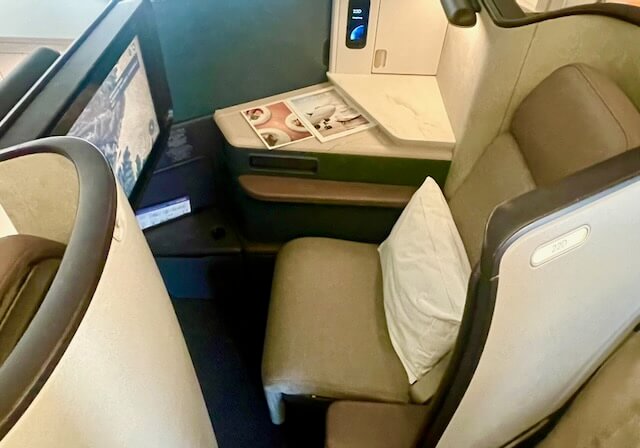
What impressed me most, though, was the level of privacy. If you’re in the center section, as I was, a moveable panel closes you off from your neighbor, while on the aisle side your upper body sits deep within the sculpted shoulder wing.
It wasn’t until halfway through the flight that I realized there also was a sliding door. And I had to wonder, why bother? There was more than ample privacy as it was. With the seat in the bed position, there was barely two feet of open space, roughly at the position of your knees or mid-thigh. From Cathay’s point of view, is installing doors really worth the extra weight and mechanical complexity?
Looks like they’ve been bullied into it. For better or worse, doors are the industry standard these days. Indeed, airlines have gone sliding-door crazy. It’s become an arms race of sorts, and your first or biz class seat can’t be considered world class unless it comes with one, no matter how needless the amenity might be.
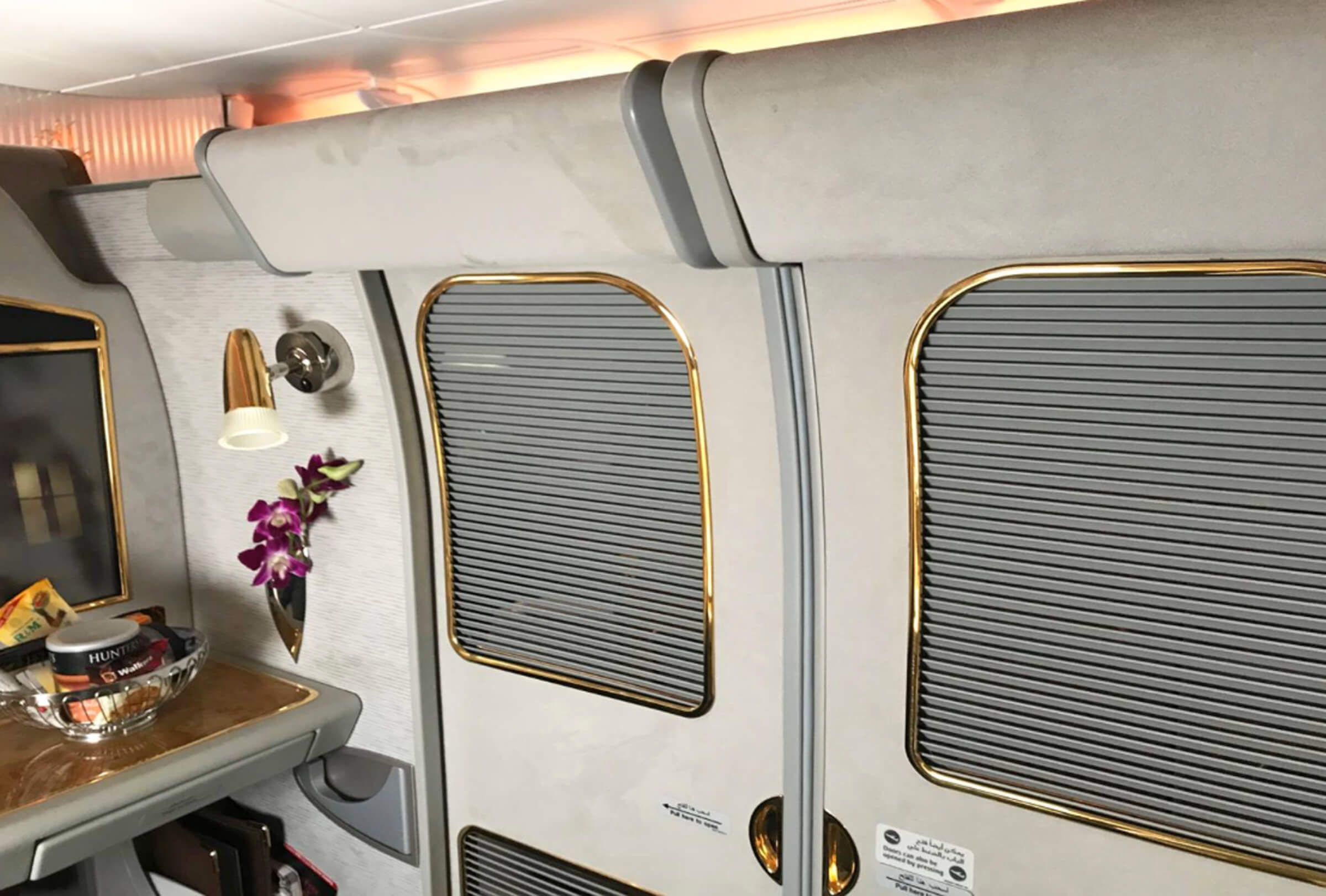
In some cases it makes sense. The geometry of a suite can be such that the lack of a door leaves you feeling exposed. The photo above, for example, shows the inside of an Emirates first class suite with its doors closed to the aisle (there are two that slide together). Without them, there’d be too much openness, too much clatter from outside.
But many are cozy enough to begin with, and the presence of a door feels gratuitous — even a little silly. They’re simply not needed.
If you insist, consider the way Air France does it, with a floor-to-ceiling curtain ensconcing each first class occupant. This is a simpler, less expensive, and much more elegant concept than the clunkiness of a door. (A curtain needs to be hung, however, which presents a problem for most cabin designs.)
How to define and quantify comfort? I reckon there are smarter ways for airlines to invest. We’re talking now about “soft product” enhancements, like better food or more gracious service. The worst thing a carrier can do is become hyper-focused on material aspects while the rest of its product deteriorates. I’d rather have a more attentive crew, a better meal presentation, or a less chaotic boarding experience, than some flimsy door.
Photos by the Author.

Leave a Comment
Maximum 1500 characters. Watch your spelling and grammar. Poorly written posts will be deleted!
9 Responses to “What’s the Big Obsession With Doors?”
You are viewing newest comments first. Click to reverse order
I used to agree about the doors, especially in business class. But, I’m starting to feel like doors are like masks: “My mask protects you, your mask protects me.” On a recent flight in one of the United Polaris seats that’s open to the aisle, I was trying to get comfortable in sleep mode, my pants snagged on the seat and got pulled down a little bit, and for a second my butt crack was closer to the passengers across the aisle than I think they’d feel comfortable with (or not, but this wasn’t that kind of plane). If anyone caught a glimpse, I’m sure that person would have thought that a door would have been awfully nice at that moment.
As one of the hordes doomed to be scrunched into a sea being nickel and dimed in coach, you’ll forgive me for not waxing poetic about the joys of being an airline passenger these days. Stale sandwich from the airport grab-and- go rack, anyone?
The worst part of an air flight these days? That’s easy. The worst part is everything other than the actual time sitting in a seat-constricted space.
We are told, for instance, to arrive 2 hours before boarding — three if the flight is international. Three hours! And that clock doesn’t even start until we’ve arrived at the gate, excluding traffic, and parking; and once we are inside the terminal, the entire security apparatus is simply abominable. And time consuming.
Domestic flight times in the US hover around 2.5 hours. A useful flight-length number is hard to find. Wikipedia says 1-5 hours domestically in the US, but even so, the point is clear. Flight times are quite short. Barely long enough to consume a meal or watch a sitcom or read. The are short. And yes, international flights are in a different category.
Of course minimum seat dimensions exist; the airlines are doing everything they can to find an ideal set of seat dimensions that yield a tolerable amount of bitching while still filling the seat.
But folks, listen up. It’s only a few hours , m’kay?
It’s hilarious how much we demand privacy now. Travel in the 19th and early 20th century insisted that you give up ALL privacy unless you were very wealthy. Sleeping cars on trains were often “open sections” which were a bed that folded down into a seat during the day and provided you with only a curtain for privacy at a time when modesty was much more prevalent for men and absolutely demanded of women. Cole Porter even wrote:
In olden days, a glimpse of stocking
Was looked on as something shocking
But now, heaven knows
Anything goes
That song was written in 1934!
IIRC, it wasn’t loudly featured. I believe I discovered it while exploring the touchscreen settings.
Replying to Simon: My wife and daughter swear by DL. UA was my go-to airline for domestic and trans-pacific for many years (after they assumed Pan Am’s pacific routes). Since relocating to HKG though 18 years ago, CX became more or less a necessity for intra-Asia business travel and is now the only airline that I can take non-stop for my commutes between JFK and HKG. So yeah, points and miles. But in the realm of cabin technology and comfort they are still a bit behind some of the other Asian carriers; not to mention the Gulf-based airlines (recently RT HKG-DXB on a CX 777 that was a bit worn at the heels–Emirates envy!!!)
I’m more of a DL guy myself, but I will say that UA offers Bluetooth connectivity even on regular economy seats on their trans-Pacific Triple-7s and Dreamliners. I’ve used it myself many times to connect my noise canceling AirPods Pro without having to remember to bring along my old BT-audio transmitter dongle. So I’m not sure why all the fuss about this having been added as some kind of supposedly premium feature to a new biz cabin. Especially when I know how otherwise Asian carriers usually put to shame most of what we here in the US face on our carriers. What am I missing?
Welcome back to my home base on my home airline! I had the good luck to do a round trip HKG-YVR last summer in J class. Vancouver is one of the designated “aria suite” routes, have to say it is indeed a notch or two above their standard Cirrus biz class seats–the little door helps but the bluetooth for headphones, big HD screen, and general newness were the highlights for me.
Damn, I didn’t realize there was a bluetooth option for the headphones. Never saw it.
I thought I did a pretty good inventory on the amenities. They need to show it off a little more.
Re this post and the expressblog about excellent caviar service in first class:
It’s good to be the patrick, these days. Long way from piloting a dash 8 in a threadbare uniform jacket.